The morphology of auxiliary and copulative verbs
This section deals with auxiliary verbs as well as copulative verbs of Setswana. The topic is structured as follows:
Auxiliary verbs as a sub-category of Setswana verbs
Setswana verbs are divided into three groups also referred to as sub-categories based on their morphological, semantical, and syntactical similarities and differences. These are main (ordinary/independent), auxiliary and copulative verbs.
The nature of auxiliary verbs
An auxiliary verb is dependent on a predicative complement that can be either an ordinary or a copulative verb. Auxiliary verbs therefore always appear in phrases and function as the head of the phrase (Berg, 2018: 92). Krüger (2006: 267) refers to these phrases as auxiliary verbal groups where the auxiliary verb is the first member of the group and acts as the introductory member of the auxiliary verbal group.
| Bana ba ne ba kwala ditlhatlhobo. |
| ba-ana ba -ne ba -kwal -a di-tlhatlhob-o |
| NPre2-child AgrSubj1-Aux-AgrSubj2 -write-VEnd NPre10-examine -DevSuf |
| The children were writing exams. |
| Bana ba ntse ba kwala ditlhatlhobo. |
| ba-ana ba-ne ba-kwal -a di -tlhatlhob-o |
| NPre2-child AgrSubj1-Aux AgrSubj2-write-VEnd NPre10-examine -DevSuf |
| The children have been busy writing exams. |
The complementary verb expresses the main action (process/event) while the auxiliary verb enriches its’ meaning by adding semantic information regarding the progression or completion of the action. Pretorius (1997: 98) explains that semantically, an auxiliary verb in Setswana expresses a certain type of duration of the action; it thus has an aspectual function. It can also express the logical time at which the action is executed. Setshedi (1974) and Pretorius (1997) present a classification and description of the Setswana auxiliary verb as a subcategory of verbs.
Grammaticalisation
The origin of a large number of auxiliary verbs is linked to the proses of grammaticalisation (rank shifting) that lexical items including auxiliary verbs, undergo. The unidirectionality (from lexical to grammatical) in the grammaticalisation processes is stressed in the various definitions of grammaticalisation. Traugott et al. (1991: 406) states that “Grammaticalization refers to the dynamic unidirectional historical process whereby lexical items in the course of time acquire a new status as grammatical, morphosyntactic forms. The study of grammaticalization takes as central the concept of continuum of bondedness from independent units occurring in syntactically relatively free constructions at one end of the continuum to less independent units such as clitics, particles or auxiliaries, to fused agglutinative constructions, inflections and lexical fusion, and finally to zero”
. Guldemann (2003: 183-187) gives an overview of grammaticalisation processes related to verbs in Bantu languages.
Louwrens (1994a: 72) stresses the shift in rank that units in Northern Sotho undergo during the process of grammaticalisation: “a term denoting the process whereby linguistic elements of a higher rank such as words develop into linguistic elements of a lower rank such as grammatical formatives and therefore start to function as morphological constituents of words. It is observed in some grammatical descriptions of Northern Sotho that, for example, the potential -ka-, the progressive -sa- and the futuritive -tla/-tlô- have undergone a process of grammaticalization since they have shifted in rank from what originally were auxiliary verb stems to what they are today, namely verbal prefixes”
. In Setswana -tlô- historically originated from -tla go-, and therefore became -tlôô and not -tlô. The future marker should therefore actually be -tlaa and not -tla as it is often presented in the literature. The double vowel is evident in tonology.
Mkhatswa (1991: 11) confirms that “all lexical items involved in the process of grammaticalization move from the lexical point of the continuum to the grammatical point of the continuum. It may at this point, be worth stating that the now “halfway” verbs may become fully grammatical morphemes as time goes on.”
Guldemannn (2003: 183) gives the following example of the grammaticalisation of word forms in Bantu when he states that “morphologically complex word forms of the same functional domain often have a fairly strict order of slots filled by elements of a definable class. This synchronic ordering in a given language, called here morphotaxis, frequently correlates with the order of syntactic constituents in an earlier constructed stage. This can be explained by the attested process of univerbation of a loose syntactic structure into a morphologically complex word whereby constituent order becomes petrified in morphotactic regularity. Givón (1971) expresses this as today’s morphology is yesterday’s syntax. This historical approach to morphology can be applied fruitfully to most parts of speech in Bantu languages”
.
A case in point is the fixed order of individual element classes expressed in verbs across Bantu languages as laid out by Meeussen (1967: 108-111). Refer to topic 6 for a discussion of Setswana verb morphology and its relation to this schema.
| Slot | (Preinitial) | Initial | (Postinitial) | (Preradical) | Radical | (Prefinal) | Final | (Postfinal) |
|---|---|---|---|---|---|---|---|---|
| Functions | TAM | Subject | TAM | Object | Verb root | TAM | TAM | Participant |
| Negation | Negation | Valence change | Negation | |||||
| Clause type | Clause type | Clause type |
The various stages of grammaticalisation affect independent, copulative and auxiliary verbs. Krüger (2006: 268) indicates that: “Some items have rank shifted to become morphemes, some have developed to become proper auxiliary verbs; some have dual characteristics (verbal and auxiliary) while others obtained a metaphoric semantic value when used as auxiliaries”
. Heine et al. (1993: 149) indicate that terms such as reanalysis, syntacticisation, semantic bleaching, semantic weakening, condensation, reduction, etc. have been used to refer to grammaticalisation/rank shifting.
The classification of auxiliary verbs
The following classification is based on the features of auxiliary verbs (Pretorius, 1997: 89). Setshedi (1974) presents a classification and description of the Setswana auxiliary verb as a subcategory of verbs.
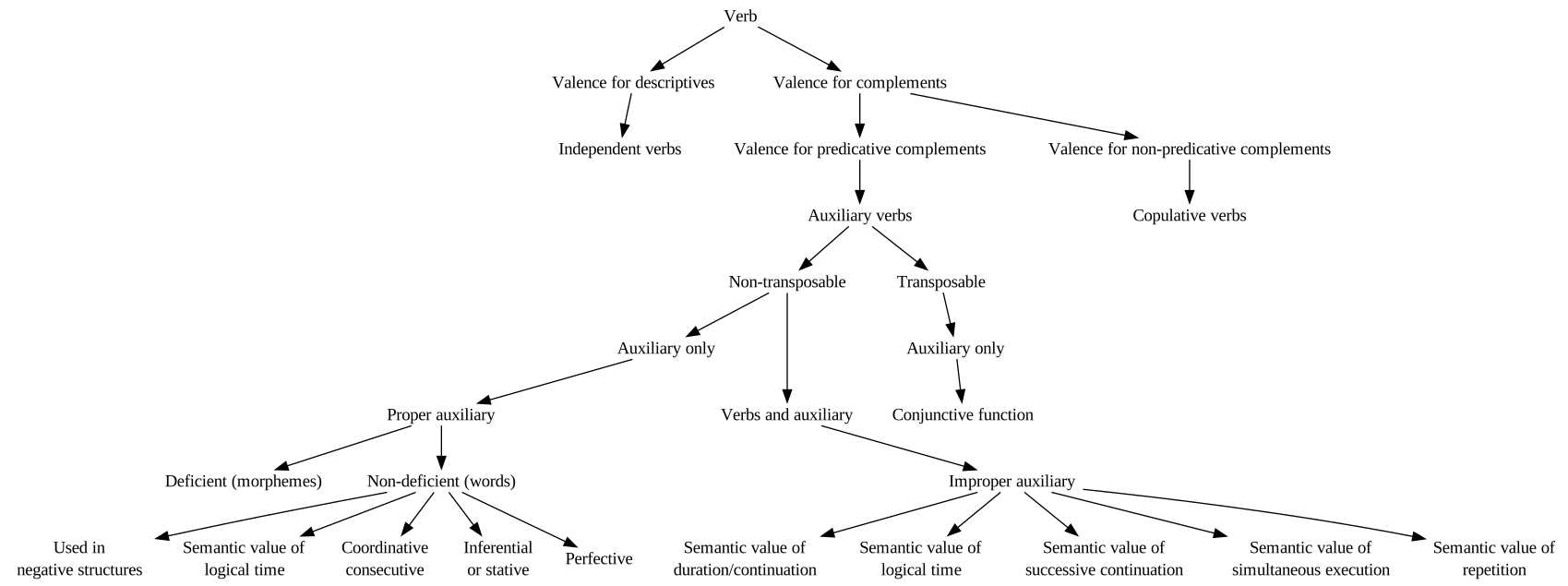
| Deficient (morphemes) | Used in neg. structures | Sem. value of logical time | Coordinative consecutive | Inferential or stative | Perfective | Sem. value of duration/continuation | Sem. value of logical time | Sem. value of successive continuation | Sem. value of simultaneous execution | Sem. value of repetition | Conjunctive function |
|---|---|---|---|---|---|---|---|---|---|---|---|
| Continuative | -bisa | -bôlo | -ba | -bô | -nê | -aga | -akofa | -fêla | -nama | -atisa | e bilê |
| -a- | -ise | -sena | (-bô) | -nna | -dika | -tloga | -sala | -boa/(-boêla) | e kete | ||
| Progressive | -ka | -jafilê | -bilê | -ntsê | -lêtse | -feta | -êta/nna | e re | |||
| -sa | -kitla | -kilê | -tlhôla | -lala | -tsamaya | gobô | |||||
| Futuritive | -nê | -ilê | -phakêla | -tla | gonne | ||||||
| -tla | -nke | -sale | -tsonga | -fitlha | gobane | ||||||
| Potential | -ekilê | gore | |||||||||
| -ka | -sêtse | go tla | |||||||||
| go tloga | |||||||||||
| go fitlhêla | |||||||||||
| go tsamaya | |||||||||||
| ntswa/etswa | |||||||||||
| mme |
In broad terms Setswana auxiliary verbs can be categorised as proper and improper auxiliary verbs (Pretorius, 1997: 259-343). Brief discussion of the diagram: Auxiliary verbs are divided into two groups – transposable and intransposable, based on their syntactical features. The transposability of the auxiliary influences the complexity of the complements that it can take. The morphological features that accompany the syntactical differences are mentioned below.
Transposable auxiliary verbs take predicative complements and are inseparable from the complement. Morphologically there are two groups, those with a fixed (also referred to as invariable) subject agreement morpheme such as e re ‘say’ and those that take an infinitive prefix such as go fitlhela ‘to arrive’. They are used as conjunctions with a metaphorical meaning derived from their meaning as verb:
| E re o ba bona o ba bitse. |
| E re o ba bon-a o ba bits -e |
| AgrSubj-Aux AgrSubjP2sg -AgrObj2-see-VEnd -AgrSubjP2sg-AgrObj2-call-VEnd |
| When you see them, you (must) call them. |
E re can also introduce temporal adverbs (clauses):
| E re kgantele fa o ba bona o ba bitse. |
| E re kgantele o ba bon-a o ba bits-e |
| AgrSubj-Aux Adv AgrSubjP2sg-AgrObj2-see-VEnd AgrSubjP2sg-AgrObj2-call-VEnd |
| When just now you see them, you (must) call them. |
| Kgantele e-re fa o ba bona o ba bitse. |
| kgantele e re o ba bon-a o ba bits-e |
| Adv AgrSubj-Aux AgrSubjP2sg-AgrObj2-see-VEnd AgrSubjP2sg-AgrObj2-call-VEnd |
| Just now when you see them, you (must) call them. |
| Ke tla go thusa go fitlhela ba tla go go tsaya. |
| ke- tla -go -thus-a go fitlhela ba tl -a go go tsay -a |
| AgrSubjP1sg-FutPre-AgrObjP2sg-help-VEnd Adv AgrSubj2-come-VEnd InfPre-AgrObjP2sg-fetch-VEnd |
| I will help you until they come to fetch you. |
| Go fitlhela ba tla go go tsaya, ke tla go thusa. |
| go fitlhela ba tl-a go-go tsay -a ke -tla -go- thus-a |
| AdvAgrSubj2-come-VEnd InfPre-AgrObjP2sg- fetch-VEnd AgrSubjP1sg-FutPre-AgrObjP2sg-help-VEnd |
| Until they come to fetch you, I will help you. |
Non-transposable auxiliary verbs also take predicative complements but they furthermore have valence for subjects and secondary and/or tertiary descriptives. Morphologically their complements may include a class bound subject agreement morpheme, the unchangeable or neutral subject agreement morpheme or no subject agreement morpheme at all. Based on their syntactical features they are classified in two categories: proper and improper auxiliary verbs.
Proper auxiliary verbs can only function as auxiliaries in a sentence. Based on their word status a distinction is made between deficient auxiliary verbs and non-deficient auxiliary verbs. Deficient auxiliary verbs have lost their status as words and function as morphemes only. Non-deficient auxiliary verbs are proper auxiliaries which have retained their word status and function as words – auxiliary verbs. These auxiliary verbs usually indicate TAMP (Tense, Aspect, Mood and Polarity) information. Based on their meaning they are sub-divided in 5 groups to indicate negation, logical time, coordinative consecutive meaning, inferential or stative meaning or perfective meaning. Refer to Krüger (2006: 269-275) and Pretorius (1997: 259-279).
The improper auxiliary verbs are “proper independent verbs which can also function as auxiliary verbs followed by predicative complements”
(Pretorius, 1997: 279). They are also divided into five groups based on their meaning expressing a semantic value of continuation or duration, logical time, successive continuation, simultaneous execution or repetition while a group of the improper auxiliaries have a conjunctive function. Refer to Krüger (2006: 269-275) and Pretorius (1997: 279-343) for a more elaborate discussion.
Features of auxiliary verbs
Morphological features
The basic morphological structure of auxiliary verbs (proper as well as improper) does not differ from that of independent (ordinary) verbs.
Auxiliary verbs have the following basic morphological components:
| Prefix (agreement morpheme) | + | Root | + | Ending |
|---|---|---|---|---|
| di- | + | -tlhol- | + | -a |
| o- | + | -b- | + | -ô |
Prefixes
The prefix can be either a subject agreement morpheme or an infinitive prefix. While the customary ending is -a, it can be -ê (-nê), -e (-ise) and ô (-bô) in selected cases.
The basic morphological structure of auxiliary verbs (proper as well as improper) does not differ from that of independent (ordinary) verbs. Auxiliary verbs do not have valency for objects, their morphological structure can thus not be extended by object agreement morphemes. They do however have valency for the following verbal prefixes:
- The progressive -sa
Even though proper auxiliary verbs cannot take the progressive, improper auxiliary verbs are in rare cases extended by –sa-:
Example 8Ke sa ntse ke leka. Ke sa -ntse ke lek -a AgrSubP1sg -Prog-nn -PerfSuf AgrSubP1sg -lek -VEnd I am still (busy) trying. Example 9Ga re sa tlhôle re itse kwa a leng teng. Ga -re- sa -tlhôl-e (re itse kwa a leng teng). NegPre -AgrSubPpl -Prog -tlhol-VEnd We do not know where he/she is anymore. - The potential -ka-
The potential appears only with the proper auxiliary verbs -bô/ba:
Example 10Ba kabô ba go thusitse. Ba ka b ô ba go thusitse AgrSub2 -pot-b-VEnd -AgrSub2-AgrObjP2sg -thus-PerfSuf-VEnd They could have helped you. The potential can however appear with almost all improper auxiliary verbs:
Example 11Lo ka nna lwa dula fa. Lo ka nna lwa dula fa AgrSubP2pl-Pot-nn-VEnd -AgrSub2-AgrObjP2pl -dul-VEnd You may sit here in the meantime. Example 12Ngwana yoo a ka tloga a wa mô setlhareng sêo. Ngwana yoo a ka tlog -a a w-a (mô setlhareng sêo). NPre1a child DemPro1a AgrSub1a-Pot-tlog -VEnd AgrSub1a-w-VEnd (...) That child could just now/at any moment fall from that tree. - The future tense prefix tla-
The prefix -tla- only combines with the proper auxiliary verb -bô:
Example 13Ba tlabô ba fêditse go ja fa re gôrôga. Ba tla b ô ba fêditse go j-a (fa re gôrôga) AgrSub2-Fut-b-VEnd- AgrSub2-fel-PerfSuf-VEnd -InfPre-j-VEnd (...) They will have finished eating when we arrive. The prefix tla- is also used with all the improper auxiliary verbs in the formation of future tense forms. e.g.,:
Example 14Ke tla tlhôla ke baakanya baesekele ya me. I will be fixing my bicycle in the meantime. Example 15O tla tloga ba gatiwa ke dikôlôi fa o sa tlhokomele. You will be hit by vehicles shortly/just now/at any moment if you aren't careful. No type of auxiliary verb has valence for the present tense prefix -a-.
Suffixes
Auxiliary verbs have attained a pragmatic function through their idiomatic or metaphoric meaning. They therefore do not have valence for any suffixes that ordinary/independent verbs may take. There is an exception in that some auxiliary verbs take the perfective suffix -il-:
| A sala a mo duela. |
| He/she stay he/she him/her pay [direct translation] |
| A sala a mo duel-a |
| AgrSub1-Aux -AgrSub1-AgrObj1-duel-VEnd |
| He/she then/eventually paid him/her. |
| O setse a mo duetse. |
| He/she stayed he/she him/her paid [direct translation] |
| O setse a mo duetse. |
| AgrSub1-sal-PerfSuf-AgrSub1-AgrObj1-duel-VEnd |
| He/she has already paid him/her. |
| Ke tloga ke tsamaya. |
| I leave I walk [direct translation] |
| Ke tloga ke tsamay-a. |
| AgrSubP1sg-Aux -AgrSubP1sg-tsamay-VEnd |
| I will leave just now. |
| Ke tlogile ka tsamaya. |
| I leave I walk [direct translation] |
| Ke tlogile ka tsamay-a. |
| AgrSubP1sg-tlog-PerfSuf-AgrSubP1sg-tsamay-VEnd |
| I then (eventually) left. |
The perfect form of the auxiliary seems to invoke a consecutive modal meaning in the complementary verbs –duel- and -tsamay hence the consecutive forms -a- and -ka- of the subject agreement morpheme.
Syntactical features
Similarities and differences in syntactical features were taken as criteria in the classification of auxiliary verbs in Figure 2. Deficient, proper, improper, and a category of auxiliary verbs with conjunctive function were identified on this basis. The syntactical features of proper and improper auxiliary verbs are attended to first while deficient auxiliaries and auxiliaries with conjunctive function are treated subsequently.
Features of proper and improper auxiliary verbs
These auxiliary verbs act as introductory members, and are dependent on a main verb, a copulative verb phrase or another auxiliary verb phrase as complement:
- Main verbExample 20
Ke nê ke opel-a. AgrSubP1sg-Aux-AgrSubP1sg-opel-VEnd I was (busy) singing. - Copulative verb phraseExample 21
Ke nê ke le moithuti. AgrSubP1sg-Aux-AgrSubP1sg-IdCopV NPre1-Refl-rut-Dev I was a student. - Auxiliary verb groupExample 22
Ke nê ke sa ntse ke opela. AgrSubP1sg-Aux-AgrSubP1sg Aux-AgrSubP1sg-opel-VEnd I was still singing. Example 23Ke nê ke sa ntse ke le moithuti. AgrSubP1sg-Aux-AgrSubP1sg-Prog-Aux- AgrSubP1sg-IdCopV NPre1-Refl-rut-DevEnd I was still a student.
Deficient auxiliary verb
These auxiliaries have grammaticalised and in the process lost their status as words and now feature as morphemes. They act as prefixal morphemes of the verb, and therefore they are part of the verb. They are the continuous / imperfective / present tense prefix -a-, the progressive -sa- and the potential -ka-:
| Re ka go thusa ka tirô ya gago fa o ka re letlela. |
| We can help you with your work if you would (can) allow us. |
This ka is the instrumental particle. It is homophonic with the potential prefix.
Auxiliary verbs with conjunctive function
Auxiliary verbs with a conjunctive function are transposable in sentences:
| Ga a ise a bue le nna go tloga maabane bosigo. |
| He/she has not spoken to me since last night. |
| Go tloga maabane bosigo ga a ise a bue le nna. |
| Since last night he/she hasn't spoken to me. |
Semantic features
The proper auxiliary verbs usually specify tense, aspect, mood and polarity (TAMP) information. Improper auxiliary verbs are “proper independent verbs which can also function as auxiliary verbs followed by predicative complements”
(Pretorius, 1997: 279). They express a semantic value of continuation or duration, logical time, successive continuation, simultaneous execution or repetition while some of the improper auxiliaries can also have a conjunctive function. The auxiliary verb thus enriches the meaning of its complement by adding semantic information regarding the progression or completion of the action or event (Louwrens, 1994a: 17). The complement of the auxiliary verb expresses the main action/process/event Krüger (1967: 159) describes these complements). Pretorius (1997: 98) maintains that auxiliary verbs in Setswana express a certain type of duration of the action or the logical time at which the action is executed.
- Future:Example 27
Re tlabô re kwala. re -tlabô re -kwal-a AgrSubjP1pl-Aux AgrSubjP1pl-kwal-VEnd We will be writing. - Past:Example 28
Ke nê ke reka dijô. ke -nê ke -rek-a di -j -ô AgrSubjP1sg-Aux AgrSubjP1sg-buy-VEnd NPre10-eat-DevSuf I was buying food.
Copulative verbs
Grammaticalisation of the copulative verb -nna
Grammaticalisation (rank shifting) is also prevalent with copulative verbs. Scholars hypothesise that the copulative verb -nna is a grammaticalised form of the infinitive verb go-nna ‘to be, to become, to come into existence’. (Further reading on different forms in the various modal categories: Cole, 1975: 336-339; Krüger, 2006: 284-286; Pretorius, 2004: 111; Taljard, 1999: 291; Lanham, 1953: 160)
Rose et al. (2002: 21) indicate that copula verbs in Bantu are generally versions of ‘be’, including -ba, -li and -(i)kala all ‘be’, as well as na- ‘have’ (lit.: ‘be with’) Copula auxiliaries often occur in compound predications, or in various stages of grammaticalisation within the verb phrase. Setswana copulative verbs in dependent clauses take the form -le- / -se- as in:
| Fa monna a le moruti |
| fa monna a -le moruti |
| Conj NPre1-man AgrSubj-IdCopV NPre1-preacher |
| If the man is a preacher... |
| Fa monna a se moruti. |
| fa monna a -se moruti |
| Conj Npre1-man AgrSubj-IdCopV NPre1-preacher |
| If the man is not a preacher... |
Cole (1975: 311) indicates that the associative copulative in Setswana “regularly employs the deficient verb -na expressing the idea of English ‘have’ or ‘be with’ and in this respect it differs radically from the other two”
.
The word status of copulative verbs
The status of copulative verbs as words or morphemes is still contested among grammarians. Posthumus (2000) discusses the often-erroneous interpretation of the element -be in IsiZulu. He specifically indicates that the copulative verb, which is a word, forms part of the copula, which is a phrase (sometimes referred to as a word group), (Pretorius, 2004: 110). Krüger (2006: 284) makes a distinction between variable and invariable forms of copulative verbs. He indicates that: “The invariable forms are formally characterized by the classless subject agreement morpheme e- and are typical of the identifying copulative group. The variable forms on the other hand are characterized by the subject concord and this feature is typical of the descriptive and associative copulative verbs respectively”
. This subject concord could also be referred to as a class 9 subject concord, which is neutral for purposes of syntactic use.
Copulative verbs that bear resemblance with the subject concords are referred to as variable copulative verbs. This resemblance causes scholars such as Lombard et al. (1985: 194) to be hesitant to refer to these forms as copulative verbs as he refers to them as copulative particles. Poulos & Louwrens (1994: 307) refrain from using a particular term and state that: “the descriptive copulative consists of a form resembling the subject concord. In our view however, they now act as copulative verbs because they can be negated, as in Ba botshwakga ‘They are lazy’. Ga-ba botshwakga ‘They are not lazy’ and can be conjugated in the moods”
. It can be posited as ba-ø-botshwakga and ga-ba-ø-botshwakga since the form is ba-le-botshwakga / ba-se-botshwakga in dependent clauses.
The invariable copulative
keand its negative counterpart
ga secause the same problem when deciding whether they are verbs or particles. Krüger (2006: 284) who employs van Wyks’ criteria for word identification and classification opts to refer to them as invariable copulative verbs and not as particles. Because
kecan be negated (assume negative polarity), his view is accepted as correct.
Types of copulative verbs
Copulative verbs are distinguished from each other based on the differences in the relation of the subject to the complement of the copulative verb in the sentence. Three types viz. the identifying (the subject identifies the complement of the verb), describing (the subject describes the complement of the verb in terms of a feature or location), and associative (the subject associates the complement of the verb with an item or it can indicate that the subject is in the company of somebody) copulative verb are identified. The morphological form of the copulative verb indicates the formal realisation of each type. Note that some grammars refer to the describing copulative as the descriptive copulative. Cole (1975: 311) refers to the identifying copulative as the identificative copulative. Views regarding the identifying and describing copulative verbs in the Sotho languages differ, as some scholars categorise these verbs as particles (Lombard et al., 1985: 194; Taljard & Bosch, 1988; Louwrens, 1991: 18; Poulos & Louwrens, 1994: 307; Taljard, 2001a, 2001b; Taljard, 2003; Pretorius, 2004: 71–73; Krüger, 2006: 275–278, Krüger, 2013a, 2013b). Refer to Table 1 for modal and temporal forms.
Identifying copulative
The copula is formed by a nominal following the copulative verb. It serves to “identify the subject as regards type, status or profession or simply to predicate the existence or presence of a thing”
(Cole, 1975: 311). The most used form of the copulative verb is ke in the positive and ga se in the negative. There is no agreement with the subject.
| Ke bônê |
| ke bônê |
| IdCopV PersPro2 |
| It is they/them |
| Ga se bônê |
| ga -se bônê |
| NegPre-IdCopV AbsPro2 |
| It is not them |
| Mosadi wa me ke morutabana. |
| mo-sadi wa me ke |
| NPre1-woman PossPart1 PossProP1sg IdCopV |
| My wife is a teacher |
| morutabaana |
| mo -rut -a -ba -ana |
| NPre1-teach-VEnd-NPre2-child |
| Mosadi wa me ga-se morutabana. |
| mo-sadi wa me ga -se |
| NPre1-woman PossPart1 PossProP1sg NegPre-IdCopV |
| My wife is not a teacher. |
| morutabaana |
| mo -rut -a -ba -ana |
| NPre1-teach-VEnd-NPre2-child |
In certain modal forms such as the participial mood an invariable subject agreement morpheme e- is used with -le as verb in thepositive while it is used with -se in the negative.
| Fa e le bônê |
| fa e -le bônê |
| Conj AgrSubj-IdCopV AbsPro2 |
| If it is them... |
| Fa e se bônê |
| fa e -se bônê |
| Conj AgrSubj-IdCopV AbsPro2 |
| If it is not them... |
The invariable subject agreement morpheme is also used with the forms -nna/-nnê/-nne/-nnilê in other modal/temporal variants. It could be postulated that this morpheme was grammaticalised from class 9 to evolve into the value of ‘it’ in European languages. This would bring about the option to “primitively render the impersonal in Bantu languages”
.
| E tla nna ênê. |
| e -tla -nna ênê |
| AgrSubj-FutPre-IdCopV AbsPro1 |
| It will be them. |
| Katlego e nnilê morui. |
| (-) -katlego e -nnilê ênê |
| NPre1a-katlego AgrSubj-IdCopV AbsPro1 |
| Katlego became a farmer. |
Copulative verbs can have different forms when they appear in modal and tense forms. These modal and tense forms are the same as main verbs. (cf. Cole, 1975: 330, 335). Krüger (2013b: 422–486) describes these tenses.
Describing copulative
The describing copulative describes the subject in terms “some quality, characteristic or state, or it’s situation or a locality”
and is formed from qualificatives and adverbs (Cole, 1975: 319). The copulative verb agrees with the class of the subject in present declarative sentences.
| Bana ba botlhale. |
| ba -ana ba botlhale |
| NPre2-child DesCopV2 adjective |
| Children are clever. |
| Bana ga ba botlhale. |
| ba -ana ga -ba botlhale |
| NPre2-child NegPre DesCopV2 adjective |
| Children are not clever. |
Associative copulative
This copulative indicates the idea of possession or association which is translated with the English ‘have’ or ‘be with’ Cole (1975: 330). This verb, -na, in this context, is regular. O-na le dibuka / O-nnile le dibuka.
| Morutabana o ne le dibuka tse dintsi. |
| mo -rut -a -ba -ana o -na le di -buka tse di -ntsi |
| NPre1-teach-VEnd-NPre2-child-AgrSubj2-AssCopV-AssPart NPre10-book QualPart10-NPre10-many |
| A teacher has many books. |
| Morutabana ga-a-na dibuka tse dintsi. |
| mo -rut -a -ba -ana ga -a -na di -buka tse di -ntsi |
| NPre1-teach-VEnd-NPre2-child-NegPre-AgrSubj2-AssCopV NPre10-book QualPart10 NPre10-many |
| A teacher does not have many books. |
Features of copulative verbs
The morphological features of copulative verbs
The different copulative relations to the subject (identifying, describing and associative) - also referred to as types of copulative verbs and their TAMP inflections yield a variety of morphological forms. These forms are hypothesised to be adaptions of the copulative verb go nna ‘to be/to become’ to indicate and differentiate between the three copulative verbs and their inflected forms. In summary the basic morphological structure of copulative verbs can be:
The invariable form ke and ga se (identifying copulative).
| Ke bônê. |
| ke bônê |
| IdCopV AbsPro2 |
| It is they/them |
| Ga se bônê. |
| ga -se bônê |
| NegPre-IdCopV AbsPro2 |
| It is not they/them. |
Variable copulative verbal forms where the subject of the copula is one of the three persons (a personal pronouns) or one of the noun classes and the subject agreement morpheme is resembled in the copulative verb.
| Wena o kwa tirong. |
| wena o kwa (ne-)-dir -o -ng |
| PersProP2sg DesCopVP2sg LocPart NPre9-work-DevSuf-LocSuf |
| You are at work. |
| Ga go monate. |
| ga -go monate |
| NegPre-DesCopV Adv |
| It is not nice. |
An invariable or variable subject agreement morpheme followed by a copulative verbal root:
| Re ne re le têng maabane. |
| re -ne re -le (-) -têng maabane |
| AgrSubjP1pl-Aux AgrSubjP1-pl-DesCopV NPre20-inside Adv |
| We were there yesterday. |
| Namane ê e tla nna pôo e ntle. |
| (ne-)-namane ê e -tla -nna (ne-)-pôo e (-) -ntle |
| NPre9-calf QualPart9-AgrSubj-FutPre-DesCopV NPre9-bull QualPart9-NPre9-beautiful |
| This calf will become a beautiful/good bull. |
| Go-nê go le bollo thata. |
| go -nê go -le bo -llo thata |
| AgrSubj-Aux AgrSubj-DesCopV NPre14-hot Adv |
| It was very hot. |
go-nê is the undetermined subject agreement morpheme meaning ‘it (is)’.
Semantic features of copula verbs: Stative and inchoative meaning
A stative meaning is indicated when the subject has a certain characteristic or is in a certain state or condition. Copulative verbs that indicate stative meaning are referred to as stative copulative verbs:
| Mosadi ke morutabana. |
| mo -sadi ke mo -rut -a -ba -ana |
| NPre1-woman IdCopV NPre1-teach-VEnd-NPre2-child |
| The woman is a teacher. |
| Mosadi o botlhale. |
| mo-sadi o bo-tlhale |
| NPre1-woman DesCopV NPre14-clever |
| The woman is clever. |
| Mosadi o na le ditlhako tse dintsi. |
| mo-sadi o -na le di -tlhako tse -di-ntsi |
| NPre1-woman AgrSubj1-AssCopV AssPart-NPre8-shoe QualPart8 NPre8-many |
| The woman has a lot of shoes. |
Inchoative meaning has its origin in the Latin inchoare ‘to begin/to start’. It is indicated when the subject is in the process of acquiring a certain characteristic or moves or enters into a certain state or condition. Certain modal or temporal forms of copulatives can indicate inchoative meaning. They are sometimes referred to as dynamic copulative verbs:
| Mosadi e nna morutabana. |
| mo -sadi e -nna mo -rut -a -ba -ana |
| NPre1-woman AgrSubj-IdCopV NPre1-teach-VEnd-NPre2-child |
| The woman is becoming teacher. |
It is important to note that Setswana has the ability to shift the emphasis from N1 to N2. In Mosadi e-nna morutabana the emphasis is on morutabana by impersonalisation; while in Mosadi o-nna morutabana the focus is mosadi.
| Mosadi o nna botlhale. |
| mo -sadi o -nna bo -tlhale |
| NPre1-woman AgrSubj1-IdCopV NPre14-clever |
| The woman is becoming clever/wise. |
| Mosadi o nna le madi a mantsi. |
| mo -sadi o -nna le madi a mantsi |
| NPre1-woman AgrSubj1-AssCopV AssPart-NPre6-money a QualPart6 NPre6-many |
| The woman is getting/acquiering a lot of money (is becoming rich). |
Inchoative meaning is always expressed morphologically by the copulative verb -nna and its modal/temporal variants -nnê, -nne.
Indistinct stative and inchoative meaning
In certain instances, with the copulative verb -nna, the difference between stative and inchoative meaning is indistinct: (cf. Cole, 1975: 336-339; Krüger, 2006: 285).
- The potential form of the moods with tenses (indicative, participial and relative).Example 56
Mosadi yô e ka nna morutabana. mo -sadi yô e -ka -nna mo -rut -a -ba -ana NPre1-woman DemPro1 AgrSubj-PotPre-IdCopV NPre1-teach-VEnd-NPre2-child This woman can be (can become) a teacher. - The future tense of the moods with tenses (indicative, participial and relative):Example 57
Batho ba ba ithutileng sentlê, ke bôna ba ba tla nnang le ditiro. ba -tho ba ba -i -rut -il -e -ng sentlê ke bôna ba ba -tla -nna -ng le di -dir -o NPre2-person QualPart2 AgrSubj2-ReflPre-learn-PerfSuf-VEnd-RelSuf Adv IdCopV AbsPro2 QualPart2 AgrSubj2-FutPre-AssCopV-RelSuf AssPart NPre10-work-DevSuf People that have studied, it is they that will get (will have) jobs. - The infinitive, consecutive, subjunctive, imperative and habitual moods:Example 58
Go nna moleele. go -nna mo-leele AgrSubj-DesCopV NPre1-tall To be (to become) tall. Example 59Mosimane a nna moleele. mo-simane a -nna mo-leele NPre1-boy AgrSubj1-DesCopV NPre1-tall The boy was (became) tall. Example 60Rraago o go romela kwa yunibesiting gore o nnê morutabana. (-)-rraago o-go-rom-el-a kwa (ne-)-yunibesiti-ng gore o-nne mo-rut-a-ba-ana NPre-1a-your father AgrSubj1a-AgrObjP2sg-send-ApplSuf-VEnd LocPart NPre9-university-LocSuf Conj AgrSubj1-IdCopV NPre1-learn-VEnd-NPre2-child Your father sends you to university so that you can become (can be) a teacher. Example 61Se nne morutabana! se -nne mo -rut -a -ba -ana NegPre-IdCopV NPre1-learn-VEnd-NPre2-child Do not be (become) a teacher! Example 62Morutabana yo o dirang thata e tle e nne tlhogo ya sekôlô. mo -rut -a -ba -ana yo o -dir -a -ng thata e tle e -nne (ne-)-tlhogo ya se -kôlô NPre1-learn-VEnd-NPre2-child QualPart1 AgrSubj1-work-VEnd-RelSuf Adv Adv AgrSubj-IdCopV NPre9-head PossPart9 NPre7-school A teacher that works hard usually is (becomes) the head of the school.
Inchoative and stative meaning in copula is also influenced by the complements of copulative verbs:
- Describing copulative verbs with locative complements cannot indicate inchoative meaning:Example 63
Bana ba tla nna kwa gae. ba -ana ba -tla -nna kwa (le-)-gae NPre2-child AgrSubj2-FutPre-DesCopV LocPart NPre5-home The children will be at (stay at) home. - Associative copula can very rarely indicate inchoative meaning as it is unusual to indicate an associative relation which is ‘being entered into’. It is however possible in rare cases:Example 64
Fa pula e nele, dikgômo di tla nna le dikgofa. Fa (ne-)-pula e -n -il -e di -kgômo di -tla -nna le di -kgofa Conj NPre9-rain AgrSubj9-rain-PerfSuf-VEnd NPre10-cattle AgrSubj10-FutPre-AssCopV AssPart NPre8-tick When it has rained (after the rains) the cattle will be getting (becoming with) ticks.
The syntactic features of copulative verbs
When used in a sentence each copulative verb is the head of the copulative verb phrase (‘VPIDCOP’, ‘VPDESCOP’ or ‘VPASSCOP’) (Berg, 2018: 136). The complements of the different copulatives differ:
- Identifying copulative verbs take non-verbal and non-locative complements viz.:
- Noun phrases
- Pronoun phrases
- Possessive particle phrases
- Qualificative particle phrases
- Describing copulative verbs take non-verbal complements viz.:
- Adjectives
- Particle phrases
- Locative class noun phrases
- Absolute, demonstrative and quantitative pronouns of classes 16 to 20
- Place names — adverbs of place
- Interrogatives kae?, jang? and go mang?
- Possessive particle phrases of classes 16 to 20
- Associative copulative verbs take non-verbal complements viz.:
- In the positive, it takes an associative particle phrase where the associative particle le has the same valency as the assossiative copulative verb in the negative, as indicated below. The associative particle is elided in the negative.
- In the negative it has valency for a class noun phrase, a pronoun phrase, an adverbial phrase, a possessive particle phrase or a qualificative particle phrase (QUALPARTP).
Impersonal in Setswana
Reference to a “classless” subject morpheme (concord) as well as an undetermined subject morpheme (concord) draws attention to a possible interface between the copulative in Setswana and the expression of impersonal subjects, especially when using expletive subjects with -e- and -go-.
Describing this phenomenon lies more in the field of syntax though. In this regard, Nurse & Phillipson (2003: 10) remark that “The originality of Bantu syntax is seen more clearly if one recognizes how the system – of which passivisation, objectivisation, and (locative) inversion are further extensions – interacts subtly with pronominal incorporation which in turn reflects nominal classification.”
The problem that arises is when a subject agreement morpheme (which is a pronominal marker (PM)) seems to be non-subjective, that is not being generated by a nominal in the position of a subject (N1). The prefix of the locative class (17) -go- acts as such a pronominal marker. Refer to Demuth (2003: 217-218) for a discussion of how some languages use the class 17 prefix for all locative nouns. When it represents a substantive with the prefix go- where it commutes with other substantives, this marker has a simple function:
| mosadi yo o montle |
| mo -sadi yo o mo -ntle |
| NPre1-woman DemPro1 DesCopV1 NPre1-adjective |
| This woman is beautiful. |
| golo mo go gontle. |
| golo mo go go -ntle |
| NPre17-place DemPro18 DesCopV17 NPre17-adjective |
| This place is beautiful. |
| Go aga ntlo go thata. |
| go -aga (ne-)-ntlo go thata |
| AgrSubj15-build NPre9-house DesCopV15 Adv |
| To build a house is tough. |
However, it also presents syntactic functions which are problematic to analyse while the categorisation of structure is also ambiguous. This marker also produces other uses in which it is tempting to see a comparison with structures referred to as the “impersonal” in European languages (Creissels, 1991: 238). Refer also to Demuth & Mmusi, 1997 and Zeller 2008. Consider the following sentence:
| go-tlhabilwe kgomo. |
| There-has been slaughtered cow |
| go -tlhab -il -w -e (ne-)-kgomo |
| AgrSubj15-slaughter-PerfSuf-Pass-VEnd NPre9-cow |
| A cow has been slaughtered. |
This is the passive of:
| ... kgomo e -tlhabilwe |
| NPre9-cow AgrSubj9-slaughter-PerfSuf-Pass-VEnd |
This sentence can be analysed as m1-V N3. The NP kgomo here has no syntactic properties of controlling the m1 marker. It is impossible to work out a topicalisation which will produce a marker that would represent the -go-. The commutations that can be effectuated on kgomo have no incidence on m1.
The structure of this sentence cannot be compared to or identified with:
| kgomo e-tlhabilwe |
| cow it-has-been-slaughtered |
| ... kgomo e -tlhabilwe |
| NPre9-cow AgrSubj9-slaughter-PerfSuf-Pass-VEnd |
| A cow has been slaughtered. |
Kgomo controls the m1 marker in this sentence, which is not the case in the first sentence.
There is a striking resemblance of this predicative structure to the European languages' impersonal. There is however a difference. The -go- in Setswana is a regular subject agreement morpheme associated with the locative, and the presence of a locative being possible with any verb, an interpretation of this Setswana predicative structure can be given. It can be said that the selection of the participant to the act where N1 controls m1 constitutes a lexico-syntactic property of the Setswana verb. But elsewhere in Setswana there exists a possibility that the control of the m1 does not arise from the NP to which the lexico-syntactic sense of the verb confers this property. It is the locative that is present or implied which takes the role. Locative inversion also referred to as abstract Locative inversion (LI) is a construction that is very prominent in Bantu languages. It involves inversion of a locative with the logical/thematic subject. The inversion is accompanied by a reversal of grammatical functions whereby the locative becomes the subject.
| go-ditlhare (kwa nokeng). |
| It is trees (at the river) |
| go -ditlhare (kwa nokeng) |
| DesCopV17-NPre10-tree (LocPart-NPre9-river-LocSuf) |
| There are (many) trees at the river / It is tree rich at the river. |
This should not be confused with:
| Go na le ditlhare (tse dintsi) kwa nokeng. |
| There is with trees (that are many) at the river |
| go na le ditlhare (tse dintsi) kwa nokeng |
| AgrSubj17 AssPart NPre10-tree (QualPart10 NPre10-adjective) LocPart NPre9-river-LocSuf |
| There are a lot of trees at the river. |
| go-tsididi (kwa nokeng). |
| It is cold (at the river) |
| go tsididi (kwa nokeng) |
| DesCopV17 adjective (LocPart-NPre9-river-LocSuf) |
| It is cold (at the river). |
These two sentences can be compared to:
| (ditlhare) di-kwa-nokeng |
| (Trees) they are at the river |
| (ditlhare) di (kwa nokeng) |
| NPre10-tree DesCopV8 (LocPart-NPre9-river-LocSuf) |
| The trees are at the river. |
| (metsi) a-tsididi |
| (water) it is cold |
| metsi a tsididi |
| NPre6-water DesCopV6 adjective |
| The water is cold. |
The structure go-tsididi can be analysed by posing that the locative kwa nokeng occupies a structural position of the subject, which in a-tsididi is occupied by metsi. The sentence go-ditlhare can therefore be analysed as being a result of a transformation which transfers the control of the m1 marker to the locative constituent or phrase (‘Nloc’), as it is demonstrated in the following figure.

With this demonstration, we can comfortably talk of the impersonal in Setswana, albeit in an evolutionary perspective. As the phenomenon of the impersonal links strongly to syntax, we suffice with these introductory remarks.
References
Berg, A. (2018) Computational syntactic analysis of Setswana. Doctoral Thesis. North-West University, South Africa.
Cole, D. T. (1975) Introduction to Tswana grammar, 2nd impression. Cape Town: Longman.
Creissels, D. (1991) Description des langues négro-africaines et théorie syntaxique. Grenoble, ELLUG Université Stendhal, 466 pp., 2902709668
Demuth, K. & Mmusi, S. (1997) ‘Presentational focus and thematic structure in comparative Bantu.’ Journal of African Languages and Linguistics. 18, 1-19.
Demuth, K. (2003) ‘The acquisition of Bantu Languages’. In Nurse, D. & Philippson, G. (eds.). The Bantu Languages. London: Routledge.
Givón, T. (1971) ‘Historical syntax and synchronic morphology: An archaeologist’s field trip’. Chicago linguistic society. 7(1): 394-415.
Guldemann, T. (2003) ‘Grammaticalization’. In. Nurse, D. & Philipson, G. (eds.). The Bantu languages. London: Routledge. pp. 182-194.
Heine, B., Claudi, U. & Hunnemeyer, F. (1991) ‘From cognition to grammar - Evidence from African languages’. In Traugott, E. C. & Heine, B. (eds.). Approaches to grammaticalization. Philadelphia: John Benjamins. pp. 149-187.
Krüger, C. J. H. (1967) Die struktuur van die woordgroep in Tswana. Doctoral Thesis. University of Pretoria, Pretoria.
Krüger, C. J. H. (2006) Introduction to the morphology of Setswana. München: Lincom.
Krüger, C. J. H. (2013a) Setswana syntax: a survey of word group structures: Volume 1. München: Lincom.
Krüger, C. J. H. (2013b) Setswana syntax: a survey of word group structures: Volume 2. München: Lincom.
Lombard, D., Van Wyk, E. B. & Mokgokong, P. C. (1985) Introduction to the grammar of Northern Sotho. Pretoria: Van Schaik.
Louwrens, L. J. (1991) Aspects of Northern Sotho grammar. Pretoria: Via Afrika.
Louwrens. L. J. (1994a) Dictionary of Northern Sotho grammatical terms. Pretoria: Via Afrika.
Louwrens. L. J. (1994b) A linguistic analysis of Northern Sotho. Pretoria: Via Afrika.
Meeussen, A. E. (1967) ‘Bantu grammatical reconstructions’. Africana linguistica. 3(1): 79-121.
Nurse, D. & Philippson, G. (2003) ‘Introduction.’ In Nurse, D. & Philippson, G. (eds.). The Bantu languages. London: Routledge. pp.1–13.
Posthumus, L. C. (2000) ‘The so-called adjective in Zulu’. South African Journal for African Languages. 20(2): 148–158.
Poulos, G. & Louwrens, L. J. (1994) A linguistic analysis of Northern Sotho. Pretoria: Via Afrika.
Pretorius, R. S. (1997) Auxiliary verbs as a subcategory of the verb in Tswana. Doctoral Thesis. North-West University (University of Christian Higher Education), Potchefstroom.
Pretorius, W. J. (2004) ‘n Dimensionele grammatiese beskrywing van hulpwerkwoorde in Noord-Sotho. Doctoral Thesis. University of Johannesburg (Rand Afrikaans University), Johannesburg.
Rose, S., Beaudion-Lietz, C, & Nurse, D. (2002) ‘A glossary of terms for Bantu verbal categories with special emphasis on tense and aspect’. Lincom studies in African languages. (55): xiv, 106. München: Lincom.
Setshedi, J. E. (1974) The auxiliary verbs and the deficient verbs in Tswana. Master’s Dissertation. University of the North, Polokwane (Pietersburg).
Taljard, E. (2003) `‘To be (with)’ or ‘to have’? a case for grammaticalization in Northern Sotho.’ South African Linguistics and Applied Language Studies. 21(3): 169–181.
Taljard, E. (1999) ‘Die kopulatief van Noord Sotho: ‘n nuwe perspektief’. Doctoral Thesis. University of Pretoria, Pretoria.
Traugott, E. & Heine, B. (1991) Approaches to grammaticalization. Philadelphia: John Benjamins.
Zeller, J. (2008) ‘The subject marker in Bantu as an antifocus marker.’ Stellenbosch Papers in Linguistics. 38: 221-254.