Word structure
This topic is focussed on the structure of Setswana words. The topic starts by reviewing the nature of morphemes where the difference between morpheme, morph and allomorph is described. Subsequently the contribution of grammatical morphemes to words is considered. This contribution could be inflectional, where morphemes contribute a grammatical feature to the word, or derivational, where morphemes contribute to the words’ meaning (lexically). The terminology used to refer to words in different contexts is then introduced followed by an overview of the arrangement / organisation of morphemes in words. To conclude the morphological analysis of complex Setswana words according to the hierarchy of their morphemes are described.
The nature of the morpheme
Morphology as linguistic discipline is closely related to the other linguistic disciplines. As a result of the influence that sounds on morpheme boundaries have on each other, morphology is related to phonology in particular. That relationship is the origin of the term morphophonology. A knowledge of phonology is thus important for the understanding of the different phonological appearances or shapes that a morpheme might have. In linguistic literature the term morpheme is applied in two senses, on the one hand it refers to a physical unit consisting of sounds while on the other hand it refers to an abstract unit used to signal lexical content or grammatical function (Kosch, 2006: 19). Kosch thus indicates a dual nature expressed by the concept morpheme.
Approaches to the nature of the morpheme
The term morpheme is used to refer to the smallest, indivisible unit of semantic content or grammatical function which words are made up of (Katamba, 1993: 20). Morphemes are described in topic one as “the smallest minimum meaningful part of a word-form”
and the smallest unit when words are analysed. These minimal units consist of the fewest sounds possible to still contribute some kind of meaning to the word (Kosch, 2006: 19). Some words are morphologically simple, like the Setswana word ruri (‘really’) which consists of a single morpheme and which cannot be reduced in any way without losing its meaning. Many words are however morphologically complex and can be broken down into smaller units which are meaningful. Lists can be used to look for recurring morphemes and thus identify them:
| moruti |
| preacher - someone who teaches |
| morutiwa |
| scholar/pupil - someone who is being taught |
| go rutiwa |
| to be taught |
| go rutana |
| to teach each other |
The morpheme -rut- appears repeatedly in this list. It consists of the same sounds and the meaning of teach is included in each example. The morpheme may however differ in shape in other contexts:
| moithuti |
| a student |
| go ithuta |
| to study |
To be able to know that -rut- and -thut- is the same morpheme but where -thut- is phonologically modified one needs to be familiar with knowledge of the phonological rules of the language. Kosch (2006: 20) indicates that “linguists have introduced the concept of the morpheme as a concrete unit on the one hand and an abstract unit on the other hand”
.
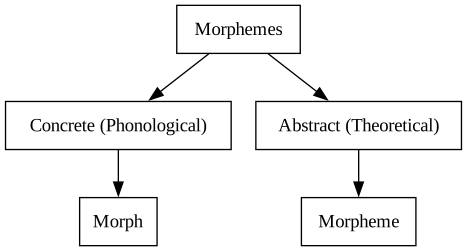
The concrete form of the morpheme is indicated by the new term morph while the known form morpheme is used to refer to the morpheme in its abstract form. Kosch (2006: 20) states that “a morph is to be understood as a concrete, physical unit which occurs in words and which may be pronounced. A morpheme is to be interpreted as an abstract unit which is never pronounced”
.
Thus the basic form -rut- as well as the phonologically altered form -thut- are both morphs as they carry the same basic meaning. Two or more forms of the same morpheme are referred to as allomorphs: -rut- and -thut- are thus allomorphs which are different/alternate realisations of the same morpheme. Allomorphs are thus any of two or more actual representations of a morpheme. Kosch (2006: 22) defines an allomorph as: “When a morpheme is realised by a series of different morphs, the alternative realisations are called allomorphs”
.
Morphemes as abstract grammatical concepts
The term morpheme may also be understood as a unit disconnected from the concrete form it is associated with. When the term morpheme is used to refer to the abstract form it is used as a kind of overarching term for roots and affixes, it is thus not specified regarding a phonological form. Kosch (2006: 22) refers to it as the “default realisation, that is, the representative form from which it is easiest to derive all the other forms”
.
| (Default) Morpheme | Allomorphs |
|---|---|
| -bon- ‘to see’ |
|
| mo- class prefix noun class 1 singular |
|
The meaning that morphemes contribute to words
Dimmendaal (2000: 170) indicates that in morphology “a distinction is usually drawn between compounding, inflection and derivation. Inflectional and derivational markers involve bound, functional morphemes with a partly differential grammatical status”
. Morphemes contribute a meaning to words. This meaning can either add to the content of the word lexically or in performing a grammatical function. Roots and stems are referred to as lexical morphemes as they contribute the central or core meaning of a word. Consider the Setswana root -rek- ‘buy’ in the following:
| Moithuti o reka dibuka. |
| The student buys books. |
| Moithuti o rekisa dibuka. |
| The student sells (let buy - causative) books. |
| Thekiso ya dibuka |
| The selling/sale of books. |
| Mosadi ke morekisi |
| The woman is a seller/vender (one who sells). |
Affix morphemes can be divided into two major functional categories, namely derivational morphemes and inflectional morphemes. This reflects a recognition of two principal word building processes i.e., inflection and derivation (Katamba, 1993: 47). In the examples above affixes also contribute to the lexical value of the word. In (ii) a suffix contributes to the original meaning of the verb, in (iii) and (iv) a prefix and a suffix change the verb to a noun. Morphemes which change the semantic/lexical value of words are referred to as derivational morphemes as they create a morphological process termed derivation.
Morphemes which do not contribute to the meaning of the word in this manner contribute a grammatical feature/value, they are thus meaningful on a functional level:
| Moithuti o reka dibuka. |
| The student buys books. |
| Moithuti o tla reka dibuka. |
| The student will buy books. |
| Baithuti ba rekile dibuka. |
| The students bought books. |
| Dibuka di rekiwa ke moithuti. |
| The books are being bought by the student. |
Even though the verb ‘buy’ appears in different forms in examples (8) to (11) it retains its semantic value. Its lexical value thus remains the same. The plural form of the subject agreement morpheme ba in (10) does not alter the meaning of the verb and neither does the fact that the future tense morpheme tla in (9), the past tense morpheme -il- in (10) and in the passive morpheme -iw- in (11) alter the characteristic meaning of the verb. These morphemes are affixes and they are referred to as inflectional morphemes or functional morphemes or affixes. Katamba (1993: 205) indicates that “inflectional morphology is concerned with syntactically driven word formation”
. Kosch (2006: 85) states that inflectional morphology “specifies the grammatical functions of words in phrases without altering their meaning”
. Derivation and inflection “are traditionally recognised as the two most important types of morphological process”
and the difference between them “lies mainly in the fact that in derivation the lexical content of a word is affected, while in inflection it is not”
(Kosch, 2006: 86). Inflectional morphology deals with syntactically determined affixation processes while derivational morphology is used to create new lexical items (Katamba, 1993: 205). Katamba (1993: 206-210) discusses the differentiation between inflection and derivation.
Inflection
The morphological process of inflection refers to a process where an affix which contributes a grammatical category is added to a word. The form of the word is changed in a way that is permitted by the grammatical rules of the language.
Characteristics of inflection
The affixes that are responsible for inflectional processes have the following characteristics (Kosch, 2006: 87):
- While they create a variety of forms of the lexical item they do not create a new lexical item; o-tla-reka, ba-rekile and di-rekiwa are all inflected forms of reka ‘buy’ - not new lexical items.
- The grammatical meaning that they add to the verb is mostly constant and defined and adds a predictable meaning to the word. The suffix -el (or one of its phonological variants/allomorphs) will add an applicative value to Setswana words. Ke-reka dijo ‘I buy food’ – Ke-rekela bana dijo ‘I buy food for the children’. The applicative can also add the value that the verb is executed in a certain direction.
- The meaning or function that they add to the word is general and widely applicable which allows them to combine with a large number of items. They are thus morphologically productive. Most Setswana verbs can be inflected with the suffix -il (or its allomorphs) which indicates past tense.
- The set of affixes that constitute an inflectional category are usually fixed. Aspectual, tense and class gender morphemes in Setswana are mostly a closed group.
- Proximity to the root can be used as a criterion to distinguish between inflectional and derivational morphemes. In cases where both inflectional and derivational affixes co-occur, the derivational affixes generally (but not necessarily) occur closer to the root than the inflectional ones as demonstrated in examples (12) and (13).
- Inflectional affixes help to create correct grammatical relationships between the forms to which they are attached and other parts of the sentence, they are thus typically involved in the syntax of the language. The system of class gender agreement in the Bantu languages in general and in Setswana in particular establishes these grammatically correct relations for example: Bana ba bagolo botlhe ba tla boela kwa sekolong sa bone ‘all the big children will return to their schools’.
- Inflectional affixes only appear in the grammatical context permitted for them. The agreement morphemes in the example above are obligatory and they cannot be substituted by other agreement morphemes.
- Inflectional affixes are not word category changing, they cannot change the word category / class membership of a word. See examples (14) and (15).
| -kwalotse |
| had rewritten |
| root (-kwal-) + derivational morpheme -olol- (reversive transitive) + inflectional morpheme -il (past tense) |
| -bofologilê |
| became loose |
| root (-bof-) + derivational morpheme -olog- (reversive intransitive) + inflectional morpheme -il- (past tense) |
| -reka > -rekile > rekiwa |
| buy > bought > being bought |
| setlhako > ditlhako |
| shoe > shoes |
Characteristics of derivation
A list of generically valid characteristics for derivational morphology is presented by Kosch (2006: 111-112). The list is adopted for Setswana and illustrated with applicable examples:
- During the process of derivation new lexical items are created from existing words through the use of derivational morphemes.
- The meaning of derived word is not always deducible from the original word and the derivational affix responsible for the derived word. The derivational affix does not always have a predictable meaning that it adds to the derived word.
- The meaning or function that they add to the word is not general and widely applicable which does not allow them to combine with a large number of items. They are thus not as morphologically productive as inflectional affixes.
- An unlimited number of derived words may be created through derivation. The word categories to which the words are added are in principle the “open” word categories which are verbs and nouns. Derivational affixes are still limited in number (a closed set) as are inflectional affixes.
- In terms of the criterion of proximity to the root, derivational affixes tend to appear closer to the root than inflectional affixes.
- Derivation is linked to the lexicon which is why it is sometimes referred to as lexical morphology. Inflection is linked to grammar or the contribution of a grammatical category. Derivational affixes do not have to occur in a word – they are optional. The preferences of the speaker determine their inclusion; it is a lexical consideration. The use of the causative suffix -is- is semantically just as acceptable as not using it, thus Ke rekisa diaparo ‘I sell clothes’ is just as acceptable as Ke reka diaparo ‘I buy clothes’ where the derivational suffix is not part of the word. Derivational affixes are also optional in the sense that they can be replaced by other derivational affixes. This is not the case with inflectional affixes. Inflectional affixes have to change in agreement with the lexical item in order to establish grammatically well-formed phrases and sentences. In the examples below it is showed that the derivational affixes in the noun that acts as subject may change when a new lexical item is formed. Mokwadi ‘a writer’ and lekwalo ‘a letter/a written text’ are both deverbative nouns that are derived from the verb go kwala ‘to write’. Mokwadi is a class 1 noun while lekwalo is a class 5 noun. However, when the subject noun changes the subject agreement morpheme which is an inflectional morpheme must also change to render the correct grammatical form of the verb. See examples (16), (17) and (18).
- Derivational affixes are able to change the class membership of items; however, they are also able to create derivations within the same word class.
| Molwetse o gorogile maabane. |
| The sick person arrived yesterday. |
| *Bolwetse o gorogile maabane. |
| The disease arrived yesterday |
| Bolwetse bo gorogile maabane. |
| The disease arrived yesterday. |
What is a word?
The term word is used in a variety of senses which are usually not clearly defined (Katamba, 1993: 17). Trask (1996: 389) sees it as “a label applied in linguistics to any of several rather different conceptions of a unit which is typically larger than a morpheme but smaller than a phrase and which shows a high degree of internal coherence”
. Crystal (2003: 500-501) agrees with Trask and points out that there is a problem with the boundaries of words and that the answer is not evident from the orthography. We could take the word to be the smallest independently functional linguistic unit.
To determine what autonomous words are and what constitutes parts of words, we can employ word tests which rely on the features of words (Lombard et al., 1985). In this regard the identification and classification of words in the Sotho languages is described by Van Wyk (1958). His work contributes to understanding the boundaries of linguistic words in written text (orthography). He proposes and applies four tests to identify words, i.e., isolatability, separability, transposability and replaceability. He also proposes a comprehensive classification system consisting of both principles and procedures based on the four disciplines in linguistics i.e., morphological, syntactical, phonological, and semantic criteria (Van Wyk, 1966: 51-52; Krüger, 2006: 13-16; Lombard et al., 1985: 11-15; Louwrens, 1991: 6-9).
Sotho languages include Setswana, Sepedi (also sometimes referred to as Northern Sotho) and Sesotho (also sometimes referred to as Southern Sotho).
Most of Setswana words are morphologically complex which makes it important to identify and classify the various morphemes (morphological items) that constitute them. Understanding the level and hierarchy of morphemes in Setswana words could aid the understanding of the concept word. The following figure of the naming (taxonomy) of the morphemes of a word in Setswana is presented by Brits (2006: 29):
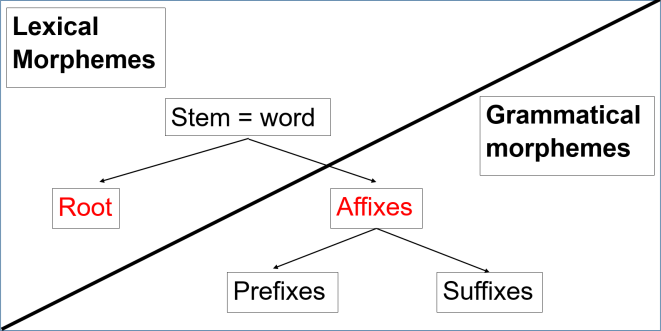
Morphemes are classified according to their meaning as lexical morphemes (roots and stems) and grammatical morphemes (derivational and inflectional morphemes). Lexical morphemes have a direct correlation with words in the lexicon. Lexical items (words) are the elements that constitute the lexicon of a given language (Katamba, 2005). The classification shows that semantically and morphologically only a stem can function as an independent word. The root is the semantic nucleus of the word and it does not have a word correlate. In contrast to that, the stem has a word correlate and is part of a more complex word and includes one or more grammatical morphemes. Note that in a sense the term bound morpheme refers to roots and grammatical morphemes while the term free morphemes refers to stems as they can function as words. Consider the following figure:
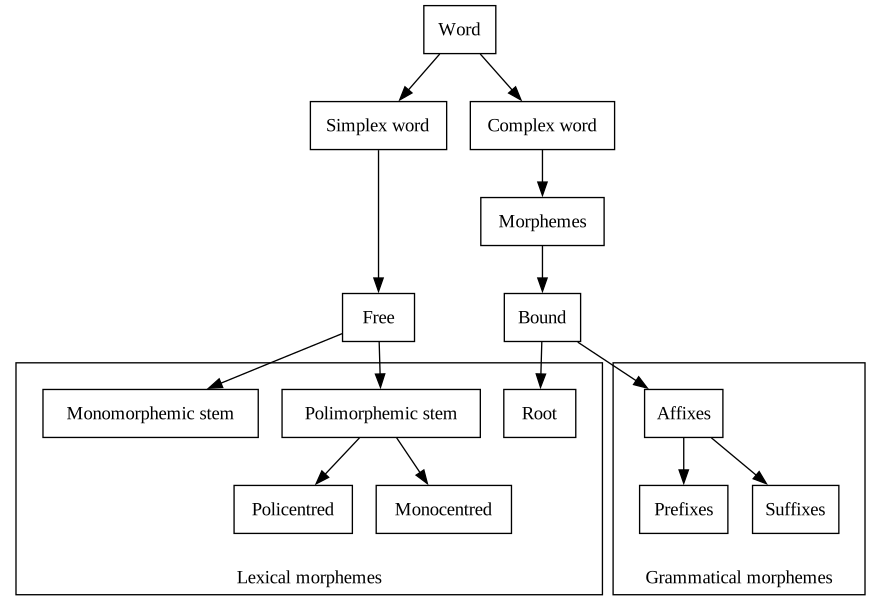
The stem dikatsana ‘kittens’ in example (19) can operate as a semantically independent word while it still has valency to take grammatical morphemes.
| dikatsana |
| di- katse-ana |
| NPre10- cat- DimSuf |
| kittens (small/little cats) |
Dikatsana ‘kittens’ is a complex word as it consists of three morphemes. In terms of morphemes it is poli-morphemic but the stem is mono-centred. It has a word correlate in the lexicon that consists of the root -katse ‘cat’ (see example 20) and two grammatical morphemes, the class prefix di- that indicates class and number as well as the dimunitive suffix -ana.
| katse |
| (ne)- katse |
| NPre10-cat |
| cat |
Katse ‘cat’ is a mono-morphemic (mono-centred) stem as it can operate as an independent word (it has a word correlate in the lexicon) while it remains the stem of dikatsana ‘kittens’.
Stems may also include two root morphemes in which case they will be compound (poli-centred) stems for example modulasetulo ‘chairperson’ (see example 21).
| modulasetulo |
| mo- dul- a se- tulo |
| NPre1- sit- Dev.end NPre5-chair |
| chairperson (one that sits on the chair) |
Terminology for words in different contexts
Lexical items (word forms) are the elements that constitute the lexicon of a given language. The term is used in semantics to refer to complete words in general but not to affixes as they only have grammatical meaning and not lexical meaning. Lexeme is a term that is used as a synonym for lexical item. The term is also referred to in a dictionary context as “the ‘common, abstract element which underlies the variant forms of a word – go, goes, going, gone, went would all be forms of the same underlying lexeme, GO for example”
(Kosch, 2006: 86). Following Katamba (1993: 17) we shall refer to the ‘word’ in this sense of abstract vocabulary item using the term lexeme.
The term lexicon can in its’ broadest sense be regarded as having the same meaning as dictionary, i.e., the sum total of lexical items commonly referred to as words which constitute the vocabulary of a language (Louwrens, 1994: 95).
The term lemma is used in lexicographic terms where it refers to a base form. It is a term “used in morphology as an alternative to root or stem: it refers to any part of a word seen as a unit to which an operation can be applied, as when one adds an affix to a root or stem”
(Crystal, 2003: 48). In Setswana it would be a word and therefore a stem, but then the simplest stem, thus a stem that does not include any additional grammatical morphemes. The word category to which a word belongs must be considered when its’ lemma is determined. Brits (2006) discusses the lemma of Setswana words in her study on lemmatisation.
Arrangement of morphemes in complex words
Linear arrangement
The linear arrangement of morphemes refers to the sequence in which morphemes follow one another in a complex morphological structure. It thus indicates the way in which the morphemes follow each other in a grammatically correct manner for the language and the relevant morphological context in which they occur. Consider the following example:
| Ke go tlisetsa kofi |
| ke- go- tl- is- el- a (ne-)-kofi |
| AgrSubjP1sg- AgrObjP2sg- come-CausSuf-ApplSuf-VEnd NPre9-coffee |
| I am bringing you coffee |
The linear arrangement is in this example is clear. The subject agreement morpheme ke- is followed by the object agreement morpheme go- and this morpheme is always closest to the root. Note that subject and object agreement morphemes are translated as pronouns. Setswana is a pro-drop language.
The negative morpheme ga- appears before the subject agreement morpheme, for example:
| Ga ke go tlisetse kofi |
| ga- ke- go- tl- is- el- e (ne-)-kofi |
| NegPre-AgrSubjP1sg-AgrObjP2sg-come-CausSuf-ApplSuf-VEnd NPre9-coffee |
| I am not bringing you coffee |
The determining factor in the sequence of morphemes in Setswana verbs for instance would be the structures that are grammatically allowed. The order of verbal morphemes is fixed. As is shown for the prefixes in the following examples, verbal suffixes also have a fixed position. The productive verbal suffixes typically follow the well-known CARP template
| Ke go tlisetsa kofi |
| ke- go- tl- is- el- a (ne-)-kofi |
| AgrSubjP1sg-AgrObjP2sg-come-CausSuf-ApplSuf-VEnd NPre9-coffee |
| I am bringing you coffee |
| Re go tlisetsa kofi |
| re- go- tl- is- el- a (ne-)-kofi |
| AgrSubjP1plg-AgrObjP2sg-come-CausSuf-ApplSuf-VEnd NPre9-coffee |
| We are bringing you coffee |
| Ke mo tlisetsa kofi |
| ke- mo- tl- is- el- a (ne-)-kofi |
| AgrSubjP1sg-AgrObj1-come-CausSuf-ApplSuf-VEnd NPre9-coffee |
| I am bringing him/her coffee |
| Re ba tlisetsa kofi |
| re- ba- tl- is- el- a (ne-)-kofi |
| AgrSubjP1pl-AgrObj2-come-CausSuf-ApplSuf-VEnd NPre9-coffee |
| We are bringing them coffee |
Phonological changes on morpheme boundaries is prevalent and is described in what is referred to as the morphophonology. The hierarchy ascribed to verbal and nominal morphemes can be seen in the tables below.
A > Linear arrangement, B > Hierarchical arrangement
| Prefixes | Root | Semi-productive suffixes | Productive suffixes | Ending | ||||||||||||||
|---|---|---|---|---|---|---|---|---|---|---|---|---|---|---|---|---|---|---|
| A | Neg. m | Subj.Conc. | Neg. m | Asp. m | Temp. m | Obj.Conc. | Root | Rev.Intr. | Rev.Tr. | Denom | Neuter | Iter. | Caus. | Appl. | Recipr. | Perf. | Pass. | Neg/-Mod. |
| ga- |
|
|
| -tla- |
|
|
|
|
|
| -ak- |
|
| -an- | -il- |
|
| |
| B | 1 | 6 | 1 | 2 | 3 | 4 | 15 | 14 | 13 | 12 | 11 | 10 | 9 | 8 | 5 | 7 |
| |
| Essential structure: lemma | |||
|---|---|---|---|
| Class prefix + root | Augmentative/Feminitive | Diminutive | Locative |
| 1 | 2 | 3 | 4 |
| Essential structure | ||||
|---|---|---|---|---|
| Class prefix | + Root | Deverbative ending | Diminutive | Locative |
| 1 | 1 | 2 | 3 | |
| Replaced by infinitive prefix | Replace verbal ending -a |
Hierarchical arrangement
When the arrangement of morphemes is considered from a hierarchical perspective the semantic independence of intermediate stems is paramount. The combination of grammatical morphemes, roots and stems in order to form larger or more complex meaningful forms. The process is controlled by the morpho-syntactic rules of the language and implies that the underlying structure must be a word correlate (operand), thus a meaningful component to which a grammatical morpheme can be added (Krüger, 2006: 36). The English words unfriendly and ungrateful will not be analysed as unfriend + -ly, and ungrate + -full as these are not meaningful parts, but rather as un- + friendly and un- + grateful. Krüger then applies the same principle to Setswana. (As demonstrated by die complex verbs in the examples below.) The hierarchy of nominal and verbal morphemes is described by Krüger (2006: 98, 256) while the sequence of verbal morphemes is described by Pretorius (2014).
| Ga ke dire kofi |
| ga- ke- dir- e (ne-)-kofi |
| NegPre- AgrSubjP1sg-make-VEnd NPre9-coffee |
| I am not making coffee |
The underlying form of ga ke dire is ke-dira ‘I am making’ which is formed by prefixing the negative morpheme ga- and concomitantly replacing the verbal ending -a with the negative ending -e. The underlying component of ke dira is the infinitive form go dira ‘to work’ which is the basic stem or lemma and thus the smallest/minimal form with word-status. Below the word level go dira can be analysed further into the infinitive prefix go- the root -dir- and the verbal ending -a. These three morphemes have the same hierarchical level, they appear on the same level or in other words they are all concomitant and essential morphemes. They are characteristic of the morphological structure of basic verbs or the lemma.
A linear analysis is unable to express the semantic relations between morphemes. These relations are evident in a hierarchical analysis where the combination of morphemes is treated individually and the meaning of each intermediate stem is indicated. We now consider the morphological analysis of complex words based on the hierarchy of their affixes in more detail. The hierarchical analysis of Setswana verbs and nouns is described by Krüger (2006).
Morphological analysis of complex words
A morphologically complex word consists of a root or stem with one or more affixes.
Conditions
In a hierarchical analysis it is paramount that there is a meaningful relation between the underling components of morphologically complex words. The following considerations indicated by Krüger (2006: 45) must be adhered to:
Significance of underlying components
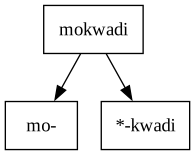
Underlying components must be meaningful and must be existing linguistic items in correlation to the English example of unfriendly and ungrateful. The Setswana noun mokwadi ‘writer’ cannot be analysed as mo- and -kwadi as the units unfriend/ungrate and -kwadi do not have a meaning and are non-existent. They can thus not function as underlying forms/operands.
Reflection of word formation processes involved
There must be a reflection of the various word formation processes which apply only to underlying meaningful components acting as operands. The underlying meaningful component of a negative verb would be the positive. Thus the underlying meaningful component in Ga ke go utlwe ‘I do not hear you’ is Ke a go utlwa ‘I hear you’. The negative morpheme ga- and the verbal ending -e which indicates the negative and substitutes the positive verbal ending -a are concomitant morphemes and have to be removed simultaneously.
Identification of the stem
In the third place at least one of the analysed components of the immediate underlying structure must be a stem or word correlate in a hierarchical analysis. This is in line with the view of word-based morphology where word-formation processes are applied to existing words as bases, not roots or non-existent segments. Thus in Ga ke go utlwe ‘I do not hear you’ the immediate underlying word correlate is ke a go utlwa ‘I hear you’ which is an existing stem. In the deverbative noun mokwadi the underlying component is the verb go-kwala ‘to write’.
Identification of morpheme boundaries
Binary division
A complex structure is usually built up or constructed of a two (a pair of) morphemes based on their hierarchy. These may be referred to as twosomes and therefore be named a two-way composition. Within the twofold unit one component is a stem and the other is a grammatical morpheme. The stem should be identified first as it is the base or the operand which has a lexical correlate. “The process is to be applied to every underlying component until the original structure is reduced to its ultimate components, i.e., up to either the base or the root”
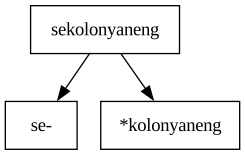
(Krüger, 2006: 49). The analysis of the complex noun sekolonyanêng in, from, to the little school is as follows:
| sekolonyanêng |
| se- kolo- nyana- ing |
| NPre7-school-DimSuf-LocSuf |
| in, from, to the little school |
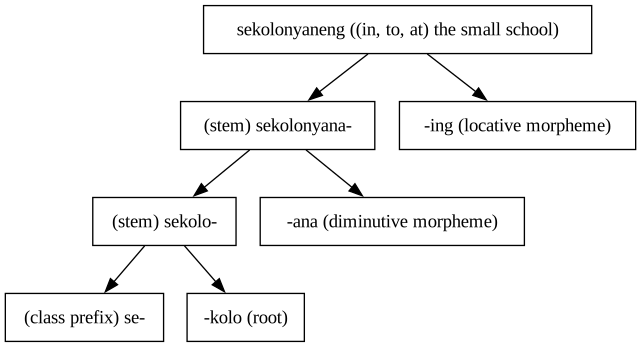
Dividing the word in the units indicated below is unacceptable as these units are meaningless:
Three-way division
Krüger (2006: 50) identifies structures where concomitant grammatical morphemes occur in a word i.e., morpheme which have a similar hierarchical ranking. Concomitant morphemes have to be analysed together resulting in a three-way division of meaningful components. Concomitant morphemes occur in a number of environments. Negative verbs are a case in point as a negative morpheme is always concomitant with a negative verbal ending. In the minimal morphological structure of verbs (lemma) the infinitive prefix and the verbal ending are also concomitant. The analysis of Ga ke dire ‘I am not making’ in Ga ke dire kofi ‘I am not making kofi’ is as follows:
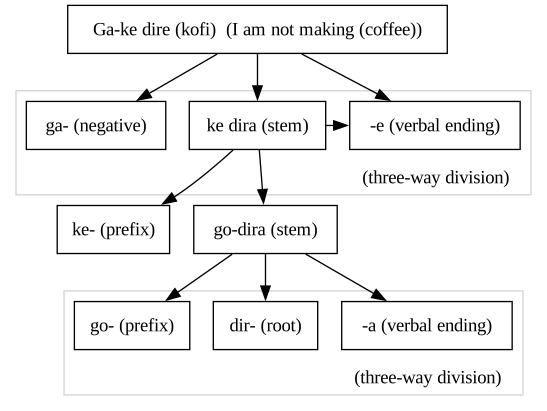
In this example the negative prefix ga- is concomitant with the negative verbal ending -e in step one where the negative morpheme and the verbal ending are of equal ranking. In step three the infinitive prefix go- is concomitant with the verbal ending -a as the verb in its’ simplest form (lemma) essentially takes an infinitive prefix and a verbal ending.
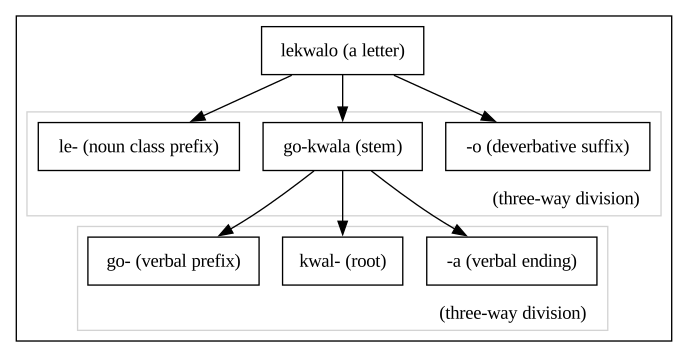
In deverbative nouns the class prefix and a deverbative suffix are concomitant, for example:
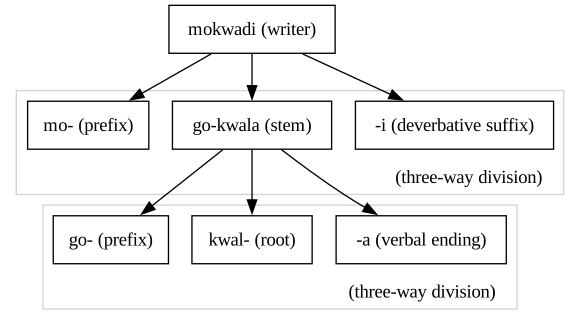
A three-way division can be defended on the grounds of the essential morphological structure of words, semantic co-occurrence of morphemes and the relevant word formation processes (Krüger, 2006: 51). A binary division of the following example would render the component *-kwadi which is structurally, semantically and lexically non-existent and is incorrect.
Hierarchical preference
There are however some cases where the identification of an appropriate underlying constituents is problematic. Morphemes with a possible equal ranking such as verbal structures which include progressive and potential morphemes are a case in point. The progressive and potential morpheme have been proven to be “non-essential grammatical morphemes”
and they are thus “more peripheral”
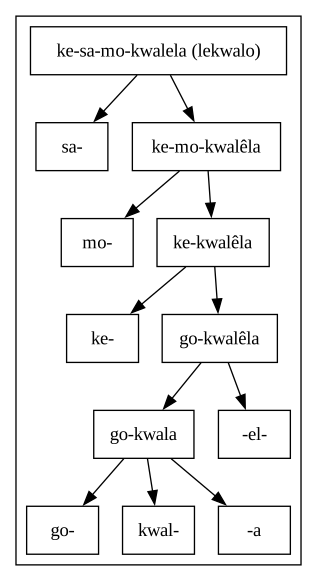
and display a weaker semantic connection with the root (Krüger, 2006: 51). The object agreement morpheme -mo- may be regarded as having a stronger semantic connectivity to the stem than the progressive morpheme -sa-. The grammatical meaning of the applicative suffix -êl- necessitates the subcategorisation for two objects. Kwala is transitive but it becomes double transistive with the applicative. *ke-sa-mo-kwala is unsound. The close proximity of the object agreement to the root is an indication of its’ semantic strength. Reduplicated and compounded stems are also sometimes a problem.
| ke-sa-mo-kwalela (lekwalo) |
| ke- sa- mo- kwal- el- a |
| AgrSubjP1sg- ProgPre- AgrObjP2sg- write-ApplSuf-VEnd |
| I am still writing him (a letter). |
Hierarchical levels
Hierarchical levels in the structure of words range from the level of morphological complexity of a given stem down to the root level. It is often necessary to highlight or to identify a certain hierarchical level for discussion purposes. It is therefore convenient to distinguish between different levels in the hierarchical structure of words, ranging from the given word level down to the root level. These levels are identifiable in the examples above and are listed by Krüger (2006: 53) as:
- An initial structure level: Could refer to any given structure (the structure of the word which is being analysed) ke sa mo kwalela ‘I am still writing to(for) him/her’ / sekolonyaneng ‘in/at the little school’,
- An intermediate level/levels (stems): ke mo kwalela and ke kwalela are the intermediate stems of ke sa mo kwalelela while go kwala is the basic stem or lemma of the verb / sekolonyana is the intermediate stem of sekolonyaneng while sekolo is the basic stem or lemma of the noun,
- A final level or base level: This is the minimum word level, the lemma which only includes the essential morphemes go kwala / sekolo, and
- The root level: -kwal- is the root of go kwala / -kolo is the root of sekolo.
Krüger (2005: 54-55) discussed the application of these principles and proposes several practical steps to be followed.
Application of principles for analysis
The application of the following steps to deal with the combinability and arrangement of parts would help to determine the underlying structures of words.
Immediate constituents: two-way or three-way division?
As a first step it is important to determine the number of immediate constituents for the word you are working with to determine whether a two-way or three-way division should be followed. When concomitant morphemes are present a three-way division is followed, when concomitant morphemes do not appear in the word a two-way division is followed.
Immediate underlying stem
Once it is determined whether there are concomitant morphemes in the word, the immediate underlying stem of the complex should be determined, i.e., that part which has a word form in the lexicon, a word correlate. In the noun setlhakonyaneng ‘in/at the small little shoe’ the stem is setlhakonyana ‘small shoe’ while in the verb ga-ke-kwale (lekwalo) ‘I am not writing (a letter)’ the stem is ke kwala (lekwalo) ‘I am writing (a letter)’.
Replacement (Substitution)
Where morphemes have been substituted in the forming of the word, they must be replaced by the original morphemes when the word is morphologically analysed. For example, in deverbative nouns such as lekwalo below, the class prefix is replaced by the verbal prefix, the root is retained as it carries the core meaning of the word and the deverbative suffix is replaced by the verbal ending. Substitution is discussed in more detail by Krüger (2006: 104-108).
Morphemes of presumably equal rank
Where the ranking of morphemes is presumed to be the same the criterion of proximity to the root is applied in determining which one has a stronger semantic connection with the root. Morphemes with stronger semantic connection to the root have a higher hierarchical ranking and are removed later in analysis (Krüger, 2006: 54).
The class prefix di- has a higher ranking than the locative suffix -ing, in the noun dibukeng ‘in/on/at the books’ which results in removing the locative suffix first to render the stem dibuka ‘books’.
References
Brits, J. H. (2006) Outomatiese Setswana Lemma-identifisering. Master’s dissertation. North-West University, South Africa.
Dimmendaal, G. J. (2000) ‘Morphology’. In Heine, B. & Nurse, D. (eds.). African Languages: An introduction. Cambridge: Cambridge University Press. pp.161-193.
Crystal, D. (2003) A dictionary of linguistics and phonetics. 5th edn. Oxford: Blackwell.
Katamba, F. (1993) Morphology. London: Macmillan press.
Katamba, F. (2005) English words: structure, history, usage. 2nd edn. New York: Routledge.
Kosch, I. M. (2006) Topics in morphology in the African language context. Pretoria: University of South Africa.
Krüger, C. J. H. (2006) Introduction to the morphology of Setswana. München: Lincom.
Lombard, D., Van Wyk, E. B. & Mokgokong, P. C. (1985) Introduction to the grammar of Northern Sotho. Pretoria: Van Schaik.
Louwrens, L. J. (1991) Aspects of Northern Sotho grammar. Pretoria: Via Afrika.
Louwrens. L. J. (1994) Dictionary of Northern Sotho grammatical terms. Pretoria: Via Afrika.
Pretorius, R. S. (2014) ‘The sequence and productivity of Setswana verbal suffixes’. Stellenbosch Papers in Linguistics Plus. 44: 1–23.
Trask, R. L. (1996) A dictionary of phonetics and phonology. London: Routledge.
Van Wyk, E. B. (1958) Woordverdeling in Noord-Sotho en Zoeloe. Doctoral thesis. University Pretoria, Pretoria.
Van Wyk, E. B. (1966) ‘The word classes of Northern Sotho’. Lingua. 17(2): 230–261.