Locative phrases
Locatives or locative phrases in isiXhosa are referred to as locative adverbs or locative adverbial phrases, because they are classified under the adverbial phrases (Taljaard & Bosch, 1988). This topic will focus on the construction of the ‘LOCNP’, and ‘LOCCLNP’ and how this constituent structure functions in larger constructions.
- Locative nouns and locative noun phrase
- Characterisation
- The internal structure of the locative noun phrase LOCNP
- Projection of locative noun phrases
- Syntactic uses of locative noun phrases
- Locative class nouns and locative class noun phrases (LOCCLNP)
- The internal structure of the locative class noun phrase (LOCCLNP)
- Syntactic and semantic functions of the locative class noun phrase (LOCCLNP)
- Projection of locative class noun phrases
- Syntactic uses of locative class noun phrases
- Conclusion
- References
Locative nouns and locative noun phrase
Two aspects of syntax are to be identified, i.e., the internal and external syntax (Aarts et al., 2014). Internal syntax deals with how a given phrase, itself is constructed in a well-formed manner whereas external syntax is concerned with how a phrase can be used in a larger construction (Jones et al., 1991). Likewise, the locative Noun Phrase (LOCNP) and LOCCLNP are examined according to these two aspects.
The topic will centre around the construction of the LOCNP, subsequently focusing on how this constituent structure functions in larger constructions. However, the discussion will commence by outlining the characterisation of isiXhosa locative noun and the locative noun phrase.
Characterisation
The locative noun in isiXhosa refers to the form taken by a word usually a noun or a pronoun, when it articulates the idea of location of an action (Crystal, 1980: 214). Even structures that express locational meaning may also be referred to as locatives (Crystal, 1980: 214). The latter that Crystal (1980) is referring to above are:
- The few nouns that are considered to be traditional locatives sometimes referred to as nouns of class 16 and 17, e.g., phambili ‘forward’ and ukunene ‘right hand side’, etc.
- A few demonstrative locatives that emanate from the above class nouns with the prefix pha-, like: apha ‘here’, apho ‘there’ and phaya ‘yonder’. These are also followed in word order by a locative, for example, apho kuwe ‘there by you’.
- Nouns that are inherently locative in character, e.g., ubuhlanti ‘kraal’, umlambo ‘river’ etc.
- And also those nouns that are semantically locative which denote time, e.g., izolo ‘yesterday’, ngomso ‘tomorrow’, etc.
- Abalimi bafike izolo. Farmers arrived yesterday.
- Ndiza kuhamba ngomso. I will go tomorrow.
Generally, locatives in isiXhosa are derived from other parts of speech, particularly, nouns and pronouns as alluded to above. These are nouns from class 1 to class 14 which are affixed with the prefix e- and the suffix –ni.
Nouns that are locative in nature only take the prefix e-, ebuhlanti ‘in the kraal’, and modifiers of this group agree with the locative noun phrase by means of a concord that takes its cue from the base noun of the locative.
Nouns that are known to be semantically locative in nature do not even need a locative formative.
The traditional locatives, that is, class 16 and 17 nouns like phezu ‘on top’ are always followed by modifiers that use the locative formatives ku-, and kwa- from noun class 17, for example, Phezu kwetafile kwa + itafile = e ‘on top of the table’. These ‘LOCNPs’ are always followed by the modifier, that is, modifiers never precede them.
Nouns of class 15, normally referred to as infinitives are rarely used as locatives in isiXhosa.
- Ukuhamba kukubona. ‘Going is seeing.’
- Ukuthetha kubalulekile. ‘Talking is important.’
Details on the morphological aspect of locatives have received attention in the section on morphology.
The internal structure of the locative noun phrase LOCNP
A locative noun phrase comprises of a locative noun. The locative noun may either be on its own or consist of syntactic dependents. These dependents may either be on the left of the locative noun, or consist of a noun phrase with a locative postposition. A grammatical locative noun phrase has a noun that functions as the head of the expression.
- Uya kuthenga isonka evenkileni. ‘He/she has gone to buy bread from the shop.’
- Izinja zizingela izilwanyana ehlathini. ‘Dogs are hunting animals in the forest.’
The head of a phrase is the central element in a phrase that determines the syntactic function of the whole phrase. More often than not, in an isiXhosa sentence, the noun phrase (NP) functions as the head of a sentence. In isiXhosa, locative phrases occur in a variety of contexts: as verbal modifiers, as predicates in clauses of adverbial type, as prenominal modifiers, or virtually in all NP positions (Paperno, 2014).
Locative noun phrase (LOCNP) modifiers
As alluded to above, a locative noun phrase may have constituent dependents. Below is a presentation of these various locative noun modifiers:
- The possessive particle phrase modifier
The LOCNP functioning as the head of the sentence is modified with a possessive particle phrase (POSSPARTP). The relationship between the LOCNP and the POSSPARTP is maintained by means of the concordial agreement between it and the base noun of the locative.
Example 1Emzini kabawo emzini ka + bawo At home of father > At my father's home. The constituent structure of the above sentence can be represented by the following tree diagram:
Figure 1 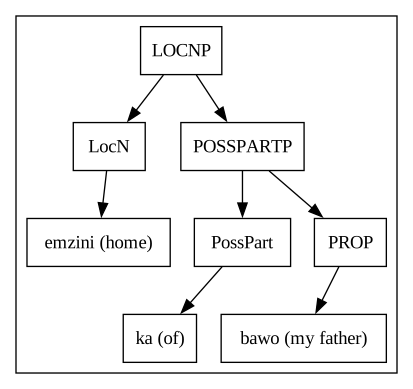 [click image to enlarge]
 - The qualificative particle phrase as a LOCNP modifier
The LOCNP phrase functioning as the head of the sentence is modified with a qualificative possessive particle phrase (QUALPARTP) that exhibits agreement features with the locative base noun functioning as the head of the LOCNP. (The syntactic structure of the QUALPARTP to be discussed later).
Example 2Emzini omdaka Emzini a + umdaka a + u = omdaka At a homestead that is dirty > A dirty homestead. The constituent structure of the above LOCNP can be represented by the following tree diagram.
Figure 2 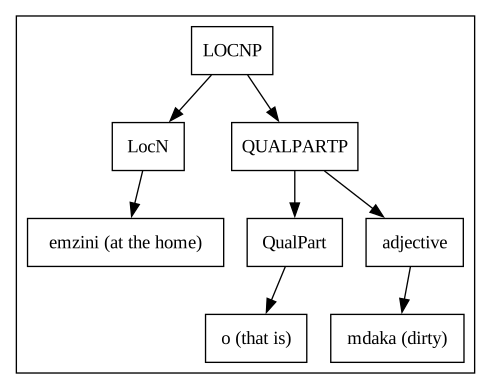 [click image to enlarge]
 - The inclusive quantitative pronoun as a LOCNP modifier
The LOCNP that functions as the head of the sentence may be modified with an inclusive quantitative pronoun - IncQPro. However, in isiXhosa the LOCNP that is being modified has to be derived from a pronoun. The modifier has to subsequently agree with the base pronoun of the LOCNP by means of a concord to make an acceptable syntactic structure.
Example 3Kuyo yonke ku + yona yonke in it all Below is a tree diagram that represents the above LOCNP constituent structure:
Figure 3 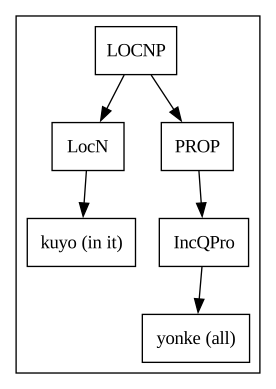 [click image to enlarge]
 - The selective quantitative pronoun as a LOCNP modifier
The LOCNP that functions as the head of the sentence may be modified with a selective quantitative SelQPro. However, in isiXhosa the LOCNP that is being modified has to be derived from a pronoun. The modifier has to subsequently agree with base pronoun of the LOCNP by a concord to make an acceptable syntactic structure.
Example 4Yena yedwa She/him only The constituent structure of the above LOCNP can be represented by the following tree diagram:
Figure 4 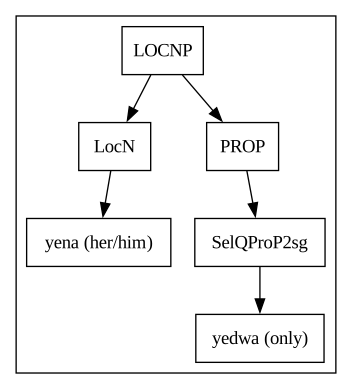 [click image to enlarge]
The separative quantitative pronoun as a LOCNP modifier
The LOCNP that functions as the head of the sentence may be modified with a separative quantitative pronoun SepQPro. However, in isiXhosa the LOCNP that is being modified has to be derived from the inclusive quantitative pronoun and use the locative formative ku- of class 17. The modifier has to subsequently agree with the base pronoun of the LOCNP by means of a concord to render it acceptable as a syntactic structure.
Example 5Kwezinye izikolo. In other schools. The constituent structure of the above LOCNP can be represented by the following tree diagram:
Figure 5 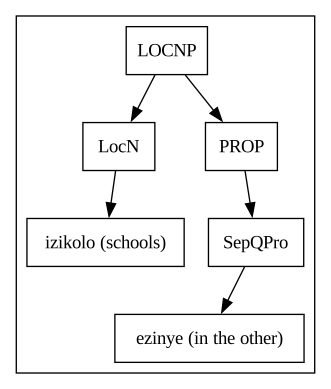 [click image to enlarge]
While other African languages like Setswana may have a number of locative modifiers, isiXhosa possesses only the above five. For example, isiXhosa does not have the following modifiers: Interrogative quantitative modifier, exclusive quantitative pronoun and an adverb modifier.
Regarding locative agreement and the concord in isiXhosa, the relationship between the locative constituents and the modifiers is maintained by means of concordial agreement as in the foregoing discussion.
In some cases, in isiXhosa, where the locative functions as the subject and appears before the verb, the “the locative subject triggers locative noun class agreement on the verb, realized by the subject markers of class 16-18 (Zeller, 2019: 12). For example, Kumlambo othile kuwelwa ngesikhitshane. ‘They cross a certain river by means of a boat.’ In isiXhosa there seems to be no locative object agreement.
- Syntactic and semantic functions of the locative noun phrase (LOCNP)
The term syntax refers to the grammatical structure whereas the term semantics refers to the meaning of the vocabulary symbols, arranged with that structure. The structure of a sentence comprises more than what its constituents are. It includes being able to specify the category and the function of those constituents.
This topic is mainly about syntactic and semantic functions of LOCNP and about how they relate to categories and constituents. The aim is to show how an understanding of syntactic and semantic functions of LOCNP help in identifying constituents in a systematic sentence analysis.
In isiXhosa the LOCNP can act as internal and external arguments of the verb (Zeller, 2019).
Example 6Umama uthume umpheki evenkileni. Mother sent the chef to the shop. The LOCNP evenkileni is the internal argument of the verb uthume. The LOCNP shows the way in which sentences are grammatically constructed, in this case as the goal-thetha role of the verb.
The above sentence can also be encoded into a tree diagram.
Figure 6 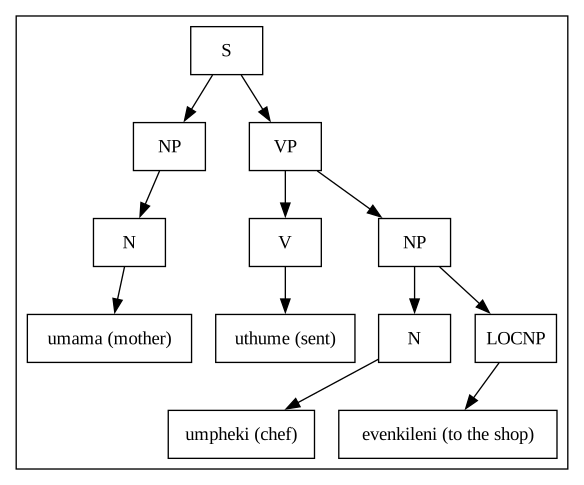 [click image to enlarge]Example 7
EGwadana kuya ndoyikisa. (In) Gwadana scares me. The LOCNP eGwadana functions as the thematic subject argument of the causative ndoyikisa.
Example 8Ndinike uZola incwadi apho. I gave Zola a book there. The LOCNP demonstrative apho functions as the internal theme argument of the verb ndinike.
LOCNP can also combine with nouns or function as predicates and agree with their subjects (Zeller, 2019).
Example 9Isitya (sis)ekhabhathini. The dish is in the cupboard. The LOCNP ekhabhathini functions as the predicate and agrees with the subject isitya.
When LOCNPs are used as adjuncts, they can be freely ordered with respect to other adjuncts, such as temporal adverbs. (Zeller, 2019).
Example 10Uthethe oku izolo esikolweni. He said this yesterday at school. In the example the LOCNP esikolweni is used as an adjunct, thus izolo has been used as another adjunct.
In isiXhosa each verb has only one semantic slot for a location. More than one LOCNPs can modify a verb and they always describe one location (Paperno, 2014).
Example 11Ufike ekhaya eGcuwa. He arrived home in Butterworth. The LOCNPs ekhaya and eGcuwa describe the same location.
LOCNPs refer to a localisation only. The semantic role of the localisation is not marked in the LOCNP and has to be inferred from the verb modified by the LOCNP (Paperno, 2014). The LOCNPs combined with the verbs express the source, the goal, the manner of motion.
Example 12Udlule ngasehlathini. He passed through the forest. With the verb ‘udlule’ in the example the LOCNP refers to a location which the path of motion crosses.
Example 13Uvele ehlathini. He came from the forest. With the verb uvele the LOCNP refers to the source of motion.
Example 14Uye ehlathini. He went to the forest. With the verb uye the LOCNP defines the goal, or the final point of motion.
Example 15Ufike ehlathini. He arrived at the forest. Due to the verb ufike the LOCNP describes the location of the event.
Projection of locative noun phrases
“Projection is a term used in generative linguistics to characterize the capability of a grammar to extend the analysis of any given set of sentences so that it applies also to the potentially infinite number of sentences in the language as a whole.”
(Crystal, 1980).
IsiXhosa corresponds with this Projection Principle which states that when notating the syntactic structure of a sentence one must specify at every level what lexical category each piece of the sentence belongs to. The following example shows how the locative noun phrase is projected.
- Umfundi uya eklasini. ‘The learner goes to the classroom.’
- umfundi > noun
- uya > verb
- eklasini > locative noun
The above sentence shall be encoded into a tree diagram in order to show the structural categories of lexical items of the projected LOCNPs.
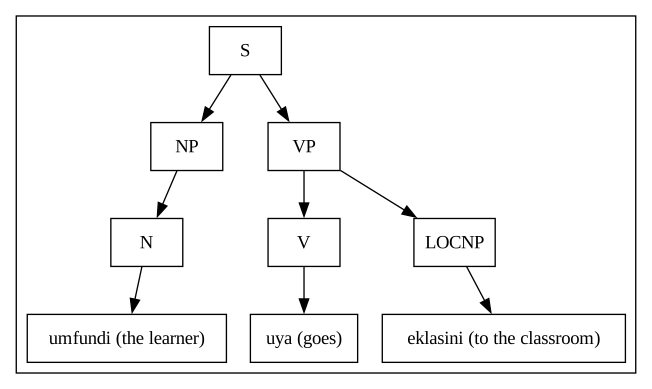
Syntactic uses of locative noun phrases
Focusing on the syntactic uses of phrases implies paying attention to the external syntax of linguistics. The Internal syntax deals with how a given phrase, itself is constructed in a well-formed manner whereas external syntax is concerned with how a phrase can be used in a larger construction. The uses of the Locative NP in a sentence are listed below.
Adjunct
An adjunct is a word or phrase which tells us something about the predicate (Van Rooyen et al., 1982). A LOCNP sometimes functions as an adjunct in a sentence. Generally, adjuncts come after the predicate and they constitute an optional element in a sentence.
- Ndithunywe evenkileni. ‘I have been sent to a shop.’
Below is a tree diagram that represents the above LOCNP in the example.
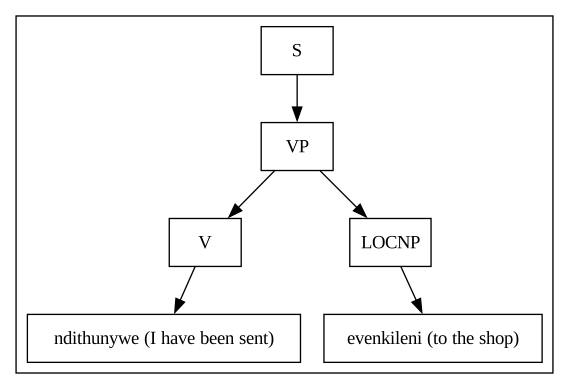
Oblique
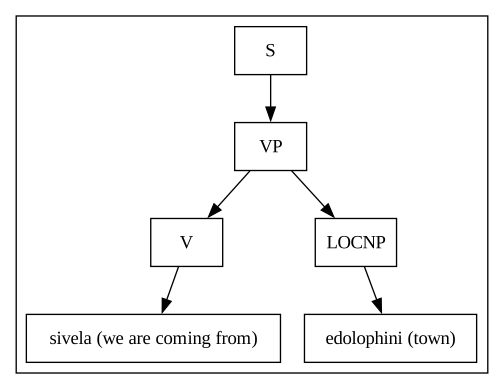
While the adjunct in linguistics is defined as an optional or structurally dispensable part of a sentence, oblique is known to be an argument that always carries semantic obligatoriness (Gawron, 2013). LOCNP sometimes function as an oblique in a sentence.
- Sivela edolophini. ‘We are coming from town.’
Below is a tree diagram representation of the constituent structure of the sentence:
Qualificative
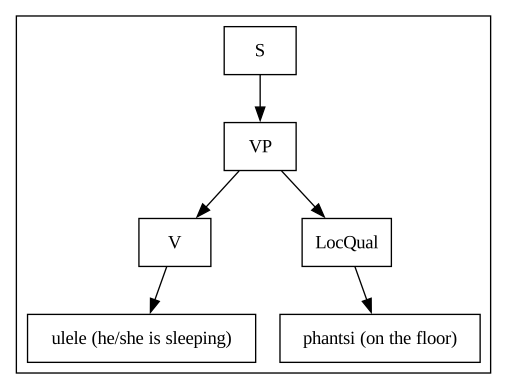
The LOCNP derived from class 16 nouns traditionally known as locatives may function as a qualificative. These LOCNP describe the action or the state of the predicate that is modified.
- Ulele phantsi. ‘He/she is sleeping on the floor.’
Below is a tree diagram representation of the constituent structure of the sentence:
Locative class nouns and locative class noun phrases (LOCCLNP)
“A locative phrase consists of either a locative noun, which may or may not have syntactic dependents on the left, or a noun phrase with a locative postposition. On top of that, locative phrases also usually have a deictic marker on the right edge. Locative phrases occur in a variety of contexts: as post-verbal, as predicates in clause of adverbial type, as prenominal modifiers, or referentially in all NP positions”
(Paperno, 2014: 55-58). This topic discusses locative nouns and locative noun phrases in isiXhosa.
Characterisation
IsiXhosa noun classes 1 to 14 are common nouns, i.e., nouns that refer to class of entities and may be used when referring to instances of a specific class. The class nouns in class 15 are infinitive nouns, i.e., they can act as nouns, adjective or adverbs. The class nouns in noun classes 16 and 17 are known as the locative class nouns and are not used in singular or plural (Krüger, 2006).
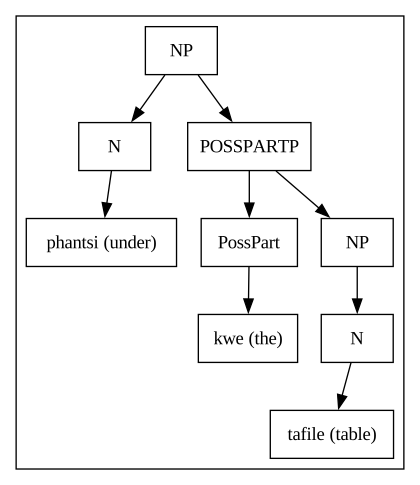
A locative class noun functions as the head in the syntactic structure of a locative class noun phrase.
- phantsi kwetafile. ‘under the table’ (class 16)
- phakathi kwibhokisi. ‘inside the box’ (class 16)
- kunene kwendlu. ‘right side of the house’ (class 17)
The internal structure of the locative class noun phrase (LOCCLNP)
The discussion is based on how the locatives are derived in isiXhosa, focusing mainly on locative formation by means of locative noun class prefixes and suffixes. It also examines the agreement properties of locatives with respect to locative internal modifiers and locative external predicates (Zeller, 2019). Therefore, locative class nouns and locative class noun groups will be examined.
LOCCLNP constructed with only a locative class noun
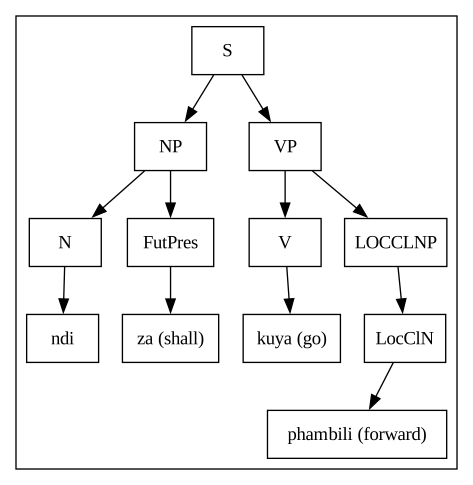
In isiXhosa when constructing any phrase, there is one obligatory element in each one i.e., the head.The head of a locative class noun is the central element in a phrase that determines the syntactic function of the whole phrase. A head word is a head word because it is essential to the meaning of the sentence or the phrase. Noun classes 16 and 17 have a head as a locative class noun. The minimal structure of a LOCCLNP constructed by a locative class noun can only consist of a head.
- Ndiza kuya phambili. ‘I shall go forward.’
The phrase structure rule for the LOCCLNP phambili (forward) is:
The locative class noun phrase constructed with a locative class noun group
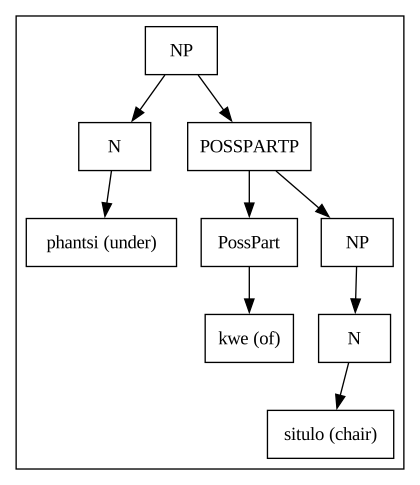
The LOCCLNP can be formed from a locative class noun group. A noun group is a group of words relating to, or building on the noun. Noun groups usually consist of a pointer plus one or adjective or adverbs and are an important language resource for building up descriptions. It is the head noun that determines what sort of thing or person the whole noun phrase refers to. This head can be followed by a possessive particle phrase which can be illustrated in the locative classes 16 and 17.
- Phantsi kwesitulo. ‘Under the chair.’
This sentence can be represented in a tree diagram:
Syntactic and semantic functions of the locative class noun phrase (LOCCLNP)
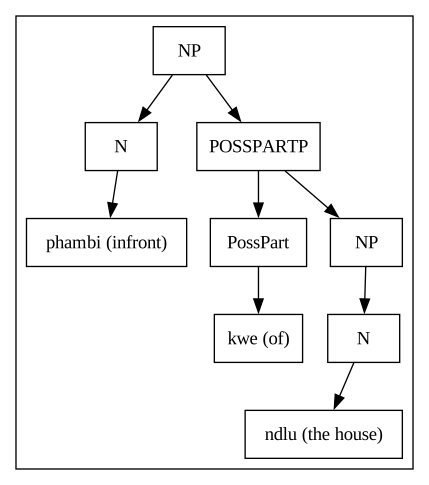
Locative formation by means of noun classes 16 to 18 is the rule in the Central Bantu, North Eastern and Southern Bantu regions. The most important thematic role of the LOCCLNP is to indicate the place for the location of the event or action. Locatives in isiXhosa are derived and formed by focusing on locative formation by means of locative noun class prefixes (Zeller, 2019). Usually in isiXhosa the locative is derived by means of the noun class markers of class 16 pha- and class 17 ku-. These markers are prefixed to the base noun, whose original class marker is preserved (Zeller, 2019). Examples of the two classes are given below.
- phambi kwendlu ‘in front of the house’ (class 16)
- ekunene kwendlu ‘to the right of the house’ (class 17)
The following tree diagram represents these examples.
Certain general locative meanings associated with these two locative classes can be identified. Class 16 expresses close relative proximity, or attachment with contact, and also used to refer to specific locations, like phambili ‘infront’, phakathi ‘inside’, phandle ‘outside’ etc. Class 17 is the semantically least specific locative class, it denotes a general location or further relative proximity, and when used with emotion verbs, it often translates as ‘towards’ (ku-, ngase-, ngaku-) or ‘from’ (vela) (Zeller, 2019: 2). In isiXhosa it translates to ku-, ngase-, ngaku-) or vela)
- Ndiya ngasesikolweni. ‘I am going towards the school.’
- Ndivela emlanjeni. ‘I come from the river.’
Projection of locative class noun phrases
The projection principle simply states that when notating the syntactic structure of a sentence one must specify at every level what lexical category each piece of the sentence belong to. Two common ways of notating the syntactic structure of a sentence under X-bar theory include bracketing, labelled bracketing, tree diagram and partial tree diagram.
- Izinja zibaleka phakathi kwabo. ‘Dogs are running between them.’ (class 16)
- Izinja > noun
- zibaleka > verb
- phakathi > locative class noun (class 16)
- kwabo > demonstrative pronoun
Figure 15 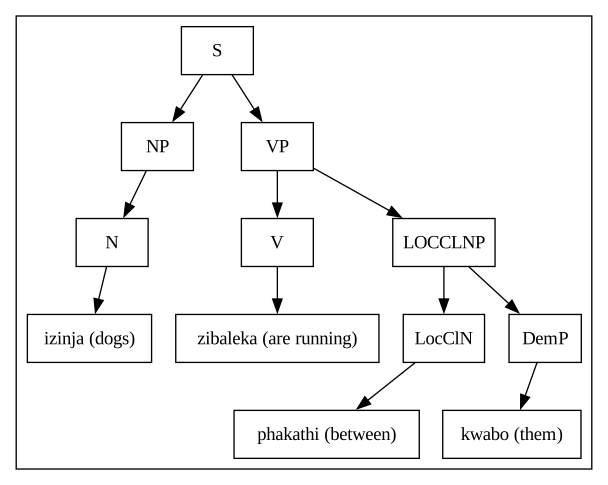 [click image to enlarge]
 - Umama utya umbona ekwindla. ‘Mother is eating mealies in autumn.’ (class 17)
- Umama > noun
- utya > verb
- umbona > noun
- ekwindla > locative class noun (class 17)
Figure 16 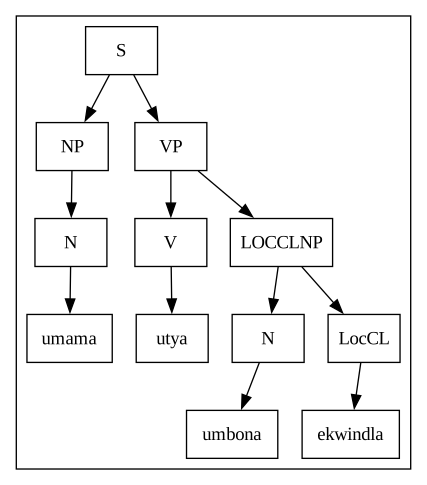 [click image to enlarge]
Syntactic uses of locative class noun phrases
To understand locative inversion in Bantu languages and the analytical issues they pose, it is crucial to first understand something about Bantu noun classes, and specifically the peculiarities of the locative noun classes. Most Bantu languages have a number of noun classes each of which triggers distinctive agreement morphology on different parts of speech such as demonstratives and verbs. (Buell, 2007).
Some of these classes are strongly associated with particular semantic concepts as it can act as a complement of specific particles, as an oblique or adjunct in a sentence. Of particular interest to us in isiXhosa are the locative classes 16 and 17.
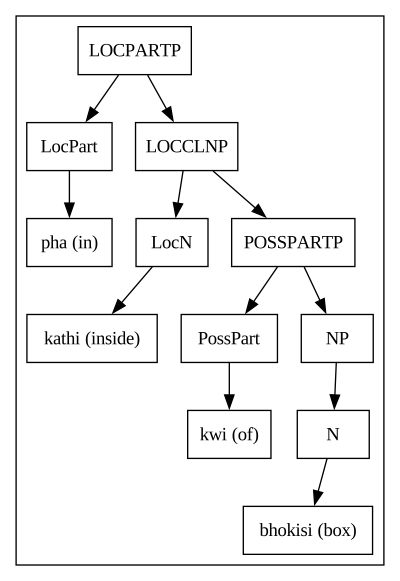
Complement of locative particles pha- and ku-
- Phakathi kwibhokisi ‘Inside of the box.’
The phrase structure rule applicable to the syntactic structure of the LocPart is:
Oblique
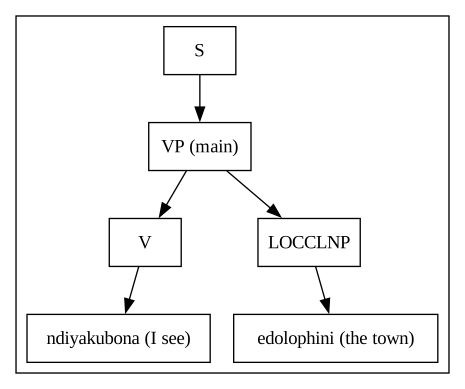
An oblique argument is an argument of a relation that is marked with a preposition. Syntactically it is not a direct argument (Crystal, 1980).
- Ndiyakubona edolophini ‘I see the town.’
Compare the following tree diagram:
Adjunct
An adjunct is an optional or structurally dispensable part of a sentence, clause, or phrase that, if removed or discarded will not otherwise affect the remainder of the sentences (Crystal, 1980).
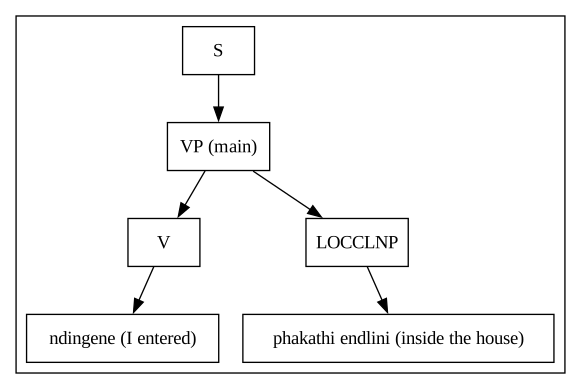
- Ndingene phakathi endlini. ‘I entered inside the house.’
Conclusion
This topic has dealt with different aspects of the locative noun phrases. These include characterisation features which specify the different types of locative nouns such as traditional locatives, demonstrative, nouns that are locative in character and those that are semantically locative. The topic also focuses on the locative noun phrases which have dependents such as verbal modifiers, prenominal modifiers and a noun which functions as head of the expression. Syntactic and semantic functions and uses of locative class noun phrases functioning as internal and external arguments, as predicates and as adjuncts for specific sentences have been dealt with. Projection of the class noun phrases which basically specify categories in sentences have been clearly shown in tree diagrams.
References
Aarts, B., Chalker, S. & Weiner, E. (2014) The Oxford Dictionary English Grammar. Oxford: Oxford University Press.
Buell, L. (2007) Semantic and Formal Locatives: Implications for the Bantu Locative Inversion Typology. Leiden: Leiden University Centre for Linguistics.
Gawron, J. M. (2013) Argument structure as soft constraints. San Diego: San Diego State University. Available at: https://enm.wikipedia.org (Accessed: 22 January 2021).
Jones, C., Jones, C. & Jones, J. K., (1991) Purpose clauses: Syntax, thematics, and semantics of English purpose constructions. (Vol. 47). Springer Science & Business Media.
Krüger, C. J. H. (2006) Introduction to the syntax of Setswana. Munchen: Lincom Europe.
Paperno, D. (2014) Locative phrases. p.55-58. https://doi.org/10.4000/mandenkan.566. https://www.slideshare.net.
Van Rooyen, C. S., Louw, J. A., Cantrell, J. V., Taljaard, P. C., Satyo, S. C., Ntuli, D. B. & Davey, A. S. (1982) Xhosa only guide for XHS201-3. Pretoria: University of South Africa.
Zeller, J & Ngoboka, P. (2018) ‘Corrigendum to: Agreement with locatives in Kinyarwanda: A comparative analysis’. Journal of Africana Languages and Linguistics. 39(1): 65-106.