Organs of speech
This section presents an overview of the organs of speech and airflow mechanisms involved in the production of speech sounds in Setswana.
Phonetics: Speech production
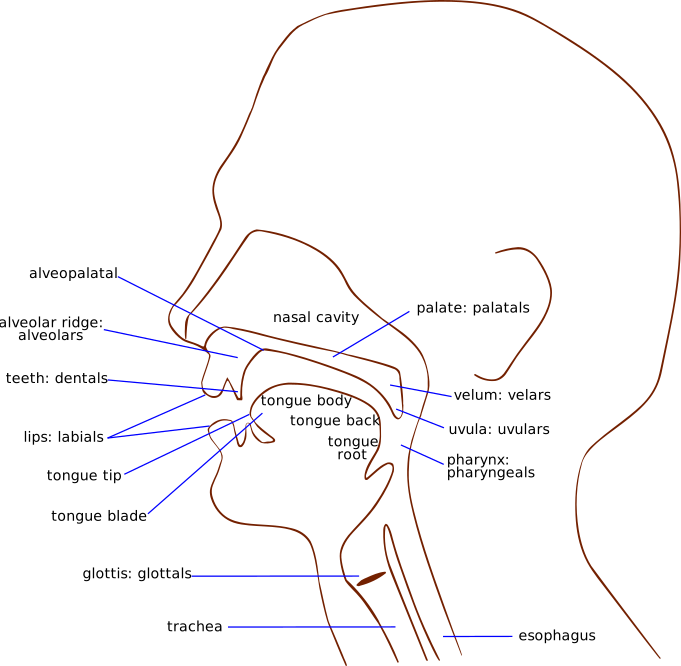
The diagram below displays the various organs that play a role in the articulation of speech sounds that are classified as Consonants (C) and Vowels (V).
In the production of speech sounds there are different types of airflow modalities at work.
In general, two main types of airflow are to be identified: egressive airflow, i.e., air flowing through the oral cavity to the outside, and ingressive airflow entering the oral cavity from the outside. (Setswana, however, does not have sounds produced by ingressive airflow.)
The following types of egressive airflow occur:
- airflow originating in the lungs through contraction of the diaphragm and intercostal muscles, moving air into the oral cavity where it may be modified before moving outwards – this is referred to as pulmonic initiation, with airflow moving egressively – also termed pulmonic egressive airflow. Typically, all aspirated stops as well as vowels are produced in this fashion:
- <ph> [pʰ]: phala ‘impala’
- <th> [tʰ]: thata ‘hard’
- <kh> [kʰ]: khai ‘cloth’
- airflow originating within the larynx with the vocal cords closed (closed glottis) with some closure within the oral cavity and simultaneous closure of the velum to prevent nasal airflow; the larynx (containing the vocal cords) moves upwards causing pressure build up in the oral cavity. When the occlusion in the oral cavity is released a sharp stop burst is perceived – this is referred to as glottalic initiation, with airflow moving egressively – also termed glottalic egressive airflow. Typically, all ejective stop consonants are articulated in this manner, however there is a view that ejectives do not occur so frequently in the speech of younger generations speaking Setswana (cf. Duran et al., 2017).
- <p> [p']/[p]: pala ‘goal post’
- <t> [t']/[t]: tala ‘raw’
- <k> [k']/[k]: kala ‘branch’
- airflow originating within the lungs moving egressively through open vocal cords with simultaneous closure of the velum (to prevent nasal airflow) produce voiceless sounds; similarly, airflow moving over vibrating vocal cords produce voiced sounds:
Table 1 Voiceless sounds Voiced sounds p[p'] in palo ‘number’ b[b] in bana ‘children’ t[t'] in tau ‘lion’ m[m] in metsi ‘water’ k[k'] in koko ‘hen’ n[n] in nako ‘time’
References
Duran, D., Bruni, J., Dogil, G. & Roux, J. C. (2017) ‘The social life of Setswana ejectives’. Proceedings of Interspeech. pp. 3787–3791.