Vowel segment inventory
In phonological terms, a vowel is the most sonorous sound in a syllable. It is, in most cases, the nucleus of the syllable. Vowels are normally described in terms of (a) the localisation of the tongue; (b) the height of the tongue; (c) the position of the lips; and (d) the positions of the muscles of the tongue.
Localisation of the tongue
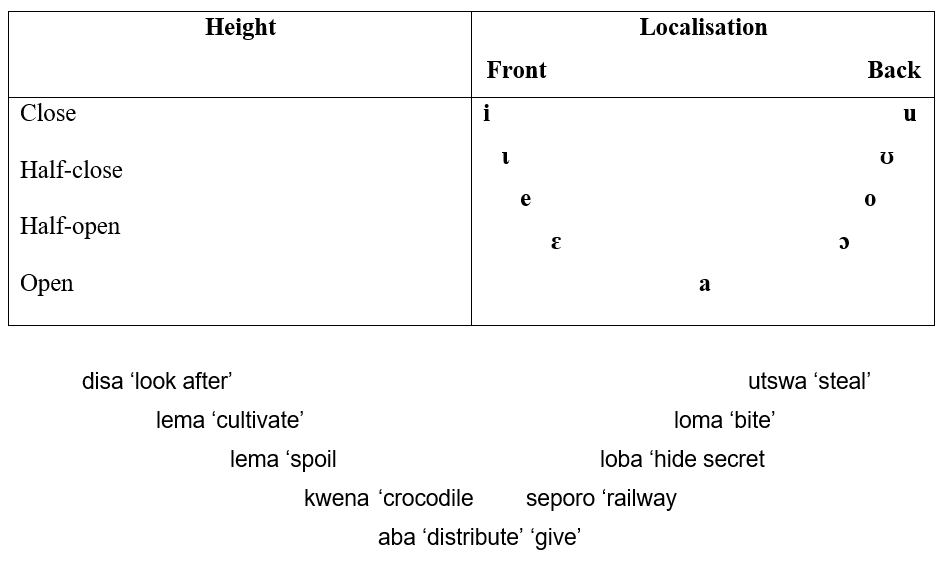
Vowels may be distinguished according to the part of the tongue raised. When a vowel is articulated with the front of the tongue raised towards the hard palate, it is known as a front vowel. By contrast, when a vowel is produced with the back of the tongue raised towards the soft palate, it is known as the back vowel.
Height of the tongue
Vowels may be characterised according to the height of the tongue at the time of articulation. Vowels can be articulated at either high level (closed), mid-level (half-closed) or low level (open).
Position of the lips
Vowels may be articulated with rounded lips or spread lips.
Position of the muscles of the tongue
Vowels can be articulated with tense muscles of the tongue or lax muscles of the tongue.
Phonetic inventory of vowel segments
If vowels are regarded as segments which can be associated with a syllabic onset to form a syllable with the structure onset + nucleus, a phonetic inventory of nine vowel segments can be established in Setswana. Subject to phonetic information, which is more precise than the one currently available, this inventory can be presented in a triangle form with five different degrees of apertures. For the degrees of aperture ranging from 1 to 4, there are coronal vowels [i], [ɩ], [e], [ɛ], which are also characterised as front vowels, and non-coronal vowels [u], [ʊ], [o], [ɔ], which are also characterised as back vowels. There is only one vowel for aperture 5 [a]. The feature tense characterizes vowels [i], [u], [e], [o], and the feature lax, characterizes [ɩ], [ʊ], [a]. The advanced tongue root (ATR) feature is not attested in Setswana Creissels et al. (1997), DALL (1999). 
Realisation of vowels in the last syllable of words
One outstanding feature of Setswana that will be dealt with in the description of the tonal system is to mark the end of a word by realisations which are unique to the last two syllables and as such need to be given a demarcative status. The general principle is to introduce contrast in which the second last syllable appears to be strengthened as compared to the last syllable which is weakened:
- The vowel of the second last syllable is elongated:
- The vowel of the second last syllable tends to become shortened, devoiced and to lose its sharpness, except in cases where the word ends with a tonal sequence High Low (HL)
For example, by using small upward offset characters to mark brief and devoiced vowels, the word mʊsádi, ‘woman’ can be presented as [mʊ̀sáːdi] in a narrow transcription.
It can be noted that these demarcative phenomena are particularly significant at the end of the enunciation when the end of the word coincides with a sharp pause. It can also be noted that in Setswana, the elongation of vowels with demarcating value is perceived as different from the realisation of two identical vowels which are directly following each other, for example in the word [-báakaɲa] ‘repair’.
Distribution and pertinence
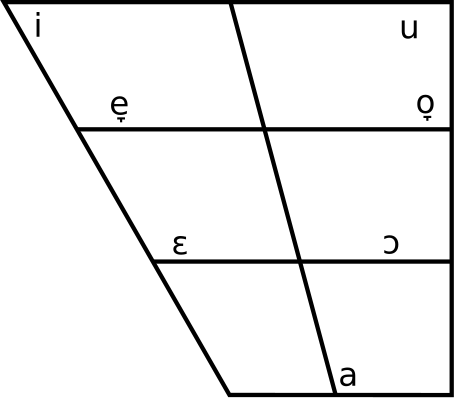
There are minimal pairs opposing pairs of elements of the subset /i/, /ɩ/, /e/, /a/, /o/, /ʊ/, /u/, and the same for the subset /i/, /ɩ/, /ɛ/, /a/, /ɔ/, /ʊ/, /u/. This proves that there are at least seven different phonemes. The difficulty lies in determining whether /ɛ/ can be opposed to /e/ or /o/ to /ɔ/.
In fact, the choice between /ɛ/ and /e/ or between /o/ and /ɔ/ is in certain cases conditioned. For example, in a disyllabic word with one of the following vowels in the final position, /i/, /ɩ/, /u/ or /ʊ/ it is impossible to have /ɛ/ or /ɔ/ in the first syllable. Comparative data shows that by reference to the Proto-Bantu languages, /e/ and /ɛ/ are both reflexes of *e, whilst /o/ and /ɔ/ are reflexes of *o. It is therefore reasonable to assume that originally there were two phonemes and each of them had two combinatory variants. However, careful observation of the distribution system in the current Setswana language shows that the assumption that each of the two pairs /e/ɛ/ and /o/ɔ/ constitute a single phoneme cannot be retained in a synchronic description of this language. Indeed:
- In some cases, the conditioning calls for morphological information and not the phonic nature of the environment. For example, the choice of /o/ in a verbal base such as /-χorosa/ can be expected due to the presence of a causative morpheme in this base, to which /i/ can be assigned as an underlying form, but no phonic element present in the realised form can be used to predict this choice as a phoneme can be preceded by a vowel of aperture 4.
- In any way, there is a certain number of occurrences of these vowels in which, at least from the synchronic point of view, they escape conditioning, whether phonic or morphologic. For example, there is a substantival prefix bo- in which the vowel is always /o/. This vowel can be explained historically because of an amalgam, but nothing in the actual state of Setswana makes it possible to decompose this prefix that would eliminate o from the basic form. This emerges very clearly in the detailed presentation made by Cole (1975) on the distribution of these vowels. Once Cole had proposed a certain number of distributional rules that phonologically or morphologically make it possible to choose between aperture 3 and aperture 4, he was faced with the obligation to enumerate, without any explication, a list of lexemes and morphemes that make an exception to the rule. He further points out that words that were recently borrowed expand the list of exceptions. Based on these data, it appears that only the confusion between the synchronic point of view and the diachronic point of view led Cole to conclude that there were seven vowel phonemes instead of nine.
It should be noted that, here again, borrowed words strengthen the opposition between what was originally combinatory variants. For example, in the lexicon of Bantu origin, /ɛ/ or /ɔ/ never appear in front of a nasal syllabic. This restriction can be explained through regressive assimilation. In the lexicon of Bantu origin, nasal syllabics are formed by syllables of the structure “consonant nasal + closed vowel”
. As a matter of fact, the closed vowel can be reinserted within the context of morphological analysis, but borrowed words invalidate that regularity: [sitɛ́mpɛ] stamp and [pɔ́mpa] to pump introduce occurrences of /ɛ/ and /ɔ/ in a context where the lexicon of Bantu origin attests the presence of e and o, thereby destroying the complementarity that probably existed originally.
We can conclude that, even though the possibility of opposing /e/, /o/ to /ɛ/, /ɔ/ remains limited in the system and underexploited in the lexicon, in its current state, Setswana virtually possesses a system of nine vowel phonemes.
Representation of vowels in a practical linguistic transcription and orthography of Setswana
The standard Setswana orthography does not adequately address the relevant distinctions of vowels. In common practice, only five symbols are used:
- The letter <e> is used indifferently to represent /i/, /e/, or /ɛ/
- The letter <o> is used indifferently to represent /ʊ/, /o/ or /ɔ/
In certain cases (reading books for elementary schools, dictionaries), <e> and <o> are used to represent /ɛ/ and /ɔ/ respectively, but in no case does the Setswana orthography take into account the distinction between /i/ and /e/ or between /ʊ/ and /o/.
Cole (1955) uses a different convention that retains the seven symbols <i>, <e>, <e>, <a>, <o>, <o>, <u> but with different values from those observed in the standard orthography. In this convention, <e> exclusively represents /i/ and /o/ exclusively represent /ʊ/. However, <ê> can indifferently represent /e/ or /ɛ/ and <ô> can indifferently represent /o/ or /ɔ/. This solution is better than the one adopted for the standard orthography given that the distinction that it overlooks is usually predictable. However, it cannot be considered entirely satisfactory.
Both the standard orthography and the convention adopted by Cole have the drawback of recommending the use of diacritics above vowels to mark the differences in apertures. This is problematic considering that languages like Setswana also uses the diacritics to mark tonal distinctions (Creissels, 1991).
In an experimental phonetic investigation of Setswana vowel qualities by Bennett et al. (2016) published by the International Phonetic Association (IPA), it is argued in favour of a seven vowel (phonemic) system. The status of open-mid vowel raising seems problematic as far as consistency is concerned. They present the following vowel chart as well as the results of an acoustic analysis.
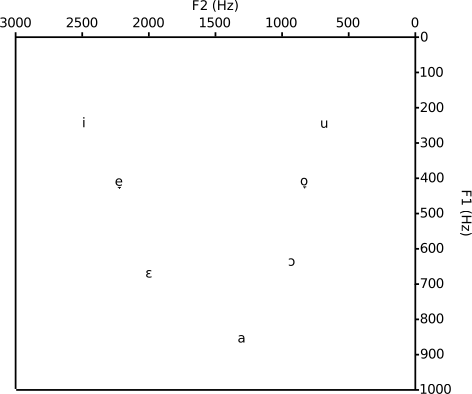
The description of the vowels of Setswana has a long history which include Jones & Plaatje (1916), Jones (1928), Cole (1955), Chebanne et al. (1997) and Le Roux (2012). Recordings of Setswana vowels in this website, as well in the digital resources of the sounds of the languages at the South African Centre for Digital Language Resources (SADiLaR) provide excellent data for further research by scholars of Setswana.
References
Bennett, W. G., Diemer, M., Kerford, J., Probert, T. & Wesi, T. (2016) ‘Illustrations of the IPA: Setswana (South African)’. Journal of the International Phonetic Association. 46(2): 235-246.
Chebanne, A. M., Creissels, D. & Nkhwa, H. W. (1997) Tonal morphology of the Setswana verb. München: Lincom.
Cole, D. T. (1955) An introduction to Tswana grammar. London: Longmans.
Cole, D. T. (1975) Introduction to Tswana grammar, 2nd impression. Cape Town: Longman.
Creissels, D. (1991) Phonologie du Setswana. Centre de Linguistique Africaine de l’Universite Stendhal (Grenoble 3), Grenoble.
Department of African Languages and Literature (DALL) (1999) The sound system of Setswana. Gaborone: University of Botswana.
Jones, D. & Plaatje, T. S. (1916) A Sechuana Reader. London: University of London Press.
Jones, D. (1928) The tones of Sechuana nouns. London: International Institute of African Languages and Cultures.
Le Roux, M. (2012) ‘An acoustic comparison: Setswana vowels versus cardinal vowels’. South African Journal of African Languages. 32(2): 175-180.