Pronouns and pronoun phrases
This topic focuses on the pronoun and pronoun phrases in the context of two constituent structures, namely, the internal and external structure. The internal syntax will centre on the internal structure of the pronoun phrase (PROP), that is, how it is constructed, looking at concepts like, agreement, word order, etc., while the external syntax will deal with how this constituent structure functions in larger constructions.
Pronouns and pronoun phrase
A pronoun in isiXhosa is a subcategory of nouns and it can act as a substantive of a verb – as it functions as a noun (Lockwood, 2002; Pahl, 1985). Krüger (2006), in his analysis of Setswana pronouns have identified that pronouns, like nouns, can be modified and can be the complement of other constituents like a demonstrative pronoun etc. This is one feature that linguists like Pahl (1985) and Satyo (1997), Van Rooyen et al. (1982) who have achieved stunning success in the analysis of isiXhosa grammar have not handled pronouns in their analysis of isiXhosa. This is despite the fact that, the grammar of isiXhosa in relation to pronouns exhibit similarities with Setswana pronouns. A pronoun phrase (PROP) in Setswana according to Krüger (2006) can be one word or a group of words comprising of a pronoun that has a modifier. That is also the case with isiXhosa pronouns although that has not been spelt out in isiXhosa grammar books. This work will follow Krüger’s (2006) theory in analysing isiXhosa pronouns.
The discussion will commence by outlining the characterisation of isiXhosa pronoun and the pronoun phrase. Then it will proceed to the internal structure of the pronoun phrase (PROP); the syntactic and semantic functions of the PROP; projection of PROP: modification and syntactic uses of the PROP.
Characterisation of pronouns
IsiXhosa has a variety of pronouns. Krüger (2006), in his analysis of Setswana pronouns, identifies 2 forms of pronouns, the personal and other pronouns that are class bound in their derivation, that is, they agree with class nouns. However, grammarians like Pahl (1978) and Satyo (1997) have ignored the structural difference that is also present in isiXhosa pronouns, and have classified all as pronouns. IsiXhosa pronouns may be divided into two forms namely, personal pronouns and pronouns that are class bound (Krüger, 2006).
Personal pronouns
Under personal pronouns we have the following:
- First person: singular and pluralExample 1
mna ndiyafunda I am studying (singular) Example 2thina siyafunda We are studying (plural) - Second person: singular and pluralExample 3
wena uyafunda You are studying (singular) Example 4nina niyafunda You are studying (plural) - Third person: singular and pluralExample 5
yena uyafunda He/she is studying (singular) Example 6bona bayafunda They are studying (plural)
Pronouns may stand alone as one word like the highlighted ones in the above examples, and that word may function as the head of the pronoun phrase (PROP) (Cole, 1955; Krüger, 2006). In some instances, pronouns are followed by other pronouns (Pahl, 1978; Satyo, 1997; Van Rooyen et al., 1982). However, these linguists do not specify the function of these pronouns with respect to the antecedent. Krüger (2006) on the other hand argues that these pronouns act as modifiers to the Head of the phrase, which could be the possessive and quantitative pronouns, while they may also be complements of the pronoun phrase (PROP). A detailed account of these syntactic features is given below.
The second form of pronouns are those that derive from the noun classes, i.e., they are class bound (Krüger, 2006). These are:
- Absolute pronouns, e.g., Ilitye lona ‘the stone it’
- Demonstrative pronouns, e.g., Esi sikhulu ‘this big one’
- Possessive pronouns, e.g., Ukutya kwam ‘my food’
The internal structure of the pronoun phrase
As alluded to above, a pronoun phrase PROP may in some instances be a single word, as in, Thina siyahamba ‘Us/We are leaving’, and that single word may be the head of that phrasal constituent (Krüger, 2006). Examples will be provided as we deal with each below.
The PROP with a single word (pronoun)
This is the pronoun phrase that is constructed with a pronoun and that pronoun becomes the Head of that phrasal constituent. As stated under characterisation, that there are different kinds of pronouns, the Head of this phrase may be one of these, namely, the absolute pronoun, personal pronoun, various kinds of quantitative pronouns, qualificative and the demonstrative pronoun (Krüger, 2006). All these will each receive attention in the discussion below, with examples provided.
| Yena uyalila |
| ABSPROP VP |
| He/she is crying |
| Bonke balele |
| INCQPROP VP |
| All of them are sleeping. |
In both cases, the PROP stands alone and is the Head of the constituent.
The above constituent structure is represented on a tree diagram below.
The PROP with a pronoun group (modifiers)
This is the pronoun phrase PROP that is constructed with a pronoun that is the head of the constituent, followed by any number of pronoun modifiers (Krüger, 2013a).
- Bona bonke ‘Them all’ / ‘All of them’
The above is an absolute pronoun that is modified with an inclusive quantitative pronoun. The following tree diagram represents the above constituent structure.
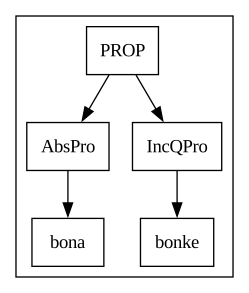
The discussion below presents the different kinds of pronouns/pronoun phrases with their respective modifiers. Because of the agglutinative nature of Nguni languages, this discussion will incorporate the agreement concept. The morphosyntactic agreement signals a link or connection between the modifier and its antecedent. Furthermore, the word order in which these grammatical constituents follow each other in a sentence in order to render it (sentence) grammatically correct will be presented.
The personal pronoun with its modifiers
A Personal pronoun from which the PROP may be derived, followed by almost all the modifiers that have been tabled in the foregoing discussion, which are, the quantitatives, qualificatives and demonstratives. Below are examples that clarify this point.
Personal pronoun modified with quantitatives
- The inclusive quantitative pronoun: A personal pronoun from which the PROP is derived may be the head of the construction and be modified by an inclusive quantitative pronoun Krüger (2013b). This pronoun can appear before and after the antecedent and it displays agreement with the modified personal pronoun to render the sentence grammatically correct.Example 9
Thina sonke siyabhala PersProP1pl INCQPROP VP Us all are writing - The selective quantitative pronoun: A personal pronoun may be the head of the PROP that is modified by a selective quantitative pronoun (SelQPro). This pronoun always appears after the antecedent and it displays agreement with the modified personal pronoun.Example 10
Mna ndodwa PersProP1sg SelQProP1sg I/ me only - The interrogative quantitative pronoun: A personal pronoun that is modified by an interrogative quantitative pronoun (IntQPro) may be the head of the PROP. This pronoun may appear before and after the modifier and it displays agreement with the modified personal pronoun.Example 11
Yena wuphi? PersProP IntQProP One which > Which one?
The absolute pronoun and its modifiers
An absolute pronoun from which the PROP is derived may be the head of the construction and be modified with some quantitative pronouns, a possessive particle phrase as well as a qualificative particle phrase (Krüger, 2013b).
| Zona zethu |
| zona za +ethu |
| ABSPROP PossPart PossProP |
| The ones that are ours. |
- The absolute pronoun modified with a demonstrative pronoun
An absolute pronoun may be the head of a Pronoun and be modified with a demonstrative (Krüger, 2013a). The relationship between the two will be maintained by the agreement with the class of the pronoun. In such a construction, the demonstrative only appears after the antecedent.
Example 13Thina aba ABSPROP DemProP Us - The absolute pronoun modified with an inclusive quantitative pronoun
An absolute pronoun may be the head of a Phrase and be modified with an inclusive quantitative pronoun (Krüger, 2013b). The relationship between the two will be maintained by the agreement with the class of the absolute pronoun. The INCQPROP never precedes the antecedent.
Example 14Kona konke AbsPro INCQPROP It all / All - The absolute pronoun modified with the selective quantitative pronoun
An absolute pronoun may be the head of a Pronoun and be modified with a selective quantitative pronoun (Krüger, 2013b). The relationship between the two will be maintained by the agreement with the class of the absolute pronoun. The modifier never precedes the antecedent.
Example 15Zona zodwa ABSPROP SelQPro10 Them only / Only them - The absolute pronoun modified with a possessive particle phrase
An absolute pronoun may be the head of a Pronoun phrase and be modified with a possessive particle phrase (Krüger, 2013b). The possessive particle is what is referred to as a possessive formative by (Pahl, 1978; Satyo, 1997; Van Rooyen et al., 1982). The relationship between the two is maintained by the agreement with the class to which the absolute pronoun belongs. The POSSPARTP always appears after the absolute pronoun.
Example 16Bona ba bo ABSPROP PossPart PossProP Them of theirs / Theirs Example 17Zona za m ABSPROP PossPart PossProP Those of mine / Mine - The absolute pronoun modified with a qualificative particle phrase
An absolute pronoun may be the head of a Pronoun phrase and be modified with a qualificative particle phrase (Krüger, 2013a). The relationship between the two are maintained by the agreement of the class of the qualificative particle with the class of the absolute pronoun. The QUALPARTP always appears after the absolute pronoun.
Example 18Sona so- -dwa ABSPROP QualPart QUALPARTP The one by itself / Alone Example 19Zona zo- -nke ABSPROP QualPart QUALPARTP Them all / All of them
The demonstrative pronoun with its modifiers
A demonstrative pronoun may be the head of the PROP and be modified by a possessive particle phrase and quantitative (Krüger, 2013a). Details regarding these modifiers are discussed below. This pronoun may appear before and after the antecedent and it displays agreement with the class of the modified personal pronoun.
- The demonstrative pronoun modified with a selective quantitative pronoun
A demonstrative pronoun may be the head of the PROP and be modified with a selective quantitative pronoun. This pronoun may appear before and after the antecedent and it displays agreement with the class of the modified personal pronoun.
Example 20Lo yedwa DemProP SelQProP This one / This alone Example 21Ezi zonke DemProP SelQProP These all / All these - The demonstrative pronoun modified with a possessive particle phrase
A demonstrative pronoun may be the head of the PROP and be modified with a PosPart. This pronoun appears only after the antecedent and it displays agreement with the class of the modified pronoun.
Example 22Aba ba- + -ethu = bethu DemProP PosPart PossProP These of ours / Ours Example 23Esi sa- + -m DemProP PosPart PossProP This one of mine / Mine - The demonstrative pronoun modified with a qualificative particle phrase
A demonstrative pronoun may be the head of the PROP and be modified with a QuaPartP. This pronoun appears only after the antecedent and it displays agreement with the class of the modified pronoun.
Example 24Ezi zin- -tle DemProP QuaPart QuaProP These that are beautiful Example 25Aba ba- -ncinci DemProP QuaPart QuaProP These that are young ones
The interrogative quantitative pronoun and its modifiers
An interrogative quantitative pronoun may be the head of the PROP and be modified with quantitative pronouns and possessive particle phrase (Krüger, 2013b). This pronoun appears only after the antecedent and it displays agreement with the class of the modified pronoun.
- The interrogative quantitative pronoun modified with a possessive particle phrase
An interrogative quantitative pronoun (IntQPro) may be modified with a possessive particle phrase (POSSPARTP). This possessive pronoun may appear before and after the antecedent and it displays agreement with the class of the modified pronoun.
Example 26Wuphi o wam? IntQProP PossPart PosProP1sg Which one of mine?
The inclusive quantitative pronoun and its modifier
An inclusive quantitative pronoun may be the head of the PROP and be modified with a possessive particle phrase (POSSPARTP). This pronoun appears only before the antecedent and it displays agreement with the class of the modified pronoun.
| Konke o- -kwakhe |
| INCQPROP PossPart PossProP |
| All of them |
- An inclusive quantitative pronoun modified with a possessive particle phrase
An inclusive quantitative pronoun (IncQPro) may be modified with a possessive particle phrase. This possessive pronoun may appear before and after the antecedent and display agreement with the class of the modified pronoun.
Example 28za khe zonke PossPart PossProP INCQPROP All hers/Hers all
Syntactic and semantic functions of the pronoun phrase
As alluded to above, this portion focuses on the external syntax of the PROP, that is, how it functions in larger constructions as detailed bellow:
Subject of the verb
In an isiXhosa sentence, when the PROP functions as the subject of the VP, it appears before the main verb and is the focus of the entire sentence.
- Yena ugula kakhulu. ‘He is very sick.’
- Wena ungabangenisa. ‘You may let them in.’
The highlighted pronouns above function as subjects of their respective verbs.
Direct object
An object argument is another nominal element which may occur in a sentence. It is a pronoun or noun phrase that receives action performed by the subject. The highlighted PROP in the following sentence is a PROP that functions as a direct object argument.
| Yona (imoto) itshayisa wona (umthi). |
| Subject NP VP Object NP |
| It (the car) hits the tree. |
The highlighted PROP in the above sentence represents a direct object. A direct object is a verb that is always used as an action verb (Crystal, 1980).
- Yona (inkomo) izele lona (ithole). ‘The cow gave birth to a calf.’
- Bona (abantwana) bavale sona isikolo. ‘The pupils closed the school.’
It is however important “not to assume that the nominal element which is not a subject in an isiXhosa sentence is an object. The noun may quite easily have a function either than that of an object.”
(Finlayson et al., 1990: 30) as shown below.
- Yona (inkomo) izele izolo. ‘The cow gave birth yesterday.’
- Zona (izikolo) zivalwe inyanga. ‘The schools closed for a month.’
The NPs in these sentences izolo and inyanga are not objects but locatives. The two NPs are not affected by the action of the VPs.
Indirect object
An indirect object is a PROP that refers to someone or something that is affected by the action of a transitive verb (typically as a recipient), but is not the primary object (Crystal, 1980).
- Yena (uZizo) unike yena (umama) yona (imali). ‘He passed the money to her (mother).’
- Yena (unovenkile) uthengisele yena (umntwana) yona (incwadi). ‘He (the shopkeeper) sold her/him (the child) it (a book).’
The highlighted two PROPs above are all indirect objects.
- In the first example, Yena (Umama) is the recipient of the direct object, yona (imali) ‘money’.
- In the second example, Yena (Umntwana-child) is the recipient of the direct object, yona ‘incwadi’;
Complement of the locative particles
A PROP may be used as a complement of a locative particle in a locative particle phrase (LOCPARTP). Mostly, the pronoun that is used in such cases is an absolute pronoun and the locative particle is inserted to the stem of the pronoun.
| Uthetha ku- + bo |
| VP LocPart ABSPROP |
| He speaks to/with them. |
| Ndithenge ku- -ye |
| VP LocPart ABSPROP |
| I bought from her/him. |
Every highlighted pronoun stem in the sentences above is functioning as a complement of the locative particle preceding it.
Complement of instrumental particle
The PROP may function as a complement of the instrumental particle in an INSTRPARTP. The pronoun functioning in this case may be an absolute pronoun and a demonstrative pronoun.
- Absolute PronounExample 32
Ndikhatshwe nga + bo VP InstrPart ABSPROP I was accompanied by them. - Demonstrative PronounExample 33
Sibethwe ngu + lo VP InstrPart ABSPROP We were punished by this one.
Complement of associative particle
A PROP may be used as a complement of the associative particle /na-/ and the particle is attached to the stem of the absolute pronoun.
| Ndikhwele na ye ibhasi |
| VP AssPart ABSPROP NP |
| I was with him in the bus. |
| Ndicula na bo ekwayarini |
| VP AssPart ABSPROP LocP |
| I sing with them in the choir. |
Complement of comparative particle
A PROP may be used as a complement of the comparative particle njenga- ‘like’; okukwa- ‘similar to’ with the absolute pronoun and demonstrative pronoun being the complement.
| Mhle njenga- -ye |
| COPP CompPart ABSPROP |
| Sh/he is as pretty as he/she is. |
| Imoto imhlophe okukwa- le yakhe |
| NP COPP CompPart DemProP PossPro |
| The car is as white like as his. |
Complement of a preposition
A PROP may function as a complement of the preposition na-, with the absolute pronoun and demonstrative pronoun being the complement.
- Absolute pronounExample 38
Ndifuna ukuhamba na we AuxV VP PrepPart ABSPROP I want to come with you. - Demonstrative pronounExample 39
Ndidlala ibhola na lo VP NP PrepPart DemProP I am playing the ball with this one.
References
Cole, D. T. (1955) An introduction to Tswana grammar. Cape Town: Longman.
Crystal, D. (1980) A First Dictionary of Linguistics and Phonetics. London: Cambridge University Press.
Finlayson, R., Jones, C. J., Mfusi, T. M. & Podile, K. (1990) Study guide for XHS2002-4. Pretoria: University of South Africa.
Krüger, C. J. H. (2006) Introduction to the morphology of Setswana. München: Lincom.
Krüger, C. J. H. (2013a) Setswana syntax: a survey of word group structure: Volume 1. München: Lincom.
Krüger, C. J. H. (2013b) Setswana syntax: a survey of word group structure: Volume 2. München: Lincom.
Lockwood, D. (2002) Syntactic analysis and description: A constructional approach. London: Continuum.
Pahl, H. W. (1978) IsiXhosa. Qonce (King Williams Town): Thandapers.
Pahl, H. W. (1985) isiXhosa. 4th edn. Johannesburg: Educum Publishers.
Satyo, S. C. (1997) Igrama Noncwadi LwesiXhosa Ibanga 9. Pretoria: Via Afrika.
Van Rooyen, C. S., Louw, J. A., Cantrell, J. V., Taljaard, P. C., Satyo, S. C., Ntuli, D. B. & Davey, A. S. (1982) Xhosa only guide for XHS201-3. Pretoria: University of South Africa.