Like the vast majority of the languages of Sub-Saharan Africa, Setswana is a tone language, i.e., a language in which pitch is used to distinguish words differing in their lexical meaning, or different grammatical forms of the same word.
The tone system of Setswana as a maximally simple tone system
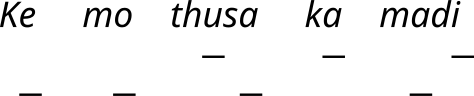
In some sense, Setswana has the simplest tone system one can imagine, since it is based on a binary contrast between two tones, high (H) and low (L), every syllable being associated with one of these two tones. High-toned syllables are signaled in the phonetic transcription by an acute accent ( ´ ), and low-toned syllables by a grave accent ( ` ). For example, the tonal melody of the sentence Ke mo thusa ka madi ‘I help him/her financially’ can be schematised as follows:
Figure 1
[click image to enlarge]
In other words, the tonal melody of this sentence is L L H L H L H. Accordingly, it will be transcribed phonetically as follows:
[kɩ̀-mʊ̀-tʰúsà ká màːdí]
(In the phonetic transcription, the colon marks the lengthening in penultimate syllable position before a pause.)
Phonetically, Setswana also has syllables with a falling tone (H͡L), signaled in the phonetic transcription by a circumflex (^), but in Setswana, the falling tone is only found as a contextual variant of the high tone. For example, in the sentence Bitsang Kitso jaanong! ‘Call Kitso now!’, the tonal melody of Kitso can be schematised as [ ¯ ¯ ], but if we delete the adverb jaanong, it changes into [ \ _ ], and a lengthening of the first syllable can also be observed. This point will be examined in more detail in the section on tonal alternations. For the moment, we observe that Kitso will appear as [kítsɔ] in the phonetic transcription of the sentence Bitsang Kitso jaanong!, [bítsáŋ̀ kítsɔ́ jáànʊ̂ːŋ]̀, but as kîːtsɔ̀ in the transcription of Bitsang Kitso![bítsáŋ̀ kîːtsɔ]̀.
The tone system of Setswana as a highly complex tone system
However, another essential characteristic of the tonal system of Setswana is the existence of a highly complex system of rules that modify the tonal melody of words, depending on their grammatical content and the phonological context in which they occur. This is a very common phenomenon among the languages belonging to the Bantu language family, and in this respect (as in many others) Setswana is a very typical Bantu language. Consequently, the reader is invited to keep in mind that it is not abnormal to find the same word with different tonal melodies in different contexts, or in different grammatical forms. Crucially, this is not a case of free variation, but rule-governed variation involving phonological and/or grammatical conditioning (cf. Creissels, 2017).
Phonological conditioning can be illustrated by the difference in the tonal contour of lobone ‘lamp’ in (1) [ _ _ _ ] and (2) [ ¯ _ _ ]. As will be explained in more detail in the section on the spreading of the H tone at word boundaries. The H tone on the first syllable of lobone in (2) is conditioned by the fact that the preceding word ends in a H-toned syllable.
Example 1
Ke tshuba lobone.
[kɩ̀-tsʰùbà lʊ̀bɔ̀ːnɛ̀ ̀]
I am turning on the lamp.
Example 2
Ke tima lobone.
[kɩ̀-tímá lʊ́bɔ̀ːnɛ̀]
I am turning off the lamp.
Grammatical conditioning can be illustrated by the difference in the tonal contour of the verb stem -dumedisa ‘greet’ in (3) [ _ _ _ _ ] and (4) [ _ ¯ ¯ ¯ ]. The explanation is that, in the imperative, but not in the present, the basic tonal melody of the verb stem is modified by the insertion of a grammatical H tone that attaches to the second syllable of the verb stem and spreads up to the last syllable.
Example 3
Ke dumedisa Mpho.
[kɩ̀-dùmèdìsà m̀ːpʰɔ́]
I am greeting Mpho.
Example 4
Dumedisa Mpho!
[dùmédísá m̀ːpʰɔ́]
Greet Mpho!
Dialectal variation in Setswana tone
Attention must also be paid to the possibility of dialectal variation. There doesn’t seem to be important dialectal variation with respect to the basic tones of the minimal units of the language (lexical stems and grammatical formatives of words), but there is some variation in the tone spreading rules that determine the concrete tonal melody of sentences. In this respect, the reader is invited to keep in mind that in this description phonetic transcriptions refer to the pronunciation of speakers of the Sengwaketse and Sengwato varieties, without prejudice to the possibility of variation in the speech of speakers of other varieties.
Orthography and phonetic transcription
A proper linguistic analysis of many aspects of Setswana cannot be carried out on the basis of the representation of Setswana sentences provided by the current orthography, and this is particularly true of tone. The point is that (a) the phonemic vowels of Setswana are not represented in the orthography properly, (b) the orthography does not mark tones, and (c) many grammatical elements written as if they were distinct words are in fact bound morphemes. Point (c) is particularly important in the analysis of tone, since the distinction between word-internal boundaries and boundaries between words is crucial in the description of tonal processes. This is the reason why, in this description, Setswana sentences in their usual orthographic representation are systematically doubled by a phonetic transcription in which:
the representation of consonants and vowels follows the conventions of the IPA;
tone is systematically indicated by means of the usual diacritics (acute accent for the H tone, grave accent for the L tone, circumflex for the falling tone);
hyphens represent the attachment of bound grammatical elements treated in the current orthography as if they were separate words
Setswana as a two-tone language in which tone fulfills both a lexical and grammatical function
Setswana is a two-tone language in which tone fulfills both a lexical and a grammatical function. This means that, in Setswana:
every syllable can be perceived as either high (H) or low (L);
a given word in a given context has a fixed tonal melody that can be described as a sequence of H-toned and L-toned syllables;
the contrast between H tone and L tone may be essential to identify the lexical meaning of words, or to distinguish different grammatical forms of the same word;
the recognition of a basic binary distinction between H-toned and L-toned syllables is sufficient to account for the linguistic function of pitch in a satisfactory way.
The tonal melody as a stable property of Setswana words with a given lexical and grammatical content when uttered in a given type of context
Examples (5) to (8) illustrates the stability of the tonal melodies of individual words with a given lexical and grammatical content in a given context. In clause-initial position and immediately followed by ba kae ‘where are’, the noun basadi ‘women’ can only have the tonal melody L H H [ _ ¯ ¯ ]. No native speaker of Setswana would ever pronounce this particular word in this particular context with another tonal melody (for example L L L [ _ _ _ ], L L H [ _ _ ¯ ], or H L H [ ¯ _ ¯ ]). However, this is a property of this particular noun, since in the same context, other nouns are regularly uttered with different tonal melodies, for example L L L [ _ _ _ ] for balemi ‘farmers’, L L H [ _ _ ¯ ] for Bafora ‘French’, and H L H [ ¯ _ ¯ ] for bontšhe ‘ostriches’.
Example 5
Basadi ba kae?
[bàsádí !bá-kâːɩ̀]
Where are the women?
Example 6
Balemi ba kae?
[bàlɩ̀mì bá-kâːɩ̀]
Where are the farmers?
Example 7
Bafora ba kae?
[bàfʊ̀rá !bá-kâːɩ]
Where are the French?
Example 8
Bontšhe ba kae?
[bóɲ̀tʃʰé !bá-kâːɩ]
Where are the ostriches?
The lexical functions of Setswana tone
Crucially, in a tone language, it may happen that, in a given context, a difference in the tonal melody is the only clue for distinguishing two words differing in their lexical meaning. For example, in (9) and (10), we see that, in the same context, the infinitive of fitlha ‘arrive’ and the infinitive of fitlha ‘hide’ are only distinguished by their tonal melody: L L for ‘arrive’ H H for ‘hide’.
Example 9
Go fitlha go siame.
[χʊ̀-fìtɬʰà χʊ́-sìâːmɩ]
It is good to arrive.
Example 10
Go fitlha go siame.
[χʊ̀-fítɬʰá χʊ́-sìâːmɩ̀]
It is good to hide.
Similarly, in (11) and (12), the pitch of the syllable bu is the only thing that distinguishes ‘speak’ (H tone on the syllable bu) from ‘skin’ (L tone on the syllable bu).
Example 11
Ga ba bue sentle.
[χà-bá-búɩ́ sɩ́-ǹːtɬɛ̀]
They do not speak well.
Example 12
Ga ba bue sentle
[χà-bá-bùɩ́ sɩ́-ǹːtɬɛ̀]
They do not skin (beasts) well.
In (13), the only difference between mabele ‘breasts’ and mabele ‘sorghum’ lies in the tone of the second syllable.
Example 13
Mabele a ntsha maši.
[màbɛ́lɛ́ !á-ńtsʰá mâːʃì]
Breasts produce milk.
Example 14
Mabele ke sejalo se se ditlhaka.
[màbɛ̀lɛ́ kɩ́ sɩ̀jálɔ̀ sé !sɩ́-dítɬʰâːkà]
Sorghum is a cereal.
The grammatical function of tone
In Setswana, the grammatical forms of a given word may differ in their tonal melody. For example, in (15) and (16), we can see that the addition of the negative prefix ga to the present form of batla ‘want’ triggers a change in the tone of the subject index ke (from L to H) and of the verb stem (from L L to L H):
Example 15
Ke batla go ja.
[kɩ̀-bàtlà χʊ̀ː-ʤá]
I want to eat.
Example 16
Ga ke batle go ja.
[χà-kɩ́-bàtɬɩ́ χʊ̀ː-ʤá]
I don't want to eat.
It may happen that differences in the tonal melodies are the only clue for distinguishing two grammatical forms of the same word. The case of grammatical meanings distinguished by tone only is illustrated in (17) and (20), where the pitch of the syllable go distinguishes the 2nd person singular object index from the locative class object index resuming the noun golo ‘place’, and the pitch of the syllable o distinguishes the 2nd person singular subject index from the class 1 subject index.
Example 17
Ke go itse sentle.
kɩ̀-χʊ̀-ítsɩ sɩ́-ǹːtɬɛ̀
I know you well (the place).
Example 18
Ke go itse sentle.
kɩ̀-χʊ́-ítsɩ́ sɩ́-ǹːtɬɛ̀
I know it well (the placce).
Example 19
O kwalela mang lokwalo?
[ʊ̀-kwálɛ́la máŋ́ lʊ̀kwâːlɔ̀]
Who are you writing a letter to?
Example 20
O kwalela mang lokwalo?
[ʊ́-kwálɛ́là̀ máŋ́ lʊ̀kwâːlɔ̀]
Who is he/she writing a letter to?
Another example of different grammatical forms of the same word distinguished by tone only is given in (21) to (23), where three forms of the verb reka ‘buy’ equally written ba reka have three distinct tonal melodies according to their grammatical meaning:
in (21), ba reka [ ¯ ¯ ¯ ] is an independent verb form of the indicative mood with the meaning ‘they buy / are buying’;
in (22), ba reka [ ¯ _ ¯ ] is a dependent verb form expressing simultaneity with the event to which the main verb refers: ‘while they were buying’;
in (23), ba reka [ _ ¯ ¯ ] is another type of dependent verb form, expressing that the event it encodes follows that encoded by the main verb: ‘and they bought’.
Example 21
Ba reka dikgomo.
[bá-rɛ́ká díqʰòːmʊ́]
They buy / are buying cows.
Example 22
Ke ba bonye ba reka dikgomo.
[kɩ̀-bá-bóɲɩ̀ bá-rɛ̀ká díqʰòːmʊ́]
I saw them buying cows.
Example 23
Ba bonye madi ba reka dikgomo.
[bá-bóɲɩ́ màdí bà-rɛ́ká díqʰòːmʊ́]
They got money and bought cows.
The basic tonal melody of words
The basic tonal melody of words is that observed in contexts in which no tonal process occurs, either phonologically or grammatically conditioned. In an elementary introduction to Setswana tone, it is not possible to discuss in detail the reasons for this choice, but a maximally simple description of the tonal alternations undergone by Setswana words under various grammatical and phonological conditions can only be achieved by positing that the basic tonal melody of nouns and verbs is that observed when a noun, or the infinitive form of a verb, occurs clause-initially in subject function, immediately followed by the verb, as in (24) to (28).
Example 24
Mosadi o apeile dijo.
[mʊ̀sádí ʊ́-àpéíle ́dìːʤɔ́]
The woman did the cooking.
Example 25
Dikgomo di timetse.
[dìqʰòmʊ́ dí-tìmêːtsɩ̀]
The cows got lost.
Example 26
Molemi o jwetse mmidi.
[mʊ̀lɩ̀mɩ̀ ʊ́-ʤwétsɩ́ m̀mîːdì]
The farmer planted maize.
Example 27
Go bereka go siame.
[χʊ̀-bɛ́rɛ́ká χʊ́-sìâːmɩ̀]
It is good to work.
Example 28
Go lebala ga go a siama.
[χʊ̀-lɩ̀bàlà χà-χʊ́-à-síâːmà]
It is not good to forget.
Crucially, the basic tonal melody of words does not always coincide with the tonal melody they show when quoted in isolation. The point is that, as will be described in detail in the section on tonal alternations, words immediately followed by a pause undergo a modification of their tonal melody resulting in neutralisation of some tonal distinctions, and this modification automatically applies to words quoted in isolation, since they are followed by a pause. For example, mosadi ‘woman’ has the basic tonal contour [mʊ̀sádi]́, as in (17), but is quoted as [mʊ̀sâːdì], and also occurs as [mʊ̀sâːdì] in sentence-final position, as in (33) below.
Note that the Setswana dictionaries that provide tonal indications for the lexical entries do not give the basic tonal melody of words as defined here, but rather the tonal melody they show when quoted in isolation. For example, the Tlhalosi ya medi ya SeSetswana gives mogatse[mʊ̀χátsɛ]̀ ‘her husband’ and mogatso[mʊ̀χátsɔ]̀ ‘your husband’ with identical tonal melodies. This notation is correct in the sense that it accounts for the tonal melody of these two words in isolation, or in sentence-final position. However, it has a serious shortcoming in that, if the tonal melody in isolation is taken as the basic tonal melody of words (as suggested by the notation in the dictionary), it is impossible to predict that, as illustrated in (29) to (30), mogatse and mogatso have distinct tonal melodies in other contexts.
Example 29
Mogatse o tsile ka terena.
[mʊ̀χátsɛ́ ʊ́-tsìlé ká tɩ̀rɩ̂ːnà]
Her husband came by train.
Example 30
Mogatso o tsile ka terena.
[mʊ̀χátsɔ̀ ʊ́-tsìlé ká tɩ̀rɩ̂ːnà]
Your husband came by train.
Tonal processes with a purely phonological conditioning
By tonal processes with a purely phonological conditioning, I mean variation in the tonal melody of words that has no lexical or grammatical significance, and automatically occurs whenever words occur in contexts defined in purely phonological terms, whatever their grammatical nature and their syntactic relationships with the neighbouring words. Setswana has three such types of tonal processes.
Tonal alternations in prepausal position
In these examples, we can observe that mosadi in sentence (33) has a tonal melody [ _ \ _ ] different from the melody [ _ ¯ ¯ ] observed in (31) and (32).
Example 31
Mosadi o apeile dijo.
[mʊ̀sádí ʊ́-àpéílé dìːʤɔ́]
The woman did the cooking.
Example 32
Ke bonye mosadi le bana ba gagwe.
[kɩ̀-bóɲɩ́ mʊ̀sádi lɩ́-bàná bà-χâːχwɛ̀]
I saw the woman with her children.
Example 33
Ke bonye mosadi.
[kɩ̀-bóɲɩ́ mʊ̀sâːdì]
I saw the woman.
The explanation is that, in (31) to (33), no tone rule applies, and the tonal melody of mosadi is simply its basic tonal melody, whereas in (33), it is modified by a phonological process that automatically affects the syllables that immediately precede a pause, regardless of the lexical and grammatical nature of the word in prepausal position:
the syllable in penultimate position before a pause is lengthened;
if the basic tone of the syllable in penultimate position before a pause is H, it is replaced by a falling tone;
a H tone following another H tone converted into a falling tone by the preceding rule is replaced by a L tone.
This process is responsible for the fact that words with distinct basic tonal melodies … H H and ... H L L are found with the same tonal melody ... H͡L L in isolation, or in sentence-final position. In other words, in prepausal position, the distinction between H H and H L tonal sequences is neutralised.
The loss of the distinction between H H and H L tonal sequences in prepausal position has already been illustrated in (29) with mogatse / mogatso. Example (34) and (35) provides an additional illustration, with the proper name Dumang and the noun dikgang ‘news’: the tonal distinction they show when followed by the time adjunct mo mosong ‘in the morning’ disappears it the time adjunct is deleted.
Example 34
Ke bonye Dumang (mo mosong).
[kɩ̀-bóɲɩ́ dùmáŋ̀ mó mʊ̀sôːŋ̀]
[kɩ̀-bóɲɩ́ dùmâːŋ̀]
I saw Dumang (in the morning).
Example 35
Ke utlule dikgang (mo mosong).
[kɩ̀-útɬúlé dìqʰáŋ́ mó mʊ̀sôːŋ̀]
[kɩ̀-útɬúlé dìqʰâːŋ̀]
I heard the news (in the morning).
H tone spreading at word boundaries
Within Setswana sentences, whenever a word whose last syllable bears a H tone is immediately followed by a word beginning with at least two successive L-toned syllables, the L tone of the first syllable of the second word is replaced by a H tone, irrespective of the internal structure of the two words and of the nature of their syntactic relationship (cf. Creissels, 1998):
...H # L L … → … H # H L …
This process can be observed for example by comparing the tonal realisation of nouns with a L-toned initial syllable in sentence-initial position (i.e., in a position where they show their basic tonal melody) with the tonal realisation of the same nouns in sentences in which they immediately follow the word ke ‘he/she/it is, they are’. If the second syllable bears a H tone, as in (36), no change occurs in the tone of the first syllable, but if it bears a L tone, the tone of the first syllable becomes H, as in (37) to (39). Note that, in all cases, the change is limited to the first syllable.
Example 36
Batswana ba kae?
Ke Batswana.
[bàtswáná !bá-kâːɩ̀]
[kɩ́ bàtswâːnà]
Where are the Batswana?
They are Batswana.
Example 37
Bafora ba kae?
Ke Bafora.
[bàfʊ̀rá !bá-kâːɩ]
[kɩ́ báfʊ̀ːrá]
Where are the French?
They are French.
Example 38
Bangwaketse ba kae?
Ke Bangwaketse.
[bàŋwàkètsɩ́ !bá-kâːɩ̀]
[kɩ́ báŋwàkèːtsɩ́]
Where are the Bangwaketse?
They are Bangwaketse.
Example 39
Bakgalagadi ba kae?
Ke Bakgalagadi.
[bàqʰàlàχàdì bá-kâːɩ̀]
[kɩ́ báqʰàlàχàːdì]
Downstep
The tonal process described in this section also occurs at word boundaries irrespective of the internal structure of words and of the nature of their syntactic relationship, subject only to the condition that the two words are not separated by a pause.
In the description of tone languages, the term downstep refers to a tonal process resulting in that H tones that immediately follow another H tone are perceived less high than the H tone that precedes them, but high enough to still be perceived as H tones. This process typically occurs in two-tone languages, but its conditioning varies greatly from one language to another. It is commonly indicated by ! or similar diacritics preceding the lowered H tone(s). The realisation of the sequences H H, H !H and H L can be schematised as follows:
H H [ ¯ ¯ ] H !H [ ¯ – ] H L [ ¯ _ ]
In Setswana, whenever a word ending with a H-toned syllable is immediately followed by at least two successive H-toned syllables, a downstep marks the word boundary:
... H # H H ... →... H # !H H ... [ ¯ – – ]
For example, (40) to (42) show that, in clause-initial position, i.e., in a context in which no phonologically conditioned tone process occurs, o bonye ‘he/she saw’ and Kitso (proper name), unambiguously have tonal melodies including H tones only, whereas in (42), a downstep occurs at the junction between Lesego and o bonye, and between o bonye and Kitso.
Example 40
O bonye Mpho mo mosong.
[ʊ́-bóɲɩ́ m̀pʰɔ́ mo mʊ̀sôːŋ̀]
He/she saw Mpho in the morning.
Example 41
Kitso ga a a tla.
[kítsɔ́ χà-á-àː-tɬá]
Kitso has not come.
Example 42
Lesego o bonye Kitso mo mosong.
[lɩ̀sɩ́χɔ́ !ʊ́-bóɲɩ́ !kítsɔ́ mó mʊ̀sôːŋ̀]
Lesego saw Kitso in the morning.
Note that, as illustrated in (43) and (44), no downstep occurs if the word boundary is followed by a single H-toned syllable.
Example 43
Lesego o gama kgomo.
[lɩ̀sɩ́χɔ́ !ʊ́-χámá qʰòːmʊ́]
Lesego is milking the cow.
Example 44
Lesego o a gama.
[lɩ̀sɩ́χɔ́ ʊ́-à-χâːmà]
Lesego is milking.
Note that the very simple analysis of the downstep put forward in this section is only possible on the basis of a division of the sentences into words different from that codified in the traditional orthography of Setswana. The point is that, on the basis of the traditional orthography of Tswana, a downstep would be incorrectly predicted to occur in many contexts where no downtsep is observed. The explanation is that the traditional orthography of Setswana treats some bound grammatical elements as if they were separate words. For example, in (45), no downstep occurs between lwa and Kitso, as should be the case if they really constituted two distinct words.
Example 45
Lobone lwa Kitso lo thubegile.
[lʊ̀bɔ̀nɛ̀ lwá-kítsɔ́ !lʊ́-tʰúbèχìːlè]
Kitso's lamp broke.
In other words, the observation of the downstep provides crucial evidence that word division in the traditional orthography of Setswana is purely conventional and has no clear correlate in the oral form of sentences.
One may wonder why the notion of mid tone is not used here instead of the notion of downstepped H tone, since phonetically, there is no difference. The main reason is that, in the tone languages analysed as having a mid-tone in addition to H and L, the mid tone is an intrinsic property of some syllables, whereas in Setswana, no syllable has intrinsically this kind of realisation, which consequently must be analysed as the result of processes affecting underlying tone sequences including only the basic tones H and L.
References
Creissels, D. (1998) ‘Expansion and retraction of high tone domains in Setswana’. In Hyman, L. M. & Kisseberth, C. W. (eds.). Theoretical aspects of Bantu tone. Stanford: CSLI Publications. pp. 133-194.
Creissels, D. (2017) ‘The conjoint/disjoint distinction in the tonal morphology of Tswana’. In Van der Wal, J. & Hyman, L. M. (eds.). The conjoint/disjoint alternation in Bantu. Boston: De Gruyter Mouton. pp. 200-238.