Nouns and noun phrases
This topic deals with nouns and noun phrases in isiXhosa. The noun is one of the universal set of categories of words that includes determiner, verb, sentence, preposition, adjective, quantifier, inflection and adverb. This topic therefore deals with the nominal features, the internal structure of the noun – heads and modifiers, word order and agreement. The syntactic and semantic functions of the noun and noun phrase are also dealt with under this heading, the focus being on the features of the noun as they unfold in the noun classes. The noun classes used in this part are drawn from the works of, among others (cf. Pahl, 1983; Satyo, 1997).
Nouns and noun phases
The noun phrase is a phrase consisting of a noun and other constituents with the noun serving as the head of the phrase. The noun phrase is either the head noun alone or the head noun with other constituent dependents. In isiXhosa, each noun belongs to a class, which is represented by a specific class prefix. The choice of a class prefix usually affects the meaning. Consider the following two nouns: umXhosa and isiXhosa. The class prefix um- in umXhosa enforces reference to humans on the root Xhosa, which is a clan name. isiXhosa refers to a culture and language which is spoken by umXhosa. This means the class prefix changes whilst the root remains the same. In isiXhosa, there are seventeen noun classes which comprise singular odd numbers and plural even numbers. and is fully explained in the section on isiXhosa nouns.
Heads
Syntax deals with structural relations between the various components of a sentence. To that effect, Radford (2009: 39) articulates “phrases and sentences are built up by a series of merger operations, each of which combines a pair of constituents together to form a larger constituent.” Miller (2002) adds that words are grouped into phrases and that groupings typically bring together heads and their modifiers. Mchombo (2004) makes a more poignant point in this regard when he states that when you know a language, you not only know what the constituents of the sentences are but you know how they function in the language and among themselves.
Two aspects of syntax may be identified, i.e., the internal and external syntax. Internal syntax deals with how a given phrase, itself is constructed in a well-formed manner whereas external syntax is concerned with how a phrase can be used in a larger construction. In isiXhosa when constructing any phrase, there is one obligatory element in each one i.e., the head.
The head of a phrase is the central element in a phrase that determines the syntactic function of the whole phrase. A headword is a headword because it is essential to the meaning of the sentence or the phrase.
- The head of the noun phrase, amanzi abilayo ashushu ‘the boiling hot water’, is the noun amanzi ‘water’.
The other elements of the phrase or compound modify the head and are therefore the head’s dependents. Analogously, the head of a compound is the stem that determines the semantic category of that compound.
- The head of the compound noun Thandabantu ‘love people’ is abantu since Thandabantu refers to, abantu ‘people’ not thanda ‘love’.
When considering possible complements of nouns in isiXhosa, two types of complements which do not behave in the same way syntactically may be distinguished. The first type of complement has two main distinguishing factors. It must agree with its head:
| isitya esikhulu |
| i-s-itya e-si-khulu |
| Dish big [literal translation] |
| Big dish |
Agreement between the complement esikhulu and the head isitya takes place through the prefix –si- of the head.
- (esikhulu) siyabukeka ‘The big one looks nice.’
The second type of complement has none of these characteristics. These are mainly complements that may also be found with verbs.
The head is thus a phrasal element that is essential in forming a phrase. Some of the mentioned isiXhosa phrases can only consist of a head, as it does not need an obligatory complement to form a grammatical phrase. Nordquist (2019) lists phrases that can only consist of a headword:
- noun phrase (head = basic noun)
- locative noun phrase (head = locative noun)
- adjective phrase (head = adjective)
- pronoun (head = one of the subcategories of the pronoun)
- verb phrase (head = main verb)
- adverb phrase (head = adverb)
- interjection phrase (head = interjection)
- ideophone phrase (head = ideophone)
Noun phrases
Noun phrases may not generally occur in this way as complements of a noun. They may only appear with derived nouns from verbs like ukhathalelo and those nouns must be in class 11. The noun ukhathalelo has been derived from the verb khathalel ‘care for’. Compare also a quite complicated set of complements, which include a noun phrase as in the examples below.
- Ukhathalelo lwam (inkosi) ‘Caring-for-of-me-chief / My caring for the chief.’
- Uqeqesho lwabafundi (imidlalo) (ngutitshala) (ngebhola) ‘Training (of students) (games) (by the teacher) (with a ball)’.
Locative noun phrase
Locative noun phrases used to have heads with their own noun class and as such they have been used in all different sentential positions. In isiXhosa, the locative noun has mostly lost this ability as though some remnants of this use can still be detected. As such a locative noun phrase can be found as the object of the verb but under very restricted conditions: firstly, the verb must be an abstract verb, not a concrete verb (Du Plessis, 1998).
Secondly, the clitic ku- must always be used together with the object and co-indexed with it, as in:
- Ndiyakwazi eGcuwa ‘I know it in Butterworth’
Thirdly, only locative nouns may be used with ku-. When a locative phrase with ku- is used, the meaning changes to the second person singular:
- Ndikuthandile [kweli laseMpuma Kapa]. ‘I did like you in Eastern Cape.’
Fourthly, no modifier may be used with a locative noun: in such cases, the sentence is to be interpreted as in:
- Ndikuthandile [elwandle lwaseMonti]. ‘I liked you in the sea of East London.’
- Ndikwazile [edolophini yaseDutywa]. ‘I knew you in the town of Dutywa.’
This condition does not apply to the old class of locative nouns:
- Ndiyakoyika [ecaleni komlambo]. ‘I am afraid there near the river.’
Modifier
In grammar, a modifier is a word, phrase or clause that functions as an adjective or adverb to provide additional information about another word or word group (called the head). A modifier is an optional element in clause structure or phrase structure. It is so called because it is said to modify another element in the structure, on which it is dependent (Huddleston et al., 2002). Typically, the modifier can be removed without affecting the grammar of the sentence. Modifiers that appear before the head are called premodifiers describing the noun ‘hat’.
- umnqwazi ubomvu ‘red hat’
The adjective ubomvu ‘red’ is a modifier describing the noun umnqwazi ‘hat’.
The modifiers that appear after the head are called postmodifiers.
- Bathethela phezulu ‘They are talking loudly.’
The adverb phezulu ‘loudly’ is a modifier of the verb bathethela ‘talking’.
Modifiers in a sentence should generally be placed as close to the noun, word, phrase they intended to modify. Misplaced modifiers can cause confusion when placed too far from the noun they are modifying.
Word order in the sentence
From the preceding discussion, we have observed that the structure of the sentence is a combination of words into groups and such groups combine to form sentences. Fromkin et al. (2003) argue that words form phrases that are larger constituents [and such phrases] are used to form clauses that culminate in grammatically correct sentences. We have also gathered that words that combine to form a group must consist of a semantic relationship between each other in order to produce meaningful word-groups, while also following each other according to a specific order. When word-groups are combined in a meaningful fashion, any language speaker is able to recognise words that belong together and is also able to distinguish the different immediate constituents of a sentence (Van Rooyen et al., 1982).
Consider the sentence below:
- Ikati emnyama ilele esitulweni. ‘A black cat is sleeping on the chair.’
In this case ikati emnyama belong together, that is, they form a constituent while ilele esitulweni forms another. The above sentence consists of the NP (noun phrase) ikati emnyama ‘the black cat’, and the VP (verb phrase) ilele esitulweni ‘is sleeping on the chair’. The words are placed in a language specific word order and are arranged according to a specific rule.
The basic arrangement of a sentence in virtually all languages is that a predicate is preceded by a subject and followed by an object:
‘The mother is beating (punishing) the child.’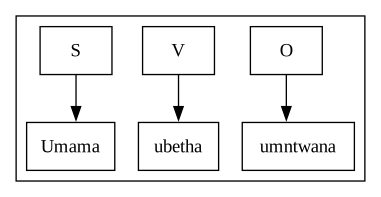
This is the basic structure of an isiXhosa sentence.
In most cases, a simple sentence is considered very explicit with nothing left to situation or context as is the case with the one above (Van Rooyen et al., 1982). However, as shown in the preceding paragraphs, (an) isiXhosa simple sentence can be made up of one word - an indication that there are many forms of sentences in isiXhosa. These many forms are generated by the constituents alluded to above which form a sentence. In the preceding sections, a variety of pronouns have been identified that are also used in isiXhosa sentences, respectively. These constituents bring about changes in the word order in sentences. Consider below the different changes in sentences that are generated using these constituents.
The word order of qualificatives in an isiXhosa sentence
A qualificative phrase in isiXhosa can be either an adjective or a relative. In addition, possessives are classified as part of this group. These function as constituents that qualify either the noun or pronoun.
Qualificatives follow either the noun or pronoun:
- Indlu enkulu (adjective) ‘a big house / A house which is big’.
Ilokhwe emnyama (relative) ‘a black dress / a dress which is black’.
Inkomo etyebileyo (relative) ‘a fat cow / a cow that is fat’
Umzi wonke (quantitative) ‘The entire household’
Ubisi oludala (adjective) ‘Rotten milk’
Ubisi lwegusha (possessive) ‘Sheep’s milk’
Qualificative may precede the noun or pronoun:
- Enkulu indlu ‘a big house’
- Oludala ubisi ‘a rotten milk’
- Etyebileyo inkomo ‘a fat cow’
- Olwegusha ubisi ‘a sheep’s milk’
From the above sentences it is clear that a qualificative is never fixed in one position. It can precede the noun but the meaning changes in terms of focus or emphasis, the emphasis being on the qualificative.
A sentence may have more than one qualificative and these may follow the qualified noun or pronoun:
- Ilokhwe ende emhlophe. ‘A dress that is long and white.’
- Inkomo emnyama etyebileyo. ‘A cow that is black and fat.’
- Indlu yam enkulu. ‘A house of mine that is big.’
More than one qualificative may preceed the noun or pronoun
- Emnyama etyebileyo inkomo. ‘A black fat cow.’
- Ende emhlophe ilokhwe. ‘A long white dress.’
- Wonke omdala umntu. ‘Every old person.’
In this regard, a point made by Mchombo (2004) makes sense as he states that the ordering of the constituents of the noun phrase, for instance is subject to variation, correlating with discourse effects. The examples above demonstrate this point. The following examples further demonstrate this view:
- Ezi ngonyama zintathu ‘These three lions’
- Iingonyama zintathu ‘The lions are three’
Qualificatives and concordial representations in sentences
In the above sentences relationships between words and phrases in sentences in Bantu languages is maintained by means of concords, an exercise that depicts an agreement relation. Grammatical concords are easily identifiable in qualificatives by the classes from where they emanate, that is, they (concords) match up with a part of the corresponding nominal prefix. For example, with possessive pronouns the concordial element is composed of two formative elements, namely, the possessive concordial element and the possessive –a-, as clarified in the previous section on the nouns (Van Rooyen et al., 1982):
- Isihlangu somntwana ‘The shoe of the child’
- Iliso lenja ‘The eye of the dog’
- Isitya somdongwe ‘The dish of clay’
The formative –so- in somntwana and somdongwe is a combination of the subject concord –si- + possessive -a-, with –i- of the subject concord –si- having undergone ellision. Van Rooyen et al., (1982: 86) however, cautions that “the possessive [pronouns like] somdongwe are not primarily the possessor(s), but really the ‘possessing’ qualification(s).”
This means that umdongwe ‘clay’ is not the possessor, but a qualification possessed by the word isitya ‘dish’. He further cautions, “We must be careful not to ascribe English and Afrikaans characteristics to isiZulu and isiXhosa constructions.”
He argues that this can easily happen when these languages are described through the medium of Afrikaans or English.
Adjectives and relatives follow the same principle as the possessive pronouns because the main characteristics of the two qualificatives is that they also have concordial reference with their arguments:
- Umnqwazi omhle (Adjective) ‘A hat that is beautiful’
- Ilitye elincinci (Relative) ‘A stone, which is small’
The above examples demonstrate that the basic formation of the isiXhosa adjective and relative is that they have concords that are similar to the noun prefix. “The initial vowel of the adjective has its own history, because it is the contracted form of the demonstrative”
(Van Rooyen et al., 1982: 87). That is also the case with relatives. In addition, these two including the possessives can be used in any position, that is, they can precede the word that is being qualified:
- Omhle umnqwazi ‘A beautiful hat’
- Elincinci ilitye ‘A small stone’
When the noun that is preceded by a demonstrative, the qualifier undergoes elision since the arguments qualified have no initial vowels. Even the initial vowels of the adjective or the relative are elided:
- Lo mnqwazi mhle ‘This beautiful hat’
- Eli litye lincinci ‘This small stone’
- Esi sitya somdongwe ‘This clay dish’
There is no observable difference in form on the above examples between the qualifier and the qualified. Also, the positions of the above three qualificatives are fixed, in that they can only appear after the substantive that is being qualified.
The use of the demonstrative
The position of the demonstrative in a sentence is similar to the above, namely, the possessive as well as the qualificatives. It can precede the noun that is qualified or follow it:
- Lo mntwana ukhulile. This child is grown up.
- Umntwana lo ukhulile. This child is grown up.
- Le ndlu indala. This house is old.
- Indlu le indala. This house is old.
- Esi sonka sesenja. This is a dog’s bread.
- Sesenja esi sonka. This is a dog’s bread.
When the demonstrative precedes the noun, the initial vowel of the noun is elided, as is the case with the first example above.
It is also possible to use the demonstrative without the noun that is qualified, and the meaning does not change:
- Lo ukhulile. ‘This one is grown up.’
- Le indala. ‘This one is old.’
- Esi senja ‘This is the dog’s one.’
The place of quantitatives in a sentence
In isiXhosa there are two quantitative stems, each of which has its own concord, which agrees with its subject noun. The two stems are the inclusive stem –nke that expresses ‘the whole of’ in the singular and ‘all’ in the plural and exclusive stem –dwa that expresses ‘only’.
Quantitatives can precede or appear after the noun:
- Onke amadoda ahambile ‘All men are gone’
- Kuhambe amadoda onke ‘All men are gone’
- Iintombi zodwa zishiyekile ‘Only women are left’
- Zishiyeke zodwa iintombi ‘Only women are left’
The quantitatives can be used alone without the noun and they can appear before and after the predicate:
- Onke ahambile ‘All of them left’
- Bahambile bonke ‘All of them left’
- Zishiyeke zodwa ‘They are left all by themselves’
- Zodwa zishiyekile ‘They are left all by themselves’
The place of the absolute pronoun in a sentence
An absolute pronoun may be used together with a subject noun and an object noun. The absolute pronoun has an element of emphasising something about the noun that it qualifies or contrasting that noun. The absolute pronoun may precede the substantive or appear after the noun:
- Zona iinkomo zafa ‘As for the cattle, they died’
- Zafa iinkomo zona ‘As for the cattle, they died’
Absolute pronouns may also appear without the nouns they contrast or emphasise. In such cases the pronoun as such is emphasised or contrasted:
- Yena ukhwele ihashe, yona ikhwele ibhayisekile. ‘He rides a horse, she however rides a bicycle.’
The absolute pronoun may stand in juxtaposition with the demonstrative, the relative, the quantifier, etc, with the intention to contrast or emphasise:
- Ndifuna lona eli. ‘I want this very one (horse).’
- Sifuna sona sikhulu. ‘We want the very big one.’
- Batya sona sonke isonka. ‘They ate the whole loaf of bread.’
With adverbial formatives the suffix –na of the absolute pronoun is usually discarded:
- Naye instead of nayena ‘with him/her’
- Ngaso instead of ngasona ‘by means of it.’
- Nam ndihamba nabo instead of nabona ‘I am also going with them.’
With the locative ku- the suffix –na may be discarded. As it is done with the absolute pronouns mna, thina, nina (Taljaard & Bosch, 1988):
- Kumna > kum ‘to me’
- Kuthina > kuthi ‘to us’
- Kunina > kuni ‘to you’
Agreement
Anderson (1998) contends that grammatical agreement can be seen as an interplay of morphological, syntactic and semantic aspects. Morphosyntactical agreement is a relation between syntactic constituents in virtue of the fact that the word forms they consist of bear similar information, either inherently or by means of morphological affixation (Wunderlich, 2015). Lehmann (1982) argues that agreement serves to keep record of discourse referents (used to indicate an entity that can be referred to by a pronoun or revived by a definite description). Only constituents that relate to the same referent may overtly agree with each other.
The following example clarifies this grammatical rule:
- Isilo siyaliluma ilitye. ‘The animal is biting it, the stone.’
The two nouns agree with each other because of the concordial agreement – si- and –li- that both relate to the same referent, which is the predicate. Even the nasal classes have concords that correspond to the nasal part of the corresponding nominal prefixes, thus depicting the agreement relation:
- Inja iluma umsila. ‘The dog is biting the tail.’
- Indlu iyawa. ‘The house is falling apart.’
In Nguni languages, the relationship referred to above is obvious, given that the concord looks generally the same (particularly with non-nasal classes) as part of the corresponding noun class prefix. To be exact, almost every sentence in Nguni languages is dominated by the concord system. To that effect, Van Rooyen et al. (1982) and Mchombo (2004) explain that Bantu languages are agglutinative, that is, they have a linear arrangement of formatives of a word. Accordingly, an isiXhosa sentence will not only consist of the stem of a verb, but also a formative referring to either the subject and/or object in the subject and object concords, as is the case with the above sentence.
As discussed in the section on nouns, the division of nouns into noun classes is based on the class prefixes. The noun class prefixes determine verbal agreement, which is the agreement between heads and their complements and the agreement between heads and modifiers (Letsholo & Matlhaku, 2014):
- Utata uyatya. ‘Father is eating.’
- Utata uyayitya inyama. ‘Father is eating meat.’
- Isilo siyatya ‘The animal is eating.’
- Isilo siyalitya isele ‘The animal is eating a frog.’
The concord u- in the first example agrees with the subject (the noun). If the concord u- is exchanged by the concord si- of the third example, the sentence becomes ungrammatical. This is an indication that for a sentence to be regarded as grammatically correct in isiXhosa, the possessed noun must agree with the possessor by means of the concord. The concord –yi- in the second example agrees with the object - inyama, ‘meat’, while the concord –li- in the last example agrees with the object – isele ‘frog’. In isiXhosa, a sentence without the concordial agreement is grammatically incorrect and senseless.
References
Anderson, R. T. (1998) ‘The development of grammatical case distinctions in the use of personal pronouns by Spanish-speaking pre-schoolers’. Journal of Speech, Language, and Hearing Research. 41, 394-406.
Du Plessis, J. A. (1998) ‘Isintaksi yesiXhosa: Xhosa Syntax’. Stellenbosch Communications in African Languages. 7.
Fromkin, V., Rodman, R, & Hyams, N. (2003) An introduction to language. 7th edn. Boston: Heine.
Huddleston, R. & Pullum, G. (2002) The Cambridge grammar of the English language. Cambridge University Press.
Lehmann, C. (1982) ‘Grammatical agreement: An overview’. Science direct topics. https://www.sciencedirect.com/topics.
Letsholo, R. & Matlhaku, K. (2014) ‘The syntax of the Setswana noun phrase’. Journal of Language and Literature. 24, 22-41.
Mchombo, S. (2004) The Syntax of Chichewa. Cambridge: Cambridge University Press.
Miller, J. (2002) Linguistics & English Language. University of Edinburg Press.
Nordquist, R. (2019) Glossary of Grammatical and Rhetorical Terms. Thought Co.
Pahl, H. W. (1983) IsiXhosa. Johannesburg: Educum Publishers.
Radford, A. (2009) Analysing English sentences: A minimalistic approach. Cambridge: Cambridge University Press.
Satyo, S. C. (1997) Igrama noncwadi lwesiXhosa. Goodwood: Via Afrika.
Taljaard, P. C. & Bosch, S. E. (1988) Handbook of isiZulu. Pretoria: Van Schaik.
Van Rooyen, C. S., Louw, J. A., Cantrell, J. V., Taljaard, P. C., Satyo, S. C., Ntuli, D. B. & Davey, A. S. (1982) Xhosa only guide for XHS201-3. Pretoria: University of South Africa.