Syllable structure
This section has to do with the nature of phonology as well as the typical syllable structures of Setswana.
The phonetics and phonology of Setswana
The study of sounds and their production by the organs of phonation is called Phonetics, while the study of the function of sounds is called Phonology (Ladefoged & Maddieson, 1996: 2). Phonology studies the sounds of a language from their functional role perspective. It involves the inventory and structure of a language’s consonants and vowels as well as its prosodic characteristics, namely the non-segmental features such as a syllable, tone, and stress (Ladefoged & Maddieson, 1996: 2; Crystal, 2006: 45). The study of consonants and vowels is known as segmental phonology and the study of prosodic features is known as supra-segmental phonology (DALL, 2001). In phonology the way sounds are organised to make speech within a language is of critical importance as this is how meaning is created, how sounds pattern in a language provides a specific way that language makes speech meaningful in communication. The Setswana language possesses 28 consonants and 7 vowels (which could be phonetically 9 as in will be shown later).
Phonology is the higher level of speech organisation and is concerned with the organisation of the systems and patterns of sounds that occur languages (Clark and Yallop, 1995; Ladefoged & Maddieson, 1996). It studies the sounds of a language from their functional role perspective. The individual sounds are referred to as phonemes. A phoneme is a phonic segment with meaning value, and which can bring a difference in meaning between two words (DALL, 1999) It is a functional unit (Cole, 1975). Phonemes include vowels and consonants. Phonology therefore involves the inventory and structure of a language’s consonants and vowels as well as its prosodic characteristics, namely the non-segmental features such as a syllable, tone, and stress. The study of consonants and vowels is known as segmental phonology and the study of prosodic features is known as supra-segmental phonology (DALL, 1999). In phonology the way sounds are organised to make speech within a language is of critical importance as this is how meaning is created. How sounds pattern in a language provide a specific way that language makes speech meaningful in communication. The Setswana language possesses 28 consonants and 9 vowels (Creissels et al., 1997).
The importance of a phoneme
Language consonants and vowels function as phonemes. When a sound acquires the status of a phoneme, it takes a functional role in the building of words. The phoneme is a minimal sound unit that cannot be further segmented, and it is characterised by a limited number of features that set it apart from the other sound unit (Crystal, 2006: 8). Each language has a limited number of phonemes which participate in speech. Sounds are of a language are the building blocks of words which in turn are used to build grammatical categories such as nouns, verbs, adjectives, conjunctions, ideophones, and other units that are used by speakers of the language to communicate meaning (Crystal, 2006: 25).
Preliminary remarks on syllabic types
Apart from imperfectly integrated rare, borrowed terms which contain closed syllables (such as sístará “religious sister”), Setswana possesses open syllables only. There are only three attested syllabic types:
- Syllables that contain the “nucleus” a vowel /V/ and also syllabic nasals /n/ and /m/. The syllabic /l/ is also attested in some dialects.
- Syllables based on the “onset + nucleus” structure /CV/ with a simple syllabic structure (which cannot be decomposed into several successive segments)
- Syllables based on the “onset + nucleus” structure with a complex syllabic attack, the only complex syllabic attacks attested in Setswana contains two segments and the second segment is always w.
These three syllabic types could be illustrated through the following example:
| O lo nkwaletse. |
| /ʊ́-lʊ̀-ŋ́-kwà-lé-tsɪ/ |
| He/she wrote it for me. |
- V: /ʊ́/
- CV with a simple attack: /Dʊ̀/, /lé/, /tsɪ/
- CV with a complex attack: /kwà/
It should be noted that if kw should be regarded as a complex syllabic onset, ts should on the contrary be considered as a unique segment which is phonetically defined as a lamino-alveolar occlusive. In fact, Setswana could be considered solely from the simple syllabic onset point of view. This could be achieved by introducing labial rounding correlation into the inventory of consonants involving consonants which are not labially articulated. This solution was not adopted here based on the fact that sometimes there are boundaries of morphemes that runs through the kw complex attacks (cf for example - /rɛ́k-w-a/ perfect /rék-il-we/ which is the passive of /rɛ́k-a/, ‘to buy’). Considering this as a simple consonant attack would therefore imply an unnecessarily complicated description in terms of alternation whereas, if this is regarded as a complex attack, this could simply be considered as a concatenation.
The example above highlights one peculiarity of the Setswana language that calls for the clarification of our understanding of the difference generally made between consonants and vowels: the language attests of articulatory type syllabic nucleus that are most attested in the role of syllabic onsets.
Syllable structures
A syllable is a minimal unit of a spoken utterance. At the level of a word, it makes a contrast between a consonant and a vowel. Phoneticians determine a syllable on the basis of a unit of sound composed of a central peak of sonority (usually a vowel), and the consonants that cluster around this central peak. Some linguists use the intuition of the speaker to cut a word into units. The syllable is composed of an onset, normally a consonant and a nucleus, normally a vowel. Each language has its own syllabic structure. The syllable structure is represented as follows in Setswana.
- Common syllable structure in Setswana: ja ‘eat’
Figure 1 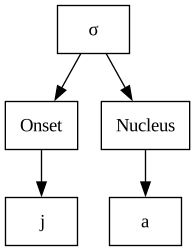 [click image to enlarge]
Some Setswana syllable can end with a coda. The coda is the sound (or sounds) that follow the nucleus or vowel. Together they are collectively known as the shell. The term rhyme covers the nucleus plus coda. The following diagram illustrates.
- Complex syllable structure in Setswana: mang ‘who’
Figure 2 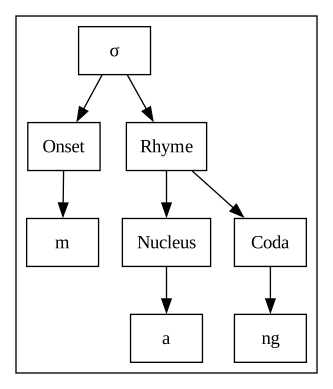 [click image to enlarge]
Setswana has essentially open syllables, that is, syllables core is made up of a consonant and a final vowel. The notion of a consonant in the sense of the structure of a syllable is a consonant or a group of consonants that make up a sound. See Table 1 for examples of this structure (listen:  ).
).
| Examples | Translation | Syllable structure |
|---|---|---|
| tlhwa-a-fa-la | ‘become serious’ | CV-V-CV-CV |
| kgwa-tla | ‘pocket’ | CV-CV |
| tla | ‘come’ | CV |
| rwa-la | ‘carry’ | CV-CV |
| n-nye-nya-ne | ‘small’ | C-CV-CV-CV |
| m-me | ‘mother’ | C-CV |
| du-me-di-sa-na | ‘greet each other’ | CV-CV-CV-CV-CV |
The syllables in Setswana can be of various length and type as some of the examples above illustrate. It can therefore be said that the common structure is as presented in the following examples. See Table 2 for examples of this structure (listen: ).
| Examples | Translation | Syllable structure |
|---|---|---|
| o | ‘you’ | V |
| e-e | ‘yes’ | V-V |
| -ga | ‘fetch water’ | CV |
| m-me | ‘mother’ | C-CV |
Setswana syllables like those of other Bantu languages are also viewed as mora, that is, they bear tones. Each syllable has a sonority that corresponds to tonal levels or pitch. Tonal sonority contrast therefore go hand in hand with syllabic contrast (Poulos & Louwrens, 1994: 443).
When Setswana acquires vocabulary from other languages, such vocabulary must be syllabified according to Setswana syllable structure.
- ‘plaas’ ‘ranch’ > polase
- ‘computer’ > khompiutara
- ‘fridge’ > foriji
- ‘slice’ > selaese
- ‘truck’ > teraka
- ‘policeman’ > lepodisi
The acquired vocabulary also confirm that Setswana syllables are of the open type. Nasal consonants in coda position are re-syllabified as syllabic nasal. For example, stamp (monosyllabic) becomes se-te-m-pe (four syllables).
Distribution and pertinence
Complementary distribution
Setswana consonant phonemes can easily be established through observation of contexts where each consonantal segment of this language may appear. There are two consonant phonemes /d/ and /l/ that have a complementary distribution which allows them to be considered as combinatory variants of the same phoneme (Cole, 1975).
- [d] appears before vowels <i> or <u>, while [l] never precedes these vowels,
- [l] appears before vowels <e>, <ê>, <a>, <ô> and <o> whereas [d] never precedes these vowels.
This rule applies even when a boundary morpheme separate <d>/<l> from the following vowel. The verbal lexeme ‘write’ -kwala gives rise to the following structures:
- base of the present positive: [-kwál-a]
- base of the present negative: [-kwál-ɪ]
- base of the subjective: [-kwál-ɛ]
- ‘letter’, ‘book’: [lʊ-kwál-ɔ]
- base of the perfect: [-kwád-ile]
- ‘writer’: [mʊ-kwád-i]
It should also be noted that borrowed words strictly follow this distribution of <d> and <l>: if a borrowed word has a <d> in front of an open vowel, in Setswana the <d> is replaced by a <t>, for example the English word ‘dip’, liquid used to kill parasites becomes tipi, ‘democracy’ becomes temokerasi, etc.
Therefore, [d] and [l] undoubtedly represent two realisations of the same phoneme which, in a strict phonological transcription, could be transcribed as /D/ to avoid any arbitrary focus on one or the other of these allophones. But this is the only point on which the distributional analysis makes it possible to reduce the consonant inventory above. Apart from this case, even if some consonants have restricted distribution or low frequency, and even if some of these consonants have fluctuations as regard to their presence in a particular lexeme, no other couple of consonants exhibits free variation or complementary distribution absolute in nature.
As far as the distribution of Setswana consonants are concerned, the following oppositions should however be noted.
Opposition between /f/ and /h/
The opposition between /f/ (or /ɸ/) and /h/ is absent from certain dialects of Setswana. These dialects overlook the fricative labial and always replaces it with an /h/. As a result, the standard dialect is characterised by a bit of hesitation between /f/ and /h/. This is manifested in the name change of a town in Botswana, e.g., Mafikeng > Mahikeng.
When the consonantal alternation system comes into contact with nasals, it should, in principle, maintain the distinction between the diaphone /f/ (which alternates with /ph/ even in dialects where it is confused with /h/) and the diaphone /h/ (which alternates with /kh/), but a certain level of confusion can be observed in Table 3 (listen: ).
| Standard | Ngwato | Neutralised | Pre-nasalised |
|---|---|---|---|
| felela | ɸelela | helela | phelelo |
| fula | ɸula | hula | phulo |
| hisa | ɸisa | hisa | phiso |
| fosa | ɸosa | hosa | phoso |
| fapha | ɸapha | hapha | phapho |
| hema | khemo | ||
| huma | khumo |
Opposition between h and χ
In dialects that distinguishes /f/ from /h/, the opposition between /h/ and /χ/ is difficult to establish because /h/, which is not a dialectal variant of /f/ often appears immediately before a closed vowel /i/ or /u/ whereas /χ/ never appears before /u/ and can only be followed by an /i/ if they are separated by a boundary (for example in /boχile/, perfect base of /-boχa/ ‘suffer harshly’).
- huma ‘be rich’
- hisa ‘burn’
- bogoma ‘stubbornness’
- bogela ‘watch’
The distribution between /h/ and /χ/ therefore evokes the distribution between /d/ and /l/ but, unlike the distribution of d/l, the distribution of /h/ and /χ/ is not absolute. Firstly, /χ/ is found at the end of a morpheme if the following morpheme starts with an /i/, whereas in the same conditions, /l/ leaves room for /d/. Secondly, this distribution can be proven false including in this case where no boundary separates /h/ or /χ/ from the following vowel. Indeed, even when considering instances where /h/ cannot alternate with /f/, cases of /h/ in front of vowels other than /i/ and /u/ have been observed, and the number of such cases is increasing as a result of borrowing from English [hámʊli]], ‘hammer’ or Afrikaans [hɛ́mpɛ], ‘shirt’). Based on these, the following comparisons could be made:
- [kí hámʊlí] ‘It's a hammer’
- [kí χámʊlɛ́] ‘(that I) wring’
It is therefore reasonable to believe that /h/ and /χ/ were originally realisations of the same phoneme, but the current language evolution has reinforced their status as distinctive phonemes and should now be considered as such.
Opposition between kh and qh
The aspirated plosives /qh/ and /kh/ raises the same problem as the fricatives /χ/ and /h/: /qh/ can only appear before /i/ if they are separated by a syllabic boundary (for example /qu-íle/, perfect base of the verb /-qu-á/ ‘spit’) and has never been observed in front of /u/ whereas /kh/ mostly appears in front of /i/ and /u/.
However, the distribution is not absolute in this case, even when restricted to situations where there is no boundary that separate these consonants from the following vowel. Some cases of /kh/ in front of non-closed vowels /khái/ ‘cloth’, /khɛ̀mɔ/ ‘breathing’ and it can be observed that words borrowed from English retain the aspirated realisation of /k/ irrespective of the following vowel (for instance /khɔ́na/ ‘turn at the corner’ which can precisely be pronounced as [kʰɔːnɘ], from the English corner). Therefore, the complementary distribution is not absolute and, although not perfect, comparisons such as the one below could be used to show at least the virtual character of the opposition:
- khái ‘cloth’
- qháitsádi ‘brother (to a sister)/sister (to a brother)’
These two sounds are therefore likely to have been variants of the same unique phoneme at an earlier state of the language but should be regarded as two different phonemes as regard to synchronic description.
It should be recalled that, whilst the phoneme /qh/ have realisations which are clearly affricated, for the coherence of the system, the + affricated trait should not be considered as a relevant characteristic of the opposition between /qh/ and /kh/. There is a fundamental difference in the place of articulation between these two phonemes which is secondarily accompanied by an irrelevant difference at the level of the occlusion release.
Opposition between lamino-alveolars and palatals
Lamino-alveolar consonants /s/, /ts/, /tsh/ can be opposed to corresponding palatals /ʃ/, /tʃ/, /tʃh/ in front of a non-labialised vowel. The following comparisons could be made:
- -sá ‘clear up’
- -ʃa ‘burn’
However, in front of a labialised vowel or a /w/, they can no longer be opposed. In this context, some dialects use the sounds /s/, /ts/, and /tsh/ while other dialects automatically use the sounds /ʃ/, /tʃ/, and /tʃh/. /-supa/ and /-ʃupa/ are two dialectal variants of the verb ‘to show’, [Mʊtswána] and [Mʊtʃwána] are dialectal variants of ‘Tswana’, etc. This type of variation is not limited to some lexemes but occurs every time such sequences occur. Phonologically, the opposition is neutralised but only in certain contexts. In front of a labialised vowel or w, the standard Setswana retains /s/, /ts/, /tsh/. Therefore, it is safe to say that in standard Setswana /ʃ/, /tʃ/, /tʃh/ are different phonemes from /s/, /ts/, /tsh/ but with restricted distribution.
References
Chebanne, A. M., Creissels, D. & Nkhwa, H. W. (1997) Tonal morphology of the Setswana verb. München: Lincom.
Clark, J. & Yallop, C. (1995) An introduction to Phonetics and Phonology. 2nd edn. Oxford: Blackwell.
Cole, D. T. (1975) Introduction to Tswana grammar, 2nd impression. Cape Town: Longman.
Crystal, D. (2006) How Language Works. London: Penguin Books.
Department of African Languages and Literature (DALL). (1999) The sound system of Setswana. Gaborone: University of Botswana.
Department of African Languages and Literature (DALL). (2001) The Sounds of Setswana, 2nd edn. Gaborone: Lentswe la Lesedi.
Ladefoged, P. & Maddieson, I. (1996) The Sounds of the world’s Languages. London: Blackwell.
Poulos, G. & Louwrens, L. J. (1994) A linguistic analysis of Northern Sotho. Pretoria: Via Afrika.