Adverbs, interjections and ideophones
This topic focuses on three syntactic categories, namely, the adverb and the adverb phrase, the interjection and the interjection phrase as well as the ideophone and the ideophone phrase. Syntactic aspects of the three categories like, the internal and external structure thereof has been explored at length and examples of them in context furnished.
Adverbs and adverb phrases
An adverb is a type of word that describes the action or adjective or an adverb in connection with manner, time, size or place (Crystal, 1980: 17). An adverb phrase is a group of two or more words that function as an adverb in a sentence, just as an adverb can modify a verb, an adjective or another adverb. An adverb phrase has an adverb as a head through which the different types of adverbs are identified, i.e., locatives, adverbs of manner derived from other parts of speech, nouns used as adverbs and adverbs without formatives. (Quirk et al., 1985)
Characterisation
In isiXhosa adverbs are divided into three categories (Taljaard & Bosch, 1988) i.e., true adverbs, inflected nouns with various formatives and adverbial constructions with ka-.
True adverbs are the original adverbs that are not derived from other parts of speech.
- True adverbs indicating time: Ufike izolo ‘He/she arrived yesterday.’
- True adverbs indicating place: Uhlala apha ‘He/she stays here.’
- True adverbs indicating manner: Udlala njalo ‘He/she always play’
Inflected nouns with various formatives: This category of adverbs consists of nouns which have been inflected by means of formatives such as:
- Locative formatives: Uthunywe kumalume. ‘He/she is being sent to uncle.’
- Instrumental nga-: Umama uhlamba ngamanzi. ‘Mother washes with water.’
- Adverbial formative na-: Uthetha nabantwana. ‘He/she speaks with the children.’
- The comparative njenga-: Utsiba njengenkawu. ‘He/she jumps like a monkey.’
- The comparative kuna-: Inja inkulu kunekati. ‘A dog is bigger than a cat.’
- Similaritive nganga-: Indlovu ingangentaba. ‘An elephant is as big as a mountain.’
Adverbial construction with ka-: “Adverbs with the morpheme ka- may be derived from numerals, adjectives or nouns. Such adverbs may denote manner or frequency”
(Du Plessis & Visser, 1992: 142).
- Adjective: Ndimbone kakuhle. ‘I saw him/her clearly.’
- Numerals: Nditye kathathu. ‘I ate three times.’
- Nouns: Undibethe kabuhlungu. ‘He/she beat me painfully.’
The internal structure of the adverb phrase
From the structural and functional point of view, each adverbial phrase must contain a head. The head is the most important word of the phrase. Headwords in adverbial phrases are basically adverbs.
- Nganeno kwengcwaba sisenokuzithandazela. ‘Before we die, we can pray for ourselves.’
- Ngaphaya kwengcwaba asisenakho. ‘Beyond the grave we cannot.’
Adverbs are words that modify verbs and adjectives. A modifier is a word, a phrase or clause which functions as an adjective or adverb, to limit or quantify the meaning of another word called the head. Modifiers can occur in all types of phrases.
- Waqhuba kancinci. ‘He drove slowly.’
- Umntu omhle kakhulu uhambile. ‘The person who is very beautiful left.’
In the first example the adverb kancinci ‘slowly’ modifies the verb waqhuba ‘drove’.
In the second example the adverb kakhulu ‘very’ modifies the adjective omhle ‘beautiful’.
Adverbs can also modify other adverbs and in this case, they are called intensifiers.
- Utata undibethe kathathu kabuhlungu. ‘Father beat me three times painfully.’
- Utitshala usibulele kamnandi kakhulu. ‘The teacher thanked us very much.’
Syntactic and semantic functions of the adverb phrase
There are various phrases in isiXhosa which may be interpreted with an adverbial function. Such phrases are usually found after the syntactic object but when adjectival agreement is present on the verb through the concord, these phrases frequently appear adjacent to the verb to put emphasis on the action (Du Plessis & Visser, 1998).
Adverbs with the adverbial affix ka-:
- Ndiyafuna baqonde izibalo kakuhle. ‘I want them to know mathematics well.’
- Ndiyafuna baziqonde kakuhle izibalo. ‘I want them to know mathematics well.’
Adverbs indicating time change or qualify the meaning of a sentence by telling us when things happen. An adverb of time is just what you might expect it to be- a word that describes when, for how long, or how often a certain action happened (Taljaard & Bosch, 1988; Satyo, 1997).
- Abantwana babuya nini esikolweni? ‘When do children return from school.’
- Abazali bafike ebusuku. ‘The parents returned late.’
In these examples the adverbs indicate the exact time the procedure happened. They are therefore complementing the verbs in the sentences.
Adverbs indicating manner are often constructed from adnominal stems, and even nouns are used, by means of the adverbial prefix ka- (Taljaard & Bosch, 1988: 42):
- Ubulewe kabuhlungu kakhulu. ‘He was brutally killed.’
- Bathethe kalusizi. ‘They spoke sadly.’
In these examples the adverbs are used as complements of the verbs. Adverbs with this morpheme ka- may be derived from numerals, adjective or nouns. Such adverbs may denote manner or frequency (Du Plessis & Visser, 1992: 142).
- Adverbs denoting manner, derived from adjectives.
- Uhambe kakuhle. He/she went well.
- Umbethe kakubi. He/she beat her badly.
In these examples the adverbs derived from adjectives complement the verbs.
- Adverbs denoting frequency.
- Ukhwaze kanye. ‘She shouted once.’
- Baphumelele kangaphi? ‘How many times did they win?’
In these examples the adverbs denoting frequency complement the verbs
- Adverbs denoting locative.
Adverbial forms in the locative indicating place can be derived from nouns by means of a prefix ku- in classes 1a, 1, 2a and 2. They form their locatives by discarding the initial vowel and substituting ku- for it.
- UThoko uye kumalume. (1a) ‘Thoko visited her uncle.’
- ULizo utyelela koomalume. (2a) ‘Lizo visited the uncles.’
- Ububele buvakala kumntu wonke. (1) ‘Kindness is felt by everybody.’
- Ububele buvakala kubantu bonke. (2) ‘Kindness is felt by everybody.’
In these examples the adverbs denoting locative are derived from nouns. They complement the verbs. The discussion above shows the use of the adverbial prefix k(a)- as the adverbs may denote manner or frequency.
- Adverbs indicating place.
Words with the prefix pha- are used as adverbial forms, but they may also occur in a subject position. The locative class pha- (class 16) plays an important role in the true adverbs indicative of place.
- Iintaka zibhabha phezulu. ‘The birds fly above.’
- Phandle ilanga lishushu. ‘Outside the sun is hot.’
In these examples the adverbials with pha- are used as complements of the subjects to complete the sentences. In the last example the adverbial form occurs in a subject position.
The following demonstratives of the pha- class are only used adverbially (Taljaard & Bosch, 1988: 41; Satyo, 1997: 75).
- UZikhona uhlala apha. ‘Zikhona stays here.’
- UYandisa uhlalaapho. ‘Yandisa stays there.’
- UKhaya uhlalaphaya. ‘Khaya stays yonder.’
In these examples the adverbials are used as complements of the verbs in the sentences.
In the examples below the adverbs indicate the exact time the procedure happened. They are therefore complementing the verbs in the sentences.
- Abazali bafike ebusuku. ‘The parents returned late.’
- UNolitha ufike izolo. ‘Nolitha arrived yesterday.’
Syntactic uses of adverb phrase
In isiXhosa the adverb takes up a position following the verb.
- Ndidiniwe ngoku. ‘I’m tired now.’
- Sitya kaninzi. ‘We eat often.’
When two or more adverbs are used and one is an interrogative, the latter will follow the predicate first. The others have no fixed position in the sentence.
- Uya kangaphi phaya kusasa? ‘How often does he go yonder in the morning?’
- Uya kangaphi kusasa phaya? ‘How often does he go in the morning?’
The exception is the interrogative na? which is preferable used at the end of a sentence.
- Uya phaya kusasa na? ‘Is he/she going yonder in the morning?’
- Bahlala apho na? ‘Do they stay there?’
When the long present tense or the long perfect is used, na? can be used immediately on the predicate.
- Bayahamba ngoku na? / Bayahamba na ngoku? ‘Are they going away now.’
- Uhambile izolo na? / Uhambile na izolo? ‘Did he/she leave yesterday?’
In sentences containing object nouns, an adverb may follow the verb directly, provided the object is represented in the predicate by means of an object concord.
- Uzihlamba apha iilokhwe. ‘She washes the dresses here.’
- Uzihlamba nini izitya? ‘When does she wash the dishes.’
When particular emphasis is made on an adverb, it can stand at the beginning of a sentence.
- Ngoku siyaphumla. ‘Now we rest.’
- Kanene bangaphi abantwana bakho? ‘Anyway how many kids do you have?’
Interjections and interjection phrases
An interjection is a word which can be used independently without any agreement that connect it with other words in the sentence. They have functions rather than meanings and they differ according to the regions (Norrick, 2009).
Characterisation
According to Ameka (1992) interjections are classified into primary and secondary interjections. Primary interjections are not used otherwise. They are non-words which in terms of their distribution can constitute an utterance by themselves and do not normally enter into a construction with other word classes.
- Awu! > ‘Ouch!’, E-e! > ‘Gee!’, Owu! > ‘Oho!’, Eyi! > ‘Oops!’
They can be used as co-utterances with other units.
- E-e! Ujongeka ngathi awonwabanga. ‘Gee, you look like you had it.’
Secondary interjections are forms that belong to other word classes based on their meanings, they can be independent and can be used to express a mental attitude or state. In addition, interjections can be found from nouns, apparent verbs and phrases.
- Nceda! ‘Help!’
- Umlilo! ‘Fire!’
- Enkosi Bawo! ‘Thank God!’
Generally, interjections can be classified into three types of meaning: volitive, emotive and cognitive. Volitive interjections function as imperative or directive expression, requesting or demanding something from the addressee (e.g., Shh! = thula > Shh! = ‘be quiet!’). Emotive interjections are used to express emotions, such as disgust and fear (Mfm = ukukruquka > Yuck = ‘disgust’). Cognitive interjections express feelings which are more related to cognition or information known to the speaker of the utterance (Whow = umothuko > ‘wow’ = surprise)
Interjections are unique and have some interesting features:
- Interjections don’t have a grammatical function in the sentence construction.
- They usually cannot be modified or inflected.
- They do not have to have a relation to the other parts of the sentence.
- They are highly context sensitive (Andrason & Matutu, 2019: 14).
The internal structure of the interjection phrase
Interjections can come in the form of a single word, a phrase or even a short clause. Aside from that, they are usually (but not always) placed at the beginning of a sentence.
The structure is only a single word which is the head of the interjection phrase.
- Suka! Kuyatsha apha. ‘Move! This place is burning.’
- Halala! Kuyatshatwa namhlanje. ‘Congratulations! It’s a wedding day.’
The interjection phrase is constructed as a head.
- Hayi ke! Okwenzekileyo kwenzekile! ‘Oh! Well what’s done is done!’
- Owu! Nyhani! Khange ndimcingele ukuba ngumntu onjalo! ‘Oh! Really I never thought he’s that kind of guy!’
Interjections can consist of a short clause as a head with a qualifying utterance.
- Ibhasi iwile entabeni. Yho! Bafa abantu! ‘The bus has fallen at the mountain. Oh! People died!’
- Halala! Halala! Yeha! Yabuy’indodana ‘Hurah! Hurah! The young man is back.’
Syntactic and semantic functions of the interjection phrase
Interjections mainly have four roles.
- Role 1: Interjections express a sudden mood, emotions and feeling with emphasis. There are also many taboo words in every conversation, but not informal aspects. These words fall into the category of interjections.
- Whow! Ngumbono omangalisayo lowo. ‘Wow! That’s an amazing scene.’
- Awu! Bendingafuni eze. ‘Aw! I did not want him to come.’
- Intoni! Zange undixelele loo nto mna. ‘What! You never told me that.’
- Role 2: Some interjections interrupt a conversation or a thought or hold someone’s attention for a moment. These are just sounds, not words because these sounds do not make any sense.
- Mh! Ihempe yakho imdaka ngemva. ‘Mh! Your shirt has a stain on the back.’
- Ndifuna, uh, ukukukhupha. ‘I want to, uh, ask you out on a date.’
- Role 3: Some interjections express only yes or no.
- Ewe! Ngokuqinisekileyo ndakuyenza. ‘Yes! I will most definitely do it.’
- Hayi, asihambi. ‘No we are not going.’
- Role 4: Some interjections are used to get someone’s attention.
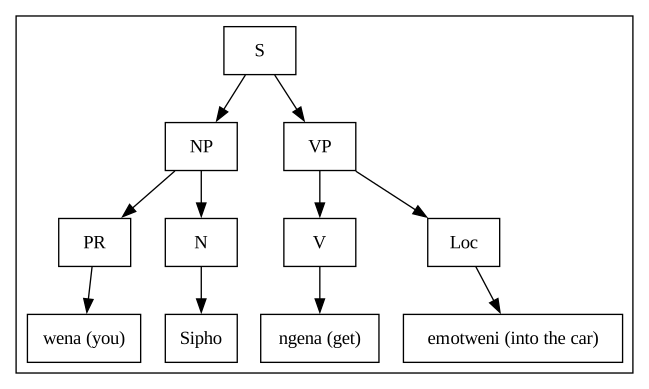
- Wena, Sipho! Ngena emotweni! ‘You, Sipho! Get in the car!’
- Yhe wena! Sapha loo bhola. ‘Hey! Will you give that ball?’
Projection of interjection phrase
The following tree diagram represents the projection of interjection phrases.
Syntactic uses of interjection phrase
Interjections are words which are used to express emotions. Different parts of speech may be used as interjections (Taljaard & Bosch, 1988).
- Interjections which express permission, agreement.
- Ewe! ‘Yes!’
- Heke! ‘That’s right’
- Interjections that express denial, negation, refusal.
- Hayi! ‘No!’
- Hayibo! ‘Not at all’
- Hayikhona! ‘Never’
- Interjections expressing surprise, joy, disappointment:
- Awu! ‘Surprise!’
- Halala! ‘hurrah’
- Imperatives may also be considered to be interjective.
- Mbambe! ‘Catch him/her’
- Suka! ‘Go away!’
- Musa! ‘Don’t’
The suffix –ndini may be used not only to express derogation, but also to express familiarity and admiration.
- Ntombindini! ‘You beautiful girl!’
- Ndodandini! ‘You good man!’
- Kufandini! ‘You cruel death!’
Ideophones and ideophone phrase
The main focus of this section is the elucidation of the internal and external syntactic structure of an isiXhosa ideophone phrase (IP). Possible constituents of both structures are also identified and presented. The internal structure of an isiXhosa IP includes aspects like, the head, word order and agreement. The external syntax of an isiXhosa ideophone on the other hand presents its functions in larger constructions. The ideophone on its own will not be discussed here; rather, its syntactic use will be our focus.
The section below presents characterisation of the IP, its internal structure, its syntactic and semantic functions, projection, and the syntactic uses of ideophone phrases.
Characterisation
As a syntactic category, the ideophone has a structure that is peculiar to itself within the IP. Accordingly, it is a part of speech that has no corresponding form in English. The IP has verbal properties that may display a dramatic description of an action (Taljaard & Bosch, 1988). It mostly follows the verb stem –thi as a descriptive. The stem –thi in such cases takes the function of an auxiliary verb.
However, in some instances it appears as a predicate. The verb stem –thi in some cases may be left out and the ideophone stands independently as in the following sentences:
| Imhlophe qhwa le hempe. |
| COPP DemP NP |
| The shirt is pure white (in colour). |
| Hlasi imbiza inkwenkwe, ngcee entloko. |
| IP NP NP IP NP |
| Object Subject AdvP |
| The boy grabbed the pot, [and] carried it on his head. |
- The copulative phrase (COPP) in the first example above, comprises of the copulative and the ideophone.
- The IP in the second example above has taken an object which therefore implies that some IPs have transitive features although other IPs may have intransitive features.
- The verb phrase (VP) and the ideophonic phrase (IP) can substitute each other in a sentence without tempering with the grammaticality of the sentence. Look closely at the following three sentences below:Example 3
Latshona emanzini isele. VP AP NP The frog jumped into the water. Example 4Dyumpu emanzini isele. IP AP NP The frog jumped into the water. Example 5Lithe dyumpu emanzini isele. IP AP NP The frog jumped into the water. The three sentences above mean exactly the same.
- In some instances, the verb phrase may be used simultaneously with the ideophone phrase, with the IP appearing after the VP that is in the indicative mood. In such cases the VP states the case (the action), while the IP dramatizes the action that is suggested by the VP as in the following sentence:Example 6
Wawa bhaxa eludakeni. VP IP AP He/she fell boom in the mud. The VP in the above sentence syntactically precedes the IP.
- The IP can duplicate itself in some instances for particular reasons. In such cases, vowel assonance is observed.Example 7
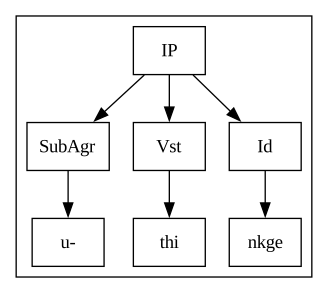
Yathi nkqe nkqe nkqe intsimbi yecawe. (Lit: It said nkqe nkqe nkqe the bell of the church.) The church bell rang and rang and rang.
The following tree diagram presents the constituent structure of the last example above.
The internal structure of the ideophone phrase
As alluded to above, the IP comprises the verb stem –thi and the ideophone, e.g., Yithi tu! ‘Be quiet!’. It is this verb stem –thi, that incorporates important aspects like the concordial agreement, tenses, moods and conjugation. That the IP becomes the Head of the ideophonic phrase derives from the stem –thi within the IP since it, (stem –thi) takes the concordial agreement. It is this concordial agreement that renders the IP syntactically correct as it (IP) agrees with the subject through the stem –thi:
- Uthe ngqe wagoduka. ‘He/she ran swiftly home.’
In this example the IP has been modified by the adverb.
The IP can even take an object concord in this same manner; namely, the object concord appearing after the subject concord, e.g.,
- Umthe qhwa ngempama. ‘He/she slapped her/him on the face.’
- u – subject concord
- m – object concord
The IP can function as a complement to a VP when the IP is operating without the verb stem –thi. As illustrated by the example above.
The basic position that the IP occupies is a sentence is that of following the subject of the sentence, hence the subject concord in this example. However, in some cases it may syntactically occupy any position within the sentence as will be discussed below.
The IP without the verb stem –thi
The IP may operate without the verb stem –thi and may also appear after the qualificative phrase (QualP) as its modifier.
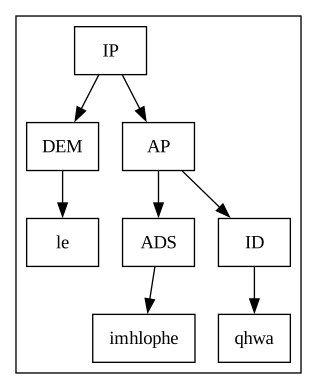
- Le imhlophe qhwa ihempe. ‘This snow white shirt.’
The following tree diagram illustrates the above constituent structure in this example:
Syntactic functions of the ideophone phrase
This sub-heading specifically deals with the external syntax of an isiXhosa ideophone phrase, i.e., it presents its functions and uses with respect to larger constructions. Below is presented possible functions of the IP.
- In instances where the IP is preceded by the VP, the IP provides a dramatic description to actions or states, in relation to manner, colour and sound (Taljaard & Bosch, 1988).Example 8
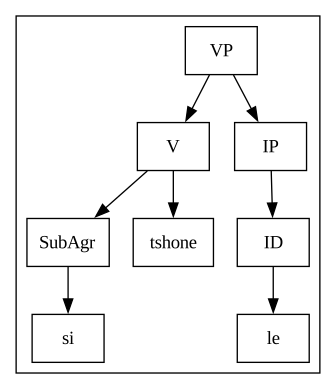
Sitshone le ematyaleni. VP IP AP We are knee deep in dept.
The following tree diagram presents the constituent structure of VP in the example above.
- The verb stem –thi that forms part of the IP mostly functions as the bearer of inflection and derivation, followed by the ideophone (Taljaard & Bosch, 1988; Du Plessis & Visser, 1992; Pahl, 1982; Satyo, 1997). The incorporation of these morphemes facilitates the IP to have transitive and intransitive features, moods and tenses.
Transitive and Intransitive features
In both cases the ideophone phrase appears immediately after the VP since it is the complement of the verb.
- Transitive:
- Umthe xhwi umntwana wahamba naye. ‘He/she snatched the child and left with her/him.’
- Intransitive:
- USisa ubile ntsi. ‘Sisa is sweating heavily.’
- Uhleli bhaxa phantsi. ‘He/she is seated flat on the floor.’
Moods
In this case the verb phrase and the ideophone are used simultaneously with the IP following the VP
- The imperative mood:
- Yithi gu bucala. (singular) ‘Move aside.’
- Yithani gu bucala. (plural) ‘Move aside.’
- The indicative mood:
- Ndimthe tshuphe ezo ndaba. (singular) ‘I have told him/her the news.’
- Ndibathe tshuphe ezo ndaba. (plural) ‘I have told them the news.’
- The subjunctive mood:
- Thu! izinja besancokola, saa! amakhwenkwe ethafeni. ‘Dogs appeared while they were talking, boys were scattered in the field.’
In the subjunctive mood, the IP occurs as a subordinate clause of the main clause.
- Thu! izinja besancokola, saa! amakhwenkwe ethafeni. ‘Dogs appeared while they were talking, boys were scattered in the field.’
References
Andrason, A. & Matutu, H. (2019) The syntax of interjections in isiXhosa: A: a corpus-driven study. Stellenbosch Papers in Linguistics Plus. 58, 1-16.
Ameka, F. (1992) Interjections: The universal yet neglected part of speech. Journal of Pragmatics 18,101-118.
Crystal, D. (1980) A first Dictionary of Linguistics and Phonetics. London: Andre Deutsch Limited
Du Plessis, J. A. & Visser, M. (1992) Xhosa Syntax. Pretoria: Via Afrika.
Du Plessis, J. A. & Visser, M. (1998) Xhosa ‘Syntax’. Stellenbosch Communications in African Languages. 7.
Norrick, N. R. (2009) ‘Interjections as pragmatic markers’. Journal of Pragmatics. 41, 866-891.
Pahl, H. W. (1983) IsiXhosa. Johannesburg: Educum Publishers.
Quirk, R., Greenbaum, S., Leech, G & Svartvik, J. (1985) A Comprehensive Grammar of the English Language, London: Longman.
Satyo, S. C. (1997) Igrama Noncwadi LwesiXhosa Ibanga 9. Pretoria: Via Afrika.
Taljaard, P. C. & Bosch, S. E. (1988) Handbook of isiZulu. Pretoria: Van Schaik.