Nouns and noun phrases
In this topic, an exposition of the Setswana NP is presented regarding its possible constituents, the word order followed and the agreement phenomena that govern the syntactic structure of an NP.
Nouns and noun phrases
The structuring of a noun phrase (NP) involves two aspects i.e., its internal and external syntax. The internal syntax takes account of how an NP itself is constructed in a well-formed manner whereas the external syntax is concerned with how an NP can be used in larger constructions. An important fact with regard to the phrase-internal syntax of the Setswana NP is that it may constitute a single word or a word group consisting of a noun followed by a modifier (qualificative, qualifier or adjunct). In both instances the noun is the obligatory element in the NP and it functions as the head (Berg, 2018: 105-107).
To follow the characterisation of nouns, the internal structure of the NP, the syntactic uses and semantic functions, modification, the syntactic functions of the NP and coordination where NPs are involved are discussed.
Characterisation of nouns
Setswana nouns are morphologically productive and constitute an open word category and, as such, cannot be exhaustively listed. The classification of nouns into numerous noun classes is a general feature of the Bantu languages. This is also the case in Setswana as 20 noun classes are distinguished. Nouns belong to a specific class based on the form of their class prefixes and to a lesser extent, their meaning (Louwrens, 1994: 126). These noun classes are divided into the non-infinitive noun classes (classes 1 to 14), the infinitive noun class (class 15), and the locative class nouns (class 16-20) (Krüger, 2006: 57-98).
The nouns in classes 1 to 14 are ordinary (basic or common) nouns and their morphological structure consists of a class prefix and a root. In the first example the noun monna ‘man’ contains a class prefix mo- and a root -nna. The nouns in classes 1 to 14 typically have singular-plural pairings. The odd class numbers express the singular and the corresponding even class numbers, the plural. In the first example the class prefix mo- of class 1 indicates the singular and in the second example the class prefix ba- of class 2 indicates the plural.
| monna |
| mo- nna |
| NPre1- man |
| man |
| banna |
| ba- nna |
| NPre2- man |
| men |
Although a noun usually contains a class prefix and a root some nouns may have a morphological structure that includes two class prefixes and a root. In this instance a denominative noun is formed by the “preprefixing or superaddition of a prefix”
(Cole, 1955: 104-105). For example, in the example below the noun bomorafe ‘nationhood’ is formed from the noun morafe ‘nation’.
| morafe > bomorafe |
| mo- rafe > bo- mo- rafe |
| NPre3-nation > NPre14-NPre3-nation |
| nation > nationhood |
The ordinary nouns in noun classes 1 to 14 have valence for four suffixes as these nouns can be inflected with a locative suffix (4), a diminutive suffix (5) and, in a smaller number of instances, a feminine suffix (6) or an augmentative suffix (7). These suffixes can also occur in combinations if the combinations are semantically viable. The morphological structure of nouns that include these suffixes are described in detail in the Morphology section (cf. Cole, 1955: 102, 126; Krüger, 2006: 73, 92).
| sekolong |
| se- kolo- (I)ng |
| NPre7-school-LocSuf |
| school locality |
| thipana |
| (ne-)-thipa-ana |
| NPre9-knife-DimSuf |
| small knife |
| kgosigadi |
| (ne-)-kgosi-gadi |
| NPre9-king- FemSuf |
| chief's wife, queen |
| podigadi |
| (ne-)-podi-gadi |
| NPre9-goat-AugSuf |
| very big goat |
Nouns in classes 1 to 14 can also be derived from other word classes. They can be derived from a verb, another noun, a pronoun, adjective, adverb, ideophone or interjection (Cole, 1955: 103-126). For example, a deverbative noun is derived from an infinitive verb. The infinitive prefix go- is substituted with a noun class prefix and the ending -a of the infinitive is substituted with a deverbative suffix -i (8) or -ô (9). In some deverbative nouns the suffix -a (10) is kept and a few deverbative nouns, that are limited in number take the suffixes -u (11) and -e (12). (cf. Cole, 1955: 113-116; Krüger, 2013a: 115-117).
| go huma > mohumi |
| go- hum- a > mo- hum- i |
| NPre15-become rich-VEnd > NPre1-become rich-DevSuf |
| to become rich > wealthy person |
| go busa > mmusô |
| go- bus- a > mo- bus- ô |
| NPre15-govern-VEnd > NPre3-govern-DevSuf |
| to govern > government |
| go disa > modisa |
| go-dis-a > mo-dis-a |
| NPre15-herd-VEnd > NPre1-herd-DevSuf |
| to herd, to look after > shepherd, guard |
| go bola > sebodu |
| go- bol-a > se- bod-u |
| NPre15-rot-VEnd > NPre5-rot-DevSuf |
| to rot > rotten thing |
| go ipôna > seipônê |
| go- i- bôn-a > se- i- bôn-ê |
| NPre15-ReflPre-see-VEnd > NPre7-ReflPre-see-DevSuf |
| to see oneself > mirror |
The term infinitive refers to a noun or a verb. The nouns in class 15 are infinitive nouns. They do not denote singular or plural (Krüger, 2006: 92-93). The morphological structure of an infinitive noun includes a class prefix go- as well as a verb root and an ending -a (13).
| go bua |
| go- bu- a |
| NPre15-speak-VEnd |
| to speak |
The infinitive noun has valence for a locative (14) and/or a diminutive suffix (15) (Krüger, 2006: 97).
| go dumiseng |
| go- dumis- a- ing |
| NPre15-pronounce-VEnd-LocSuf |
| the pronouncing locality |
| go buanyana |
| go- bu- a- ana |
| NPre15-talk-VEnd-DimSuf |
| to speak a little bit |
The nouns in classes 1 to 15, whether ordinary or derived are included in the syntactic structure of noun phrases. The nouns in classes 15 to 20 denotes the locative class nouns and their inclusion in syntactic structures will be discussed in the Topic about Locative phrases.
The internal structure of the noun phrase
An NP can be constructed with a word or a word group. In this instance the word is a noun and the word group is a noun group.
The NP constructed with only a noun
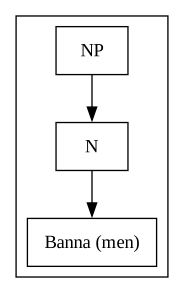
The NP can consist of only a head as it does not need an obligatory complement or a possible modifier to form a grammatical structure. The head is a basic noun in noun classes 1 to 14 or an infinitive noun belonging to noun class 15. The nouns of noun classes 1 to 14 do not only consist of basic nouns but also of nouns that are inflected with a locative suffix, a diminutive suffix, a feminine suffix or an augmentative suffix and nouns that are derived from other words (see examples (4) to (12) above). The infinitive nouns of class 15 can also be inflected with a locative or diminutive suffix (see example (14) and (15) above). The nouns in classes 1 to 15 can be used to construct the minimal structure of an NP as the NP can only consist of a head. In (16) the head in the NP consists of the noun banna ‘men’. This phrase constitutes a minimal phrase structure.
| Banna ba a bua. |
| ba- nna ba -a -bu -a |
| NPre2-man AgrSubj2-PresPre-speak-VEnd |
| The men are speaking. |
The phrase structure rule for the NP in (16) is:
- NP → N
The following tree diagram represents the constituent structure of the NP in (16).
The NP constructed with a noun group
The NP can also be constructed with a noun group and in this instance the noun group consists of a head noun followed by one or more than one modifier. Krüger (2013a: 58) refers to a noun group as a nominal group and states that this word group “consists of an antecedent and one or more qualifier/qualifiers”
. The antecedent is thus the head noun and the qualifier/qualifiers are a word or word group that modifies the head noun.
To follow an exposition of possible modifiers is presented and the word order followed and the agreement phenomena that govern the structure of an NP (NP internal agreement) are also clarified.
Noun modified with a pronoun
An NP may be constructed with a noun followed by an absolute pronoun, a demonstrative pronoun or a quantitative pronoun. Krüger (2006: 137-139) distinguishes between inclusive, exclusive, selective, separative and interrogative quantitative pronouns. Take note that Cole (1955: 148-153) refers to the exclusive, separative and interrogative pronouns as enumeratives. A pronoun is a head in a pronoun phrase (PROP) and the PROP functions as a modifier of a head noun. The phrase structure rule for the NP then is NP → N PROP. One must keep in mind that the NP may also be modified with a PROP that consists of a pronoun that in turn is modified by another word or phrase. In this section an exposition is presented of an NP that consists of a noun and a PROP that only consists of a head pronoun. (See the Topic on Pronouns and Pronoun phrases for an exposition of the syntactic structure of the PROP that consists of only heads and of heads and modifiers.)
- Noun modified with an absolute pronoun
An NP can consist of a head noun followed by an absolute pronoun as the modifier. The absolute pronoun shows agreement with the preceding noun as both are indicating noun class 2 agreement.
Example 17banna bone ba- nna bone NPre2-man AbsPro2 the men in particular Two phrase structure rules are applicable to the NP presented in (17):
- NP → N PROP
- PROP → AbsPro
The following tree diagram represents the constituent structure of the NP in (17).
Figure 2 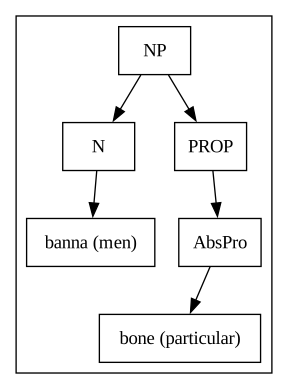 [click image to enlarge]
 - Noun modified with a demonstrative pronoun:
An NP can consist of a head noun followed by a demonstrative pronoun as the modifier. The demonstrative pronoun in (18) shows agreement with the preceding noun as both are indicating noun class 2 agreement.
Example 18banna bao ba- nna ba NPre2-man DemPro2D1 these men Two phrase structure rules are applicable to the NP presented in (18):
- NP → N PROP
- PROP → DemPro
The following tree diagram represents the constituent structure of the NP in (18).
Figure 3 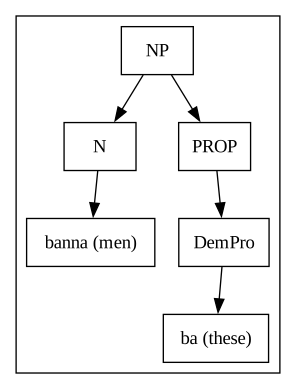 [click image to enlarge]
 - Noun modified with an inclusive quantitative pronoun:
An NP can consist of a head noun followed by an inclusive quantitative pronoun as the modifier. The inclusive quantitative pronoun in (19) shows agreement with the preceding noun as both are indicating noun class 2 agreement.
Example 19banna botlhe ba- nna botlhe NPre2-man IncQPro2 all the men Two phrase structure rules are applicable to the NP presented in (19):
- NP → N PROP
- PROP → IncQPro
The following tree diagram represents the constituent structure of the NP in (19).
Figure 4 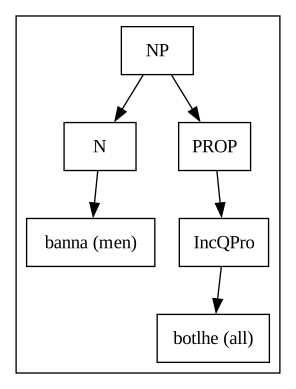 [click image to enlarge]
 - Noun modified with an exclusive quantitative pronoun:
An NP can consist of a head noun followed by an exclusive quantitative pronoun as the modifier. The exclusive quantitative pronoun in (20) shows agreement with the preceding noun as both are indicating noun class 2 agreement.
Example 20banna bape ba-nna bape NPre2-man ExcQPro2 no men Two phrase structure rules are applicable to the NP presented in (20):
- NP → N PROP
- PROP → ExcQPro
The following tree diagram represents the constituent structure of the NP in (20).
Figure 5 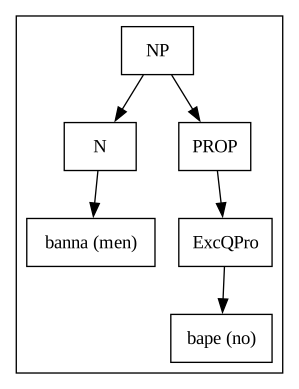 [click image to enlarge]
 - Noun modified with a selective quantitative pronoun:
An NP can consist of a head noun followed by a selective quantitative pronoun as the modifier. The selective quantitative pronoun in (21) shows agreement with the preceding noun as both are indicating noun class 2 agreement.
Example 21banna bosi ba- nna bosi NPre2-man SelQPro2 only the men Two phrase structure rules are applicable to the NP presented in (21):
- NP → N PROP
- PROP → SelQPro
The following tree diagram represents the constituent structure of the NP in (21).
Figure 6 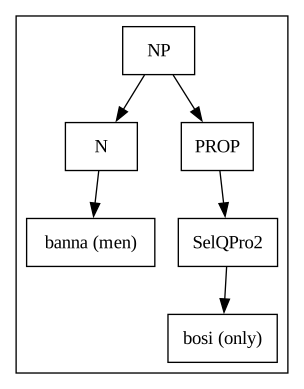 [click image to enlarge]
 - Noun modified with a separative quantitative pronoun:
An NP can consist of a head noun followed by a separative quantitative pronoun as the modifier. The separative quantitative pronoun in (22) shows agreement with the preceding noun as both are indicating noun class 10 agreement.
Example 22ditsela disele di- tsela disele NPre10-road SepQPro10 other/different roads Two phrase structure rules are applicable to the NP presented in (22):
- NP → N PROP
- PROP → SepQPro
The following tree diagram represents the constituent structure of the NP in (22).
Figure 7 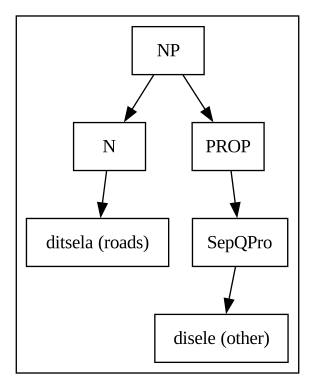 [click image to enlarge]
 - Noun modified with an interrogative quantitative pronoun:
An NP can consist of a head noun followed by an interrogative quantitative pronoun as the modifier. The interrogative quantitative pronoun in (23) shows agreement with the preceding noun as both are indicating noun class 4 agreement.
Example 23metse efe? me- tse efe NPre4-village IntQPro4 which villages? Two phrase structure rules are applicable to the NP presented in (23):
- NP → N PROP
- PROP → IntQPro
The following tree diagram represents the constituent structure of the NP in (23).
Figure 8 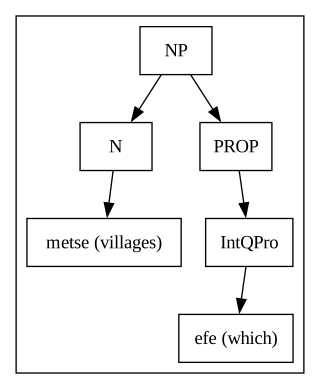 [click image to enlarge]
Noun modified with an adverb
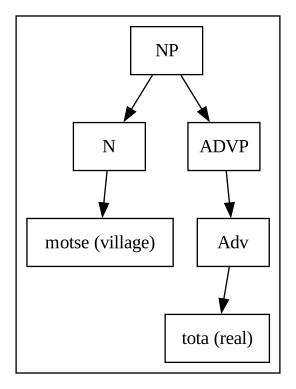
An NP can consist of a head noun followed by an adverb phrase (ADVP). The ADVP in (24) consists of only an adverb and this adverb does not show agreement with the preceding noun (24).
| motse tota |
| mo- tse tota |
| NPre3-village Adv |
| real village, real home |
Two phrase structure rules are applicable to the NP presented in (24):
- NP → N ADVP
- ADVP → Adv
The following tree diagram represents the constituent structure of the NP in (24).
Noun modified with a possessive particle phrase
An NP can consist of a head noun followed by a possessive particle phrase (‘POSSPARTP’) as the modifier. The ‘POSSPARTP’ is also referred to as a possessive particle group (Krüger, 2013a: 63). The head of the POSSPARTP is a possessive particle and it is followed by a complement which is a compulsory word or word group. The possessive particle is class bound and shows agreement with the preceding noun. Only the possessive particle in the POSSPARTP exhibits agreement with the class of the head noun. The complement of a possessive particle provides the particulars with which the possessive particle activates a relation with the head noun (cf. : Krüger, 2013a: 107-122). (The syntactic structure of the POSSPARTP is discussed in the Topic on Particles and Particle phrases.)
The complements of a possessive particle can be a demonstrative pronoun (25), a possessive pronoun (26), an inclusive quantitative pronoun (27), an exclusive quantitative pronoun (28), an interrogative quantitative pronoun (29), and adverb phrase (‘ADVP’) (30), an NP (31), a qualificative particle phrase (QUALPARTP) (32) or another POSSPARTP (33).
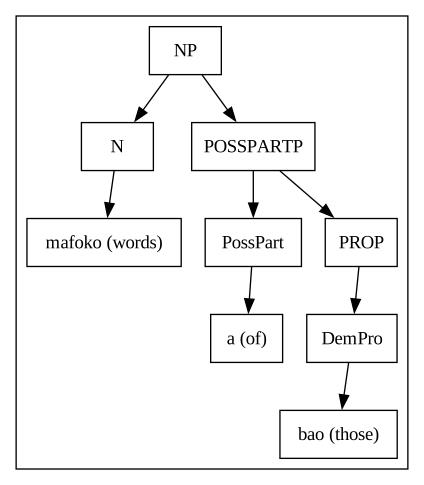
In (25) the NP consists of the head noun maduô ‘payment’ and the POSSPARTP a bao ‘of those’ as modifier. The possessive particle a shows agreement with the preceding noun as both are indicating noun class 6 agreement.
| maduô a bao |
| ma- duô a bao |
| NPre6-results PossPart6 DemPro2D2 |
| the payment of those (the salary of those) |
Three phrase structure rules are applicable to the NP presented in (25):
- NP → N POSSPARTP
- POSSPARTP → PossPart PROP
- PROP → DemPro
The following tree diagram represents the constituent structure of the NP in (25).
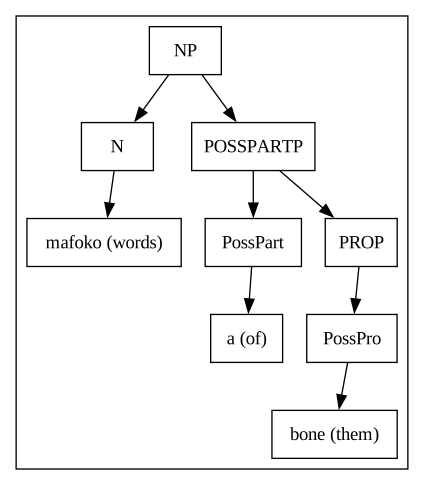
In (26) the NP consist of the head noun mafoko ‘words’ and the POSSPARTP a bone ‘of them’ as the modifier. The possessive particle a shows agreement with the preceding noun as both are indicating noun class 6 agreement.
| mafoko a bone |
| ma- foko a bone |
| NPre6-word PossPart6 PossPro2 |
| their words |
Three phrase structure rules are applicable to the NP presented in (26):
- NP → N POSSPARTP
- POSSPARTP → PossPart PROP
- PROP → PossPro
The following tree diagram represents the constituent structure of the NP in (26).
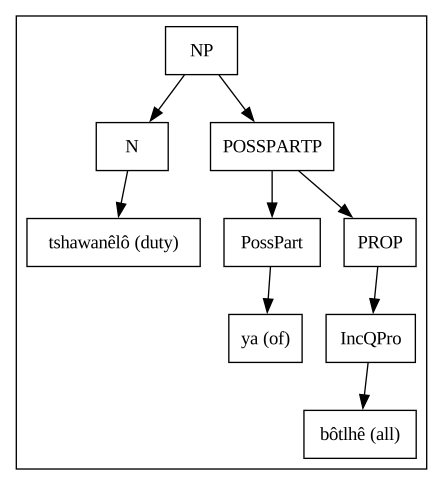
In (27) the NP consist of the head noun tshwanêlô ‘duty’ and the POSSPARTP ya bôtlhê ‘of all’ as the modifier. The possessive particle ya shows agreement with the preceding noun as both are indicating noun class 9 agreement.
| tshwanêlô ya bôtlhê |
| (ne-)-tshwanel-ô ya bôtlhê |
| NPre9-duty- DevSuf PossPart9 IncQProPro2 |
| the duty/obligation of all |
Three phrase structure rules are applicable to the NP presented in (27):
- NP → N POSSPARTP
- POSSPARTP → PossPart PROP
- PROP → IncQPro
The following tree diagram represents the constituent structure of the NP in (27).
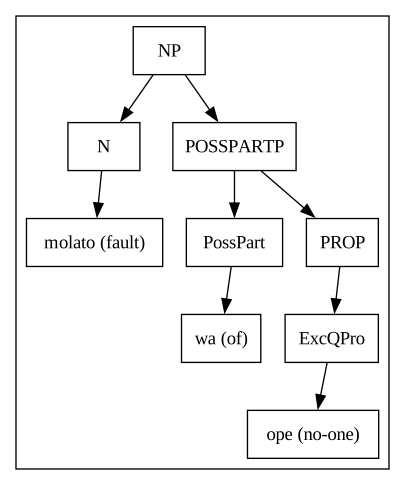
In (28) the NP consist of the head noun molato ‘fault’ and the POSSPARTP wa ope ‘of no-one’ as the modifier. The possessive particle wa shows agreement with the preceding noun as both are indicating noun class 3 agreement.
| molato wa ope |
| ma- foko wa ope |
| NPre3-fault PossPart3 ExcQPro1 |
| no one's fault |
Three phrase structure rules are applicable to the NP presented in (28):
- NP → N POSSPARTP
- POSSPARTP → PossPart PROP
- PROP → ExcQPro
The following tree diagram represents the constituent structure of the NP in (28).
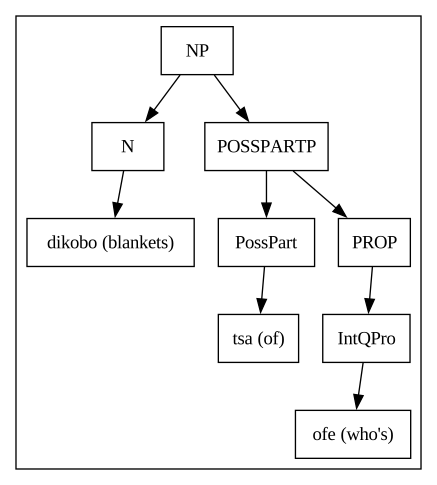
In (29) the NP consist of the head noun dikobo ‘blankets’ and the POSSPARTP tsa ofe? ‘of whom?’ as the modifier. The possessive particle tsa shows agreement with the preceding noun as both are indicating noun class 10 agreement.
| dikobo tsa ofe? |
| di- kobo tsa ofe |
| NPre10-blanket PossPart10 IntQPro1 |
| who's blankets? |
Three phrase structure rules are applicable to the NP presented in (29):
- NP → N POSSPARTP
- POSSPARTP → PossPart PROP
- PROP → IntQPro
The following tree diagram represents the constituent structure of the NP in (29).
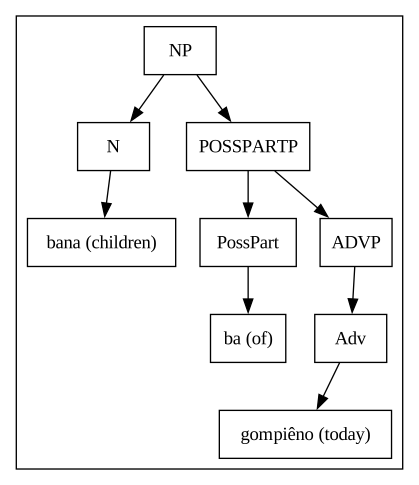
In (30) the NP consist of the head noun bana ‘children’ and the ADVP ba gompiêno ‘of today’ as the modifier. The possessive particle ba shows agreement with the preceding noun as both are indicating noun class 2 agreement.
| bana ba gompiêno |
| ba- ana ba gompiêno |
| NPre2-child PossPart2 Adv |
| today's children (children of nowadays) |
Three phrase structure rules are applicable to the NP presented in (30):
- NP → N POSSPARTP
- POSSPARTP → PossPart ADVP
- ADVP → Adv
The following tree diagram represents the constituent structure of the NP in (30).
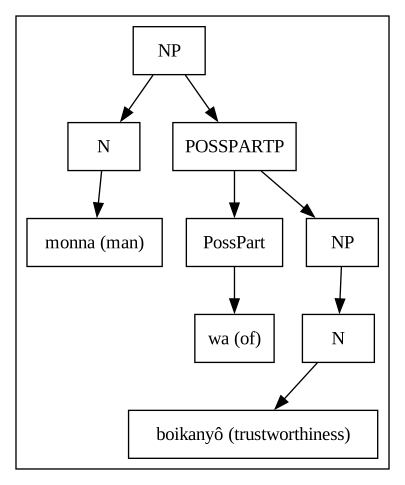
In (31) the NP consist of the head noun monna ‘man’ and the POSSPARTP wa boikanyô ‘of trustworthiness’ as the modifier. The possessive particle wa shows agreement with the preceding noun as both are indicating noun class 1 agreement.
| monna wa boikanyô |
| mo- nna wa bo- ikanyô |
| NPre1-man PossPart1 NPre14-trust |
| a man of trustworthiness |
Three phrase structure rules are applicable to the NP presented in (31):
- NP → N POSSPARTP
- POSSPARTP → PossPart NP
- NP → N
The following tree diagram represents the constituent structure of the NP in (31).
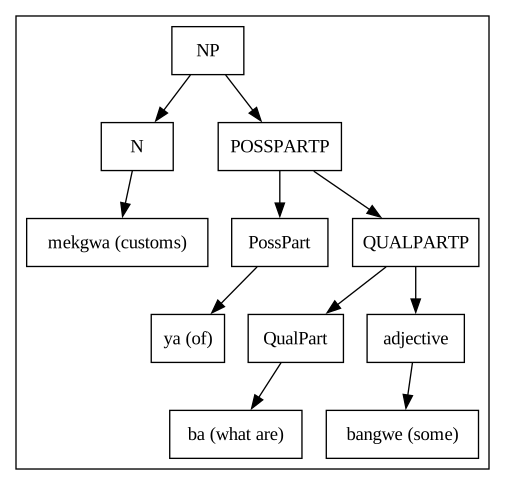
In (32) the NP consist of the head noun mekgwa ‘customs’ and the POSSPARTP ya ba bangwe ‘of others’ as the modifier. The possessive particle ya shows agreement with the preceding noun as both are indicating noun class 4 agreement.
| mekgwa ya ba bangwe |
| me- kgwa ya ba ba- ngwe |
| NPre4-custom PossPart4 QualPart2 NPre2-adjective |
| the customs of others |
Three phrase structure rules are applicable to the NP presented in (32):
- NP → N POSSPARTP
- POSSPARTP → PossPart QUALPARTP
- QUALPARTP → QualPart Adjective
The following tree diagram represents the constituent structure of the NP in (32).
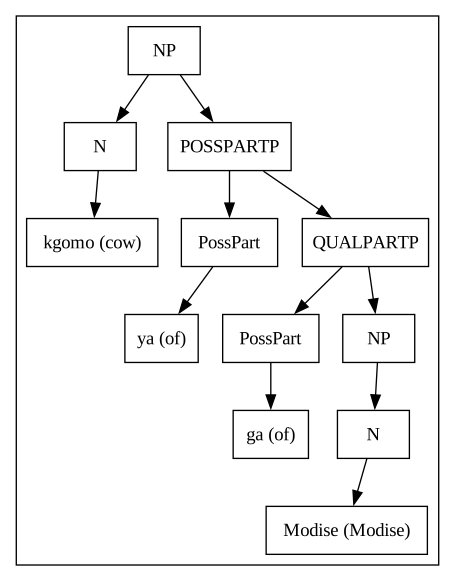
In (33) the noun kgomo ‘cow’ is modified with the POSSPARTP ya ga Modise ‘of of Modise’ as the modifier. This POSSPARTP consists of the possessive particle ya ‘of’ and another POSSPARTP ga Modise ‘of Modise’. The noun kgomo ‘cow’ is in noun class 9 and the corresponding possessive particle for this class is ya ‘of’. The POSSPARTP ga Modise ‘of Modise’ consists of the possessive particle ga ‘of’ of classes 16 to 20 and the proper name Modise ‘name of a person’. In a PossPart such as this the possessor is always a human.
| kgomo ya ga Modise |
| (ne-)-kgomo ya ga (-)- Modise |
| NPre9-cow PossPart9 PossPart16 NPre1a-Modise |
| Modise's cow |
In instances where the possessor refers to proper names, kinship nouns (family relations), and the interrogatives mang? ‘who? (singular)’ and bomang? ‘who? (plural)’, the complement of the possessive particle is another POSSPARTP (Cole, 1955: 161; Krüger, 2013a: 111-113). This POSSPARTP consists of the class 16 to 20 possessive particle ga ‘of’ and it is followed by a kinship noun, proper name or the interrogatives mang? ‘who? – singular’ or bomang? ‘who? – plural’.
Three phrase structure rules are applicable to the NP presented in (33):
- NP → N POSSPARTP
- POSSPARTP → PossPart POSSPARTP
- POSSPARTP → PossPart NP
- NP→ N
The following tree diagram represents the constituent structure of the NP in (33).
Noun modified with a qualificative particle phrase
Nouns may be modified by a qualificative particle phrase (QUALPARTP). The QUALPARTP is also referred to as a qualificative particle group or a relative particle group (Krüger, 2013a: 94). The head of the QUALPARTP is a qualificative particle and it is followed by a complement which is a compulsory word or word group. The qualificative particle is class bound and it agrees with the noun class of the preceding head noun. The complement of a qualificative particle can be an adjective (34), a relative verb (35), an identifying copulative relative verb (36), a describing copulative relative verb (37) or an associative copulative relative verb (38) (cf. Krüger, 2013a: 125-136). (The syntactic structure of the QUALPARTP is discussed in detail in the Topic on Particles and Particle phrases.)
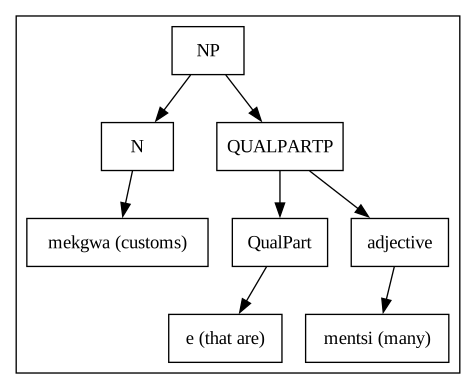
In (34) the NP consists of the head noun mekgwa ‘customs’ and the QUALPARTP e mentsi ‘that are many’ as the modifier. The qualificative particle e ‘who are’ shows agreement with the preceding noun as both are indicating class 4 agreement. In this example the adjective is a variable (changeable) adjective and therefore include the class prefix of noun class 4 as it must show agreement the noun class of the qualificative particle and the modified noun.
| mekgwa e mentsi |
| me- kgwa e me- ntsi |
| NPre4-custom QualPart4 NPre4-adjectivve |
| many customs (customs that are many) |
Two phrase structure rules are applicable to the NP presented in (34):
- NP → N QUALPARTP
- QUALPARTP → QualPart Adjective
The following tree diagram represents the constituent structure of the NP in (34).
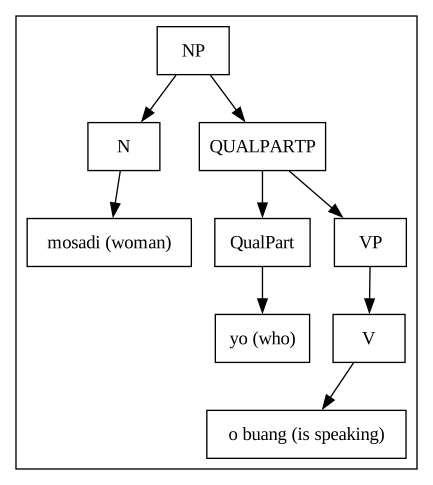
In (35) the NP consists of the head noun mosadi ‘woman’ and the QUALPARTP yo o buang ‘who is speaking’ as the modifier. The qualificative particle yo ‘who is’ shows agreement with the preceding noun as both are indicating class 1 agreement. In this example the complement of the qualificative particle is a relative verb. The subject agreement morpheme of the relative verb must also agree with the noun class of the qualificative particle and the modified noun.
| mosadi yo o buang |
| mo- sadi yo o- bu- a- ng |
| NPre1-woman QualPart1 AgrSubj1-speak-VEnd-RelSuf |
| the woman who is speaking |
Three phrase structure rules are applicable to the NP presented in (35):
- NP → N QUALPARTP
- QUALPARTP → QualPart VP
- VP → V (relative verb)
The following tree diagram represents the constituent structure of the NP in (35).
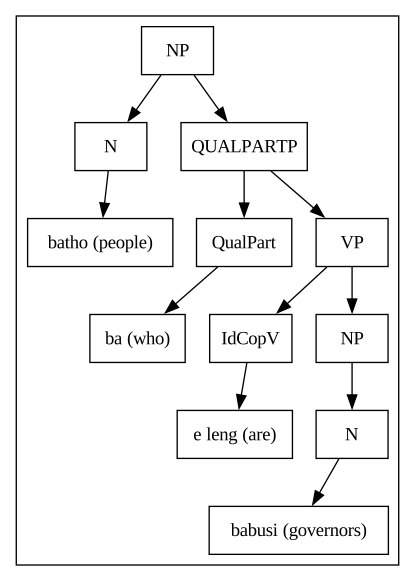
In (36) the NP consists of the head noun batho ‘people’ and the QUALPARTP ba e leng babusi ‘who are governors’ as the modifier. The qualificative particle ba ‘who are’ shows agreement with the preceding noun as both are indicating class 2 agreement. In this example the complement of the qualificative particle is a VP that includes an identifying copulative relative verb.
| batho ba e leng babusi |
| ba- tho ba e- le- ng ba- bus- i |
| NPre2-person QualPart2 AgrSubj-IdCopV-RelSuf NPre2-govern-DevSuf |
| the people who are governors |
Four phrase structure rules are applicable to the NP presented in (36):
- NP → N QUALPARTP
- QUALPARTP → QualPart VP
- VP → IdCopV (relative) NP
- NP → N
The following tree diagram represents the constituent structure of the NP in (36).
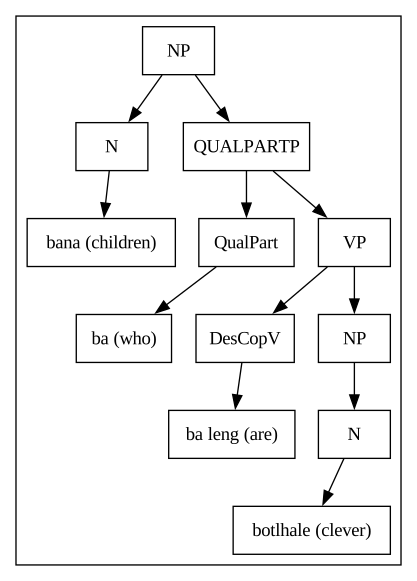
In (37) the NP consists of the head noun bana ‘children’ and the QUALPARTP ba ba leng botlhale ‘who are clever’ as the modifier. The qualificative particle ba ‘who are’ shows agreement with the preceding noun as both are indicating class 2 agreement. In this example the complement of the qualificative particle is a VP that includes a describing copulative relative verb. The subject agreement morpheme of the describing copulative relative verb must also show agreement with the qualificative particle and the modified noun.
| bana ba ba leng botlhale |
| ba- ana ba ba- le- ng botlhale |
| NPre2-child QualPart2 AgrSubj2-DesCopV-RelSuf NPre12-clever |
| the lever children (the children who are clever) |
Four phrase structure rules are applicable to the NP presented in (37):
- NP → N QUALPARTP
- QUALPARTP → QualPart VP
- VP → DesCopV (relative) NP
- NP → N
The following tree diagram represents the constituent structure of the NP in (37).
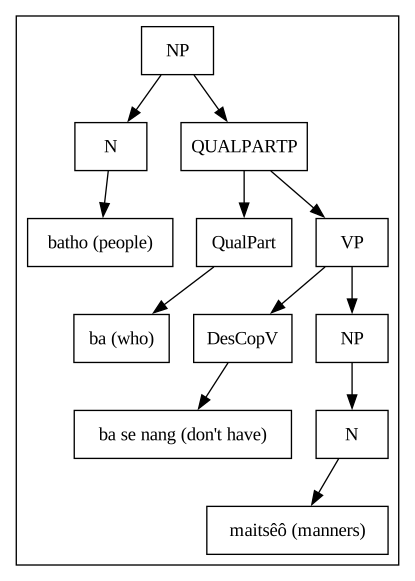
In (38) the NP consists of the head noun batho ‘people’ and the QUALPARTP ba ba se nang maitsêô ‘who don’t have manners’ as the modifier. The qualificative particle ba ‘who are’ shows agreement with the preceding noun as both are indicating class 2 agreement. In this example the complement of the qualificative particle is a VP that includes an associative copulative relative verb. The subject agreement morpheme of the associative copulative relative verb must also show agreement with the qualificative particle and the modified noun.
| batho ba ba se nang maitsêô |
| ba- tho ba ba- se- na- ng maitsêô |
| NPre2-person QualPart2 AgrSubj2-NegPre-AssCopV-RelSuf NPre6-manner |
| people who don't have manners |
Four phrase structure rules are applicable to the NP presented in (38):
- NP → N QUALPARTP
- QUALPARTP → QualPart VP
- VP → AssCopV (relative) NP
- NP → N
The following tree diagram represents the constituent structure of the NP in (38).
Syntactic uses and semantic functions of the noun phrase
An NP can be used as an argument of a predicator which is usually a verb. “The notion of argument is usually associated with verbs: verbs have argument structures, specifying the number and thematic roles of their arguments”
(Broekhuis & Den Dikken, 2012: 1118). NPs are used as arguments because they typically refer to (possibly singleton) sets of entities. The NP provides the descriptive information needed for identifying the set of entities in question. These sets of entities function as participants in the state of affairs denoted by the verb and they are assigned thematic roles. Thematic roles are informal descriptions of conceptual or semantic participant roles. The thematic roles of the arguments are selected in accordance with the lexical semantics of the predicator. The thematic roles assigned to arguments are the agent, beneficiary, experiencer/goal, instrument, patient/theme and locative.
To follow a short description of each thematic role is presented and the description is illustrated with a Setswana example.
The agent is the doer or initiator of the action denoted by the predicate, for example in (39) the agent is bana ‘the children’.
| Bana ba kwala teko. |
| ba- ana ba- kwal- a (ne)- teko |
| NPre2-child AgrSubj2-write-VEnd NPre9-test |
| The children are writing a test. |
The beneficiary is the entity for whose benefit an action occurs, for example in (40) the beneficiary is bana ‘the children’.
| Mosadi o rekela bana dijo. |
| mo- sadi o- rek-el- a ba- ana di- j- o |
| NPre1-woman AgrSubj1-buy-ApplSuf-VEnd NPre2-child NPre10-eat-DevSuf |
| The woman buys food for the children. |
The experiencer is an animated entity experiencing a state or feeling, for example in (41) mosadi ‘woman’ is the experiencer.
| Monna o rata mosadi. |
| mo- nna o- rat- a mo- sadi |
| NPre1-man AgrSubj1-love-VEnd NPre1-woman |
| The man loves the woman. |
The goal is the entity towards which the action of the verb moves. It indicates the location in the direction of which something moves, for example the goal in (42) is kwa lebenkeleng ‘to the shop’.
| Mosadi o ya kwa lebenkeleng. |
| mo- sadi o- ya- kwa le- benkele-ing |
| NPre1-woman AgrSubj1-go- VEnd LocPart NPre5-shop-LocSuf |
| The woman is going to the shop. |
The instrument is an entity by which the event/action is carried out, for example in (43) the instrument is ka boitumêlo ‘joyfully’.
| Batho ba dira ka boitumêlo. |
| ba- tho ba- dir- a ka boitumêlo |
| NPre2-person AgrSubj2-work-VEnd InstrPart NPre12-joy |
| The people are working joyfully (with joy). |
The patient is the entity that is affected by the action of the verb, for example in (44) the patient is ngwana ‘child’.
| Mosadi o tabogisa ngwana. |
| mo- sadi o- tabog-is- a mo- ana |
| NPre1-woman AgrSubj1-run- CausSuf-VEnd NPre1-child |
| The woman lets/makes the child run. |
The theme is the entity that directly receives the action of the verb, for example in (45) the theme is dijo ‘food’.
| Mosadi o reka dijo. |
| mo- sadi o- rek-a di- j- o |
| NPre1-woman AgrSubj1-buy-VEnd NPre10-eat-DevSuf |
| The woman buys food. |
The locative is the entity that specifies the place where the action or event is situated, for example in (46) the locative is mo kgetsing ‘in the bag’.
| Mosadi o tsenya buka mo kgetsing. |
| mo- sadi o- tsen- y- a (ne)- buka mo (ne)- kgetsi-ing |
| NPre1-woman AgrSubj1-enter-CausSuf-VEnd NPre9-book LocPart NPre9-bag- LocSuf |
| The woman puts the book in the bag. |
The thematic roles specify specific grammatical functions.
Modification
Multiple modifiers can be included in an NP in Setswana. Precedence with respect to modifiers is usually determined by the following orderings of which the first is more commonly used:
- PROP > POSSPARTP > QUALPARTP
- PROP > QUALPARTP > POSSPARTP
- QUALPARTP > PROP POSSPARTP
Krüger (2013a: 73) states that two main factors (linear principles) i.e., the degree of lexical extensiveness and the semantic extendibility of members occurring in the phatic layer (word content layer) of modifiers govern the mutual positions of modifiers. He presents an exposition of the possible mutual positions of the various diverse modifiers of a noun. The degree of lexical extensiveness of modifiers refers to the quantity of the lexical content of the modifier. The semantic extendibility of members refers to the further extension of a modifier by means other modifiers. Krüger (2013a: 73-74) is of the opinion that less extensive and extendible modifiers take up positions nearer to the modified noun than more extensive and extendible modifiers. The ranking and order of modifiers are therefore basically connected with the quantitative word content of the modifiers. The lesser the quantity of the lexical content the higher the ranking will be meaning that its position is nearer to the modified noun. For example, pronouns have much less lexical content than a POSSPARTP or a QUALPARTP. However, “if two or more modifiers are about equal with respect to extensiveness, their mutual order would be quite arbitrary unless convention and style prescribe a specific order”
(Krüger, 2013a: 74).
Two sources of multiplicity are distinguished i.e., juxtaposition (sequencing or stacking) where a sequence of modifiers modify the same head, and nesting where a modified head occurs inside another modifier or complement of another head.
Juxtaposition (sequencing or stacking) is the process where a sequence of modifiers modifies the same head. For example, in (47) the head noun dikomputara ‘computers’ is modified by a PROP consisting of the demonstrative pronoun tse ‘these’, a POSSPARTP tsa batho ‘of the people’ and a QUALPARTP tse dintšhwa ‘that are new’.
| dikomputara tse tsa batho tse dintšhwa. |
| di- komputara tse tsa ba- tho tse (di)- šwa |
| NPre10-compute DemPro10D1 PosPart10 NPre2-person QualPartP10 NPre10-adjective |
| these new computers of the people |
In (47) above three different modifiers (PROP, POSSPARTP and QUALPARTP) of the head dikomputara ‘computers’ are juxtaposed. However, in (48) two similar juxtaposed QUALPARTPs modify the head ngwana ‘child’ (Cole, 1955: 438). The QUALPARTP yo moleele ‘that is tall’ and the QUALPARTP yo o leng thata ‘that is strong’ modify the head.
| ngwana yo moleele yo o leng thata |
| m- ana yo mo- leele yo o- le- ng thata |
| NPre1-child QualPart1 NPre1-adjective QualPart1 AgrSubj1-DesCopV-RelSuf Adv |
| the tall, strong child |
Nesting is the process where a modified head occurs inside another modifier or complement of another head. In other words, complements and modifiers can in turn, also be modified. For each head that is modified, also for those that occur in complements and modifiers, the ordering PROP > POSSPARTP > QUALPARTP also applies. The NP in (49) consists of the head dibuka ‘books’ and three modifiers i.e., the QUALPARTP tse dintšhwa ‘that are new’, the PROP tse ‘these’ and the POSTPARTP tsa bana botlhe ba bone ‘of all their children’. In turn, the POSSPARTP consists of the possessive particle tsa ‘of’ as head and the NP bana botlhe ba bone ‘all their children’ as the complement. In this complement, the noun bana ‘children’ is the head of the modifying PROP botlhe ‘all’ and the POSSPARTP ba bone ‘of them’.
| dibuka tse dintšhwa tse tsa bana botlhe ba bone |
| di- buka tse (di)- šwa tse tsa ba- ana botlhe ba bone |
| NPre10-book QualPart10 NPre10-adjective DemPro10D1 PosPart10 NPre2-child IncQPro2 PossPart2 PossPro2 |
| these new books of all their children |
Krüger (2013a: 74-75) states that a relevant observation to the ordering of multiple modifiers is that “absolute demarcations are in some cases not possible”
and that “if two or more qualifiers are about equal with respect to extensiveness, their mutual order would be quite arbitrary unless convention and style prescribe a specific order”
.
Syntactic functions of noun phrases
The external syntax of NPs is concerned with the use and function of an NP in larger constructions. To follow an exposition is presented of possible functions the NP may have.
Subject
In a sentence an NP may be directly or indirectly involved in the execution of the action or process implied by the verb and therefore functions as the subject in a sentence. The NP is the subject of a predicate in this instance. The predicate can be a verb phrase that includes a main verb (VP), an identifying copulative verb phrase (VPIDCOPV), a describing copulative verb phrase (VPDESCOPV), an associative copulative verb phrase (VPASSCOPV) or an auxiliary verb phrase (VPAUX).
- Subject of predicate consisting of a verb phrase with a main verb
The subject can be followed by a VP where the head of this phrase is a main verb. In (50) the NP that functions as a subject is the noun basimane ‘boys’ and the main verb in the VP is ba a tshameka ‘they are playing’.
Example 50Basimane ba a tshameka. ba- simane ba -a- tshamek-a NPre2-boy AgrSubj2- PresPre-play- VEnd The boys are playing. - Subject of predicate consisting of an identifying copulative verb phrase
The subject can be followed by a VPIDCOPV. The head of this phrase is an identifying copulative verb. The identifying copulative serve
“to identify the subject as regards type, status or profession, or simply to predicate the existence or presence of a thing”
(Cole, 1955: 311).In (51) the NP that functions as a subject is the noun group monna yo ‘this man’ and VPIDCOPV ke kgosi ‘is a chief’ includes an identifying copulative verb ke ‘is’.
Example 51Monna yo ke kgosi. mo- nna yo ke (ne-)-kgosi NPre1-man DemPro1D1 IdCopV NPre9-chief This man is the chief. - Subject of predicate consisting of a describing copulative verb phrase
The subject can be followed by a VPDESCOPV. The head of this phrase is a describing copulative verb. Describing copulatives
“predicate some quality, characteristic or state of the subject, or its situation or locality”
(Cole:1955: 319). (Further reading: Cole, 1955: 319-330)In (52) the NP that functions as subject is the noun monna ‘man’ and the VPDESCOP o mogolo ‘is big’ includes a describing copulative verb o ‘is’.
Example 52Monna o mogolo. mo- nna o mo- golo NPre1-man DesCopV1 NPre1-adjective The man is big. - Subject of predicate consisting of an associate copulative verb phrase
The subject can be followed by a VPASSCOPV. The head of this phrase is an associative copulative verb. The associative copulative expresses
“the idea of the English ‘have’ or ‘be with’, and indicate possession or association”
.In (53) the NP that functions as subject is the noun batho ‘people’ and the VPDASSCOP ba na le dijô ‘they have food’ includes an associative copulative verb ba na ‘they have’.
Example 53Batho ba na le dijô. ba- tho ba -na le di- j- o NPre2-person AgrSubj2-AssCopV AssPart NPre10-eat-DevSuf The people have food. - Subject of predicate consisting of an auxiliary verb phrase
The subject can be followed by a VPAUX. The head of this phrase is an auxiliary verb. The auxiliary verb
“expresses the duration of the process/action or the time at which the process/action takes place”
(Krüger, 2013b: 191).In (54) the NP that functions as subject is the noun mosadi ‘woman’ and the VPAUX o ne a reka dijô ‘she was buying food’ includes the auxiliary verb o ne ‘she was’. This auxiliary verb indicates a relative past tense where
“in this tense form the event is interpreted in relation to a reference point that is prior to coding time”
(Pretorius, 1997: 248).Example 54Mosadi o ne a reka dijô mo- sadi o- ne a- rek-a di- j- ô NPre1-woman AgrSubj1-Aux AgrSubj1-buy-VEnd NPre10-eat-DevSuf She was buying food.
Direct object
In a sentence the NP can function as a direct object (55). The direct object is an object that is directly affected by the process or action indicated in the verb or it undergoes the process or action.
| Mosadi o reka dijo. |
| mo- sadi o- rek-a di- j- o |
| NPre1-woman AgrSubj1-buy-VEnd NPre10-eat-DevSuf |
| The woman buys food. |
Indirect object
In a sentence the NP can function as an indirect object. The indirect object is indirectly affected by the process indicated in the verb (56) (cf. Krüger, 2013a: 35; Louwrens, 1994: 55).
| Mosadi o rekela bana dijo. |
| mo- sadi o- rek-el- a ba- ana di- j- o |
| NPre1-woman AgrSubj1-buy-ApplSuf-VEnd NPre2-child NPre10-eat-DevSuf |
| The woman buys food for the children. |
Complement of possessive particle
The NP can function as a complement of a possessive particle in a POSSPARTP (cf. Krüger: 2013a: 114).
In (57) the complement of the possessive particle ba ‘of’ is an NP that consists of the noun kgôsi ‘chief’.
| bana ba kgôsi |
| ba- ana ba (ne-)-kgôsi |
| NPre2-child PossPart2 NPre9-chief |
| the children of the chief |
Complement of instrumental particle
The NP can function as a complement of an instrumental particle in an INSTRPARTP. (cf. Krüger: 2013a: 210). In (58) the complement of the instrumental particle ka ‘with’ is an NP that consists of the noun thipa ‘knife’.
| ka thipa |
| ka (ne-)-thipa |
| InstrPart NPre9-knife |
| with a knife |
Complement of temporal particle
The NP can function as a complement of the temporal particle ka ‘at’. The NP in (59) consists of the noun bosigo ‘night’.
| ka bosigo |
| ka bo- sigo |
| TempPart NPre12-night |
| at night |
Complement of locative particles
The NP can function as the complement of some of the locative particles in a LOCPARTP. The complements of the locative particles go ‘to’ or ga ‘at someone’s place, at, to’ can be an NP that consists of a noun in class 1a or 2a. These nouns indicate proper names, kinship terms, and personified names (Cole, 1955: 72-75).
In (60) the complement of the locative particle go ‘to’ is an NP that consists of the class 1a noun mme ‘mother’.
| go mme |
| go (-)- mme |
| LocPart NPre1a-mother |
| to mother |
In (61) the complement of the locative particle ga ‘to’ is an NP that consists of the class 1a noun malome ‘uncle’.
| ga malome |
| ga (-)- malome |
| LocPart NPre1a-uncle |
| to uncle's place |
A LOCPARTP with the locative particle ka ‘goes through, over, out of, into’ can also take an NP as complement (Krüger, 2006: 148).
In (62) the complement of the locative particle ka ‘into’ is an NP that consists of the noun motse ‘village’.
| ka motse |
| ka mo- tse |
| LocPart NPre3-village |
| into the village |
Complement of agentative particle
The agentative particle ke conveys the meaning of ‘by’ in passive sentences and may be followed by an NP as complement (Lombard et al., 1985: 173).
In (63) the complement of the agentative particle ke ‘by’ is an NP that consists of the noun mosadi ‘woman’.
| Mosimane o romilwe ke mosadi. |
| mo- simane o- rom- il- iw-e ke mo-sadi |
| NPre1-boy AgrSubj1-send-PerfSuf-VEnd AgPart NPre1-woman |
| The boy has been sent by the woman. |
Complement of associative particle
The associative particle le ‘with’ functions as the head of an associative particle phrase (ASSPARTP) and may be followed by an NP as complement (Berg, 2018: 98-99).
The ASSPARTP can function as an adjunct in a sentence. In (64) the adjunct is the ASSPARTP le mosadi ‘with the woman’ where the NP that consists of the noun mosadi ‘woman’ functions as the complement of the associative particle le ‘with’.
| Mosimane o tsamaya le mosadi. |
| mo- simane o- tsamay-a le mo- sadi |
| NPre1-boy AgrSubj1-walk- VEnd AssPart NPre1a-mother |
| The boy walks/goes with the woman. |
The ASSPARTP can also function as complement of the associative copulative verb in the positive. In (65) the complement of the associative copulative verb o na ‘she has’ is the ASSPARTP le bana ‘with the children’ where the NP that consists of the noun bana ‘children’ functions as the complement of the associative particle le ‘with’.
| Mosadi o na le bana. |
| mo- sadi o- na le ba- ana |
| NPre1-woman AgrSubj1-AssCopV AssPart NPre2-child |
| The woman has children. |
Complement of comparative particle
The comparative particle jaaka has the meaning of ‘like’ or ‘similar to’ (Krüger, 2006: 149). In (66) the complement of the comparative particle jaaka ‘like’ is an NP that consists of the noun group monna yoo ‘that man’.
| O bua fela jaaka monna yoo. |
| o- bu- a fela jaaka mo- nna yoo |
| AgrSubj1-talk-VEnd Adv CompPart NPre2-man DemPro2D2 |
| He talks just like that man. |
Complement of identifying copulative verb
A VPIDCOPV consists of an identifying copulative verb as head, followed by a non-verbal, non-locative complement. This complement can be an NP.
In (67) the complement of the identifying copulative verb ke ‘is’ is an NP that consists of the noun group tiro ya me ‘my job/work’.
| Ke tirô ya me. |
| ke (ne-)-dir- o ya me |
| IdCopV NPre9-work-DevSuf PossPart PossPart1pl |
| It is my job/work. |
Complement of associative copulative verb
A VPASSCOPV consists of an associative copulative verb as head and in the negative it can be followed by an NP as complement.
In (68) the complement of the negative associative copulative verb ga ba na ‘they don’t have’ is an NP that consists of the tiro ‘work’.
| Batho ga ba na tirô |
| ba- tho ga- a- na (ne)- dir- ô |
| NPre2-person NegPre-AgrSubj2-AssCopV NPre9-work-DevSuf |
| The people don't have work. |
Coordination
A coordinated phrase can include two or more NPs. This coordinated phrase can also function as subject, indirect object, direct object and complement of the possessive particle, the instrumental particle, the temporal particle, locative particles, the agentative particle, the associative particle, the comparative particle, the identifying copulative verb and the negative of the associative copulative verb.
The NPs that are included as conjuncts in a coordinated phrase are linked to each other with a conjunction such as le ‘and’ or kgotsa ‘or’. In (69) the NPs motsadi ‘parent’ and ngwana wa gagwe ‘his/her child’ are linked with the conjunction le ‘and’.
| motsadi le ngwana wa gagwe |
| mo- tsal-i le mo- ana wa gagwe |
| NPre1-bear-DevSuf Conj NPre1-child PossPart1 PossPro1 |
| the parent and his/her child |
Certain strategies can be followed in noun class agreement when the conjuncts belong to different noun classes. If both nouns are from the same singular noun class, the subject agreement morpheme of the corresponding plural noun class is used. For example, both nouns in (70) in the coordinate phrase are from class 1 and therefore the subject agreement morpheme is ba from noun class 2.
| Motsadi le ngwana wa gagwe ba a tlotla. |
| mo- tsal-i le mo- ana wa gagwe ba- a- tlotl-a |
| NPre1-bear-DevSuf Conj NPre1-child PossPart1 PossPro1 AgrSubj2-PresPre-talk- VEnd |
| The parent and his/her child talk to each other. |
If the nouns in the coordinate phrase are from different classes but indicate humans, the subject agreement morpheme ba of noun class 2 is applied (71). Any order of the nouns in a coordinate phrase that are from different classes is permissible.
| Motsadi le ngaka ba a tlotla. |
| mo- tsal-i le (ne-)-ngaka ba- a- tlotl-a |
| NPre1-bear-DevSuf Conj NPre9-doctor AgrSubj2-PresPre-talk- VEnd |
| The parent and the doctor talk to each other. |
If the nouns in the coordinate phrase are from different classes but indicate non-personal and non-animal nouns, the subject agreement morpheme di of noun class 10 is chosen (72). However, if the coordinate phrase includes both people or persons and animals or inanimate subjects, one of the nouns is placed before the verb, while the others are placed after the verb as a complement of the particle le ‘together with’ in an ASSPARTP. In (73) mosimane ‘boy’ indicates a human in noun class 1 and ntšwa ‘dog’ an animal in noun class 10. As agreement can’t be stablished le ntšwa ‘and the dog, with the dog’ is included as an ADJUNCT in the sentence.
| Dithunya le bojang di a tlhoga. |
| di- thunya le bo- jang di- a- tlog-a |
| NPre8-tree-DevSuf Conj NPre14-grass AgrSubj10-PresPre-grow-VEnd |
| The trees and grass are growing. |
| Mosimane o tshameka le ntšwa. |
| mo- simane o- tshamek-a le (ne-)-ntšwa |
| NPre1-boy AgrSubj1-play- VEnd AssPart NPre9-dog |
| The boy plays with the dog. |
References
Berg, A. (2018) Computational syntactic analysis of Setswana. Doctoral Thesis. North-West University, Potchefstroom.
Broekhuis, H. & Den Dikken, M. (2012) Syntax of nouns and noun phrase. Vol 2. Amsterdam: Amsterdam University Press.
Cole, D. T. (1955) An introduction to Tswana grammar. Cape Town: Longman.
Krüger, C. J. H. (2006) Introduction to the morphology of Setswana. München: Lincom.
Krüger, C. J. H. (2013a) Setswana syntax: a survey of word group structures. Vol 1. München: Lincom.
Krüger, C. J. H. (2013b) Setswana syntax: a survey of word group structures. Vol 2. München: Lincom.
Lombard, D., Van Wyk, E. B. & Mokgokong, P. C. (1985) ‘Introduction to the grammar of Northern Sotho. Pretoria: Van Schaik
Louwrens. L. J. (1994) Dictionary of Northern Sotho grammatical terms. Pretoria: Via Afrika.
Pretorius, R. S. (1997) Auxiliary verbs as a subcategory of the verb in Tswana. Doctoral Thesis. North-West University (University of Christian Higher Education), Potchefstroom.