Pronouns and pronoun phrases
In this topic, an exposition of the internal syntax of the Setswana pronoun phrase (PROP) is presented regarding its possible constituents, the word order followed and the agreement phenomena that govern its syntactic structure. The use of the PROP in larger constructions is the focus of its external syntax.
- Pronouns and pronoun phrases
- The internal structure of the pronoun phrase
- The PROP constructed with a pronoun group
- Personal pronoun and modifiers
- Absolute pronoun and modifiers
- Demonstrative pronoun and modifiers
- Inclusive quantitative pronoun and modifiers
- Exclusive quantitative pronoun and modifiers
- Separative quantitative pronoun and modifiers
- Interrogative quantitative pronoun and modifiers
- Syntactic functions of pronoun phrases
- References
Pronouns and pronoun phrases
The Setswana pronoun phrase (PROP) can be structured with a single word or a word group consisting of a pronoun followed by a modifier (qualificative, qualifier or adjunct) (Berg, 2018: 108-110). A fixed number of pronouns appear in Setswana (Krüger, 2006: 127-144), i.e., personal pronouns and the different types of pronouns for the noun classes (absolute, demonstrative, quantitative and possessive pronouns).
To follow the characterisation of pronouns, the internal structure of the PROP and the syntactic functions of the PROP are presented.
Characterisation of pronouns
Setswana pronouns are divided into personal pronouns and the pronouns that agree with the noun classes.
The personal pronouns are those for the:
- first person (nna ‘I’ and rona ‘we’),
- second person (wena ‘you (singular)’ and lona ‘you (plural)’), and
- third person (ênê ‘he/she’ and bônê ‘they’).
Some of the personal pronouns have corresponding possessive pronouns (indicating ordinary or communal possession) as well as corresponding quantitative pronouns (inclusive, exclusive, selective, separative and interrogative) (Cole, 1955: 154-158, 163-164; Krüger: 2006: 141).
The pronouns that are distinguished for the noun classes are:
- absolute pronouns (Krüger, 2006: 131),
- demonstrative pronouns (Krüger, 2006: 134-135),
- quantitative pronouns (inclusive, exclusive, selective, separative and interrogative) (Cole, 1955: 154-158; Krüger: 2006: 137-139), and
- possessive pronouns (Krüger, 2006: 145; Cole, 1955: 163-164).
The internal structure of the pronoun phrase
A PROP can be constructed with a word or a word group. The minimal structure is only a single pronoun which is the head. The word group consists of a pronoun which is the head followed by a modifier.
The pronoun phrase constructed with only a pronoun
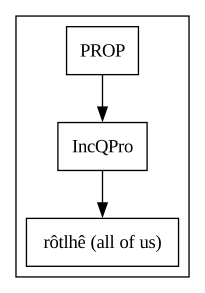
A PROP can consist of only a head. This head can be a personal pronoun, an absolute pronoun, a demonstrative pronoun, an inclusive quantitative pronoun, an exclusive quantitative pronoun, a selective quantitative pronoun, a separative quantitative pronoun or an interrogative quantitative pronoun. For example, in (1) the PROP consists of the inclusive quantitative pronoun rôtlhé ‘all of us’.
| Rôtlhê re dira thata. |
| Rôtlhe re -dir -a thata. |
| IncQProP1pl AgrSubjP1pl-work-VEnd Adv |
| All of us are working hard. |
The phrase structure rule for the PROP in (1) is:
- PROP → IncQPro
The following tree diagram represents the constituent structure of the PROP in (1).
The PROP constructed with a pronoun group
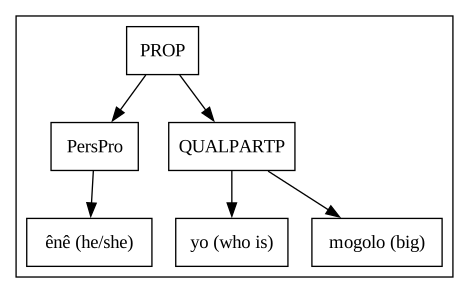
The PROP can also be constructed with a pronoun group and in this instance, the pronoun group consists of a head pronoun followed by one or more than one modifier (Krüger, 2013) also refers to a pronoun group as a pronominal group.) The head pronoun is the antecedent and the modifier (qualifier) is a word or word group that describes the head pronoun. For example, in (2) the PROP consists of a personal pronoun ênê ‘he/she’ and the qualificative particle phrase yo mogolo ‘which is big’.
| ênê yo mogolo o dira thata |
| ênê yo mogolo o-dir-a thata |
| AbsPro1 QualPart1 NPre-adjective AgrSubj1-work-VEnd Adv |
| the (specific) big one is working hard |
The phrase structure rule for the sentence PROP in (2) is:
- PROP → perspro QUALPARTP
The following tree diagram represents the constituent structure of the PROP in (2).
To follow an exposition of the possible modifiers of pronouns is presented, the word order followed and the agreement phenomena that govern the structure of PROP (PROP internal agreement) are also clarified.
Personal pronoun and modifiers
A PROP may be constructed with a personal pronoun followed by an inclusive, exclusive, selective, separative and interrogative quantitative pronoun or by an adverb phrase, a possessive particle phrase or a qualificative particle phrase.
- Personal pronoun modified with an inclusive quantitative pronoun
A PROP can consist of a head personal pronoun followed by an inclusive quantitative pronoun as modifier. The inclusive quantitative pronoun shows agreement with the preceding personal pronoun:
Example 3rona rôtlhê rona rôtlhê PersProP1pl IncQProP1pl us all, we all - Personal pronoun modified with a selective quantitative pronoun
A PROP can consist of a head personal pronoun followed by a selective quantitative pronoun as modifier. The selective quantitative pronoun shows agreement with the preceding personal pronoun:
Example 4bônê bôsi bônê bôsi PersProP3pl SelQProP3pl only they - Personal pronoun modified with a separative quantitative pronoun
A PROP can consist of a head personal pronoun followed by a separative quantitative pronoun as modifier. The separative quantitative pronoun shows agreement with the preceding personal pronoun:
Example 5bônê basele bônê basele PersProP3pl SepQProP3pl the unknown ones - Personal pronoun modified with an interrogative quantitative pronoun
A PROP can consist of a head personal pronoun followed by an interrogative quantitative pronoun as modifier. The interrogative quantitative pronoun shows agreement with the preceding personal pronoun:
Example 6bônê bafe? bônê bafe PersProP3pl IntQProP3pl which ones? them who? - Personal pronoun modified with an adverb phrase
A PROP can consist of a head personal pronoun followed by an adverb phrase as modifier. There is no agreement between the personal pronoun and the ADVP:
Example 7nna fela nna fela PersProP1sg Adv only me, only I - Personal pronoun modified with a possessive particle phrase
A PROP can consist of a head personal pronoun followed by a possessive particle phrase as modifier. The possessive particle as head of the possessive particle phrase must agree with the person and number of the preceding personal pronoun:
Example 8bônê ba me bônê ba me PersProP3pl PossPartP3pl PossProP1sg my ones, mine - Personal pronoun modified with a qualificative particle phrase
A PROP can consist of a head personal pronoun followed by a qualificative particle phrase as modifier. The qualificative particle as head of the qualificative particle phrase must agree with the person and number of the preceding personal pronoun:
Example 9ênê yo mogolo ênê yo mogolo PersProP3sg QualPartP3sg NPre1-adjective the (specific) big one
Absolute pronoun and modifiers
A PROP may be constructed with an absolute pronoun followed by a demonstrative pronoun, an inclusive quantitative pronoun, a selective quantitative pronoun, a separative quantitative pronoun, a possessive particle phrase and a qualificative particle phrase.
- Absolute pronoun modified with a demonstrative pronoun
A PROP can consist of a head absolute pronoun followed by a demonstrative pronoun as modifier. The class of the demonstrative pronoun must agree with the class of the absolute pronoun:
Example 10tsone tse tsone tse AbsPro10 DemPro10D1 these ones - Absolute pronoun modified with an inclusive quantitative pronoun
A PROP can consist of a head absolute pronoun followed by an inclusive quantitative pronoun as modifier. The class of the inclusive quantitative pronoun must agree with the class of the absolute pronoun:
Example 11gone gotlhe gone gotlhe AbsPro16 IncQPro16 the whole place - Absolute pronoun modified with a selective quantitative pronoun
A PROP can consist of a head absolute pronoun followed by a selective quantitative pronoun as modifier. The class of the selective quantitative pronoun must agree with the class of the absolute pronoun:
Example 12tsone tsosi tsone tsosi AbsPro10 SelQPro10 only them - Absolute pronoun modified with a separative quantitative pronoun
A PROP can consist of a head absolute pronoun followed by a separative quantitative pronoun as modifier. The class of the separative quantitative pronoun must agree with the class of the absolute pronoun:
Example 13bone basele bone ba-sele AbsPro2 SepQPro2 the other ones - Absolute pronoun modified with a possessive particle phrase
A PROP can consist of a head absolute pronoun followed by a possessive particle phrase as modifier. The class of the possessive particle must agree with the class of the absolute pronoun:
Example 14bone ba me bone ba me AbsPro2 PossPart2 PosProP1sg my ones, (the very ones of) mine - Absolute pronoun modified with a qualificative particle phrase
A PROP can consist of a head absolute pronoun followed by a qualificative particle phrase as modifier. The class of the qualificative particle must agree with the class of the absolute pronoun:
Example 15sone se segolo sone se se- golo AbsPro7 QualPart7 NPre7-big the (specific) big one
Demonstrative pronoun and modifiers
A PROP may be constructed with a demonstrative pronoun followed by a modifying inclusive quantitative pronoun, a selective quantitative pronoun, a separative quantitative pronoun, a possessive particle phrase and a qualificative particle phrase.
- Demonstrative pronoun modified with an inclusive quantitative pronoun
A PROP can consist of a head absolute pronoun followed by an inclusive quantitative pronoun as modifier. The class of the inclusive quantitative pronoun must agree with the class of the demonstrative pronoun:
Example 16bao botlhe bao botlhe DemPro2 IncQPro2 all (of) those, all (of) them - Demonstrative pronoun modified with a selective quantitative pronoun
A PROP can consist of a head absolute pronoun followed by a selective quantitative pronoun as modifier. The class of the selective quantitative pronoun must agree with the class of the demonstrative pronoun:
Example 17tse tsosi tse tsosi DemPro10 SelQPro10 only these - Demonstrative pronoun modified with a separative quantitative pronoun
A PROP can consist of a head absolute pronoun followed by a separative quantitative pronoun as modifier. The class of the separative quantitative pronoun must agree with the class of the demonstrative pronoun:
Example 18tseo disele tseo di-sele DemPro10 SepQPro10 those other ones, those unknown ones - Demonstrative pronoun modified with a possessive particle phrase
A PROP can consist of a head demonstrative absolute pronoun followed by a possessive particle phrase as modifier. The class of the possessive particle must agree with the class of the demonstrative pronoun:
Example 19tseo tsa me tseo tsa me DemPro10 PossPart10 PossProP1sg those of mine - Demonstrative pronoun modified with a qualificative particle phrase
A PROP can consist of a head demonstrative absolute pronoun followed by a qualificative particle phrase as modifier. The class of the qualificative particle must agree with the class of the demonstrative pronoun:
Example 20bao ba bagolo bao ba ba- golo DemPro2 QualPart2 NPre2-big those big ones
Inclusive quantitative pronoun and modifiers
A PROP may be constructed with an inclusive quantitative pronoun followed by a possessive particle phrase and a qualificative particle phrase.
- Inclusive quantitative pronoun modified with a possessive particle phrase
A PROP can consist of a head inclusive quantitative pronoun followed by a possessive particle phrase as modifier. The class of the possessive particle must agree with the class of the inclusive quantitative pronoun:
Example 21tsotlhe tsa me tsotlhe tsa me AbsPro10 PossPart10 PossProP1sg all mine - Inclusive quantitative pronoun modified with a qualificative particle phrase
A PROP can consist of a head inclusive quantitative pronoun followed by a qualificative particle phrase as modifier. The class of the qualificative particle must agree with the class of the inclusive quantitative pronoun:
Example 22botlhe ba bagolo botlhe ba ba-golo AbsPro2 QualPart2 NPre2-big all the big ones, all the grown up ones, all the old ones
Exclusive quantitative pronoun and modifiers
A PROP may be constructed with an exclusive quantitative pronoun followed by a possessive particle phrase and a qualificative particle phrase.
- Exclusive quantitative pronoun modified with a possessive particle phrase
A PROP can consist of a head exclusive quantitative pronoun followed by a possessive particle phrase as modifier. The class of the possessive particle must agree with the class of the exclusive quantitative pronoun:
Example 23dipe tsa me dipe tsa me ExcQPro10 PossPart10 PossProP1sg none of mine - Exclusive quantitative pronoun modified with a qualificative particle phrase
A PROP can consist of a head exclusive quantitative pronoun followed by a qualificative particle phrase as modifier. The class of the qualificative particle must agree with the class of the exclusive quantitative pronoun:
Example 24dipe tse di leng monate dipe tse di- le- ng mo- nate ExcQPro10 QualPart10 AgrSubj10-DefCopV-RelSuf NPre3-nice nothing nice, no nice ones
Separative quantitative pronoun and modifiers
A PROP may be constructed with a separative quantitative pronoun followed by a possessive particle phrase.
- Separative quantitative pronoun modified with a possessive particle phrase
A PROP can consist of a head separative quantitative pronoun followed by a possessive particle phrase as modifier. The class of the possessive particle must agree with the class of the separative quantitative pronoun:
Example 25disele tsa me di-sele tsa me SepQPro10 PossPart10 PersProP1sg my other ones, my other things, the different ones of me
Interrogative quantitative pronoun and modifiers
A PROP may be constructed with a interrogative quantitative pronoun followed by a possessive particle phrase.
- Interrogative quantitative pronoun modified with a possessive particle phrase
A PROP can consist of a head interrogative quantitative pronoun followed by a possessive particle phrase as modifier. The class of the possessive particle must agree with the class of the interrogative quantitative pronoun:
| dife tsa me |
| dife tsa me |
| IntQPro10 PossPart10 PossProP1sg |
| which ones of mine? |
Syntactic functions of pronoun phrases
The external syntax of PROPs is concerned with the use and function of a PROP in larger constructions. To follow an exposition is presented of possible functions the PROPs may have.
Subject
In a sentence a PROP may be directly or indirectly involved in the execution of the action or process implied by the verb and therefore function as the subject in a sentence. It can function as the subject of a phrase with a main verb as head (VP), an identifying copulative verb phrase (VPIDCOPV), a describing copulative verb phrase (VPDESCOPV), an associative copulative verb phrase (VPASSCOPV) or an auxiliary verb phrase (VPAUX).
- Subject of verb phrase with a main verb
The subject can be followed by a VP where the head of this phrase is a main verb:
Example 27Bone ba a tshameka. bone ba- a- tshamek-a AbsPro2 AgrSubj2-PresPre-play- VEnd They are playing. - Subject of predicate consisting of an identifying copulative verb phrase
The subject can be followed by a VPIDCOPV where the head of this phrase is an identifying copulative verb:
Example 28Ênê ke kgosi. ênê ke (ne-)-kgosi AbsPro1 IdCopV NPre9-chief He is the chief. - Subject of predicate consisting of a describing copulative verb phrase
The subject can be followed by a VPDESCOPV where the head of this phrase is a describing copulative verb:
Example 29Ênê o mogolo. ênê o mo- golo AbsPro1 DesCopV1 NPre1-adjective He/she is big. - Subject of predicate consisting of an associate copulative verb phrase
The subject can be followed by a VPASSCOPV where the head of this phrase is an associative copulative verb:
Example 30Bone ba na le dijô. bone ba- na le di- j- o AbsPro2 AgrSubj2-AssCopV AssPart NPre10-eat-DevSuf They have food. - Subject of predicate consisting of an auxiliary verb phrase
The subject can be followed by a VPAUX. The head of this phrase is an auxiliary verb:
Example 31Ênê o ne a reka dijô. ênê o- ne a- rek-a di- j- ô AbsPro1 AgrSubj1-Aux AgrSubj1-buy-VEnd NPre10-eat-DevSuf He/she was buying food.
Direct object
A PROP can function as a direct object in a sentence except for the exclusive quantitative pronouns and the “pronouns of the locative classes, however, have a very restricted function as objects”
(Krüger, 2013: 75). If a personal pronoun is used as an object in a sentence, it is common to rather use the corresponding object agreement morpheme. The PROP consists of an absolute pronoun tsône and the inclusive quantitative pronoun tsôtlhê:
| Ke agile tsônê tsôtlhê. |
| ke- ag- il- e tsônê tsôtlhê |
| AgrSubjP1sg-build-PerfSuf-VEnd AbsPro10 IncQPro10f |
| I have built them all. |
Indirect object
As is the case with direct objects the PROP (except for the exclusive quantitative pronoun) can function as an indirect object in a sentence. The PROP is the IncQPro bôtlhê:
| Mosadi o rekela bôtlhê dijo. |
| mo -sadi o -rek -el-a bôtlhê di-j-o |
| NPre1-woman AgrSubj1-buy -ApplSuf-VEnd IncQProP3pl NPre10-eat-DevSuf |
| The woman buys food for all of them/everyone. |
Complement of possessive particle
The PROP can function as a complement of a possessive particle in a POSSPARTP. The PROP is the possessive pronoun gagwe ‘his/her’:
| bana ba gagwe |
| ba- ana ba gagwe |
| NPre2-child PossPart2 PossPro1 |
| his/her children |
Complement of instrumental particle
The PROP can function as a complement of an instrumental particle in an INSTRPARTP. In (35) below the PROP is the demonstrative pronoun absolute pronoun ê ‘this one’:
| ka ê |
| ka ê |
| InstrPart DemPro9 |
| with this one |
Complement of locative particles
The PROP function as the complement of some of the locative particles in a LOCPARTP. The complements of the locative particles go ‘to’ or ga ‘at someone’s place, at, to’ can be a personal or absolute pronoun. The complement of the locative particle go ‘to’ is the personal pronoun ênê ‘he/she’:
| go ênê |
| go ênê |
| LocPart PersProP3sg |
| to him/her |
The complement of the locative particle ga ‘to’ is a PROP that consists of the personal pronoun ênê ‘he/she’:
| ga ênê |
| ga ênê |
| LocPart PersProP3sg |
| to his/her place |
Complement of agentative particle
The agentative particle ke conveys the meaning of ‘by’ in passive sentences and may be followed by an PROP as complement. The complement of the agentative particle ke ‘by’ is a PROP that consists of the personal pronoun ênê ‘he/she’:
| Mosimane o romilwe ke ênê |
| mo- simane o- rom- il- iw- e ke ênê |
| NPre1-boy AgrSubj1-send-PerfSuf-PassSuf-VEnd AgPart PersProP3sg |
| The boy has been sent by him/her. |
Complement of associative particle
The associative particle le ‘with’ functions as the head of an associative particle phrase (ASSPARTP) and may be followed by an PROP as complement. The associative particle is followed by a personal pronoun ênê ‘he/she’:
| Mosimane o tsamaya le ênê |
| mo- simane o- tsamay-a le ênê |
| NPre1-boy AgrSubj1-walk- VEnd AssPart PersProP1sg |
| The boy walks/goes with him/her. |
Complement of comparative particle
The comparative particle jaaka has the meaning of ‘like’ or ‘similar to’ (Krüger, 2006: 149). The complement of the comparative particle jaaka ‘like’ is a PROP that consists of personal pronoun bônê ‘them’:
| O bua fela jaaka bônê |
| o- bu- a fela jaaka bônê |
| AgrSubj1-talk-VEnd Adv CompPart AbsProP3pl |
Complement of identifying copulative verb
A VPIDCOPV consists of an identifying copulative verb as head, followed by a non-verbal, non-locative complement. This complement can be an PROP. The complement of the identifying copulative verb ke ‘is’ is a PROP that consists of the demonstrative pronoun tsê ‘these ones’:
| Ke tsê |
| ke tsê |
| IdCopV DemPro10 |
| It is these ones. |
Complement of associative copulative verb
A VPASSCOPV consists of an associative copulative verb as head and in the negative it can be followed by a PROP as complement. The complement of the negative associative copulative verb ga ba na ‘they don’t have’ is a PROP that consists of the absolute pronoun yônê ‘it’:
| Batho ga ba na yônê |
| ba- tho ga- ba- na yônê |
| NPre2-person NegPre-AgrSubj2-AssCopV AbsPro9 |
| The people don't have it. |
References
Berg, A. (2018) Computational syntactic analysis of Setswana. Doctoral Thesis. North-West University, Potchefstroom.
Cole, D. T. (1955) An introduction to Tswana grammar. Cape Town: Longman.
Krüger, C. J. H. (2006) Introduction to the morphology of Setswana. München: Lincom.
Krüger, C. J. H. (2013) Setswana syntax: a survey of word group structures. Vol 2. München: Lincom.