Particles and particle phrases
This section focuses on a variety of grammatical particles and particle phrases in relation to constituents whose existences rely on the concept of inflection. These are explored with respect to their internal and external syntax, including how they function in larger constructions.
- Particles and particle phrases
- Syntactic and semantic functions of the possessive particle phrase
- Qualificative particles and qualificative particle phrase
- The internal structure of the qualificative particle and qualificative particle phrase
- The external structure of the qualificative particle and the qualificative particle phrase
- Locative particles and locative particle phrases
- Instrumental particle and locative particle phrases
- Associative particle and associative particle phrases
- Comparative particle and comparative particle phrases
- References
Particles and particle phrases
According to Lombard (1985: 190) “…particles are words that are phonologically dependent on the complement, in other words, the particles cannot be used or said without other complements. Semantically, the particle and its complement are mutually supplementary; we refer to the particle as the first member followed by the non-verbal and predicate compliment of the word group. Word groups formed by particles are named particle groups and each particle group is named after the type of particle in the group.” In isiXhosa this relates to nominal inflectional prefixes that are the focus of this topic as listed below:
- Na- the associative prefix
- Nga- the instrumentive prefix
- Kuna-; njenga-; nganga- comparative prefix
- Y(i)- with allomorphs ng(u)-; w(u)-; the agentive/identificative prefix
- Ku- with allomorphs k-, kw-, ki-, e/o the locative prefix
- –a- with allomorph -ka- the possessive prefix
Authors of isiXhosa Grammar books like Pahl (1985) and Satyo (1997) refer to the above as formative prefixes or formatives. However, considering Lombard’s (1985) definition of a particle above, it becomes quite fitting to associate the above inflectional prefixes with the name particle. It gets particularly relevant when one considers his (Lombard’s) argument that each particle group is named after the type of the particle that has been used. Meyers (1995: 80) cited by Mathonsi (2001: 1678) further corroborates the idea that when the clitic is attached to the NP, “… the clitic takes the entire NP as its complement while forming the phonological word with the first element.”
For example, in the case of a possessive phrase, yelitye, the possessive particle a- has the noun ilitye ‘stone’ as its complement. The combination, y- + -a- + ilitye yields the term yelitye, which takes up the name of the possessive particle, thus becoming the possessive phrase (POSSP) and the term noun fades away. The element <y> before the possessive particle represents the concordial agreement marker.
These particles are mostly attached to qualificatives, adverbs and some other parts of speech. Consider the possessive particle and possessive particle phrase below.
Possessive particle and possessive particle phrases
According to Pahl (1985) and Satyo (1997) possessives in isiXhosa are derived from other parts of speech using the possessive prefix morpheme -a- with allomorph -ka-. These prefixes are referred to as particles as alluded to in the foregoing discussion. This construction always presents a concordial agreement marker in front of the possessive particle -a- accordingly causing the possessive phrase (POSSP) to be dependent on the preceding NP (Mathonsi, 2001)
- Ilitye lam
- ilitye = NP
- lam = possessive
- l = concordial morpheme
- a = possessive particle
- m = possessive stem
These particles have no existence of their own as would be the case with nouns and pronouns until they are attached to the stem of the actual word of that component (Mathonsi, 2001).
The discussion will centre on the internal syntax of the possessive particle and the possessive particle phrase POSSPARTP. That means, it will look at, how it is constructed, focussing on concepts like, agreement, word order, etc. The discussion will also look at the external syntax of the possessive particle and possessive particle phrase, particularly dealing with how this constituent structure functions in larger constructions.
In isiXhosa there are no traditional possessive stems. The language only has possessives that have been derived from other parts of speech using the possessive particle. According to Pahl (1985) and Satyo (1997) possessive in isiXhosa is derived from the following parts of speech:
- Pronouns: Absolute: mna ‘I’, yam ‘mine’
- Demonstrative: lo ‘this one’, salo ‘hers/his’
- Inclusive quantitative pronoun: bonke ‘all of them’, sabo bonke ‘of them all’
- Nouns: inja ‘dog’, lenja ‘of the dog’
- Adverbs: apha ‘here’, balapha ‘of this area’
- Conjunctions: ukuba ‘that’, lokuba ‘of’
Because of the agglutinative nature of the Nguni languages, the possessive particle a- comprises of the particle merged with the agreement concord which takes its cue from the class of the noun that is modified by the possessive particle phrase (PossPP) (Van Rooyen et al., 1982). The example below explains this:
- Isihlalo sabo ‘Their seat.’
- s- = concordial agreement marker
- -a- = possessive particle
- -bo = absolute pronoun
As observed on the above example, the -na of the absolute pronoun bona is elided (Pahl, 1985; Satyo, 1997).
The internal structure of the possessive particle phrase POSSPARTP
The POSSPARTP can be constructed from nouns and pronouns of all classes by attaching the possessive particle -a- to the noun. The PossPart becomes the head of the phrase (Berg, 2018; Krüger, 2013a, b). Because the POSSPARTP functions as a modifier, it must agree with the antecedent that is being modified through an agreement marker that corresponds with the class of the antecedent. The modifier always appears after the antecedent.
The following tree diagram represents the above constituent in this example:
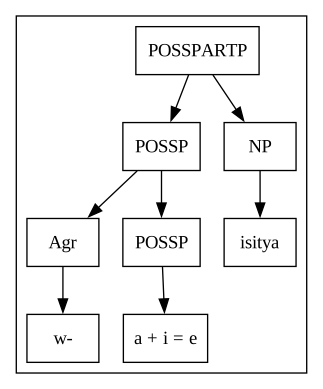
| Umqheba wesitya |
| Umqheba wa + isitya |
| NP POSSP NP |
| The handle of the dish. |
The above POSSPARTP has the NP as its complement.
Possessive particle modified with the absolute pronoun
The POSSPARTP can be constructed with the absolute pronoun by attaching the possessive particle -a- to the pronoun. The POSSPARTP becomes the head of the phrase and must agree with the class to which the antecedent belongs. The modifier follows the antecedent (Berg, 2001; Krüger, 2013a, b)
| Ibhola yabo |
| Ibhola ya bo |
| NP PossPart AbsP |
| Their ball |
Possessive particle modified with the inclusive quantitative pronoun
The PossPart can be modified with the inclusive quantitative pronoun (IncQPro) by attaching the possessive particle -ka- to the pronoun. The POSSP becomes the head of the phrase and must agree with the class to which the antecedent belongs.
| Ukutya kwethu sonke |
| Ukutya kwethu sonke |
| NP PossPart IncQPro |
| Food for all of us |
Possessive particle modified with the demonstrative pronoun
The PossPart can be constructed with the demonstrative pronoun by attaching the possessive particle to the demonstrative pronoun. The PossPart becomes the head of the phrase and must agree with the class to which the antecedent belongs. It appears after the antecedent.
| Isihlangu salo |
| Isihlangu sa lo |
| NP PossPart DemP |
| This one’s shoe. |
Possessive particle modified with the adverb
The PossPart can be modified with the adverb by attaching the possessive particle -ya to the adverb phrase (AdP). The PossPart becomes the head of the phrase and must agree with the class to which the antecedent belongs.
| Inja yasekhaya |
| Inja ya- -s- ekhaya |
| NP PossPart AdvP |
| The dog of this place. |
Possessive particle modified with the conjunction phrase
The PossPart can be modified with the conjunction phrase by attaching the possessive particle a- to the conjunction. The PossPart becomes the head of the phrase and must agree with the class to which the antecedent belongs.
| Ixesha lokuba ahambe |
| Ixesha lokuba (la + ukuba) ahambe |
| NP PossPart ConjP VP |
| The time of leaving. |
Syntactic and semantic functions of the possessive particle phrase
The external syntax of POSSPARTP is concerned with the use and function of a PossPart in larger constructions. The following are possible functions of the POSSPARTP:
- POSSPARTP as a complement of nounsThe POSSPARTP appears after the antecedent with the POSSPARTP agreeing with the NP that is being modified.Example 7
Igaba lakhe Igaba la + khe NP PossPart PersP Her/his hoe. - PossPP as a complement of locatives
The PossPP becomes the head of the phrase and always appears after the LocP with the agreement morpheme attached to the PossPP.
Example 8Entla komzi. Entla ko + mzi LocP PossPart NP Yonder the homestead. Example 9Ekuhambeni kwakhe Ekuhambeni kwa + khe LocP PossPart PersP During His/her departure. - PossPP as a complement of class 17 nouns
The PossPP becomes the head of the phrase and always appears after the class 17 noun that functions as a locative.
Example 10Phantsi kwegadi Phantsi kwa + igadi / kwa+i > kwe / LocP PossPart NP Beneath the garden. Example 11Phezu kwetafile Phezu kwa + itafile / kwa+i > kwe / LocP PossPart NP On top of the table. - PossPP as a complement of the infinitive
The PossPP follows the infinitive that is being qualified with an agreement morpheme attached to the POSSP. In that construction the PossPP becomes the Head of the phrase.
Example 12Ukukhala kosana. Ukukhala ko usana NP PossPart NP The cry of the baby. Example 13Ukucula kwabo Ukucula kwa + bo NP PossPart NP Their singing.
Qualificative particles and qualificative particle phrase
This topic elucidates the internal syntax of isiXhosa qualificative particle and the qualificative particle phrase QUALPARTP with reference to its constituents, like, the word order, as well as the agreement concept that govern the syntactic structure thereof. After that, the discussion will focus on the external syntax of the QUALPARTP with reference to its use in larger constructions (Berg, 2001; Krüger, 2013a, b).
The qualificatives in isiXhosa have stems of their own. The general view is that the qualificative, except for the demonstrative comprises of two elements, which are: the concord and the stem Mojapelo (2001), Pahl (1985) and Satyo (1997). The complements of the substantive add information about or modify it differently. This results in different types of qualificatives (Mojapelo, 2001). This work considers five types of qualificatives in isiXhosa, the possessive having been dealt with above. These are:
- the adjective
- the relative
- the possessive
- the inclusive quantifier
- the quantifier -phi ‘where’ and –mbi ‘another one’
The qualificative is defined as a grammatical concept that functions as a modifier to the NP which could be a noun or a pronoun that it qualifies. The qualificative agrees with its antecedent by means of a concordial morpheme that originates from the class to which the NP belongs Pahl (1985) and Satyo (1997).
- Lo mntwana mhle Lo mntwana m + hle ‘This pretty child’ (adjective)
- Yonandlela ibanzi Yonandlela i + banzi ‘A road that is broad.’(relative)
In the above isiXhosa examples, the antecedents’ pre-prefixes have been elided. In an event where the pre-prefix is there, the concord is preceded by a formative morpheme/participle –a-, that changes to –e-; -o- in response to the class to which the antecedent belongs. The morpheme –a- is referred to as the qualificative particle.
- Umntwana o + mhle uyathandeka. ‘A pretty child is lovable.’
- Isitya e + sikhulu siyasinda. NP PossPart AdjP VP ‘A big dish is heavy.’
A qualificative particle phrase QUALPARTP comprises of a QualPart attached to its complement. The above example is a reflection of an adjective being attached to a qualificative particle (QualPart), as its complement. This means that the adjective becomes the dependent of the particle hence it acquires the name of the particle QUALPARTP (Berg, 2001; Krüger, 2013a, b).
The internal structure of the qualificative particle and qualificative particle phrase
The internal structure of the qualificative particle and the qualificative particle phrase (PossPP), will focus on how it is constructed, looking at the concepts of agreement, word order, etc. The qualificative structurally is a modifier that is dependent on the substantive in the noun phrase (Mojapelo, 2001).
- The qualificative particle (QualPart) with its adjective complement
The QualPart functioning as the head is attached to its complement, which is the adjective AdjP. The QUALPARTP must agree with the class of the noun that is modified by means of the concord marker (Berg, 2001; Krüger, 2013a, b). The QUALPARTP can appear before the NP that is qualified or after. Also, it may stand on its own for purposes of emphasis, the antecedent being represented by the concord within the QUALPARTP.
- The qualificative particle (QualPart) with its relative complement
The QualPart functioning as the head is attached to its relative complement RelP. The QualPart must agree with the class of the noun that is modified (Berg, 2001; Krüger, 2013a, b). The QUALPARTP can appear before the NP that is qualified or after. Also, it may stand on its own for purposes of emphasis, the antecedent being represented by the concord marker within the QUALPARTP.
Example 14Umthi oluhlaza umthi o luhlaza (a + uluhlaza: a + u > o) NP + QualPart + RelP A tree that is green/ A green tree. Example 15Oluhlaza umthi A green tree Example 16Oluhlaza The green one Example 17Inja emdaka inja emdaka (a + i mdaka: a + i > e) NP QualPart + RelP A dog that is dirty Example 18Emdaka inja A dirty dog. Example 19Emdaka A dirty one. - The QualPart with the inclusive quantitative pronoun as its modifier
The QualPart functioning as the head is attached to the inclusive quantifier that is its modifier. The QUALPARTP has to agree with the class of the noun that is modified (Berg, 2001; Krüger, 2013a, b). The QUALPARTP can appear before the NP that is qualified or after.
Example 20Izinja zo nke zifile NP QualPart IncQPro VP All the dogs are dead. Example 21Bo nke bafikile QualPart IncQPro VP All have arrived. - The QualPart with the quantitative pronoun QuanPro as its modifier
The QualPart functioning as the head is attached to the QuanPro -phi that is its modifier. The QuanPro has to agree with the class of the noun that is modified (Berg, 2001; Krüger, 2013). The QUALPARTP can appear before the NP that is qualified.
Example 22Wazi owuphi umntu? Wazi o wu phi umntu? VP QualPart Agr QuanPro NP Which person do you know? - The QualPart with the comparative quantitative phrase (ComQP) as its complement
The QualPart, functioning as the head is attached to the comparative quantifier that is its modifier. The QUALPARTP must agree with the class of the noun that is modified (Berg, 2001; Krüger, 2013a, b). The QUALPARTP can appear before the NP that is qualified.
| Ilokhwe e mhlophe okwe khephu |
| NP QualPart RelP QualPart CoQP |
| A dress that is white as snow. |
| Isiselo esi mnandi oko busi |
| NP QualPart RelP QualPart CoQP |
| A drink that is sweet like honey. |
The external structure of the qualificative particle and the qualificative particle phrase
The external structure of the qualificative particle and the qualificative particle phrase is concerned with the use and function of a QUALPARTP in larger constructions (Berg, 2001; Krüger, 2013a, b). The following are possible functions of the QUALPARTP:
- The QualPart as a complement of adverb phrases (AdvP)
The QualPart functioning as the head is attached to the AdvP that is its modifier. The QUALPARTP has to agree with the class of the noun that is modified by means of a concord morpheme marker (Berg, 2001; Krüger, 2013a, b). The QUALPARTP can only appear after the antecedent.
Example 25Uhlala edolophini enkulu Uhlala edolophini e nkulu VP QualPartLocP QualPart AdjP He/she stays in a big town. Example 26Ukhwele emotweni eluhlaza Ukhwele e motweni e luhlaza VP QualPart AdvP QualPart RelP He/she is driving a green car. - The QualPart as a complement of qualificative phrases
The QualPart, functioning as the head, is attached to the AdvP that is its modifier. The QUALPARTP must agree with the class of the noun that is modified by means of a concord morpheme marker (Berg, 2001; Krüger, 2013a, b). The QUALPARTP can only appear after the antecedent.
Example 27Isitshaba senkosi yeenkosi NP QUALPARTP POSSPARTP The crown of the king of kings. Example 28Ingxowa yomgubo wombona NP QUALPARTP POSSPARTP A bag of mealie meal.
Locative particles and locative particle phrases
This section will concentrate on the locative particles and locative particle phrases. The characterisation of locative particles and locative particle phrases, and its internal structure, which includes its head, complement and word order will be dealt with. The syntactic and semantic functions of the locative particle phrase and syntactic uses are presented. The discussion will commence with the characterisation of the above in isiXhosa.
Locative/relational particles combine with each other and with various object and subject pronouns, sometimes with phonological changes, with results that are written as single words. These particles introduce a relative clause or phrase, often more fully describing preceding noun or verb.
Mathonsi (2001) expands the concept of particles to include all functional words. According to him not only prepositions, articles, indefinite pronouns, but also prefixes, suffixes and inflectional endings. This applies in isiXhosa considering the affixes and suffixes used in the formation of the locative.
According to Taji (2020: 55) “Locative particles are shortened forms of locative nouns which correspond with locative noun classes 16 (pa-) 17 (ku-) and 18 (mu-).”
In isiXhosa the locative noun class 16 is pha- instead of pa- in Chiyayo and the locative noun class 17 is ku- in both isiXhosa and Chiyayo. The locative noun class 18 is mu- in Chiyayo whilst it does not exist in isiXhosa. Taji further states that, like demonstratives, locative particles occur in both pre- nominal and post- nominal positions.
- Phantsi ‘below’ (Class 16)
- Phambili ‘in front of’ (Class 16)
- Ukunene ‘right side’ (Class 17)
- Ukwindla ‘autumn’ (Class 17)
According to Taljaard & Bosch (1988) there are mainly three ways in which the locative nouns can be expressed:
- By means of the prefix ku-: All nouns of the person classes, i.e., um-, aba-, u-, form their locatives by discarding the initial vowel and substituting ku- for it.
- Kumalume ‘to/with/at uncle’
- Kubantwana ‘to/with/at children’
If ku- is prefixed to plural oo- the vowel undergoes the process of elision and the particle becomes k-:
- Koomalume ‘to/with/at uncles’
- Koomama ‘to/with/at mothers’
- By means of e-…-ini: In some cases, isiXhosa locatives are constructed from different lexical items through the use of two locative affixes, a prefix e- and suffix –ini. The –ini combines in various ways with the final vowel of the noun.
- umthi > emthini ‘Tree’ > ‘At the tree’
- intaba > entabeni ‘Mountain’ > ‘At/on the mountain’
- inkosi > enkosini ‘Chief’ > ‘At the chief’
- By means of the prefix e- without a suffix: A number of nouns prefix only e- in the locative without adding the suffix –ini.
- ubusika > ebusika ‘Night’ > ‘At night’
- iGoli > eGoli ‘Johannesburg’ > ‘At/in Johannesburg’
- ikhaya > ekhaya ‘Home’ > ‘At home’
Pahl (1978) and Satyo (1997) also endorse the views above about the locative particles. They state that these formatives are prefixed to the nouns to form the locative phrases.
The internal structure of the locative particle phrase
According to Berg (2018) a particle phrase in Setswana consists of a specific particle as head word, followed by a complement. The locative particle phrase i.e., LOCPARTP is headed by the locative particles go/ga ‘to’, ka ‘into’, fa ‘at’, kwa/mo ‘in’ each of which is followed by its own distinctive complements. There is no class agreement between the complement and the locative particle. In isiXhosa these locative particles are represented by: ku, ‘to’; kwa, ‘at’; ka ‘into, in’ each of which is followed by its own complement.
LOCPARTP ku- consists of the locative particle ku- ‘to’ which refers to someone personally, as head, followed by a pronoun phrase i.e., PROP or a class noun phrase i.e., CLNP as complement which belongs to class 1a or 2a. The locative particle ku- is followed by a noun in class 1a.
- Kumama ‘to mother’
- LocPart ku-mama Class 1a N
LOCPARTP kwa- consists of the locative particle kwa- ‘at’ which means at someone’s place. The particle is the head, followed by a PROP or a CLNP as a complement belonging to class 1a or 2a. Below it is followed by a noun in class 1a.
- Kwamalume ‘At uncle’s place.’
- LocPart kwa-malume Class 1a N
In isiXhosa locative is mostly represented by an affix e- and a suffix –ini
- Evenkileni < ivenkile ‘In the shop’
- Edolophini < idolophu ‘In town’
Du Plessis & Visser (1992) further confirm that: “The possessive ‘kwa’ may also occur as complement.”
- Le ntombi ikwamalume. ‘This girl is at my uncle’s place.’
- Aba bantu bakwaZulu. ‘These people are in Zululand.’
The demonstratives of the old locative classes apha, apho, phaya, may occur as complements on their own or with various other locatives.
- Baza kuba lapha enkonzweni. ‘They will be here in the service.’
- Ufuna ukukhe afike apho kuwe. ‘He/she wants to be there with you.’
Canonici (1995: 59) cited by Mathonsi (2001) affirms this, stating that the locative markers ku-/ ki- and e- / o- are in complementary distribution, since ku- and ki- occur with absolute pronouns, relativised forms, demonstratives, as well as class 1, 1a, 2 and 2a nouns, while e- and o- occur with nouns of other classes.
Syntactic and semantic functions of the locative particle phrase
When intransitive verbs are used with locatives, such locatives may be interpreted with six different semantic roles, i.e., location, direction, source, recipient, theme and benefactive (Du Plessis & Visser, 1992). From these six semantic roles the location and source roles are dominant, the other semantic roles are seldom found with very few verbs.
- Indoda imangala kuSibonda. ‘The man lays a charge to the Headman.’ (Theme)
- Umbuzo ucacile emntwaneni. ‘The question is clear to the child.’ (Benefactive)
- Umama uya enkonzweni. ‘Mother goes to church.’ (Direction)
- Intombi ivela edolophini. ‘The girl is returning from town.’ (Source)
- Utitshala ufikile esikolweni. ‘The teacher has arrived at school.’ (Location)
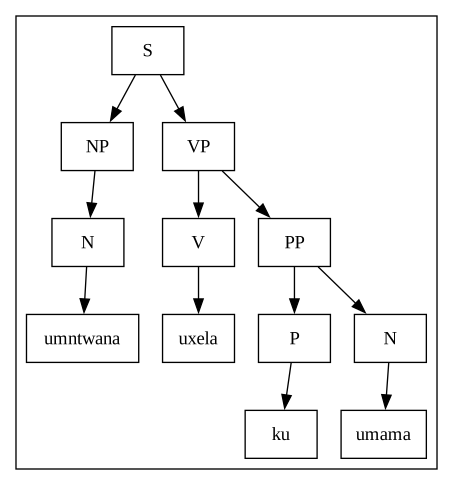
- Umntwana uxela kumama. ‘The child reports to the mother’ (Goal)
Projection of locative particle phrase
The last example can be projected by a tree diagram to show the locative particle phrase ku-
Syntactic uses of locative particle phrase
The locative particle is used to express definiteness of the location where the event is taking place. (Taji, 2020: 56)
- KwaDukuza kwakukho ilali ‘At KwaDukuza there was a village.’
- Kuloo lali kwakukho inkosi ‘In that village there was a chief.’
The locative particle is used to indicate the location of an object (Hobson, 1999).
- Umama ufikile ekhaya. ‘Mother has arrived at home.’
The locative particle is used as a prefix ku-, kwa- and nga- to the noun (Hobson, 1999).
- NgeCawa siye ecaweni. ‘On Sunday we went to church.’
- Ndifuna ukuya kugqirha wamazinyo. ‘I want to go to the dentist.’
- Ndithunywe kwamalume. ‘I have been sent to my uncle’s home.’
The prefixed and suffixed locatives can also be used as locative particles (Hobson, 1999; Satyo, 1997; Pahl, 1978).
- umgidi > emgidini ‘in/at the festival’
Du Plessis & Visser (1992), state that the locatives in isiXhosa with the affixes e/ini or the preposition ku are used extensively with the semantic role of time, depending on the type noun which also denote time. Such locatives are always found as adjuncts, and not complements. There are many nouns denoting times of the day or seasons which may be used in this way:
- Abantu bavuna umbona ebusika. ‘The people reap the mealies in winter.’
- Bonke abantu bayalala ebusuku. ‘All the people sleep at night.’
Instrumental particle and locative particle phrases
In this section the instrumental particle which means causing something to happen will be discussed. The characterisation of the instrumental particle, the internal structure, projection, and the syntactic uses of locative particle phrases will be explained. The internal structure will look at the head, the complement, and the word order.
The adverbial formative nga- has the meaning ‘with (an instrument)’; ‘concerning’, hence the term instrumental. Nga- is prefixed to the noun which means that it always comes before the initial vowel of the class prefix resulting in the coalescence of a- or nga- with the initial vowel (Taljaard & Bosch, 1988: 48):
| nga- + um- > ngom (Class 1) |
| nga- + aba- > ngaba (Class 2) |
| nga- + imi- > ngemi (Class 4) |
| nga- + ili- > ngeli (Class 5) |
The instrumental case (abbreviated INS or INSTR) is a technical description often denoting the phrase ‘by means of’, which is similar to ‘by use of’ in the instrumental case, a predicate with infinitive, future tense, imperative. The instrumental case denotes the time in which the action takes place. Some authors endorse this view referring to them as adverbs indicating time (Pahl, 1978; Satyo, 1997)
- Ndibuya ngongcwalazi. ‘I come back at dawn.’
- Ndihamba ngeenyawo. ‘I travel on foot.’
Crystal (1980) states that in languages which express grammatical relationships by means of inflections, the term instrumental refers to the form taken by a word, usually a noun or pronoun, when it expresses such a notion as ‘by means of’. The term has a special status in case grammar, where it refers to the semantic case of the inanimate entity casually involved in a verb’s action.
- Ucango luvulwe ngesitshixo. ‘The door was opened with the key.’
- UNomsa upheka ngembiza. ‘Nomsa cooks with a pot.’
A particle phrase consists of a specific particle as a head word followed by a complement. instrumental particle is nga ‘with’.
- Ndihlamba ngamanzi. (nga + amanzi) ‘I wash with water.’
- Bahamba ngemoto. (nga + imoto) ‘They travel by means of a car.’
- Ndibhala ngosiba. (nga + usiba) ‘I write with a pen.’
- Udlala ngebhola. (nga + ibhola) ‘He/she plays with a ball.’
The sound changes (a + i > e / a + u > o) are explained in the section of Phonology.)
The internal structure of the locative particle phrase
In isiXhosa nga- can be prefixed before the adverb/noun to indicate different locative particle phrases. Pahl (1978) points out the adverbs indicating manner:
- Utata ufike ngokukhawuleza. ‘Father arrived very quickly.’
- ULizo ubaleka ngamandla. ‘Lizo runs very fast.’
Nga- can be prefixed to the adverb to indicate reason or aim:
- Size ngomcimbi wemfundo. ‘We came because of education.’
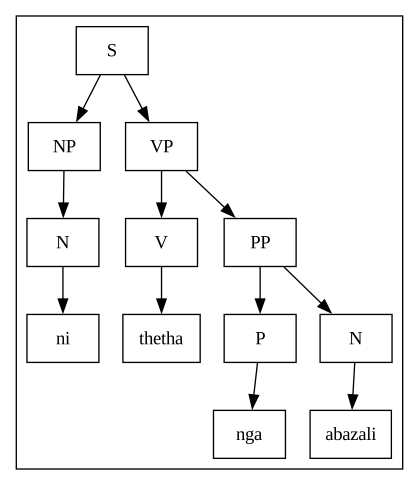
- Nithetha ngantoni? ‘What are you talking about?’
Nga- can be prefixed to other parts of speech to show locatives:
- Ulele ngendlu. ‘He/she is bed-ridden.’
- Hlala ngemva emotweni. ‘Sit at the back seat of the car.’
Nga- may be prefixed to the interrogative –phi?
- Amakhosikazi abheka ngaphi? ‘Where about are women going?’
- Amadoda adibene ngaphi. ‘Where about are men meeting?’
Syntactic and semantic functions of the locative particle phrase
When nga- is used with the locative it expresses ‘towards’, ‘round -about’, ‘in the direction of’. Note that in the case of a locative with initial e- vowel, coalescence does not take place but the so-called pre-locative–s- separates the two vowels (Taljaard & Bosch, 1988).
- Inja kaLizo ifele ngasekhaya. ‘Lizo’s dog died near my home.’
- Abantwana badlala ngasemlanjeni. ‘The children are playing near the river.’
Some locatives which denote proximity may be succeeded by a possessive with a Class 17 concord (ku-)
- Naziya ngaphaya kothango. ‘They are there over the kraal.’
- Bahleli ngasemva komzi. ‘They are sitting behind the home.’
Sometimes nga- is used in the locative with an –s- to fill- up a gap:
- Yima apho ngasemnyango. ‘Stand there by the door.’
- Jonga phaya ngasentla. ‘Look there at the top.’
Additional to the above functions nga- may also be used to convey the meaning ‘concerning’ or ‘about’ (Taljaard & Bosch, 1988).
- Sikhala ngabaphangi. ‘We complain about the gangsters.’
- Nithetha ngabazali. ‘You talk about your parents.’
Projection of locative particle phrase
The last example can be projected by a tree diagram to show the locative particle phrase.
Syntactic uses of locative particle phrase
Nga- is used with the names of the days of the week and the names of the months to indicate ‘on that day/in/during that month’ (Taljaard & Bosch, 1988).
- ngoMvulo ‘on Monday’
- ngoLwesibini ‘on Tuesday’
- ngoLwesithathu ‘on Wednesday’
- ngoLwesine ‘on Thursday’
- ngeyoKwindla ‘in March’
- ngeyomQungu ‘in January’
- ngeyoMnga ‘in December’
Nga- has become stylised when used with pha- words, and there is hardly any difference in meaning whether it is used or not.
- Sihlala ngaphandle. ‘We are sitting outside/ on the outside.’
- Libeke ngaphezulu. ‘Put it on top.’
Associative particle and associative particle phrases
In Nguni languages, the associative particle uses different class prefixes in accordance with what it possesses. The associative particle acts as the head of an associative particle phrase (Crystal, 1980; Huddleston, 1984). In isiXhosa no-/ne- are classified as associative particles and describe the meaning of these words as ‘with’:
- Intombi ihamba nomfana. ‘The girl walks/goes with the young man.’
- Ikati ilwa nenja. ‘The cat is fighting with a dog.’
In the above examples the associative particle is no- and ne- which are formed by the combination of the possessive particle na- and the prefix of the noun.
- umfana: na- + u-= nomfana
- inja: na- + i- = nenja
The associative particle phrase consists of an associative particle no- ‘with’ as head, followed by a noun as the complement. There is no agreement between the complement and the preceding associative particle.
- Inkomo itya nethole. ‘The cow is eating with the calf.’
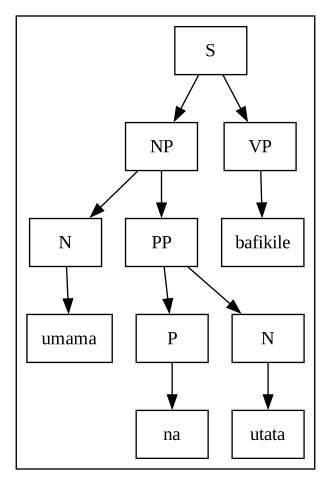
- Ndihamba nomama. ‘I am going with mother.’
In the first example the associative na- is followed by a noun ithole.
In the second example the associative na- is followed by a noun umama.
The associative marker na- may have different meanings such as ‘in the company of’ or assume the predicative meaning ‘to have/ possess/ be with’ (Mathonsi, 2001).
- Umama ufika notata. ‘Mother arrives with father (i.e., in the company of)’
- Inkosikazi inabantwana. ‘The lady has children; or, is with the children.’
The associative marker na- can also be a case marker (Meyers, 1995 cited by Mathonsi, 2001).
- Utata unomnqwazi. ‘Father has a hat.’
- Umfundisi unomthika. ‘The priest has a gown.’
The case marker na- can be agglutinated before kho- which is followed by an infinitive, na- shows the ability to have the strength to do something or not.
- Ndinakho ukuwenza lo msebenzi. ‘I can do this work.’
- Asinakho ukuhamba ngeenyawo. ‘We cannot walk by foot.’
Na- can be attached to nouns like –mhla, -nyaka to form adverbs of time (Pahl, 1978).
- Namhlanje ‘Today’
- Nonyakanje ‘This year’
The internal structure of the associative particle phrase
An associative particle can be used as the head in a phrase that functions as an adjunct in a sentence (Berg, 2018: 99).
- Ndisebenza nomama. ‘I work with mother.’
An associative particle can be used as the head of the phrase that follows the associative copulative verb in the positive (Berg, 2018: 99).
- Umfazi unemoto. ‘The woman has a car.’
Syntactic and semantic functions / uses of the associative particle phrase
Na- is prefixed to the noun which means that it always comes before the initial vowel of the class prefix resulting in the coalescence of a- of na- with the initial vowel. The inflected noun with na- usually follows the verb (Taljaard & Bosch, 1988).
- Udlala nabantwana. ‘He/she plays with the children.’
- Sibuya namahashe. ‘We return with the horses.’
It shows cooperation between people/animals (Pahl, 1978).
- UKhulile uhamba kunye noyise. ‘Khulile walks together with his father.’
- URoman utsala noWitfoot. ‘Roman pulls with Witfoot.’
To do something that involves someone else (Pahl, 1978).
- Ndithetha nawe. ‘I am speaking with you.’
- Kutheni usilwa nam nje? ‘Why are you fighting with me?’
The na- can function as simple coordinating conjunctions, which means they cannot be considered as prepositions because they do not mark a syntactic change in the use of the noun and moreover a morphological expression cannot be inclusive of coordination (Mathonsi, 2001).
- Umama notata bafikile. ‘Father and mother have arrived.’
- Ndithenga ubisi neswekile. ‘I buy milk and sugar.’
Projection of associative particle phrase
The first example can be projected by the following tree diagram to show the associative particle na-.
Comparative particle and comparative particle phrases
There are three comparative particles in isiXhosa, i.e., njenga- ‘just like’, kuna- ‘than’ and nganga- ‘size / shape/ length’. These comparative particles perform very similar functions in the language, i.e., to compare likeness and differences between objects, persons, etc. These functions are not necessarily adverbial, but they are discussed here because, as is the case with the other formatives, the noun is inflected in the same manner. All three are prefixed to a noun with the resultant coalescence of vowels. Each one of them has, however, certain limitations as to its usage (Taljaard & Bosch, 1988).
According to Canonici (1995) the comparative prefixes can be considered as prepositional heads of phrases. However, they should not be considered as heads of the phrases they precede on grounds of their prefixed/attached to them.
- Intombi intle kunenkwenkwe. ‘The girl is more beautiful than a boy.’
- Esikolweni asidlali njengasekhaya. ‘At school we don’t play like at home.’
- Indlovu ingangentaba. ‘An elephant is as big as a mountain.’
The internal structure of the comparative particle phrase
The structure of the comparative particle phrase is like that of the associative particle phrase, except that it has the comparative particle njenga- ‘just like’ as head (Berg, 2018).
- Kunjengasehlotyeni namhlanje. ‘It is just like in summer today.’
- Kunjengokwayizolo oku kutya. ‘It is just like yesterday’s food.’
Syntactic and semantic functions / uses of the comparative particle phrases
- Njenga-
When njenga- is prefixed to a noun, it can be used in the normal adverbial positions in the sentence (Taljaard & Bosch, 1988).
- Ubaleka njengenkawu. ‘He/she runs like a monkey.’
- Batya njengamakhwenkwe. ‘They eat like boys.’
A noun inflected by njenga- can also be used to form the predicate of the sentence by prefixing a subject concord to it (Taljaard & Bosch, 1988).
- ULizo unjengoyise ‘Lizo is just like his father’
- Kunjengasebusika namhlanje. ‘It is just like in winter today.’
- Kuna-
To express comparison an adverbial formative kuna- ‘than’ is prefixed to a noun. It can only be used in a descriptive manner and it can even follow another adverbial form (Taljaard & Bosch, 1988).
- Amakhwenkwe akhawuleza kakhulu kunamadoda. ‘Boys walk faster than men.’
- Ibhasi inkulu kunemoto. ‘A bus is bigger than a car.’
- Nganga-
expresses comparisons of size/shape/length, etc. (Taljaard & Bosch, 1988).
- Inde ngangendlulamthi. ‘As tall as a giraffe.’
- Inkulu ngangendlovu. ‘As big as an elephant.’
Projection of comparative particle phrase
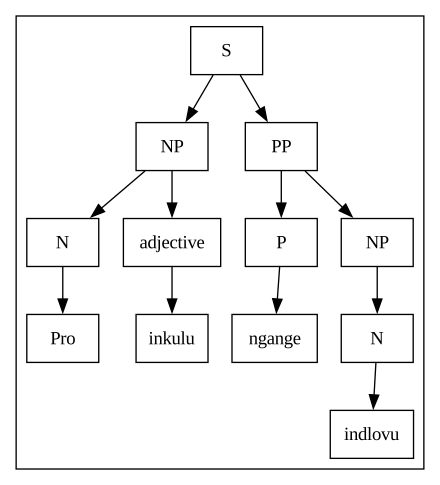
The last example of the comparative particle phrase can be projected in a tree diagram to show the comparative particle nganga-
References
Berg, A. (2018) Computational syntactic analysis of Setswana. Doctoral Thesis. North-West University, Potchefstroom.
Canonici, N. N. (1995) Zulu Grammatical Structure, 3rd edn. Durban: University of Natal, Department of Zulu Language and Literature.
Crystal, D. (1980) A first Dictionary of Linguistics and Phonetics. London: Andre Deutsch Limited.
Du Plessis, J. A. & Visser, M. (1992) Xhosa Syntax. Pretoria: Via Africa.
Hobson, C. B. (1999) Morphological Development in the Interlanguage of English Learners of isiXhosa Language of English Learners of isiXhosa. CITESEER.
Huddleston, R. (1984) Introduction to the Grammar of English. Cambridge: Cambridge University Press.
Krüger, C. J. H. (2013a) Setswana syntax: a survey of word group structures: Volume 1. München: Lincom.
Krüger, C. J. H. (2013b) Setswana syntax: a survey of word group structures: Volume 2. München: Lincom.
Lombard, D. P. (1985) Introduction to the Grammar of Northern Sotho. Pretoria: Van Schaik.
Mathonsi, N. N. (2001) ‘Prepositional and adverb phrases in Zulu: a linguistic and lexicographic problem’. South African Journal of African Languages. 21(2), 163-175.
Mojapelo, M. (2018) The distribution and interpretation of the qualificative in Sesotho. Doctoral Thesis. University of South Africa, Pretoria.
Pahl, H. W. (1978) IsiXhosa. Qonce (King Williams Town): Thandapers.
Pahl, H. W. (1985) isiXhosa. 4th edn. Johannesburg: Educum Publishers.
Ross, M. (1982) Oxford English Dictionary. (Vol.111). London: Oxford University Press.
Satyo, S. C. (1997) Igramanoncwadi lwesiXhosa Ibanga 9. Pretoria: Via Afrika.
Taji, J. (2020) ‘Definiteness in Chiyao’. Ghana Journal of Linguistics. 9(2): 44-64.
Taljaard, P. C. & Bosch, S. E. (1988) Handbook of isiZulu. Pretoria: Van Schaik.
Van Rooyen, C. S., Louw, J. A., Cantrell, J. V., Taljaard, P. C., Satyo, S. C., Ntuli, D. B. & Davey, A. S. (1982) Xhosa only guide for XHS201-3. Pretoria: University of South Africa.