Inventory of click sounds
Description of the nature of click sounds in isiXhosa.
Inventory of clicks
There are 15 click speech sounds in isiXhosa of which three are considered to be basic whilst each of these have different phonetic accompaniments as well as three versions of a nasal and click combination.
The pronunciation of all click sounds assume at least three points of tongue closure in the upper oral cavity. Tongue closure takes place in the front (anterior) part of the mouth, at the back part of the mouth (at the velum) as well as at both sides (lateral parts) of the upper oral cavity. In this process an amount of air is trapped in the oral cavity created by the closures. A downward, backward or lateral movement of the tongue rarefies the trapped air after which a release of any of the three closures causes an ingressive flow of air into the oral cavity creating a particular click sound.
- When the anterior closure is released with a downward movement of the tongue an alveolar click sound is perceived as in the sequence <aca> [aǀa]

- When the blade of the tongue moves backwards and the closure is released at the palatal area a palatal click sound is perceived as in the sequence <aqa> [aǃa]
- When one side of the tongue moves downwards and the lateral closure is released a lateral click sound is perceived as in the sequence <axa> [aǁa]
The activities in producing these sounds may be recorded by means of electropalatography (EPG) “… which involves the use of an artificial palate containing several electrodes, which register the tongue contacts as they are made: the results are presented visually as electropalatograms”
(Crystal, 2008: 165).
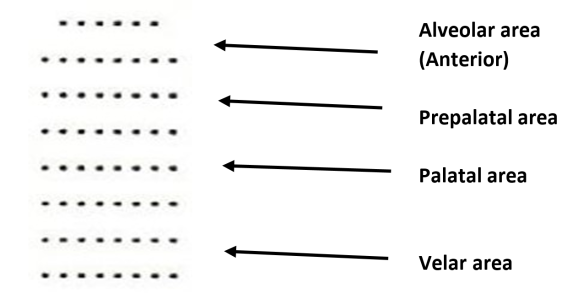
This artificial palate is embedded with sensors and is linked to a computer that displays the palate on a computer screen. As soon as the tongue touches a sensor it lights up and registers a 0 sign on the point of contact on this palate. These recorded palates are presented as slides in the discussions to follow. The slides follow each other in rapid succession - no time scale is presented for these articulatory sequencies.
The EPG recordings demonstrated below were made at the School of Oriental and African Studies in London. The speaker (NM) who produced these click sequences confirmed that he was a fluent speaker of isiZulu and isiXhosa.
Consider the followings EPG-slides produced in non-word sequences
During the articulation of the clicks the body of the tongue may touch different points in the oral cavity, however, the articulatory labels assigned to each click represents the articulatory position at the point of release (also see Ladefoged & Maddieson 1996: 251).
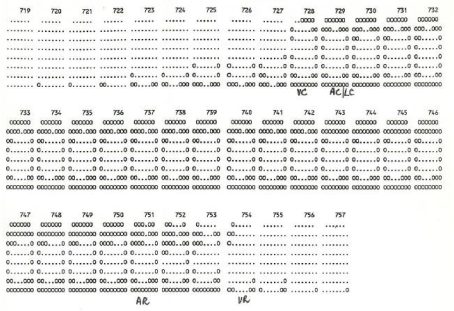
- Slide 719:
- No contact of the tongue and the roof of the mouth as the sound [a] is a vowel.
- Slide 725 – 727:
- The back of the tongue start touching the velum.
- Slide 728-729:
- Velar closure (VC) takes place with full anterior closure (AC) and lateral closure (LC).
- Slide 730-750:
- Central pocket of air trapped between the anterior, lateral and velar closures.
- Slide 751-753:
- Gradual anterior release (AR) concomitant with lateral release.
- Slide 754:
- Full velar release (VR) with ingressive flow of air producing a voiceless alveolar click sound.
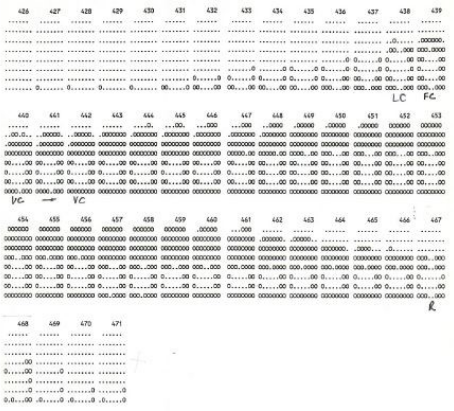
- Slide 426-437:
- No real contact with the palate as the first sound is a vowel [a]
- Slide 437-438:
- Gradual lateral and velar closure.
- Slide 439:
- Full front closure (FC) in the alveopalatal region.
- Slide 440-442:
- Velar closure (VC) sealing off a contained pocket of air.
- Slide 443-454:
- Tongue movement towards the anterior (alveolar) region with an increase in the volume of the pocket of air.
- Slide 455-464:
- Gradual retraction of the tongue with simultaneous closing (rarefication) of the pocket of air.
- Slide 467:
- Simultaneous release (R) of the tongue contact at the velum and pard palate with ingressive flow of air producing a voiceless palatal click.
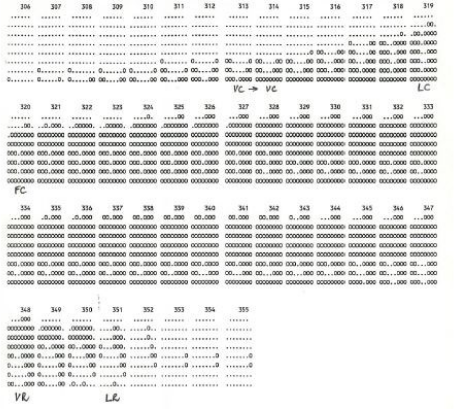
- Slide 306-312:
- No real contact with the palate as the first sound is a vowel [a].
- Slide 313-319:
- Initial velar closure (VC) followed by bilateral closures (LC).
- Slide 320:
- Full closure (FC) at velum and alveopalatal regions without creating a significant pocket of air as in the case of alveolar and palatal articulations.
- Slide 321-347:
- Tongue contact with the roof of the mouth maintained.
- Slide 348-350:
- Velar release (VR).
- Slide 351:
- Lateral release (LR) at the left side of the mouth producing a voiceless alveolateral click sound.
Although literature on the articulation of clicks generally proclaim that two points of closure (anterior and posterior) in the oral cavity is necessary to produce a click sound, electro-palatographic data indicate that lateral closure is equally important in the articulation of a click sound.
Phonetic attributes of affricated clicks
This section is primarily based on Roux (2007) and frequently refers to results obtained through a speech processing technique known as Smoothed Pseudo-Wigner Distribution Analysis (SPWD) that combines the good frequency resolution of narrow band spectrograms, and the good time resolution of wide band spectrograms.
Some of the earliest descriptions of click sounds proclaim that the dental/alveolar [ǀ] and lateral [ǁ] are pronounced with friction, see Doke (1930), Beach (1938), as well as Ladefoged & Traill (1994). Concerning this topic, Sands (1991: 3) also concludes “(i)t seems that the lateral and dental clicks are made with a long constriction release which is more gradual, causing the release to be affricated.”
Ladefoged & Traill (1994: 40) present two waveforms (Figure 5) stating that these clicks “… have considerable turbulent noise after the release.”
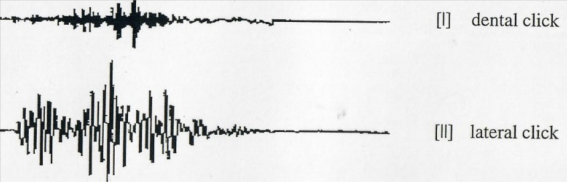
“For the noisy clicks, after the anterior closure is released, the noise increases in intensity until it reaches a maximum, after which the noise decreases in intensity”
(Ladefoged & Traill, 1994: 41). This interpretation seems to be in line with the general definition of an affricate, i.e., a release burst of a stop followed by frication. Laver (1994: 364) declares “This phonetic process of making the overlap phase between a stop and the following articulation audibly and momentarily fricative is called affrication.”
However, the results of an SPWD analysis by Roux et al. (1995: 574-577) seem to suggest the opposite. Figure 6 represents the analysis of the noise burst of the voiceless alveolar click c [ǀ] in isiXhosa as in a /Ca/ sequence and should be interpreted as follows:
- an initial silence (0-0.02s) representing the closure phase of the click;
- an audible frication phase clearly detectable by frication excitation spreading over the whole spectrum (0-5kHz) up to a point in time (0.046s) – this is indicative of the blade of the tongue gradually being ‘sucked’ in towards the point of release causing noise prior to the release;
- the point of release (0.046s) is marked by the first sharp deviation from the zero-line and attested as an impulse excitation, i.e., a vertical line extending into a horizontal island at 1200 Hz extending towards the first and second formant frequencies of the following low vowel /a/ without excessive high frequency turbulence.
“Translated into articulatory terms, this is to be expected with sounds utilizing ingressive airstream mechanisms: a backward (and downward) movement of the anterior closure creates friction up to the point where the seal is finally broken with enough energy to result in a pulse-like excitation.”
(Roux et al., 1995).
The view that the alveodental and alveo-lateral clicks in isiXhosa are affricated cannot be supported – these sounds rather show pre-affrication where the sound starts out with a noise component followed by a pulse. (Roux, 2007).

To conclude this section, consider the following three figures of waveforms and spectrograms that illustrate the two “noisy” clicks /aca/ (Figure 7) and /axa/ (Figure 8) as well as the “sharp” click /aqa/ (Figure 9) (cf. Roux et al., 1995: 575).


Click accompaniments
Apart from these voiceless clicks, each of them may be accompanied by additional articulatory gestures.
Aspirated voiceless clicks: Momentarily after the release of the occlusion an egressive puff of air accompanies articulation of the click. This is orthographically and phonetically presented as:
- <ch> [ǀh]; <qh> [ǃʰ]; <xh> [ǁʰ]
Voiced clicks: During the articulation of the click a simultaneous vibration of the vocal folds take place resulting in a voiced accompaniment. This is orthographically and phonetically presented as:
- <gc> [ǀɡ]; <gq> [ǃɡ]; <gx> [ǁɡ]
Nasalised clicks: During the articulation of the click the velum stays open simultaneously releasing air through the nasal cavity. This is orthographically and phonetically presented as:
- <nc> [ŋǀ]; <nq> [ŋǃ]; <nx> [ŋǁ]
Nasalised and voiced clicks: A simultaneous articulation of the voiced click with air moving through the nasal cavity. This is orthographically and phonetically presented as:
- <ngc> [ŋǀɡ]; <ngq> [ŋǃɡ]; <ngx> [ŋǁɡ]
Pre-nasalised voiceless clicks: A velar nasal precedes the articulation of a voiceless click. This is indicated orthographically with a <k> preceding the click and phonetically presented as:
- <nkc> [ŋkǀ]; <nkq> [ŋkǃ]; <nkx> [ŋkǁ]
Table of clicks and accompaniments
| Description | Orthographic | IPA | Examples | Gloss |
|---|---|---|---|---|
| Voiceless alveolar click | c | [ǀ] |
|
|
| Aspirated alveolar click | ch | [ǀh] |
|
|
| Nasalised alveolar click | nc | [ŋǀ] |
|
|
| Voiced alveolar click | gc | [ǀɡ] |
|
|
| Voiced alveolar nasalised click | ngc | [ŋǀɡ] |
|
|
| Pre-nasalised and alveolar click combination | nkc | [ŋkǀ] |
|
|
| Description | Orthographic | IPA | Examples | Gloss |
|---|---|---|---|---|
| Voiceless palatal click | q | [ǃ] |
|
|
| Aspirated palatal click | qh | [ǃh] |
|
|
| Nasalised palatal click | nq | [ŋǃ] |
|
|
| Voiced palatal click | gq | [ǃɡ] |
|
|
| Voiced palatal nasalised click | ngq | [ŋǃɡ] |
|
|
| Pre-nasalised palatal click combination | nkg | [ŋkǃ] |
|
|
| Description | Orthographic | IPA | Examples | Gloss |
|---|---|---|---|---|
| Voiceless alveolateral click | x | [ǁ] |
|
|
| Aspirated alveolateral click | xh | [ǁh] |
|
|
| Nasalised alveolateral click | nx | [ŋǁ] |
|
|
| Voiced alveolateral click | gx | [ǁɡ] |
|
|
| Voiced alveolateral nasalised click | ngx | [ŋǁɡ] |
|
|
| Pre-nasalised alveolateral click combination | nkx | [ŋkǁ] |
|
|
References
Beach, D. M. (1938) The phonetics of the Hottentot language. Cambridge: W. Heffer.
Crystal, D. (2008) A dictionary of linguistics and phonetics. Oxford: Basil Blackwell.
Doke, C. M. (1930) Textbook of Zulu grammar. Cape Town: Longman
Ladefoged, P. & Maddieson, I. (1996) The sounds of the world’s languages. Oxford: Blackwell Publishers.
Ladefoged, P. & Traill, A. (1994) ‘Clicks and their accompaniments’. Journal of Phonetics. 22(1): 33-64.
Laver, J. 1994. Principles of phonetics. Cambridge: Cambridge university press.
Roux, J. C. (2007) ‘Unresolved issues in the representation and phonetic description of click articulations in Xhosa and Zulu’. Language Matters. 38(1): 8 -25.
Roux, J. C., Dogil, D. & Wokurek, G. (1995) ‘Click articulations in Xhosa: New perspectives through Wigner Distribution Analysis’. Proceedings of the XIIIth ICPhS. Stockholm. 2: 574-577.
Sands, B. (1991) ‘Evidence for click features: Acoustic characteristics of Xhosa clicks’. UCLA Working Papers in Linguistics. 74: 6-37.