Syntactic and semantic functions of the noun phrase
In isiXhosa, syntactic rules can never be grammatically correct without interconnecting with semantic items. This is achieved by looking at the relationship between the two concepts, syntax and semantics with particular reference to the functions of the noun phrase.
Syntactic and semantic functions of the noun phrase
Salinas (2001) argues that the study of syntax is not complete unless that fixed structure of units makes sense, has meaning (semantics), is understood and shared by those who know how to handle them, namely, by those who speak, listen, write and read well-formed sentences in a given language. In keeping with the above fact, in the foregoing discussion it has been spelt out that in isiXhosa a sentence that only applies syntactic rules can never be grammatically correct without interconnecting with semantic items. Hussein & Elttayef (2018), in their article on ‘the homogeneous relationship between syntax and semantics’, take the view even further when they argue that organised sentences cannot exist without a homogeneous relationship between the two concepts, namely, syntax and semantics. Syntax is the study of the linguistic structures of how each and every language item interrelates and correlates grammatically with other items at the sentence level. Semantics on the other hand, is the study of meaning at mainly two different, basic levels: the word and the sentence (Salinas, 2001).
In isiXhosa, nouns do not need a determiner but can stand on their own and thus be regarded as phrases as long as they appear in a set syntactic position. This implies that even a pronoun which is a subcategory of nouns in isiXhosa can be a phrase. The following examples are a true reflection of this.
- Inja iyakhonkotha ‘A dog barks.’
- Inja > noun phrase
- Umntwana utya isonka. ‘A child eats bread.’
- Umntwana > noun phrase
- Aba bayafunda They are reading.
- Aba > demonstrative pronoun
- Ezam zezi. ‘Mine are these.’
- Ezam > possessive pronoun
In these examples inja ‘a dog’ and umntwana ‘a child’ are noun phrases that stand on their own in isiXhosa. In the other examples aba ‘they are’ and ezam ‘mine are these’ are pronoun phrases.
The noun phrase
A noun phrase in isiXhosa, is a phrase that has a noun or indefinite pronoun as its head or a phrase that performs the same grammatical function as a noun. Noun phrases are very common cross-linguistically, and they may be the most frequently occurring phrase type (Lockwood, 2002).
The noun phrase can also consist of a noun with several dependents. The dependents occur mostly after the noun head depending on their function. The noun is the anchor of the phrase.
- Inja emdaka. ‘A brown or dirty dog.’
- Intombi entle ebhityileyo. ‘A slim pretty girl.’
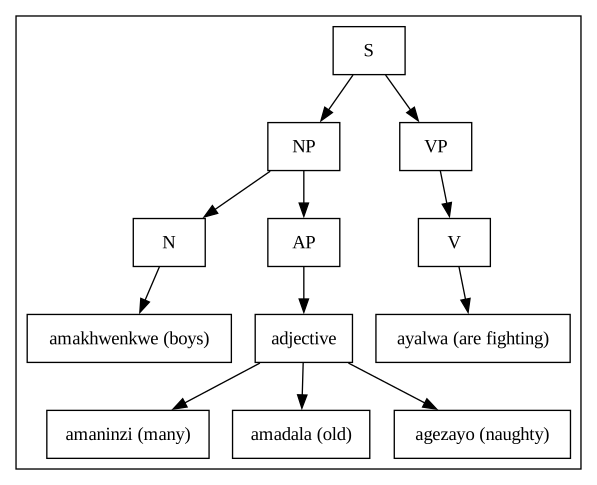
- Amakhwenkwe amaninzi amadala agezayo ayalwa. ‘Many old naughty boys are fighting.’
In these examples Inja ‘dog’, Intombi ‘girl’ and Amakhwenkwe ‘boys’ are the nouns, and emdaka ‘brown’ or ‘dirty’, entle ebhityileyo ‘slim pretty’ and amaninzi amadala agezayo ‘many old naughty’ are dependents.
In every language when constructing any phrase, there is one obligatory element in each one i.e., the head. The head of a phrase is the central element in a phrase that determines the syntactic function of the whole phrase.
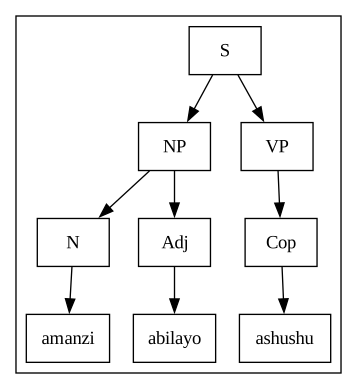
- Amanzi abilayo ashushu. ‘The boiling hot water.’
The noun phrase, is amanzi abilayo ‘boiling water’, head is amanzi ‘water’, and ashushu ‘hot’ is the copulative.
Functions of the noun phrases
According to Giorgi & Longobardi (1996) grammatical relations in linguistics are functional relationships of one constituent to one another within a syntactic construction. They further argue that noun phrases fulfil the syntactic functions of being arguments of the main clause predicate, particularly those of subject, object and predicative expression (Giorgi et al., 1996)
However, isiXhosa does not have the predicative expression, instead isiXhosa aligns itself with what is known to be the most frequently occurring arguments of verbal predicates which are subject phrase and object phrase. A noun phrase can only serve as a subject and/or object. This simply means that the clause predicate, which is often a content verb, demands certain arguments in order to complete the meaning of the verb. The most frequently occurring arguments of verbal predicates which are subject phrase and object phrase are reflected on the following sentence.
- UNomsa uhlamba izitya. ‘Nomsa washes the dishes.’
- UNomsa > subject argument
- uhlamba > verb phrase
- izitya > object argument
Noun phrases including nouns and pronouns perform several grammatical functions within sentences (Giorgi & Longobardi, 1996; Hopper, 2013). IsiXhosa may have the following functions.
- Subject
- Direct object
- Indirect object
- Noun phrase modifier
- Appositive
- Adjunct / adverbial
These functions are illustrated in the examples below:
- Look closely at the following sentence:
Abantu abakhulu banike umntwana oyinkwenkwe olambileyo isonka esimhlophe.
‘Old people gave a hungry boy child white bread.’
- Abantu ‘people’ > is the subject;
abakhulu ‘old’ > is the noun phrase modifier;
umntwana ‘child’ > is the indirect object;
oyinkwenkwe ‘boy’ > is the appositive;
olambileyo ‘hungry’ > is the adjunct;
isonka ‘bread’ > is the direct object;
esimhlophe ‘white’ > is the adverbial.
Subject argument
A subject is a term used in the analysis of grammatical functions with the aim of referring to a major constituent of sentence or clause structure, traditionally associated with the ‘doer’ of an action (Crystal, 1980: 337). It is usually an important nominal element in a sentence. The bolded terms in the following sentences represent the subject.
- Umntu uyahamba. ‘The person walks.’
- Inja iyakhonkotha. ‘The dog barks.’
In almost all instances the subject is represented in the predicate by its concord (Finlayson et al., 1990) as demonstrated in the following sentences. The bolded formatives are subject concords.
- Isizwe siyakhala. ‘The nation is crying.’
- Iliso liyabona. ‘The eye sees.’
This concept will receive further clarification later in the discussion.
Object argument
As mentioned in the foregoing discussion, an object argument is another nominal element which may occur in a sentence. It is a noun phrase that receives the action performed by the subject. The bolded nouns in the following sentences function as object arguments.
| Imoto itshayisa umthi. |
| i-moto i-tshay-is-a u-m-thi |
| The car hit the tree. |
In some cases, there may be two objects: a direct and an indirect object. A verb used with a direct object is always an action verb (Crystal, 1980) The bolded noun umthi on the above sentence represents a direct object. It is important for one not to assume that the nominal element which is not a subject in an isiXhosa sentence is an object. The noun may quite easily have a function other than that of an object (Finlayson et al., 1990: 3).
- Inkomo izele ithole. ‘The cow gave birth to a calf.’ object
- Inkomo izele izolo. ‘The cow gave birth yesterday.’ adverb
- Ootitshala bavale izikolo. ‘Teachers have closed the schools.’ object
- Abantwana bavale isikolo. ‘Children have closed the school.’ object
- Izikolo zivalwe inyanga. ‘Schools have been closed for a month.’ adverb
Indirect object
It is a noun phrase referring to someone or something that is affected by the action of a transitive verb (typically as a recipient), but is not the primary object. Indirect objects usually appear before the direct object (Crystal, 1980: 183).
- UZizo unike umama wakhe imali. ‘Zizo passed the money to her mother.’
- UNovenkile uthengisele umntwana incwadi. ‘The shopkeeper sold the child a book.’
- Umfundi ubonise utitshala umsebenzi. ‘The student showed the teacher some work.’
Umama ‘mother’, umntwana ‘child’ and utitshala ‘teacher’ are all indirect objects: (Umama is the recipient of the direct object, imali ‘the money’, umntwana ‘child’ is the recipient of the direct object incwadi ‘book’, utitshala ‘teacher’ is the recipient of the direct object, umsebenzi ‘work’.
Direct object
A direct object is a grammatical relation that exhibits a combination of certain independent syntactic properties. A direct object receives action performed by the subject. The verb used with a direct object is always an action verb (Crystal, 1980).
| Imoto itshayisa umthi. |
| i-moto i-tshay-is-a u-m-thi |
| The car hit the tree. |
| UZola uhlamba uLizo iinyawo. |
| u-Zola u-hlamb-a u-Lizo ii-nyawo |
| Zola washes Lizo’s feet. |
Noun phrase modifier
A noun phrase modifier in isiXhosa is a word, phrase or clause that modifies or describes a noun, pronoun, or noun phrase. Although adjective and adjective phrases are traditionally defined as words describing nouns and noun phrases they can function as noun phrase modifiers. Typically, the modifier can be removed without affecting the grammar of the sentence.
- Ithole lenkomo lifile. ‘The cow’s calf is dead.’
- Abantu benkosi bayakhonza. ‘People of the chief are worshipping.’
- Umntu olusizi uyakhala. ‘The unhappy man is crying.’
The noun phrase modifier lenkomo and benkosi have been derived from the noun inkomo and inkosi using a possessive formative a- coupled with the subject concord. Similarly, the noun phrase modifier olusizi has been derived from a noun usizi through the use of the formative -a- that has undergone the process of vowel coalition with the concord –u.
Several grammatical forms can perform grammatical functions of noun phrase modifiers in isiXhosa, like the following:
- Noun phrases
- Adjective phrases
- Verb phrases
Noun phrases
They are defined as phrases that consist of a noun including pronouns and any determinatives, modifiers and complements such as adjective determiners, verbs, prepositions and clauses. For example, the following bolded noun phrases function as noun phrase modifiers.
- Nomsa vala ucango, abantu balele! ‘Nomsa close the door people are sleeping.’
- Inkwenkwe isenga inkomo amathole sel’ekhethiwe. ‘The boy is milking the cow while the calves have been separated from them.’
- Inja ikhotha icephe umama ewahlamba. ‘The dog is licking the spoon while mother is washing them.’
Adjective phrases as noun phrase modifiers
Adjective phrases are defined as phrases that consist of an adjective and any modifiers such as adverbs and prepositions. For example, the following bolded adjective phrases function as noun phrase modifiers.
- La ntombazana incinci ithanda ilokhwe ebomvu. ‘The little girl likes a red dress.’
- Usisi uthanda ikomityi enkulu. ‘The sister loves a big cup.’
- Inja emnyama ileqa abantwana abadala. ‘The black dog chases old children.’
Verb phrases as noun phrase modifiers
Verb phrases are defined as phrases formed by one or more verbs plus any objects, modifiers, complements, particles and infinitive markers, such as nouns, verbs and prepositions. For example, the following bolded verb phrases function as noun phrase modifiers.
- Inkosikazi ethetha kamnandi indiphe igaqa lekhaphetshu. ‘A woman who speaks nicely offered me a ball of cabbage.’
- Inyama etyiwe ziindwendwe ivuthwe kakhulu. ‘The meat that has been given to visitors is overcooked.’
Appositive
It is a word, phrase, or clause that supports another word, phrase, or clause by describing or modifying any other word, phrase, or clause in a sentence. Appositive is a sequence of units which are constituents at the same grammatical level, and which have an identity or similarity of reference (Crystal, 1980: 29).
- USipho umdlali webhola uphumelele imbasa. ‘Sipho the football player has won a medal.’
- UNomazizi ugqirha wamazinyo usebenza kakuhle. ‘Nomazizi the dentist works perfectly.’
- UYiza imazi yenkomo itya egadini. ‘Yiza the female cow grazes in the garden.’
- Umama utitshala wesiXhosa ulele. ‘Mother an isiXhosa teacher is asleep.’
- ULumka imfusi yamawele uyahleka. ‘Lumka a girl who comes after twins is laughing.’
These examples have two noun phrases: they have identity of reference, and they have the same syntactic function. Anyone of them can be omitted without affecting the sentence:
- USipho uphumelele imbasa or umdlali webhola uphumelele imbasa. ‘Sipho won a medal’ or ‘the football player won a medal’.
- UNomazizi usebenza kakuhle or ugqirha wamazinyo usebenza kakuhle. ‘Nomazizi works perfectly’ or ‘the dentist works perfectly’.
- UYiza itya egadini or imazi yenkomo itya egadini. ‘Yiza grazes in the garden’ or ‘the female cow grazes in the garden’.
- Umama utitshala wesiXhosa ulele. ‘Mother an isiXhosa teacher is asleep.’
- ULumka imfusi yamawele uyahleka. ‘Lumka a girl who comes after twins is laughing.’
Adjunct/adverbial
It is a word, phrase, or clause that modifies an entire clause by providing additional information about time, place, manner, condition, purpose, reason, results, and concession. It may refer to an optional or secondary element in a construction. Removal of the adjunct may not affect the structural identity of the rest of the construction (Crystal, 1980). Many adjuncts can also be analysed as modifiers, attached to the head of a phrase (Crystal, 1980: 15).
- Inkwenkwe ikhabe ibhola izolo. ‘The boy kicked the ball yesterday.’
- Utata uthenge indlu eGcuwa. ‘Father has bought a house in Butterworth.’
The adjunct izolo and eGcuwa can be removed without affecting the meaning of the sentence.
Adjuncts found in Nguni are:
- A primary question enclitic: phi?
- UNompucuko lo uye phi? ‘Where has Nompucuko gone to?’
- UVelaphi uvela phi? ‘Where is Velaphi coming from?’
- Uvela phi lo? ‘Where is this one coming from?’
- Descriptives derived from adjectives and relative stems.
- Usityelele kabini. ‘She visits us twice.’
- Usithanda kakhulu. ‘He loves us a lot.’
- Usihlalisa kakubi. ‘He makes us sit uncomfortable.’
- A locative:
- Ulele ebhedini. ‘He is sleeping in the bed.’
- Ufunda eUnitra. ‘He is schooling at Unitra.’
- A secondary descriptive as in:
- Ubhala ngosiba. ‘He writes with a pen.’
- Uhlamba ngesepha. ‘He washes with a bar of soap.’
The above secondary descriptive adjuncts include the distributive adverbs.
- Babizwe ngababini. ‘They were invited in pairs.’
- Badlale ngamaqela. ‘They played in groups.’
- A descriptive participial copulative.
- Sihambe kusemnyama. ‘We left while it was still dark.’
- Bakutye kuseshushu. ‘They ate it while it was still hot.’
Normally adjuncts follow the predicate as in the above examples. The primary interrogative enclitics phi? ni? nini? have no other position.
- Niza kuhlamba nini? ‘When are you going to wash?’
- Niza kuya phi? ‘Where are you going?’
- Nifuna ni? ‘What do you want?’
Most adverbs derived from adjectives and relative stems also follow the predicate.
- Ndisele kanye. ‘I drank once.’
- Undibethe kaninzi. ‘He beat me many times.’
Projection of noun phrases
The Projection Principle states that “lexical structures must be represented categorically at every syntactic level”
(Chomsky, 1986: 84).
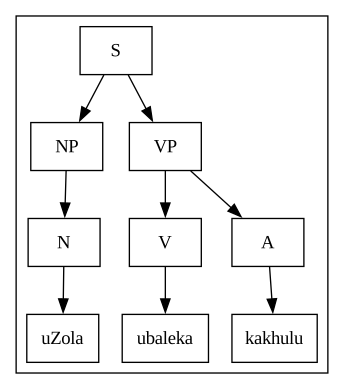
IsiXhosa coincides with this projection principle which states that when notating the syntactic structure of a sentence one must specify at every level what lexical category each piece of the sentence belongs to.
- UZola ubaleka kakhulu. ‘Zola runs fast.’
- UZola > noun
- ubaleka > verb
- kakhulu > adjective
This can also be presented in a tree diagram as shown below.
Modification
Modification is a term used in syntax to refer to the structural dependence of one grammatical unit upon another, but with different restrictions in the scope of the term being introduced. It is composed of a head and a modifier. In a phrase containing a modifier, the element that is modified forms the essential centre of the phrase and is said to be the head of the phrase. (Burton-Roberts, 1992; Crysral, 1980).
Amabali kaZola ayonwabisa kakhulu. ‘Zola’s most enjoyable stories.’
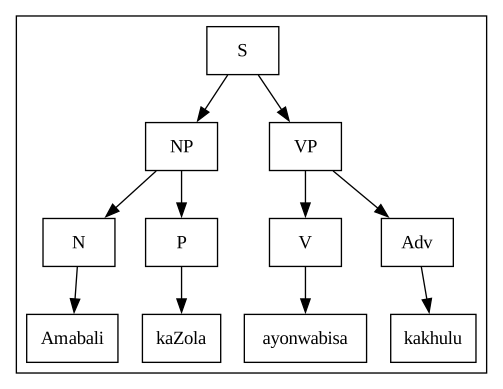
Ayonwabisa ‘enjoyable’ is the head of the verb phrase; kakhulu ‘mostly’ specifies the extent to which amabali ‘stories’ ayonwabisa ‘(are) enjoyable’. The adverb kakhulu ‘mostly’ is dependent upon the copulative ayonwabisa ‘enjoyable’. If we were to omit ayonwabisa ‘enjoyable’, the sentence would be: Amabali kaZola kakhulu and the adverb kakhulu ‘mostly’ would have no function, and the sentence would be meaningless. We can omit kakhulu ‘mostly’ and still be left with a perfectly good phrase (Amabali kaZola ayonwabisa).
The phrase ayonwabisa kakhulu ‘mostly enjoyable’ specifies the character of the noun phrase amabali ‘stories’. This means that the noun amabali ‘stories’ is the head of the sentence. The verb phrase ayonwabisa kakhulu ‘mostly enjoyable’ as a whole is a dependent modifiier of the head amabali ‘stories’ but not vice versa. The verb phrase ayonwabisa kakhulu ‘mostly enjoyable’ could be omitted (leaving amabali kaZola), but amabali ‘stories’ (the head of the phrase) cannot be omitted.
The modifiers may come either before or after the modified element depending on the type of modifier and the rules of syntax for the language in question. A modifier placed before the head is called a pre-modifier and the one placed after the head is called a post-modifier.
- Ilokhwe entle ikrazukile. ‘The beautiful dress is torn.’ (Post modifier)
- Entle ilokhwe ingcolile. ‘The beautiful dress is dirty.’ (Pre modifier)
Modifiers in a sentence should generally be placed as close to noun, word, phrase they intended to modify as possible. Misplaced modifiers may cause confusion when placed too far from the noun they are modifying.
Syntactic uses of noun phrases
Subject
As alluded above, nouns and noun phrases in isiXhosa fulfil the syntactic functions of the arguments of the main clause predicate, particularly those of subject, object and predicative expression (Crystal, 1997). A subject is defined as a word, phrase, or clause which performs the action of, or acts upon the verb (Matthews, 1981; Lockwood, 2002). Clauses contain both a subject and a predicate. The following noun phrases are examples of subjects:
- Umfundi ubhala incwadi. ‘A pupil writes a letter.’
- Utata usenga inkomo. ‘Father milks a cow.’
A pronoun can act as a substantive of a verb; substantive because it is not a noun but functions as a noun:
- Yena uyasenga. ‘She is milking.’
- Bona batya isonka. ‘They are eating bread.’
A pronoun, therefore, can perform the function of a noun or noun phrase as is the case with the examples above, but within the sentence also functioning as a pronoun. This implies that noun phrases in isiXhosa can take different forms than that described above, for example, when the head is a pronoun like the two above rather than a noun. “In almost all instances the subject is represented in the predicate by its concord”
(Finlayson et al., 1990; Satyo, 1997; Pahl, 1978).
As a subject of the verb, the substantive appears before the verb as in the sentences below
- Umfundi ubhala incwadi. ‘A pupil writes a letter.’
- Utata usenga inkomo. ‘Father milks a cow.’
The subject may also appear after the verb:
- Uyasenga yena. ‘Milking is he.’
- Ubhala incwadi umfundi. ‘Writing the book is the pupil.’
Now that the verb appears before the subject, the verb gets emphasised. As an object of the verb, the substantive comes after the verb:
- Ubhala incwadi. ‘He/she is writing a book.’
- Batya isonka. ‘They eat bread.’
Under the circumstances, the object cannot shift this position. According to Van Rooyen et al. (1982), “the short form of the verb has the tendency to fix the order of words in the sentences.”
Even in sentences where both the subject and the object appear with the verb the verb is a short form, both are bound to the above-mentioned fixed position in the sentence (Van Rooyen et al., 1982).
- Umama ubhaka isonka. ‘Mother bakes bread.’
- Yena upheka ukutya. ‘She cooks food.’
The subject and object may be omitted as long as they are represented by their concords.
- Siyisengile. ‘We have milked it.’
- Ukutyile. ‘We have eaten it.’
In instances where the subject connected to the predicate is not known or expected, i.e. if there is no certainty about it, an indefinite subject concord ku- is used with the verb stem (Van Rooyen et al., 1982).
- Kutsho utitshala. ‘It is the teacher who says so.’ / ‘The teacher says.’
- Kulwa amakhwenkwe. ‘It is boys who are fighting.’ / ‘Boys are fighting.’
- Xa kufika abantwana, sakuwavula amasango. ‘When the pupils come, we shall open the gates.’
- Xa kucinywe isibane, sakubalisa iintsomi. ‘When the lights have been switched off, we shall narrate folktales.’
What we observe in this type of construction is that the predicate has a grammatical subject (the indefinite concord ku- referring to an unknown noun, and the logical subject which is utitshala; amakhwenkwe; abantwana; isibane. The concord ku- is indefinite because it represents anything that can be said by anybody.
Van Rooyen et al. (1982: 71) argues, “When the ku- concord is used with a predicate, the logical subject follows immediately after the predicate and may never precede it.”
The four examples above illustrate this.
Direct object
The direct object receives action performed by the subject.
- Umfundi ubhala incwadi. ‘The pupil writes a book.’
- Inja iluma ikati. ‘The dog bites the cat.’
In both sentences, the object incwadi and ikati are receiving the action of the two subjects: umfundi and inja respectively. The verb used with a direct object is always an action verb.
In sentences where the long form of the verb is used, which is brought about by adding the present tense formative –ya- after the subject concord -uyabhaka, the formative –ya- (which brings the object isonka to an agreement with the verb) is then followed by the object concord –si- and the verb becomes –uyasibhaka.
- Umama uyasibhaka isonka. ‘Mother is baking bread.’
- Yena uyakupheka ukutya. ‘She is cooking food.’
The presence of the object concord enables the release of the fixed word order with regards to the subject and object (Van Rooyen et al., 1982).
- Isonka uyasibhaka umama. ‘Bread mother is baking.’
- Isonka umama uyasibhaka. ‘Bread mother is baking.’
- Uyasibhaka umama isonka. ‘Mother is baking bread.’
- Ukutya uyakupheka yena. ‘Food she is cooking.’
- Ukutya yena uyakupheka. ‘Food she is cooking.’
- Uyakupheka ukutya yena. ‘She is cooking food.’
From the above sentences, freedom in the word order is evident and meaning remains the same except for the question of emphasis.
In situations where the object concord is used or not used, there may be a change in the meaning of the sentence.
- Andiyiboni impahla entsha oyithengileyo, ndibona leya indala. ‘I do not see the new clothes that you have bought, I only see old clothes.’
- Andiboni mpahla intsha, ndibona endala. ‘I don’t see new clothes, I see old ones.’
The first sentence implies that the speaker is particularly concerned with new clothes, whereas the second one refers to what he/she can see - which is old clothes. In instances where an adverb is used, several changes arise within the sentence and the object is pushed away from its normal position.
- Utata uyisenga ngocoselelo inkomo. ‘Father milks the cow cautiously.’
Here, the short form of the predicate is used, but the object is still represented by its concord. The degree of emphasis which the object normally has, is annulled by the new syntactic grouping, with the adverb claiming emphasis (Van Rooyen et al., 1982).
Indirect object
This refers to predicates that take two objects in one sentence. According to Van Rooyen et al. (1982) applicative and causative predicates have a tendency of making use of two objects. One is the object of the basic stem and the other is a derived stem. The indirect object always comes between the verb and the direct object. The noun phrases with italics are indirect objects.
- Inkwenkwe inikele umama imali. ‘The boy passed the money to his mother.’
- Umama ubhalele uNana ileta. ‘Mother has written Nana a letter.’
In the above two sentences the objects are imali and ileta.
The two sentences above have a fixed word order. But when the object is represented by its concord in the predicate, there is freedom of movement.
- Inkwenkwe imnikele imali umama. ‘The boy passed the money to his mother.’
- Imali inkwenkwe iyinikele umama. ‘The money the boy passed to his mother.’
- Iyinikele umama imali inkwenkwe. ‘Passed to his mother the money the boy.’
- Umama imnikele imali inkwenkwe. ‘The mother passed the money to the boy.’
- Umama umbhalele ileta uNana. ‘Mother has written a letter to Nana.’
- Umbhalele ileta umama uNana. ‘Written a letter to mother Nana.’
- Ileta umama umbhalele uNana. ‘A letter the mother has written to Nana.’
- UNana umama umbhalele ileta. ‘Nana the mother written a letter.’
Basically, all the above sentences mean almost the same thing except for the concept of emphasis. The same syntactic arrangement can be done with causative predicate and the same semantic pattern continues.
- Ndinxibisa umntwana ijezi. ‘I am dressing the child a jersey.’
- Ndihlambisa umama izitya. ‘I am washing the dishes with mother.’
Like in the above sentences, when the predicate makes use of the object’s concord, the syntactic arrangement of the sentences becomes flexible.
- Ndimnxibisa ijezi umntwana. ‘I am dressing the jersey the child.’
- Umntwana ndimnxibisa ijezi. ‘The child I am dressing the jersey.’
- Ndimhlambisa izitya umama. ‘I am assisting mother washing the dishes.’
- Umama ndimhlambisa izitya. ‘The mother I am washing the dishes.’
Intransitive verbs take an object – but in a different manner:
- Iselwa lihlala amasi. ‘The calabash contains sour milk.’
- Ikhaya lihlala usapho. ‘The home is where the family stays.’
- Umhlonyana unyanga ifiva. ‘The wormwood heals the fever.’
According to Van Rooyen et al. (1982) the following are observed on the above sentences:
- The object of the sentence has become an agent.
- The subject is in animate.
- The subject mostly implies a locative.
- Although it is the object that executes the action, the predicate takes the usual subject concord.
Thus, the grammatical object assumes a logical subject. In its turn the grammatical subject presupposes a locative adverb in the above sentences (Van Rooyen et al., 1982).
Complement of particle phrases
A complement is a term used in the analysis of grammatical functions, to refer to a major constituent of sentence or clause structure, traditionally associated with ‘completing’ the action specified by the verb. In its broadest sense, complement therefore is a very general notion, subsuming all obligatory features of the predicate other than the verb, e.g., objects and adverbials (Crystal, 1980: 74).
- USipho ukhabe ibhola. ‘Sipho kicked the ball (object)’.
- Utata ebesemasimini. ‘Father was in the field (adverbial).’
From the above examples it is observed that without a complement, one would not understand.
- Utitshala ubhala incwadi. ‘Teacher writes a book.’
- Isiqholo sinuka kamnandi. ‘The perfume smell nicely.’
In the first sentence utitshala ‘teacher’ is the subject, ubhala ‘writes’ is the linking verb, and incwadi ‘a book’ is the complement. It completes the idea.
In the second sentence isiqholo ‘the perfume’ is the subject, sinuka ‘smells’ is the linking verb, and kamnandi ‘nicely’ is the complement.
Particles
In grammar the term particle has a traditional meaning, as a part of speech that cannot be inflected, and a modern meaning, as a function word associated with another word or phrase to impart meaning. It has a grammatical function but does not fit into the main parts of speech that are known as noun, verb and adverb.
- Ukubhabha. ‘to fly’
The infinitive uku- ‘to’ in ukubhabha ‘to fly’ is an example of a particle.
A particle is a term used in grammatical description to refer to an invariable item with grammatical function, especially one which does not readily fit into a standard classification of part of speech. (Crystal, 1980: 258)
There are various types of particles in isiXhosa, namely, possessive, qualificative, locative, and associative.
Possessive particle
A possessive particle is a grammatical particle used to indicate possession and ownership. The possessive in isiXhosa can be constructed from other parts of speech like the following, noun, pronoun conjunction and adverb. A possessive particle denotes the case of nouns and pronouns and shows agreement between them through the possessive concord. It is constructed by combining a class prefix with a possessive concord.
| Abantu bam. |
| ba- + -a- = ba |
| My people. |
| Iinkomo zam. |
| zi- + -a- = za |
| My cattle. |
The possessive particle is formed by combining the subject concord and the possessive –a- which are derived from the prefix of each noun class.
| Noun class | Possessive concords |
|---|---|
| Class 1 – um- | u- + -a- > wa- |
| Class 2 – aba- | ba- + -a- > ba- |
| Class 3 – um- | u- + -a- > wa- |
| Class 4 – i- | i- + -a- > ya- |
| Class 5 – ili- | li- + -a- > la- |
| Class 6 – ama- | a- + -a- > a- |
| Class 7 – isi- | si- + -a- > sa- |
| Class 8 – izi- | zi- + -a- > za- |
| Class 9 – in- | i- + -a- > ya- |
| Class 10 – izin- | zi- + -a- > za- |
| Class 11 – ulu- | lu- + -a- > lwa- |
| Class 14 – ubu- | bu- + -a- > ba- |
| Class 15 – uku- | ku- + -a- > kwa- |
| Class 17 – uku- | ku- + -a- > kwa- |
The qualificative particle
A qualificative particle is a part of speech which qualifies the nominal element more precisely. It may also qualify the nominal part of a predicative construction. There is a qualificative concord for each noun class.
- Relative: Ilitye elimdaka. ‘Brown stone.’
- Enumerative: Sitya siphi? ‘Which dish?’
- Adjective: Intombi entle. ‘A beautiful girl.’
- Possessive: Imoto yam. ‘My car.’
- Quantitatives: Izinja zonke. ‘All the dogs.’
- Demonstrative: Le gusha iyatya. ‘This sheep is eating.’
Locative particle
Locative particles combine with various object and subject nouns and pronouns, sometimes with phonological changes, with results that are written as single words. There are mainly three ways in which the locative of nouns can be expressed: (Taljaard & Bosch, 1988)
- By means of the prefix ku-:
All nouns of the person classes, i.e., um-, aba-, u-, form their locatives by discarding the initial vowel and substituting ku- for it.
- Kumalume ‘to/with/at uncle’
- Kubantwana ‘to/with/at children’
If ku- is prefixed to plural <oo-> the vowel undergoes the process of elision, and the particle becomes k-:
- Koomalume ‘to/with/at uncles’
- Koomama ‘to/with/at mothers’
- By means of e-…-ini:
In some cases, in isiXhosa locatives are constructed from different lexical items using two locative affixes, a prefix e- and suffix –ini. The –ini combines various ways with the final vowel of the noun.
- umthi > emthini ‘at the tree’
- intaba > entabeni ‘at the mountain’
- inkosi > enkosini ‘at the chief’
- - By means of the prefix e- without a suffix:
A number of nouns prefix only e- in the locative without adding the suffix –ini:
- ubusika > ebusika ‘in the night’
- iGoli > eGoli ‘at/in Johannesburg’
- ikhaya > ekhaya ‘at home’
Associative particles
In Nguni languages, the associative particle uses different class prefixes in accordance with what it possesses. The associative particle acts as the head of an associative particle phrase. In isiXhosa there are various associative particles i.e., no-/ne- ‘with’.
- Intombi ihamba nomfana. ‘The girl walks/goes with the young man.’
- Ikati ilwa nenja. ‘The cat is fighting with a dog.’
In the above examples the associative particle is no- and ne- which are formed by the combination of the possessive particle na- and the article of the noun.
- umfana: na- + u- = nomfana ‘with the boy’
- Inja: na- + i- = nenja ‘with the dog’
In conclusion, this topic has demonstrated how isiXhosa Syntax as a study of the linguistic structures interrelates and correlates grammatically with each and every language item at the sentence level. It has particularly outlined that in isiXhosa, syntactic rules can never be grammatically correct without interconnecting with semantic items. This has been achieved by looking at the relationship between the two concepts, syntax and semantics with particular reference to the functions of the noun phrase. The discussion has presented the fundamental functions of noun phrases, like for example, fulfilling the syntactic functions of being arguments of the main clause predicate, particularly those of subject and object. In addition to the two functions already mentioned, noun phrases function as object arguments, noun phrase modifiers, appositive and adjunct arguments, and these have been discussed at length. Furthermore, the discussion has touched on the concept of the projection of noun phrases, syntactic uses of noun phrases as well as the complement of particle phrases. This topic therefore provides an introductory background to the topic on the verb phrase that follows henceforth.
References
Burton–Roberts, N. (1986) Analysing Sentences: An Introduction to English Syntax. London: Longman.
Chomsky, N. (1986) Knowledge of Language: It’s nature, origin and use. Westport: Praeger.
Crystal, D. (1980) A First Dictionary of Linguistics and Phonetics. London: Cambridge University Press.
Finlayson, R., Jones, C. J., Mfusi, J. M. & Podile, K. (1990) Study guide for XHS202-4. Pretoria; University of South Africa.
Giorgi, A. & Longobardi, G. (1996) The Syntax of Noun Phrases. Cambridge: Cambridge University Press.
Hopper, P. J. (2013) Grammatical Functions of English Nouns and Noun Phrases. New York: W.W. Norton.
Hussein, N. & Elttayef, A. (2018) ‘The effect of authentic materials on developing undergraduate EFL students’ communicative competence’. Journal of Literature, Languages and Linguistics. ISSN 2422-8435.
Lockwood, D. (2002) Syntactic analysis and description: A constructional approach. London. Continuum.
Matthews, P. (1981) Syntax. Cambridge: Cambridge University Press.
Pahl, H. W. (1978) IsiXhosa. Qonce (King William’s Town): Thandapers.
Salinas, A. G. (2001) ‘The relation between syntax, semantics and pragmnatics’. Revista de Humanidades: Tecnológico de Monterrey. 11, 13-19.
Satyo, S. C. (1997) Igrama Noncwadi LwesiXhosa. Pretoria: Via Afrika.
Taljaard, P. C. & Bosch, S. E. (1988) Handbook of IsiZulu. Pretoria: Van Schaik.
Van Rooyen, C. S., Louw, J. A., Cantrell, J. V., Taljaard, P. C., Satyo, S. C., Ntuli, D. B. & Davey, A. S. (1982) Xhosa only guide for XHS201-3. Pretoria: University of South Africa.