Tone
This section provides an introductory overview of tonal profiles in isiXhosa. Although there may be broad consensus on the nature of tonal structures, there are various discrepancies in the tonal data. These discrepancies may be related to various aspects such as dialectal variations, personal idiosyncrasies, and different methodological issues. Suggestions for further research are made in the final section.
Tone
IsiXhosa, as the rest of the Nguni-languages is a tone language in which distinctions are made at word level as well as grammatical level. Tone is not indicated in written isiXhosa, however The Greater Dictionary of isiXhosa by Pahl (1989) does provide tonal markings on most words in isolation. The study of tonal aspects of isiXhosa may be traced to the works of Beach (1923), Westphal et al. (1967), Lanham (1963), Jordan (1956), Louw (1968, 1971), all of whom made valuable contributions to the study of tonal features in isiXhosa. Some of these contributions will be discussed in more detail later. At least three doctoral dissertations focused on isiXhosa tone: Davey (1973), Jokweni (1995), and Claughton (1992). Cassimjee (2004) made a specific contribution to the understanding of tone in isiXhosa by implementing an Optimal Domains Theory Analysis of isiXhosa. This work, although regarded by the author as “… the most comprehensive study of isiXhosa verbal tonology available.”
(Cassimjee, 2004: 2) will not be discussed in any detail here as this online version of the grammar of a language should, as far as possible be ‘theory neutral’.
This presentation of tonal aspects of isiXhosa is largely based on the work of Davey (1973) with references to other authors where applicable. The description of tonal patterns in the language is not exhaustive as it will only address the tonal profiles of the Infinitive mode as far as verbs are concerned and should only be interpreted as a baseline version of tone as a phenomenon in isiXhosa. The main reason for this is that, although there may be broad consensus on tonal structures, there are various discrepancies in the tonal data presented by authors in the field. These discrepancies may be related to aspects such as dialectal variations that are not always clearly stated, personal idiosyncrasies, and different methodological issues. The penultimate section contains some remarks on phonetic aspects of tones and the influence of certain consonants on tone, whilst the final section will focus on problematic aspects of tonal studies.
Predictable tonal profiles
In this section the focus will be on identified tonal patterns related to grammatical morphemes. Tone is assigned to vowels in each syllable, as well as to a nasal consonant in some cases. The following notations are used: H = High tone, L = Low tone, F = Falling tone.
Noun classes
Noun classes are identified by means of a pre-prefix + prefix + stem.
The following patterns arise:
- If the first syllable of the stem is L, then the pre-prefix and the prefix are HH
- If the first syllable of the stem is H or F, then the pre-prefix and the prefix are HL
- A sequence of HHH is not permitted.
In all the cases above, a Polarity rule applies as no HHH sequence is permitted – this also applies to verb profiles.
The typical structure of a noun:
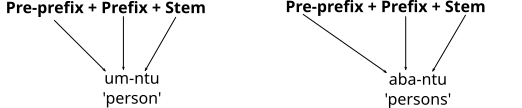
- Class 1
- umntu (HH-L)
- umlimi (HH-LL)
- umfundi (HL-HL)
- Class 2
- abantu (HH-L) ‘person/s’
- abalimi (HH-LL) ‘farmer/s’
- abafundi (HL-HL) ‘student/s’
- Class 1a
- uNomsa (H-LL)
- Class 2a
- ooNomsa (F-LL) ‘Nomsa/and others’
- Class 3
- imlambo (HH-LL)
- Class 4
- imilambo (HH-LL) ‘river/s’
Note classes 1 and 3 with syllabic /m/ nasals in the prefix.
- Class 5
- ilitye (HH-L)
- i(li)qanda (H( )-LH)
- Class 6
- amatye (HH-L) ‘stone/s’
- amaqanda (HH-LH) ‘egg/s’
- Class 7
- isitya (HH-L)
- isitulo (HL-HL)
- Class 8
- izitya (HH-L) ‘dish/es’
- izitulo (HL-HL) ‘chair/s’
- Class 9
- inkomo (H-LL)
- itafile (H-HLL)
- Class 10
- iinkomo (F-LL) ‘cow/s’
- iitafile (F-HLL) ‘table/s’
- Class 11
- uluvo (HH-L)
- Class 10 (also plural Class 11)
- izimvo (HH-L) ‘opinion/s’
- Class 15
- ukuqonda (HH-LL) ‘agreement’
- ukufuna (HL-HL) ‘wanting’
Concords
- Subjectival concords:
1st and 2nd person singular and plural are all L intoned.
- L HL HLL
- Ndibona ithanga. ‘I see the pumpkin.’
- Sibona ithanga. ‘We see the pumpkin.’
- Ubona ithanga. ‘You see the pumpkin.’
- Nibona ithanga. ‘You (plural) see the pumpkin.’
- 3rd person singular and plural (Noun classes 1-15) are all H intoned.
- Class 2 ábántù báfúnà úkùtyá ‘People want food’
- Class 7 ísìkérè sísíkà íphèphà ‘The scissors is cutting paper’
- L HL HLL
(Cf. Riordan et al., 1969: 97-102).
- Objectival concords:
There appears to be different views on the status of objectival concords (OCs). The authors of Lumko (Riordan et al., 1969: 146-151) claim that the OCs are all L intoned, whilst Davey (1973), Claughton (1992) and Cassimjee (1998) assign a H tone to all OCs. This issue will be discussed in the section about the problematic aspects of tonal studies. For practical considerations, the view of Davey will be espoused in the description of tonal patterns of verbs in the Infinitive mode.
- Úyàyíthì ‘he is saying it’
- Báyàyílwà ‘they are fighting it’
- Báyàyítháthà ngôkù ‘they are taking it now’
Pronouns
- Personal (absolute) pronouns:
Personal pronouns of the 1st and 2nd person singular and plural as well all classes 1-15 are all L H intoned. Compare the use of absolute pronouns placed before nouns to indicate emphasis:
- Class 2 bòná ábántù LH (HHL) ‘they, the people’
- Class 6 wòná ámátyè LH (HHL) ‘they, the stones’
(Cf. Riordan et al., 1969: 159-160)
- Possessive pronoun (stems):
The possessive pronoun stems which are all H (except for 1st and 2nd person singular which are L) link up to possessive concords which are all L intoned.
Table 1: Possessive pronoun stems 1st person singular -m L 1st person plural -ithu H 2nd person singular -kho L 2nd person plural -inu H Class 1/1a -khe H Class 2/2a -bo H Class 3 -wo H Class 4 -yo H Class 5 -lo H Class 6 -wo H Class 7 -so H Class 8 -zo H Class 9 -yo H Class 10 -zo H Class 11 -lo H Class 14 -bo H Class 15 -kho H - 2nd p/s ábántù bà+khò > bàkhò (HHL) LL ‘your people’
- 2nd p/p ábántwànà bà+inú > bènú (HHLL) LH ‘your children’
- Class 2 ábántwànà bà+bó > bàbó (HHLL) LH ‘their children’
- Class 7 ísìkólò sà+khé > sàkhé (HLHL) LH ‘his/her school’
- Demonstrative pronouns
Demonstrative pronouns indicate different positions related to the speaker signifying concepts such as ‘this’, ‘that’, and ‘yonder’. The tonal profiles of these pronouns are listed in the table below:
Table 2 Class ‘Here’ ‘There’ ‘Yonder’ Class 1 lo H lowo / loo FL / HL lowa / laa LF / HL Class 2 aba HL abo FL abaya / abaa FHF / FHH Class 3 lo H lowo HL lowa HF Class 4 le H leyo / loo HL / FL leya / laa HF / HF Class 5 eli HL elo HL eliya FHF Class 6 la H lawo / loo HL / FL lawa / laa HF / HL Class 7 esi FL eso FL esiya / esaa FHF / HHL Class 8 ezi FL ezo FL eziya / ezaa FHF / HHL Class 9 le H leyo / loo HL / FL leya / laa FHF / HHL Class 10 ezi FL ezo FL eziya / ezaa FHF / HHL Class 11 olu FL olo FL oluya / olwaa FHF / HHL Class 14 obu FL obo FL obuya FHF Class 15 oku FL oko FL okuya FHF - Class 14 ôbù tywàlá / ôbò tywàlá ‘this beer / that beer’
- Class 7 êsì sìtyà / ésáà sìtyà ‘this dish / yonder dish’
Tonal patterns: Infinitive verbs
- Mono-syllabic verb stems:
In describing the tonal structure of mono-syllabic verb stems in the Infinitive mode, Davey (1973: 13-24) makes a distinction between two groups of stems: L stems and H stems.
The infinitive prefix uku- ‘to’ precedes the verb stem and has a HH tonal profile. (The use of the term prefix also includes the pre-prefix – unless formally mentioned otherwise.) This HH profile is maintained when it precedes an L stem whether it is in the positive or negative which is indicated by -nga- with inherent L tone followed by an -i verb stem final. Apart from marking the prefix as HH or HL, all further tones are marked per syllable, indicated here by a white space.
| Positive |
|
| Negative |
|
Therefore, an HH sequence remains intact when followed by an L.
In the case of adding an object concord (OC) which has an inherent H tone (Davey 1973: 14), the HH-prefix changes to HL as no more than two H tones may follow in succession. This is also referred to as a Polarity rule mentioned by Louw (1971) and Westphal et al. (1967).
- L tone stems
- Positive:
- úkùyílwà HL H L ‘to fight it’
- Negative:
- úkúngàyílwí HH L H H ‘not to fight it’
- Positive:
- H tone stems
- Positive:
- úkùtyá HL H ‘to eat’
- ukutsha HL H ‘to burn’
- ukuba HL H ‘to steal’
- Negative:
- úkúngàtyí HH L H ‘to not eat’
- ukungatshi HH L H ‘to not burn’
- ukungabi HH L H ‘to not steal’
- Positive:
In the example above the profile of the prefix HH in the positive changes to HL as the stem of the verb is H and the Polarity rule. By the same token, the HH of the prefix is unaffected as the negative morpheme -nga- carries an L.
In the case of adding an object concord (OC) -yi- in this case, the following patterns arise:
- Positive:
- úkùyîtyà HL F L ‘to eat it’
- ukuyitsha HL F L ‘to burn it’
- ukuyiba HL F L ‘to steal it’
- Negative:
- úkúngàyîtyì HH L F L ‘to not eat it’
- ukungayitshi HH L F L ‘to not burn it’
- ukungayibi HH L F L ‘to not steal it’
Given the examples above, the HL in the positive is the result of the Polarity rule as the OC carries an H. The H of the OC manifests itself as a falling tone (F) followed by an L. In the negative the HH of the prefix is restored due to the following L of -nga-, whilst the OC (-yi-) is realised with a falling tone (F) on the lengthened penultimate syllable.
Vowel commencing stems
There are several H and L stems commencing with a vowel. Davey (1973: 15) argues that “The initial H tone of these stems is actually the H tone from the second syllable of the prefix, i.e., these stems behave as L toned monosyllabic stems.”
This implies the intervention of phonological rules to retain the normal syllable structure.
- HL vowel commencing stem
- uku + -ondla > úkóndlà HH L ‘to feed’
- uku + -anga > úkwángà HH L ‘to kiss’
In the second H in the first example above, uku is deleted while the H is transferred to the first syllable of the stem.
In the second H in the second example above uku changes to a semivowel /w/ whilst keeping the H intact.
The negative version with the nga morpheme (with L tone) plus verb ending in -i calls for the deletion of a first vowel in a sequence as indicated below:
- uku + nga + ondl + i > úkúngòndlî HH L H ‘to not feed’
In the event of an OC (with H) occurring, the following patterns arise:
- uku + yi + ondla > úkùyóndlà HL H L ‘to feed it’
In this case the second H of uku becomes L in accordance with the Polarity rule as it does not allow HHH sequences. To maintain the syllable structure, the sequence of yi + ondla is reduced to yondla through the deletion of the first vowel whilst the initial H of the OC is maintained. The negative version is exemplified below:
- uku + nga + yi + ondl + I > úkúngàyôndlí HH L F H ‘to not feed it’
The HH of the prefix is restored due to the following L of -nga-, whilst the OC (-yi-) is realised with a falling tone (F) on the lengthened penultimate syllable.
- FL vowel commencing stem
“These stems would appear to have an underlying HH tone sequence, the first tone of which can easily be elided. This being the reason that they can, in certain instances, act like disyllabic FL (HH) stems”
(Davey 1973: 17).- Positive
- úkônà H F L ‘to sin’
- úkòná (kakhulu) H L H ‘to sin a lot’
The FL in the first example is realised as LH when it appears in a non-final position as in the second example.
- Negative
“In the negative two patterns are possible. One in which the stem acts as a monosyllabic H stem and the other in which it acts as a disyllabic FL (HH) stem”
(Davey 1973: 17).- As monosyllabic H: uku + nga + on + i > úkúngòní HH L H ‘to not sin’
- As disyllabic FL: uku + nga + on + i > úkúngônì HH F L ‘to not sin’
- Positive
Disyllabic verb stems
Davey (1973: 18-22) makes a distinction between three groups of stems: LL stems, HL stems, and FL stems.
- LL tone stems
- Positive:
- úkúsùsà HH L L ‘to remove’
- ukupheka HH L L ‘to cook’
- ukutyhila HH L L ‘to uncover’
- Negative:
- úkúngàsùsí HH L L H to not remove
- ukungapheki HH L L H to not cook
- ukungatyhili HH L L H to not unover
- Positive:
In the negative above, the L toned -nga- conditions the final H in the stem.
- With an OC the patterns are:
- Positive
- úkùyìsúsà HL L H L ‘to remove it’
- úkuyiphékà HL L H L ‘to cook it’
Referring to the OC, Davey (1973: 18), following Westphal et al. (1967), contends that the H of the OC shifts towards the initial syllable of the stem.
- Negative
- úkúngàyísùsí HH L H L H ‘to not remove it’
- úkúngàyíphekí HH L H L H ‘to not cook it’
- Positive
- HL tone stems
- Positive
- úkùqáshà HL H L ‘to guess’
- ukusula HL H L ‘to wipe’
- ukuphatha HL H L ‘to carry’
- Negative
- úkúngàqâshì HH L F L ‘to not guess’
- ukungasuli HH L F L ‘to not wipe’
- ukungaphathi HH L F L ‘to not carry’
“The L toned negative formative conditions the expected final H tone. This and H tones of the root are realized as FL before a juncture”
(Davey 1973: 20). - Positive
- With an OC the patterns are:
- Positive
- úkùyìsúlà HL L H L to wipe it
- ukuziphatha HL L H L to carry them
In these cases above the H of the OC (yi / zi) loses its H tone, whilst being transferred to the first syllable of the stem.
In the negative the OC retains its H tone as indicated below.
- Negative
- úkúngàyísûlì HH L H F L ‘to not wipe it’
- ukungaziphathi HH L H F L ‘to not carry them’
- Positive
Phonetic aspects related to tone
There are at least two phonetic factors related to the production of tonal sequences which need to be mentioned:
Depressor consonants
Certain consonants depress (lower) the tone of a following tone bearing unit, normally a vowel in the next syllable. This is a common phenomenon in the Nguni languages. These consonants “… have a marked lowering effect on following tone. Depressors are characterized by a combination of voice and a ‘noise’ component (plosion or friction) produced by a pulmonic airstream. The following is the complete list of depressors: <bh>, <d>, <dy>, <j>, <g>, <gc>, <gq>, <gx>, <v>, <z>, <gr>, <dl>, <mh>, <nh>, <nyh>, <ngc>, <ngq>, <ngx>, <r>, <h>…”
Thus “(a) depressor before a H-tone or a F-tone depresses the first part of the tone and so the H-tone is realised as a rising glide and the F-tone as a rising-falling glide”
Claughton (1992: 22-23).
Downdrift
“In phonetics, downdrift (automatic downstep) is the cumulative lowering of pitch in the course of a sentence due to interactions among tones in a tonal language. Downdrift often occurs when the tones in successive syllables are H L H (high, low, high) or H L L H (high, low, low, high).”
As for isiXhosa Claughton claims that “(i)f, however, two H-tones are separated by one or more L-tones, then the second H-tone is lower than the first.”
And “A H-tone after a F-tone has a lower pitch than the beginning of the fall”
(cf. Claughton, 1992: 19) for examples.
Problematic aspects of tonal studies
The study of prosody in African languages boasts a wealth of descriptions stretching over many decades. Most of these studies are based on impressionistic observations of non-mother tongue researchers as well as speakers of the particular language. In a series of articles Roux (1995, 2001 and 2003; Dogil et al., 1995) the author focused on the nature of tonal data and tonal descriptions in the Sotho and Nguni languages against the background of research in human perception of speech and the implications for tonal studies in these African languages. Interpreting and transcribing supra-segmental phenomena in speech have always been a taxing endeavour – an observation of Hirst four decades ago which can be applied to Bantu languages, still seems to be relevant:
“Despite a considerable amount of research in recent years devoted to prosodic studies, both in the field of intonation and of tone, it is still probably true to say that this domain suffers crucially from a basic lack of reliable primary data. The elusiveness of pitch contours is notorious...”
(Hirst, 1981: 195)
Roux (1995: 24) addresses questionable methods of data acquisition in many tonal studies and vague references to, for instance, the number, history, age, gender etc. of informants participating in data gathering. Claughton (1992: 6-7, 172-178), however, explains in much detail how he had obtained, checked and cross-checked the data provided by his single informant. Although he regards his specific method working with a mother-tongue informant as ‘somewhat unusual’ and ‘a method with many dangers’ (Claughton, 1992: 6), he apparently ends up with good ‘consistent’ data. The informant was trained as a mother-tongue speaker to identify and mark tonal sequences within a specific system. The consistency claim of Claughton may, however, be questioned when some of his data is compared to that of other authors. Claughton (1992: 33) explicitly mentions that his work, Davey’s dissertation (1973), and the work of Riordan et al. (1969), are all mainly based on the speech of one speaker (Mr B). Furthermore, the authors did not regard this mother tongue speaker's tones as idiosyncratic in any way. Although he has high regard of his informant’s judgements, several examples may be cited indicating how the same informant, over a period, have come up with different tonal judgements and how they are reflected in the different works as in the example below:
| Riordan et al. (1969) | Davey (1973) | Claughton (1992) |
|---|---|---|
| ukoja LLH | ukoja HHL | |
| ufudo HFL | ufudo FHH | ufudo HFL |
| umhlaba HFL | umhlaba HHL | umhlaba HFL |
| ekhaya HFL | ekhaya FFH | ekhaya HFL |
| isela HHL | isela FHL | isela HHL |
| ubisi HFL | ubisi FFL | ubisi HFL |
| abafazi HLFL | abafazi HHHL | abafazi HLFL |
| izicaka HLFL | izicaka HLHL | izicaka HLFL |
| ukutheta HLHL | ukutheta HLFL | ukutheta HLFL |
Roux (1995: 197) refers to the factors that influence the perception of prosody which includes pitch (fundamental frequency), loudness (intensity) and length (duration): “Changes in some or all of these parameters may aid the listener in perceiving different linguistic categories (question-statement phrases, focus and emphasis), different lexical meanings (as in tone languages) as well as paralinguistic categories (attitudes, emotions and involvement).”
This phenomenon has also been aptly demonstrated by Hart et al. (1990), House (1990) and Hermes & Rump (1993).
Consider the following original data represented by Riordan et al. (1969: 15) explicating the disambiguation function of tone in isiXhosa.
- Íthàngà HLL ‘a pumpkin’
- Íthàngá HLH ‘a thigh’
- Íthângà HFL ‘a cattle-post’
This data reflects the above authors' judgements of Mr B's speech, and his speech examples were available as tape recordings.
Now consider the respective pitch (tone as F0 values – indicated by the solid line) and amplitude (loudness as dB values – indicated by the dashed line) of the examples above in the following figures in Roux (1995: 25):


The pitch (tone) pattern in Figure 2 for ithanga ‘pumpkin’ (HLL) and that of ithanga ‘cattle-post’ (HFL) in Figure 4 seem to support the judgements of the speaker-hearer that these are indeed the correct tonal markings. However, the tonal markings for ithanga ‘thigh’ in Figure 2 do not suggest a HLH sequence, rather a HLL sequence. However, the amplitude curve sheds some light on this situation – while the F0 value is relatively low, the energy on the final vowel is considerably higher than that of the previously penultimate vowel. “The perceptual confusing taking place here becomes quite clear – the listener observes something ‘higher’ and assigns an H-tone value to it! Here we find some indication of a perceptual judgement that does not actually represent the parameter (F0) allegedly associated with it.”
(Roux 1995: 24).
Conclusion
Although researchers working in the domain of phonetics and phonology in African languages are implicitly aware of influences on the perception of tone exerted by for instance, depressor consonants, downdrift, downstep and other features, this has not yet really been investigated experimentally, despite the growth in digital methodologies. The work of Govender (2006: 3) on intonation modelling for the Nguni languages is an excellent move in this direction as a response to acquire quantitative prosodic data (instead of relying on impressionistic data) in languages such as isiXhosa and isiZulu. The need for this type of prosodic data is of extreme importance in for instance, the development of natural-sounding text-to-speech (TTS) systems in tone languages. She developed two different statistical approaches to build intonation models for isiZulu and isiXhosa and came to the conclusion that “(f)rom the two intonation models built we can deduce that the F0-based features and the amplitude based features produce comparable accuracy. This lends independent support to the hypothesis advanced by Roux (1998). regarding the substantial role of amplitude/intensity in the perception of tone – based on our analysis, amplitude may even be somewhat more important than F0 in this determination.”
Roux’s (1998) question remains valid whether isiXhosa could be regarded as a pitch-accent language. This remains an area for further research.
References
Beach, D. M. (1923) The science of tonetics and its application to Bantu languages. Bantu Studies 2(1): 75-106.
Cassimjee, F. & Kisseberth, C. W. (1992) ‘The tonology of depressor consonants: Evidence from Mijikenda and Nguni’. In Annual Meeting of the Berkeley Linguistics Society. 18(2): 26-40.
Cassimjee, F. (1998) Isixhosa Tonology: An optimal domains theory analysis. München: Lincom.
Cassimjee, F. (2004) IsiXhosa Tonology: Studies in African Linguistics. München: LINCOM
Claughton, J. (1992) The tonology of Xhosa. Doctoral Thesis, Rhodes University, Makhanda (Grahamstown).
Davey, A. S. (1973) Moods and tenses of the verb in Xhosa. Masters Dissertation, University of South Africa, Pretoria.
Dogil, G., Mayer, J. & Roux, J. C. (1996) ‘Syllables and unencoded speech: Clicks and their accompaniments in Xhosa’. Phonologica 1996. pp. 49-60.
Govender, N. (2006) Intonation modelling for the Nguni languages. Masters Dissertation. University of Pretoria, Pretoria.
Hart, J. T., Collier, R. & Cohen, A. (1990) A perceptual study of intonation: An experimental-phonetic approach to speech melody. Cambridge: Cambridge University Press.
Hermes, D. J. & Rump, H. H. (1993) Prominence in speech intonation induced by rising and falling pitch movements. Manuscript no 922. Eindhoven: Institute for Perception Research.
Hirst, D. J. (1981) ‘Phonological implications of a production model of English intonation’. Phonologica. pp 195-201.
House, D. (1990) Tonal perceptions in speech. Sweden: Lund University Press.
Jokweni, M. W. (1995) Aspects of isiXhosa phrasal phonology. Doctoral Thesis, Urbana-Champaign University of Illinois, Champaign (Illinois).
Jordan, A. C. (1956) A phonological and grammatical study of literary Xhosa. Doctoral Thesis. University of Cape Town, Cape Town.
Lanham, L. W. (1963) ‘The tonemes of Xhosa: a restatement’. Studies in Linguistics. 17: 35-58.
Louw, J. A. (1968) The intonation of the sentence and its constituent parts in Xhosa and Tsonga. Pretoria: University of South Africa.
Louw, J. A. (1971) ‘The tonal paradigm of the verb in Xhosa’. Taalfasette.13(1): 33-44.
Pahl H. W. (1989) The greater dictionary of isiXhosa. Alice: University of Fort Hare.
Riordan, J., Mathiso, M., Davey, A.S., Bentele, S.V., Mahlasela, B. & Lanham, L. W. (1969) LUMKO: Xhosa self-instruction course.
Roux J. C. (2001) ‘Comments on ‘Zulu tonology and its relationship to other Nguni languages’. Cross-linguistic Studies of Tonal Phenomena. Institute for the Study of Languages and Cultures of Asia and Africa (ILCAA), Tokyo University of Foreign Studies, Tokyo. pp.361-.367.
Roux, J. C. (1995) ‘On the perception and production of tone in Xhosa’. South African Journal of African Languages. 15(4):196-204.
Roux, J. C. (1998) ‘Xhosa: a tone or pitch-accent language?’ South African Journal of Linguistics. 16(36): 33-50.
Roux, J. C. (2003) ‘On the perception and production of tone in the Sotho and Nguni languages. Zulu’. Proceedings of the Third International Symposium on Cross linguistic studies of Tonal Phenomena. Tokyo University of Foreign Studies, Tokyo. pp. 155-176.
Westphal, E. O. J., Notshweleka, M. & Tindleni, S. M. (1967) ‘Tonal profiles of Xhosa verb-nominals’. Communications from the School of African Studies 32. Cape Town: University of Cape Town.