Organs of speech
This section presents an overview of the organs of speech and the physiological processes involved in the production of speech sounds in isiXhosa followed by a classification of the sounds.
Speech organs
The diagram below identifies the various organs that play a role in the articulation of speech sounds that are classified as consonants (C) and vowels (V)

An inventory of consonantal segments refers to airflow modalities and the manner of articulation at a specific place of articulation.
Airflow modalities
In the production of speech sounds there are different types of airflow modalities at work. In general, two main types of airflow are to be identified: egressive airflow, i.e., air flowing through the oral cavity to the outside, and ingressive airflow entering the oral cavity from the outside.
Furthermore, the origin of these types of airflow are also identified:
- airflow originating in the lungs through contraction of the diaphragm and intercostal muscles, moving air into the oral cavity where it may be modified before moving outwards – this is referred to as pulmonic initiation, with airflow moving egressively – also termed pulmonic egressive airflow. Typically, all aspirated stops as well as vowels are produced in this fashion:
Table 1 <ph> [pʰ] ukuphila [uk’uphʰːla] ‘to live’ <th> [tʰ] ukuthetha [uk’utʰɛːtʰa] ‘to speak’ <tyh> [cʰ] ukutyhala [uk’ucʰaːla] ‘to push’ and all vowels - airflow originating within the larynx with the vocal cords closed (closed glottis) with some closure within the oral cavity and simultaneous closure of the velum to prevent nasal airflow; the larynx (containing the vocal cords) moves upwards causing pressure build up in the oral cavity. When the occlusion in the oral cavity is released a sharp stop burst is perceived – this is referred to as glottalic initiation, with airflow moving egressively – also termed glottalic egressive airflow. Typically, all ejective stop consonants are articulated in this manner:
Table 2 <p> [p’] impilo [imp’iːlͻ] ‘health’ <t> [t’] utolo [ut’ͻːlͻ] ‘arrow’ <ty> [c’] ukuthala [uk’uc’aːla] ‘to plant’ Figure 2: Spectrogram demonstrating difference between ejective and aspirated consonants 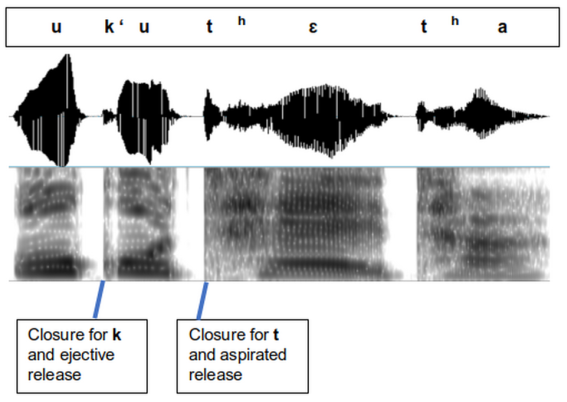 [click image to enlarge]
 - airflow originating through a decrease in oral pressure due to either a downward movement of the larynx (containing the vocal cords), or a downward movement of the back of the tongue (velum) causing an inflow of air into the oral cavity. This is referred to as velaric initiation, with the airflow moving ingressively (i.e., into the oral cavity.) Typically, all click sounds as well as an implosive sound /b/ are produced in this manner.
- c [ǀ]
- q [ǃ]
- x [ǁ]
- b [ɓ] etc.


The fact that there is no voicing in the final consonantal position may be ascribed to weakened airflow as attested in the decreased amplitude of the final vowel. However, Lindau (1984) distinguished between two types of implosives regarding the amount of voicing (Jessen 2002: 154) i.e., voicing throughout the closure, and no voice during the closure that may be attributed to glottal constriction. Roux (1991) is of the opinion that for some speakers this variability is related to tempo of speech where voicing occurs, whereas for others it is subject to pure toke-to-token variability.
Manner of articulation
Apart from the typical consonant types mentioned above, the flow of air during the articulation phase may be released:
| Description | Example 1 | Example 2 |
|---|---|---|
| as plosives (or stops) such as ejectives: | <p> [p'] | <t> [t'] |
| as aspirated plosives such as: | <ph> [pʰ] | <th> [tʰ] |
| as voiced sounds as the airflow sets the vocal cords vibrating: | <b> [ɓ] | <d> [d] |
| with delayed breathy voice: | <bh> [b̥] | <d> [d̥] |
| as voiceless sounds as the air flows over open vocal cords: | <p> [p'] | <t> [t'] |
| as nasal sounds with flow of pulmonic air: | <m> [m] | <n> [n] |
| as fricative sounds with the flow of egressive air: | <s> [s] | <sh> [ʃ] |
| as affricates comprising of a stop followed by a fricative: | <ts> [ts'] | <dz> [ʣ] |
| as clicks being voiced or unvoiced or nasalised etc.: | <q> [!] | <nc> [ŋǀ] |
Place of articulation
Bilabial consonants are produced through the closure of the lips: b [ɓ], p [p’], m [m] etc.
Labio-dental consonants are articulated with the lower lip touching the upper teeth: f [f] and v [v].
Alveolar sounds are produced with the tip or front of the tongue touching the alveolar ridge: t [t’], n [n], etc.
Pre-palatal sounds are formed with the tip or front of the tongue touching the ridge between the alveolus and the palate: ty [c’], tyh [cʰ], etc.
Velar sounds are formed with the back of the tongue touching the velum: k [k’], kh [kʰ], g [ɡ], etc.
See Inventory of isiXhosa consonants and Inventory of click sounds for a detailed description of the sounds of isiXhosa.
References
Jessen, M. (2002) ‘An acoustic study of contrasting plosives and click accompaniments in Xhosa’. Phonetica. 59: 150-179.
Lindau, M. (1984) ‘Phonetic differences in glottalic consonants’. Journal of Phonetics. 12:147-155.
Roux, J. C. (1991) ‘On ingressive glottalic and velaric articulations in Xhosa’. Proceedings of the 12th International Congress of Phonetic Sciences. Aix-en-Provence. pp. 158-161.