This section focusses on the morphology of Setswana nouns. The order in this topic will be to firstly consider the features of nouns followed by their classification which will typically be based on the customary system of noun classes, which in morphological terms, is constructed mainly on the prefixes of nouns. To follow an overview of the types of noun roots will be considered. A synopsis of the noun suffixes which mainly bring about inflection will also be discussed. After this discussion a classification of nouns based on morphological, syntactic and semantic criteria is given. In conclusion a brief discussion of nominal derivation in Setswana is given.
Morphologically the basic form (lemma) of a noun comprises of a class prefix and a root, for example mo- and nna- in monna ‘man’. Class prefixes are inflectional morphemes that indicate class and number. As the noun class prefixes are paired, they are often referred to as gender number prefixes (Katamba, 2003: 103; Kosch, 2006: 90). Setswana nouns are thus characterised by a grammatical gender, also referred to as class gender. They do not indicate sex gender.
Setswana nouns do not have a pre-prefix as some other Bantu languages such as the Nguni languages isiXhosa and isiZulu have. Syntactically the class prefixes of the noun classes are the basis of an extensive system of grammatical agreement (concord) in Setswana (Lombard et al., 1985: 54; Katamba, 2003: 111). Agreement between a noun and the main verb in a Setswana sentence is expressed by affixes such as the subject and object agreement morphemes which are prefixed to the verb root. Agreement is also prevalent in noun modifier constructions such as:
Example 1
setlhare se
se- tlhare se
NPre7-tree DemPro7D1
this tree
The classification of Setswana nouns
Nouns in Bantu languages are typically grouped together in noun classes. Noun class systems are a strong areal feature in Africa where noun classification has always occupied a central place in Bantu linguistics (Katamba, 2003: 103). Setswana is a Bantu language categorised in the South-Eastern Zone of Bantu languages where it appears in group S30 in Guthries’ 1971 classification. Maho (2003: 649) presents an updated version of Guthries’s referential system. Setswana retains its position as number S31 in group S30, the Sotho-Tswana group. Setswana nouns are also grouped together in 20 methodically numbered groups according to their class prefixes. Class prefixes are mono-morphemic with a consonant vowel (CV) shape. Noun classes have a semantic connotation (Cole, 1975: 68-105; Krüger, 2006: 57-98; Katamba, 2003: 114). Nouns therefore belong to a class based on the form of their class prefix and to a lesser extent due to their meaning Berg (2018: 189).
Table 1: Setswana noun classes
Class
Class prefix
Semantic content
1
mo-
Human beings
2
ba-
Regular plural of class 1
1a
(-)-
Proper names, kinship terms, and personifications
2a
bo-
Regular plural of class 1a
3
mo-
Natural phenomena, body parts, tools, instruments, animals, natural phenomena, most names of trees and plants
4
me-
Regular plural of class 3
5
le-
Natural phenomena, animals, many plants, collective nouns, strangers, undesirable people, augmentatives, derogatives and regions
6
ma-
Regular plural of classes 5 and 14
7
se-
Body parts, tools instruments and utensils, languages, customs, habits, mannerisms, diseases, some plants, outstanding people, augmentatives, derogatives and some personal nouns
8
di-
Regular plural of class 7
9
n-
Animals, people, some plants, body parts, tools, instruments and household effects and personal nouns indicating people with a special rank
10
di(n)-
Regular plural of class 9
11
lo-
Body parts, natural phenomena, implements, utensils and other artefacts. This class is disappearing and few nouns belong to it
10
di(n)-
Plural of class 11
14
bo-
Abstract concepts and collective nouns
6
ma-
Abstract concepts and collective nouns
15
go-
Infinitive
16
fa-
Location or place
17
go-
Location or place
18
mo-
Location or place
19
ga-
Location or place
20
(-)
Location or place
To conclude the following general comments on Setswana noun classes are relevant:
Nouns can overall be categorised into 3 groups, non-infinitive nouns (classes 1 to 14), infinitive nouns (class 15) and locative nouns (classes 16 - 20).
Noun classes 1 to 14 consist of singular-plural pairs – grouped together as classes 1 and 2, 3 and 4, 5 and 6, 7 and 8, and 9 and 10. Odd numbers indicate the singular and even numbers the plural. Note that Cole (1955: 69) and Setshedi (1980: 25-53) classify singular and plural forms of a noun in a single class, thus in their classification classes 1 and 2 are class 1 (the mo-ba- class) resulting in only 9 classes all together.
Nouns in class 11 are singular and their plural forms conform to class 10.
Classes 12 and 13 are not found in Setswana. They occur in only one language in the Sotho group viz. Lozi (Gowlett, 2003: 620). Since these nouns were essentially diminutive, they disappeared when the language introduced the diminutive suffix -ana, -nyana. There are some residues of the class 12 prefix in a few insect and reptile nouns with the form kga- (low tone) i.e., kgatutswe ‘lizard’.
The nouns in class 14 are singular but their plural forms conform to class 6.
Classes 1 and 2 each have a sub class, viz. classes 1a and 2a. Nouns in class 1a are singular and their plural counterparts appear in class 2a.
Classes 15 to 20 do not denote singular or plural.
Class 15 contains infinitive nouns.
Classes 16 to 20 are the locative classes (Krüger, 2006: 92–98). Berg (2018: 2) distinguishes classes 19 and 20, which are referred to by some scholars as classes X and Y or as the ga- and n- locative classes (Poulos & Louwrens, 1994: 47).
Exposition of members of noun class
In this section a brief exposition of the lexicon per class is given. Limited reference is made of morpho-phonological variants that appear in selected classes.
Noun classes 1 (mo- singular) and 2 (ba- plural)
The prefix mo- occurs in the majority of nouns. The class prefix ba- is the norm class prefix for class 2, the plural class prefix for class 1 (Cole, 1975: 69-72; Krüger, 2006: 57-58; Setshedi 1980: 28).
Example 2
motho > batho
human being, person
Example 3
mosadi > basadi
woman, female
Example 4
monna > banna
man, male
Example 5
mosimane > basimane
boy
Example 6
mosetsana > basetsana
girl
Note that Cole (1955: 69) and Setshedi (1980: 25-53) classify singular and plural forms of a noun in a single class, thus in their classification classes 1 and 2 are class 1 (the mo-ba- class) resulting in only 9 classes all together. The prefix mo- is the base form of class 1 from which derivations are made.
Noun class 1a (-singular) and 2a (bo- plural)
Nouns belonging to class 1a (-) have no prefix. The prefix bo- of class 2a is the plural for nouns of class 1a. Nouns of class 1a are classified as members of class 1 as they generate the same agreement morphemes as class 1 mo-, e.g., subject and object morphemes respectively.
Class 1a includes nouns denoting personal names, surnames, kinship terms and personifications:
Table 2: Class 1a singular and plural forms
Singular
Plural
rra ‘father’
borra / borre ‘gentlemen, men; males’
rremogolo ‘grandfather’
borremogolo ‘grandfather and company’
mma ‘mother’
bomma ‘mother and company’
mmemogolo ‘grandmother’
bommemogolo ‘grandmother and company’
malome ‘uncle’ (maternal)
bomalome ‘uncle and company’
rakgadi ‘aunt’ (paternal)
borakgadi ‘aunt and company’
Pule (proper name)
boPule ‘Pule and company’
Animal and plant names used as personifications occur in this class:
Example 7
Phage
mr/mrs Wildcat
Bophage
Phage and company
Example 8
Gôpane
mr Leguan / large lizard
Bogôpane
Gopane and company
The prefix bô- can indicate distributive as well as associative plurality, e.g., bômmê ‘mothers’ or ‘mother and company’.
Noun classes 3 (mo- singular) and 4 (me- plural)
The class 3 prefix mo- is the norm class prefix indicating singular while the class 4 prefix me- indicates plural:
Table 3: mo- singular and me- plural
Singular
Plural
Translation
motse
metse
‘town, village’
molômo
melômo
‘mouth’
molato
melato
‘fault, debt, offence’
mokgwa
mekgwa
‘manner, method, way’
molelô
melelô
‘fire’
Krüger (2006: 60) indicates that “the variant prefix m- occurs before roots originally commencing in /b/, which, after /o/ (of mo-) is deleted, becomes nasalised to /m/ by /m/. It also occurs in deverbatives, derived from verbs commencing in /b/.”:
Example 9
mmala (*mobala)
colour
Example 10
mmila (*mobila)
narrow track, footpath
Example 11
mmutla (*mobutla)
hare
Example 12
mmu (*mobu)
soil, ground
Example 13
mmusô (*mobusô)
government
Example 14
mmupudu (*mobupudu)
wild plum
The variant class prefix ngw- occurs before a few original roots that commenced in vowels:
Example 15
ngwêdi
moon
Example 16
ngwaga
year
Both these examples take class 10 (di-) as plural, thus:
Example 17
dingwêdi
moons
Example 18
dingwaga
years
The class 4 prefix me- has no variants:
Example 19
molelô > melelô
fires
Example 20
moraka > meraka
cattle posts
In instances where the variant class 3 prefix m- appears it takes the regular class 4 plural by substituting m- with the full prefix mo-, and then replacing it with me-:
Table 4: Class 3 singular prefixes and class 4 plurals
Root
Singular
Plural
Plural translation
Roots with original /b/
mmala (*mobala)
mebala
‘colours’
Roots with original /b/
mmusô (*mobusô)
mebusô
‘governments’
Roots with original /f/
mhêrô (mofêrô)
mefêrô
‘weeds’
Noun classes 5 (le-) and 6 (ma-)
The class 5 prefix le- has no variants (Cole, 1975: 69-72; Krüger, 2006: 61-65, Setshedi, 1980: 30-32):
Table 5: Noun class 5
Example
Translation
leina
‘name’
lefoko
‘word, newe, statement’
leinô
‘tooth’
lengau
‘cheetah’
lee
‘egg’
lefatshe
‘land, country, earth’
leru
‘cloud’
In the eastern regions of the Setswana area there is a tendency for nouns of class 11 (lo-) to be absorbed into class 5 (le-) (Cole, 1975: 91; Krüger, 2006: 62). Consequently, some nouns can occur in both classes:
Table 6: Class 11 and 5 nouns
Class 5
Translation
Class 11
Translation
lebaka
‘time’
lobaka
‘occasion’
leleme
‘tongue’
loleme
‘language’
legong
‘piece of wood’
logong
‘piece of wood’
lebônê
‘lamp’
lobônê
‘light’
Some commonly used nouns in this class sometimes appear without the class prefix:
Table 7: Nouns without prefixes
Example
Translation
(le)lapa
‘yard’
(le)gae
‘home’
(le)tsatsi
‘day, sun’
(le)fatshe
‘earth, country’
The class 6 ma- prefix is the plural for the class 5 prefix le-. The prefix ma- is the conventional class prefix:
Example 21
maina < leina
names
Example 22
maru < leru
clouds
Example 23
mae < lee
eggs
Example 24
mafatshe < lefatshe
countries
The variant class prefix is m- and it occurs in nouns:
Example 25
mênô < ma-inô
teeth
(vowel assimilation)
Example 26
mêtsi < ma-itsi
water
(vowel assimilation)
Several nouns in class 6 do not seem to have a singular form. Cole (1975: 81-82) divides them into four groups, viz:
Table 8: Basic collective nouns of class 5 signifying liquid or semi-liquid forms
Example
Translation
mêtsi
‘water’
madi
‘blood/money’
mas(w)i
‘milk’
marê/mathê
‘spittle, saliva’
madila
‘sour milk, thick milk’
mafura
‘fat’
Singular forms of nouns may be from noun classes other than noun class 5. This plural form is also referred to as a mass plural.
Table 9: Collective nouns signifying large numbers of animals
Singular
Translation
Plural
Translation
nku
‘sheep’
manku
‘very large number of sheep’
tau
‘lion’
malau
‘very large number of lions’
podi
‘goat’
mabodi
‘very large number of goats’
kgomo
‘head of cattle’
magomo
‘very large number of cattle’
Table 10: Abstract or semi-abstract nouns
Examples
Translation
maatla
‘strength’
maanô
‘plans’
makgakga
‘cheekiness, impudence’
mafôlôfôlô
‘zeal, enthusiasm’
Nouns with temporal significance indicating time or seasons mainly function as temporal adverbials.
Table 11: Nouns functioning as temporal adverbials
Example
Translation
maabane
‘yesterday’
malôba
‘day before yesterday, couple of days ago’
mariga
‘winter’
maitsiboa
‘evening’
maabanyane
‘evening / period of twilight’
mahube
‘daybreak’
Some nouns of class 11 (lo-) that have been absorbed into class 5 (le-) also take the plural prefix di(n) of class 10:
Table 12: Noun class 11 plural formation with Class 5 and 10 prefixes
Singular
Plural forms
lebônê ‘light’
mabônê/dipônê
legong ‘piece of wood’
magong/dikgong
lekala ‘branch of tree’
makala/dikala
lenaka ‘horn’
manaka/dinaka
Noun classes 7 (se-) and 8 (di)
The class 7 singular class prefix is se-. This class prefix has no morpho-phonological variants (Cole, 1975: 69-72; Krüger, 2006; 57-58; Setshedi, 1980: 32-33):
Table 13: Noun class 7 examples
Example
Translation
selô
‘thing’
setlhare
‘tree’
seatla
‘hand’
sediba
‘well’, ‘waterhole’
selêpê
‘axe’
sefôfu
‘blind person’
seganka
‘brave one’
sekhurumêlô
‘lid of a pot’, ‘cap’
sehuba
‘chest’
sebata
‘carnivore’
semumu
‘dumb person’
seane
‘proverb’
sekgwa
‘forest’
setšhaba
‘nation’, ‘tribe’
sebete
‘liver’
setlhako
‘shoe’ / ‘hoof of an animal’
segôlê
‘maimed person’
setulô
‘chair’
The class prefix di- of noun class 8 has no morpho-phonological variants. The class 8 prefix has to be distinguished from the class 10 prefix di(n)- as it does not include traces of the nasal:
Example 27
dilô < selô
things
Example 28
diatla < seatla
hands
Example 29
dijô < sejô
food
Noun classes 9 (n-) and 10 (di(n)-)
Krüger (2006: 68) indicates that the class prefix n-“is characterized by an original prefix *ne- that has assimilated with the root of the noun due to the phonological processes of (a) elision of /e/ and (b) the plosivation of the initial consonant (a fricative only) of the root by the nasal /n/. In this process /n/ is deleted before original (not derived) polysyllabic roots but is retained before monosyllabic roots even if their number of syllables is increased through suffixation of morphemes. In the latter cases the nasal /n/ occurs as a homorganic nasal viz. it is influenced phonetically by the initial phoneme of the root represented as a homorganic nasal <m>, <n>, <ng>, <ny>.” Cole (1975: 86-90) and Setshedi (1980: 33-35) treat these classes as class 5 n-, din-.
n- before alveolar sounds:
Example 30
ntwa
war
Example 31
ntlo
house
Example 32
nthô
wound
Example 33
nta
louse
Example 34
ntsi
fly
Example 35
ntlha
point, direction
With bilabial nasal m-:
Example 36
mpa
rod, cane
Example 37
mphô
gift, present
Example 38
mpe
filthy, bad
With velar nasal n-:
Example 39
nku
sleep
Example 40
nkô
nose
Example 41
nkwê
leopard
Example 42
nkgô
water pitcher, water pot
With pre-palatal nasal n:
Example 43
ntšhwê
ostrich
Example 44
ntšwa
dog
Example 45
ntšhwê
sweet reed
The class prefix n- assimilated with the root where the original root commenced with a vowel:
Example 46
nama
meat
Example 47
nôga
snake
Example 48
nare
buffalo
Example 49
nôtshi
bee
Example 50
nong
vulture, large bird
Example 51
noka
river
Example 52
naga
country, land, field
Example 53
naane
story
Example 54
nônyane
bird
The prefix does not occur before original polysyllabic nouns. However, the diachronic plosivation (occlusivation) caused by the nasal is retained, implying that the prefix is hypothetically present:
Example 55
thipa
knife
Example 56
pula
rain
Example 57
nakô
time
Example 58
pitsa
pot
Example 59
kgêtsi
bag
Example 60
kgômo
head of cattle
Example 61
pitsô
meeting
Example 62
tlhôgô
head
Example 63
kgôsi
chief
Example 64
tlhware
python
Example 65
tlala
hunger
Example 66
phefô
wind
Example 67
nakêdi
polecat
Example 68
nkgwana
small water pot
Example 69
bôlô
ball
adoptive from English
The class 10 prefix di(n)- is essentially a compound of the plural prefix di- combined with the class 9 prefix n- (singular). Plural formation in this class is thus reached by adding the class 10 prefix to the singular morpheme and not by replacing it as is customary in the other classes. The singular form is not a root in this instance but a stem:
Example 70
mphô > dimphô
gifts
Example 71
ntwa > dintwa
wars
Example 72
thipa > dithipa
knives
Example 73
podi > dipodi
goats
Example 74
pitsa > dipitsa
pots
Example 75
tsêbê > ditsêbê
ears
Example 76
tau > ditau
lions
Example 77
phôlôgôlô > diphôlôgôlô
wild animals
Example 78
thaba > dithaba
mountains
Noun classes 11 (lo-) and 10 (di(n)-)
The prefix of class 11 lo- does not have variants. As most of the members of this class have been absorbed into class 5 le- it contains a small number of nouns. Note that the class 5 prefix could also be a free variation le-/lo-.
Table 14: The nouns contained in class 11
Noun
Translation
lorole
‘dust’
logadima
‘lightning’
logong
‘piece of wood’
lobônê
‘light, candle’
loleme
‘tongue’
lomaô
‘needle’
lothêka
‘waist’
lore
‘twig’
losô
‘death’
lotlhaka
‘reed’
lonaka
‘horn’
lonaô
‘foot’
lokwalô
‘book, letter’
loêtô
‘journey’
lobese
‘fresh milk’
lobêbê
‘cream’
lobelô
‘speed’
Class 11 nouns take the class 10 di(n) compound prefix when plurals are formed. The nasal causes plosivation (occlusivation) of the initial consonant of the root if it is a fricative. The nasal is retained before monosyllabic roots even if the latter is extended by suffixes. It is deleted before polysyllabic roots.
Monosyllabic roots:
Table 15
Plural formation
Suffixes
dinthe < lore ‘twig’
/r/ > /th/
dintshô < losô ‘death’
/s/ > /tsh/
dintshi < losi ‘shore, eyelash’
/s/ > /tsh/
Polysyllabic roots:
Table 16
Plural formation
Suffixes
dithole < lorole ‘dust’
/r/ > /th/
dikgong < logong ‘wood’
/g/ > /kg/
ditshika < losika ‘vein, sinew’
/s/ > /tsh/
diteme < loleme ‘tongue, language’
/l/ > /t/
dipônê < lobône ‘light’
/b/ > /p/
If the initial phoneme of the root is not a fricative, then no phonological changes occur. Only fricatives can be plosivated (occlusivated):
Example 79
dikwalô < lokwalô
book
Example 80
dinaka < lonaka
horn
Example 81
dimaô < lomaô
needle
Noun classes 14 bo- and 6 ma-
The prefix bo- is the norm singular class prefix. Cole (1975: 93-96) and Setshedi (1980: 36) treat these classes as class 7 bo-, ma- (Krüger, 2006: 72-73). Variant prefixes and dialectal variants are not discussed here (Further reading Krüger 2006: 72).
The plural of class 14 nouns is formed by substituting the bo- prefix of class 14 with the class 6 prefix ma-:
Example 82
botshelô > matshelô
ways of life, life styles
Example 83
bojalwa > majalwa
kinds of beer, liquor
Example 84
bosigo > masigo
nights
Example 85
bojang > majang
great quantities of grass
Example 86
boikaelêlô > maikaelêlô
intentions
Example 87
botlhoko > matlhoko
pains, illnesses
Example 88
bonnô > mannô
dwellings, residences
Example 89
bobôkô > mabôkô
brains
Example 90
bogadi > magadi
marriage cattle herds, lobola herds
Example 91
boikutlô > maikutlô
feelings
Example 92
bupi > maupi
various kinds of flour
As a consequence of their abstract and collective significance many class 14 nouns have only a singular form:
Example 93
bontsi
quantity, majority, the most
Example 94
bodutu
loneliness
Example 95
bofôfu
blindness
Krüger (2006: 73) indicates that a number of roots of nouns in class 14 bo- are sometimes used as adjectival roots. Agreement with the antecedent (the noun that is qualified) is a feature of such phrases, in this case (bo)golo:
Example 96
monna yô mogolo
a big man
Example 97
molelô ô mogolo
a big fire
Example 98
setlhare sê segolo
a big tree
Noun class 15 (go-)
The infinitive forms of verbs are included in this noun class. These nouns do not signify singular or plural as the verbal roots that are used in this class cannot be pluralised. Cole (1975: 96-97) and Setshedi (1980: 36-37) treat the infinitive class as class 8, Krüger (2006: 94-96). Morphologically the structure of infinitive nouns contains a class prefix go-, a verbal root and an ending -a:
Example 99
go tsamay-a
NPre15 walk- VEnd
the walking
Note that the class prefix is written disjunctively in this class and not conjoined to the root as it is done in the other noun classes. Note that this is an orthographic convention, other Bantu languages write it conjunctively.
Infinitive nouns have valence for locative and diminutive suffixes Morphologically, semantically and functionally, infinitives display both nominal and verbal characteristics and for that reason, the infinitive class is treated separately as a special nominal category. (Krüger, 2006: 93; Berg, 2018: 51):
Example 100
go ja
the eating
Example 101
go loma
the biting
Example 102
go tswa
the going out, the leaving
Example 103
go utlwa
the hearing, the understanding
Example 104
go bôna
the seeing
Noun classes 16 to 20
The nouns in noun classes 16 to 20 have a common semantic value of location in uninflected form and are referred to as the locative class nouns. They are to be distinguished from nouns in the non-infinitive classes inflected with the locative suffix referred to as locativised nouns. Noun classes 16 to 20 are commonly referred to as the locative classes and are marked by the prefixes fa-, go-, mo-, ga- and /-/. They are handled and described as a cluster because of common morphological, semantic, and syntactic characteristics. Morphologically they consist of a class prefix followed by a root, are not marked for singularity or plurality and rarely take suffixes (Krüger, 2006: 92-98; Cole, 1975: 97-99). Valentionally they are commonly used as adverbs. Class 19 ga- is an obsolete or archaic class according to Krüger (2006: 97). The ga- noun class is numbered as noun class 19 in line with Berg (2018: 189) and Krüger (2006: 98). For Northern Sotho (Sepedi) Lombard et al. (1985: 50) refers to this class as class X while Poulos and Louwrens (1994: 47) do not allocate a number to it. According to Krüger (2005: 97) noun class 20 in- is also an obsolete or archaic class and includes just a few members. These nouns use a single subject agreement morpheme go-.
Locative classes:
Class 16 fa-:
Example 105
fatshe
on the ground, down
Example 106
felô
place, locality
Class 17 go-:
Example 107
godimo
above, on top, upwards
Example 108
golô
place, affair, matter
Class 18 mo-:
Example 109
morago
after, afterwards, behind, at the back
Example 110
motlha
date, era, period of time, on the occasion
Example 111
moseja
side/boundary/bank of a river, overseas
Example 112
mmôgô
together
Class 19 ga-:
Example 113
gare
in between, in the middle, among
Example 114
gae
at home, home
Example 115
gaufi
nearby, near
Class 20 *in- or *n-:
Example 116
kgakala
far, far away
Example 117
ntlê
outside, except/besides
Example 118
pèlè
ahead, in front
Example 119
pélé
first, formerly, before
Example 120
têng
inside, there
Example 121
tlase
below, underneath
Example 122
thokô
side, on the side
The locative class nouns of noun classes 16 to 20 are also sometimes used as stems in lexical counterparts in other classes. The lexical counterpart does however differ with respect to the characteristics of nouns in the locative classes:
Table 17
Locative
Lexical
fatse ‘on the ground’
lefatshe ‘earth, country’
godimo ‘above, on top’
legodimo ‘heaven’
bogodimo ‘the upper side’
ledimo ‘hurricane, storm’
felô ‘a place’
lefelô ‘place, area’
mafelô ‘place, area’
gare ‘middle, between’
bogare ‘the centre, the midst’
legare ‘the centre, the midst’
gae ‘at home’
legae ‘home’
gaufi ‘near to’
bogaufi ‘nearness’
golô ‘a place, a thing’
selô ‘a thing’
kgakala ‘far from’
bokgakala ‘farness, distance’
mmôgô ‘together’
mabôgô ‘arms, side by side’
morago ‘at the back, afterwards’
lerago ‘buttock’
moseja ‘side/bank of a river’
boseja ‘other side’
pèlè ‘in front, forward’
lepèlè ‘the front part’
bopele ‘foremost, front side’
têng ‘inside’
botêng ‘the inside, depth’
matêng ‘mysteries, innards’
ditêng ‘contents’
thokô ‘sideways, next to’
dithokô ‘sides’
tlase ‘underneath’
botlase ‘nether side, bottom’
letlase ‘bottom, base’
ntlê ‘outside’
pèlê ‘quickly’
pélè ‘first, formerly, before, past’
Noun roots
Two types of Setswana noun roots can be distinguished, viz. primary and secondary roots.
Primary (original) nominal roots
Primary roots are also referred to as original roots as they do not originate from other word classes or from other languages:
Table 18
Nominal root
Example
-tho
motho ‘human being’
-simane
mosimane ‘boy’
-tlhare
setlhare ‘tree’
Secondary nominal roots
Secondary noun roots originate from other word classes or from other languages. They adapt to nominal morphology and perform the functions of nouns. Deverbatives are common in Setswana, thus resulting in many verbal roots as secondary nominal roots. Nouns are also derived from pronouns, ideophones and interjections and roots that have been adopted from other languages.
Verbal roots
The verbal root -kwal- may be used in nouns in different classes:
Example 123
mokwadi
mo- -kwal -i
Npre1- write- DevSuf
writer
Example 124
lekwalô
le- -kwal -ô
NPre5- write- DevSuf
letter
Example 125
bokwadi
bo- -kwal -i
NPre14- write- DevSuf-i
the art of writing/authoring literature
Ideophonic roots
A small number of nouns have ideophonic roots such as -fii and -tsubu.
Roots adopted from other languages
Stems with adopted roots are referred to as adoptives but they may also be referred to as loan words or foreign acquisitions (Cole 1975: 123). These nouns have been adapted to conform to the phonological and morphological structure of Setswana. Cole indicates that the majority of adoptives are nouns and that most of them tend to be in noun class 9 (with the plural in noun class 10).
The following adoptives are adapted fully to the morphological structure of Setswana as they include singular and a plural prefixes (Krüger, 2006: 75).
Table 19
Singular
Plural
Origins
sekêre ‘scissor’
dikêrê
Afrikaans skêr
borôthô ‘bread’
marôthô
Afrikaans brood
lebôtlôlô ‘bottle’
mabôtlôlô
Afrikaans bottel
The following adoptives are autonomous words which do not include morphological adaptations but only phonological adaptations in the singular. The plural prefix is evident.
Table 20
Singular
Plural
Origins
baesekele ‘bicycle’
dibaesekele
galase ‘glass’
digalase
Afrikaans glas
hempe ‘shirt’
dihempe
Afrikaans hemp
heke ‘gate’
diheke
Afrikaans hek
keetane ‘chain’
dikeetane
Afrikaans ketting
ôfisi ‘office’
diôfisi
phaepe ‘pipe’
diphaepe
tafole ‘table’
ditafole
Afrikaans tafel
Cole (1955: 125) also gives an exposition of adapted proper names.
Suffixes
A non-infinitive noun has valence for four suffixes; the diminutive, the locative and in a smaller number of instances the feminitive and augmentative suffix (Krüger, 2006: 73-92).
The diminutive
While the majority of Bantu languages use a prefix to form diminutive nouns, the Sotho group of languages which includes Setswana uses suffixes (Cole, 1975: 105). The diminutive suffixes -ana and -nyana and their variants are used to inflect the diminutive form of Setswana nouns. (Krüger, 2006: 74-87; Cole, 1975: 105-110). This is a feature in Southern Bantu where Nguni and some Shona languages also have the suffix -ana, -anyana. Adding the diminutive suffixes -ana or -anyana to nouns usually causes phonological changes in the final syllable of the noun. Adding the suffix -nyana however does not cause phonological changes except in nouns ending in -ng. Note that the -a in tsela is elided when -ana is suffixed while it remains when -nyana is added.
Example 126
tsela
(ne-)-tsela
NPre9-road
the/a road
Example 127
tselana
(ne-)-tsela- ana
NPre9-road -DimSuf
Example 128
tselanyana
(ne-)-tsela -nyana
NPre9-road -DimSuf
the/a small road
Cole (1955: 105) indicates that diminutive forms of nouns signify:
small size or quantity of inanimate things (-ana or -nyana)
small size of animals (usually -nyana)
young or immature animals (usually -ana)
derogation or disparagement (-ana or -nyana but more commonly -nyana)
The ability of nouns to take a diminutive suffix depends on whether they can semantically be changed to diminutives.
The locative
The morpheme -(i)ng is the locative suffix in Setswana. When suffixed to nouns it adds the following values to the inherent meaning of the noun:
Physical or abstract locality:
Example 129
dithaba
di- thaba
NPre10-mountain
the mountains
Example 130
kwa dithabeng
kwa di- thaba -(i)ng
LocPartkwa NPre10- mountain -LocSuf
at the mountains
Time:
Example 131
mô kgwêding (ê e tlang)
during (next/the coming) month
Example 132
mô bosigong (bôo)
during (that) night
Example 133
mô marigêng
during winter
State (condition):
Example 134
mô maemong (ao)
(in) that situation/case/state/condition
When nouns are inflected with the locative suffix they are referred to as a locativised nouns (Krüger, 2006: 89) or locative nouns (Berg, 2018: 49). This is done in order to distinguish locativised nouns from nouns which appear in the locative noun classes (noun classes 16-20) which are referred to as locative class nouns.
Locativised nouns are often used in adverbial constructions which may be the reason why Cole (1975: 342) refers to the locative suffix as an adverbial suffix. Lombard et al.(1985: 73) on the other hand, regards locativised nouns as a subcategory of the noun. Krüger (2006: 89) treats locativised nouns as inflected nouns and gives the following example:
“A locativized noun such as ntlong ‘in/to/from/out of the house, at home’ < ntlo ‘house’ specifies the venue for an action.”
Example 135
Re ya (kwa) ntlong.
We go to the house.
Example 136
Re tswilê (mô) ntlong.
We came out of the house
Generally, Re dule mo ntlong. This is a phonological rule that analyses tsw-ile > dule.
Example 137
Re tsêna (mô) ntlong.
We go into the house.
Example 138
Re ême (fa) ntlong.
We stand near the house.
Example 139
Re dutse (mô) ntlong.
We are sitting in the house.
Example 140
Ba mô ntlong.
They are in the house. / They are at home.
The locative suffix does not occur with the following nouns (Krüger, 2006: 92):
Example 141
Sefatlhane
Zeerust
Example 142
Gaborone
Example 143
Jwaneng
Example 144
Madikwe
Marico
Example 145
Huhudi
Vryburg
Proper names and personifications:
Example 146
Ke eme fa go Katlegô.
I am standing at/near Katlegô.
Example 147
Mmytla a botsa Khudu.
Hare then asked tortoise.
Nouns indicating terms of kinship:
Example 148
Ke dutse fa go rremogolo.
I am sitting at/near grandfather.
Nouns indicating compass directions:
Example 149
borwa
south
Example 150
bokone
north
Example 151
botlhabatsatsi
east
Example 152
bophirima (tsatsi)
west
Nouns expressing time:
Example 153
bogologolo
long ago
Example 154
bosigo
night, at night, during the night
Example 155
bosigogare
midnight, at midnight
Example 156
mantsiboa/maitseboa/mantsiboya
during late afternoon
Example 157
motshegare
at midday, in daylight
A number of nouns expressing time occur as complement of the temporal particle ka which conveys meanings such as by, in, at, during or per (Berg, 201: 96; Poulos & Louwrens, 1994: 329).
Example 158
ka letsatsi
per day
Example 159
ka beke
per week
Example 160
ka kgwêdi
per month, during the month
Example 161
ka ngwaga
per year, during the year
Example 162
ka mosô
also written
kamosô
tomorrow
The feminative and the augmentative
In a number of cases the suffix -gadi can have a meaning associated with the feminine, the marriage institution or opposite sex when suffixed to the roots (Krüger, 2006: 73-74; Cole, 1975: 110):
Example 163
rra > rakgadi
(-) -rra > (-)- ra- gadi
NPre1a -father NPre1a- father- FemSuf
father > paternal aunt, father's sister
Example 164
kgosi > kgosigadi
(ne)- kgosi > (ne)- kgosi- gadi
NPre9-king > NPre9- king- FemSuf
the king > the queen
In very rare occasions the suffix -gadi is used with augmentative significance (Cole, 1975: 110–111):
Example 165
podi > podigadi
(ne-) podi > (ne)- podi- gadi
NPre9- goat > NPre9- goat- AugSuf
a goat > a very big goat
The place name Kgalagadi may also be derived with this suffix where it indicates a vast area:
Example 166
go kgala > Kgalagadi
go- kgal- a > go- kgal- a-gadi
NPre15- dry up-VEnd > NPre15- dry up -AugSuf
to dry up > the great dried up place
Sub-categories of Setswana nouns
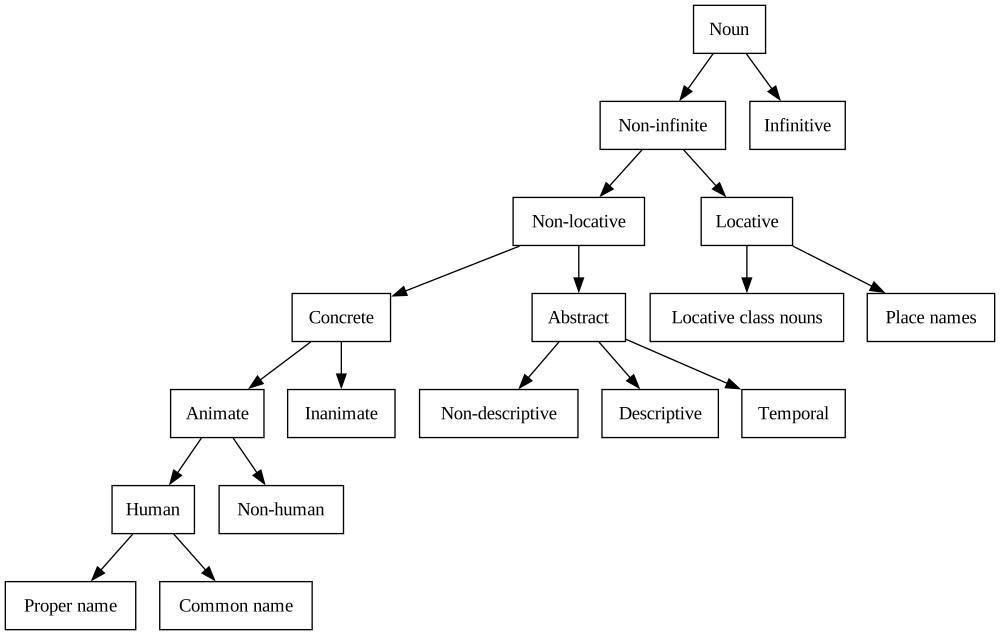
Setswana nouns can be classified into subcategories based on morphological, syntactic and semantic similarities and variances and these subcategories are presented in the diagram below. The focal categories in the classification being non-infinitives, infinitives and locatives, the same categories that emerged in the grouping of the noun classes. Subsequent categories to the ones above apply to the syntactic functions and valentional features of nouns.
The diagram of Krüger (2006: 102) is presented in a slightly amended format.
Figure 1: Categorical classification of Setswana noun classes (adapted from Krüger, 2006)
[click image to enlarge]
Table 21
Morph./Synt. Features:
Proper name
Common name
Non-human
Inanimate
Non-descriptive
Descriptive
Temporal
Locative class nouns
Place names
Infinitive
a) Plural
+
+
+
+
+
-
+
-
-
-
b) Diminutive -ana
-
+
+
+
-
-
-
-
-
-
c) Diminutive -nyana
-
+
+
+
-
+
+
+
-
-
d) locative -ng
-
+
+
+
+
+
+
-
-
+
e) Deverbative
-
+
+
+
+
-
-
-
-
-
f) Denominative
-
-
-
-
-
+
-
-
-
-
g) compl. of loc.part. go
+
-
-
-
-
-
-
-
-
-
h) compl of instr.part. ka
+
+
+
+
+
+
+
+
+
+
i) compl of rel.part. go
-
-
-
-
-
+
-
-
-
-
j) compl: descr. cop.
-
-
-
-
-
+
-
+
-
-
k) compl: ident. cop.
+
+
+
+
+
-
-
+
-
-
Piti (name)
malome ‘uncle’
Rre ‘father/sir’
moruti ‘preacher’
ngwana ‘child’
modiri ‘worker’
mokwadi ‘writer’
segokgo ‘spider’
tsiê noga ‘snake’
pitse ‘horse’
tonki ‘donkey’
sekolo ‘school’
tsela ‘road’
ntlo ‘house’
lefatshe ‘earth’
mmu ‘soil’
potsô ‘question’
tôrô ‘dream’
letshwenyô ‘worry’
thusô ‘help’
modumô ‘noise’
-golô ‘big’
-nyane ‘small’
botlhale ‘clever’
tsididi ‘cold’
boruma ‘soft’
maabane ‘yesterday’
bosigo ‘night’
nako ‘time’
letsatsi ‘day’
kgwedi ‘month’
moragô ‘behind’
godimo ‘above’
gaufi ‘near’
kgakala ‘far’
tlase ‘below’
Tswane
Mafikeng
go-ema ‘to stand’
go-nwa ‘to drink’
The derivation of Setswana nouns
The prefix seka-
This prefix is not common with Setswana nouns but is included here as a nominal prefix. It precedes the class prefix of the noun it is used with and does not replace it. Setswana nouns do not have pre-prefixes Katamba (2003: 107). Cole (1975: 111) indicates that the prefix seka- is used with some nouns to express the semantic value of:
‘Something like...’
‘Something resembling...’
‘Having the characteristics of...’
Example 167
sekatau
something like a lion, having lion-like characteristics
Example 168
sekamotho
something like a person, in human fashion
Example 169
ntšwa sekatau
a lion-like dog, fierce and brave like a lion
Morphologically it consists of the class 7 prefix se- followed by -ka“which is identical to that which occurs in the relative stems -kae, -kana and -kalo, and in the adverbial formative jaaka-” Cole (1975: 111). Valentionally nouns with this prefix have a qualificative (modifying) function as seen in the last example above.
Nouns derived from verbs (Deverbative nouns)
A deverbative noun is a noun that is derived from an infinitive verb. Krüger treats the forming of deverbatives as “word class interchange”, however a much more detailed description is given in these texts. Deverbation is accomplished by conforming the verb to the structure of a noun by substituting the infinitive prefix go- ‘to’ with a noun class prefix and, concomitantly the ending -a of the infinitive is substituted with a deverbative suffix -i or -. In some deverbative nouns the suffix -a is kept and a limited number of nouns take the suffixes -u and -e. (Further reading: Cole, 1955: 113-116; Krüger, 2006: 110-123; Krüger, 2013: 115-117). The root is kept. The deverbative noun lekwalô (a letter, a text) is formed from the infinitive verb go kwala ‘to write’. The infinitive prefix go- is replaced with the class prefix le-, the root -kwal- is retained and the deverbative suffix -ô replaces the verbal ending -a:
Example 170
lekwalô
le- kwal- ô
NPre5-write-DevSuf
a letter, a text
Nouns derived from pronouns
Nouns of noun class 14 may be derived by placing the bo- prefix of class 14 before pronouns to indicate abstract concepts as is customary in this class (Cole, 1975: 111). The personal pronouns of the first, second and third person/class one is applicable in this instance:
Example 171
bonna
bo- nna
NPre14-PersProP1sg
my personality, my individual quality
Example 172
boene
bo- ene
NPre14-PersProP3sg
his/her personality, his/her state of being
Quantitative pronouns are also sometimes used as roots to form nouns. Inclusive quantitative pronoun:
Example 173
bojotlhe
bo- jotlhe
NPre14-IncQPro14
entirety, wholeness, state of being whole
Example 174
bonosi
bo- nosi
NPre14-ExcQProP1sg
aloneness, state of being alone
A few nouns are formed using the noun class 1 prefix with the possessive particle ga (Berg, 2018: 111; Cole, 1975: 161; Krüger, 2013: 111) and personal pronouns (Cole, 1975: 112):
Example 175
mogarona
mo- ga- rona
NPre1- PossPart16- PersProP1pl
one (person) of our place, a fellow citizen
Nouns derived from adjectival noun roots
Based on their morphological composition adjectives are considered a subcategory of the noun in Setswana. They are classified as so-called describing nouns based on their use as adjectives in translation. Posthumus (2000: 148–158) discusses the morphological and valentional features of Zulu adjectives. There are two types of adjectives viz. ordinary (unchanging – they are complete independent words) and changeable adjectives (Berg, 2018: 50; Krüger, 2013: 127–136). Some of the changeable adjective roots may take the noun prefixes of noun classes 1 or 14 to derive nouns with mainly an abstract connotation (Cole, 1975: 112):
Example 176
bagolo
ba- golo
NPre2- big
adults
Example 177
bosesane
bo- sesane
NPre14- narrow
narrowness, thinness, slimness
Example 178
boleele
bo- leele
NPre14- long
length, tallness. height
Nouns derived from locative class nouns
A limited number of non-infinitive nouns are derived from locative class nouns. They tend to have an abstract connotation (Cole, 1975: 116):
Example 179
bokgakala
bo- (-) -kgakala
NPre14- NPre20 -far
distance, farness
Example 180
bogare
bo- ga- re
NPre14- NPre19-middle
the middle, the centre
Example 181
bokafatlase
bo- ka- fa- (-)- tlase
NPre14- LocPartka- LocPartfa- NPre20 -under
the underneath, the underside
Example 182
bokafateng
bo- ka- fa- (-) -teng
NPre14- LocPartka- LocPartfa- NPre20 -inside
the inside
Example 183
bosemorafe
bo- se- mo- rafe
NPre14- NPre7- NPre1- tribe
tribalism
Nouns derived from ideophones and interjections
Only a few Setswana nouns are derived from ideophones (Cole, 1975: 117):
Example 184
lefifi
le- fii
NPre5- Ideop
darkness
Example 185
letsubutsubu
le- tsubu- tsubu
NPre5- Ideop- Ideop
a storm
(ideophone reduplicated)
Cole (1975: 117) indicates that the names of several birds are onomatopoeic in that they imitate the call of the bird:
Example 186
lerweerwee
le- rwee- rwee
NPre5- Ideop- Ideop
crowned plover
(imitative of its call)
Example 187
tlatlagwe
ne- tlatla- tlatla
NPre9- Ideop- Ideop
white-quilled korhaan
(imitative of its cackling call)
Example 188
lephurrwane
le- phurr- an- e
NPre5- Ideop- Dim- End
quail
(imitative of the whirr of its flight)
Compound nouns
Compounds are grammatical units that involve two or more lexical roots. They tend to function as a single word grammatically even though they may contain forms that otherwise function as independent words (Dimmendaal, 2000: 167). Cole (1975: 117) indicates that Setswana compound nouns may consist of reduplicated forms or of nouns preceded or followed by another word. A more detailed discussion of compounds is available in Krüger (2006: 43 & 57-98), Cole (1975: 117 – 123) and Pretorius, L. et al. 2008. Reduplicated nouns may be formed through a complete or partial duplication of a root or stem (Krüger, 2006: 43):
Example 189
mosadisadi
mo- sadi- sadi
NPre1- woman- woman
a respected clever woman, a woman of high esteem
Example 190
tautau
(ne-)- tau- tau
NPre9- lion- lion
a big strong lion
Example 191
godimodimo
go- dimo- dimo
NPre17- high- high
at the very high, at the very top
Nouns are often reduplicated to indicate the intensification of the idea that is transferred:
Example 192
bontsintsi
bo- ntsi- ntsi
NPre14- many- many
the great majority, the multitude
Example 193
ditlharetlhare
di- tlhare- tlhare
NPre10- tree- tree
very many trees
Example 194
makgasakgasa
ma- kgasa- kgasa
NPre10- rag- rag
rags and tatters
The class prefix of the second noun is often deleted in noun plus noun compounds:
Example 195
leebarope
le- eba- (ma-)- rope
NPre5- pigeon- (NPre6)- ruins
rock pigeon
Example 196
letlhogonolo
le- tlhogo- (bo-)- nolo
NPre5- head- (NPre14)- kindness
a blessing, a good fortune
A selection of compound nouns is formed from underlying phrases or word groups. Pretorius L. et al., (2008: 5-8) mention the following:
Possessive groups:
Example 197
ditsela tsa nko
roads/passages of the nose
Example 198
ditselanko
nasal passages
(the possessive particle is elided)
Infinitive groups:
Example 199
go epa pitso
to convene a meeting
Example 200
moepapitso
convenor
Adjective relative groups:
Example 201
monna yo mogolo
the man that is big
Example 202
monnamogolo
old man
Verbal relative groups:
Example 203
leotwana le le gogang
a wheel that pulls
Example 204
leotwanakgogi
a pulley
Associative groups:
Example 205
go lema le go rua
to plough and to keep (animals)
Example 206
temothuo
agriculture
Miscellaneous groups:
The identification of the underlying members of the group are not apparent while in some cases it seems that the compound may be the result of a contracted form of juxtaposed words.
Example 207
Aferika borwa
Africa South
Example 208
Aferikaborwa
South Afrika
It is important to note that the prefixes of both members of compounds such as these where the first member agrees with the second change in the formation of the plural:
Example 209
bannabagolo
ba- nna- ba- bolo
NPre2- man- NPre2- big
old man
Compounds are also formed from phrases where the noun is qualified with a possessive particle phrase. A trace of the possessive particle is left in the compound:
Example 210
leaprapelo
le- apara- (ne-)- pelo
NPre5- wear- (NPre9)- heart
pericardium
Example 211
molomatsebe
mo- loma- (ne-)- tsebe
NPre1- bite- (NPre9)- ear
secret informer
In a smaller number of cases compounds are formed from verb plus adverb combinations:
Example 212
motlapele
mo- tla- (-)- pele
NPre1-come-NPre20-first
pioneer, forerunner
Example 213
motsalwapele
mo- tsal-iw- a- (-)- pele
NPre1-born-PasSuf-VEnd-NPre20-first
first born
References
Berg, A. (2018) Computational syntactic analysis of Setswana. Doctoral thesis. North-West University, South Africa.
Cole, D. T. (1955) An introduction to Tswana grammar. Cape Town: Longman.
Cole, D. T. (1975) Introduction to Tswana grammar, 2nd impression. Cape Town: Longman.
Dimmendaal, G. J. (2000) ‘Morphology’. In Heine, B & Nurse, D. (eds.). African Languages: An introduction. Cambridge: Cambridge University Press. pp.161-193.
Gowlett, D. (2003) ‘ Zone S’. In Nurse, D. & Philippson, G. (eds.). The Bantu languages. London: Routledge. pp.609–638.
Guthrie, M. (1967–1971) Comparative Bantu. 4 Vols. Farnborough: Gregg International.
Katamba, F. (2003) ‘Bantu nominal morphology’. In Nurse, D. & Philippson, G. (eds.). The Bantu languages. London: Routledge. pp.103–120.
Kosch, I. M. (2006) Topics in morphology in the African language context. Pretoria: University of South Africa.
Krüger, C. J. H. (2006) Introduction to the morphology of Setswana. München: Lincom.
Krüger, C. J. H. (2013) Setswana syntax: a survey of word group structures, Volume 2. München: Lincom.
Maho, J. (2003) ‘A classification of the Bantu languages: an update of Guthrie’s referential system’. In Nurse, D. & Philippson, D. (eds.). The Bantu languages. pp.639-651.
Lombard, D., Van Wyk, E. B. & Mokgokong, P. C. (1985) Introduction to the grammar of Northern Sotho. Pretoria: Van Schaik.
Posthumus, L. C. (2000) ‘The so-called adjective in Zulu’. South African Journal for African Languages. 20(2): 148–158.
Poulos, G. & Louwrens, L. J. (1994) A linguistic analysis of Northern Sotho. Pretoria: Via Afrika.
Pretorius, L., Viljoen, B., Pretorius, R. & Berg, A. (2008) ‘Towards a computational morphological analysis of Setswana compounds’. Literator. 29(1): 1–20.
Setshedi, J. E. (1980) Ithuteng Setswana. Mmabatho: Vision press.