Inflectional features associated with verbs
This topic outlines the inflectional features associated with Setswama verbs.
Inflectional features of verbs
Setswana verbs like the verbs of most languages show the greatest morphological complexity of all word classes. The inflection of verbal elements was traditionally referred to as “conjugation”. Katamba (1993: 220) indicates that verbs may be inflected for tense, aspect, mood and conjugation classes which all add further specification to the event, process, state, or action of the verb which he refers to as predication. The features of the verb are referred to by some grammarians as grammatical categories and are intertwined to the extent that when one is interfered with it has an influence on the others. Posthumus (1993: 95) defines the essential categories of the verb in IsiZulu as “those characteristics of the verb which are necessarily inherently present in every verb regardless of the simplicity or complexity of the morphological structure of such a verb. These characteristics which govern the semantic-syntactic usage of the verb are morphologically and phonologically marked within the verb form”
. Posthumus (1994) refers to the grammatical categories of the verb as a cobweb when he discusses the categories of the Zulu verb.
For Setswana, the categories of mood, tense, aspect, and actuality/polarity (positive and negative) are identified as the essential categories/features of the verb. The morphological marking of the different categories in the verb is as follows:
- Mood and tense are marked by the subject agreement morpheme and the categorial verbal ending.
- Aspect is marked by the progressive prefixal morpheme -sa-, the imperfective/present tense morpheme -a-, and the perfective suffix -ilê.
- Actuality is marked by the presence or absence of negative morphemes.The hierarchy of the four essential verbal categories as be presented as:
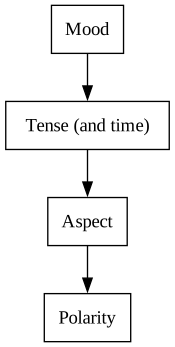
In Setswana, verbal prefixes generally inflect for gender, number and person while the subject agreement morpheme, suffixes and the verbal ending inflect for tense and mood. In some instances, a prefix and suffix is required to appear simultaneously to convey the inflectional category/feature. The descriptions of some moods, tenses and aspects differ regarding their classification and terminology in the grammars on Bantu languages in general and in Southern Bantu and the Sotho group in particular. The plural in imperatives, hortative and optative moods e.g., A re tsamayeng ‘Let us go’; Tsamayang! ‘Go!/Leave!’ can be mentioned here as explained later on.
Gender, number and person
The features of gender, number and person are inflected in the verb from a nominal element (noun or pronoun) via an agreement morpheme (subject or object agreement morpheme). The subject agreement morpheme in (1) inflects class gender 1 which indicates a singular value for number.
| Morutabana o bala dibuka. |
| mo -rutabana o -bal -a di -buka |
| NPre1-teacher AgrSubj1-read-VEnd NPre10-book |
| The teacher is reading books. |
The object agreement morpheme in (2) inflects class gender 10 which indicates a plural value for number.
| Morutabana o a di bala. |
| mo -rutabana o -a -di -bal -a |
| NPre1-teacher AgrSubj1-PresPre-AgrObj10-read-VEnd |
| The teacher reads them. |
Respect may be indicated toward the addressee by referring to him/her in the plural (3). Note that the descriptive copulative verb (‘DesCopVP2pl’) here has the same form as the subject agreement morpheme (‘AgrSubjP2pl’).
| Le kae, ntate? |
| Le kae (-) -ntate |
| DesCopVP2pl Adv NPre1a-father |
| How are you father? |
In the imperative mood a suffix which does not indicate agreement is used to indicate plural value for the number feature (4). The suffix -ng indicates that the command is given to more than one person.
| Dulang foo! |
| dul-a -ng foo |
| sit-VEnd-ImpSuf (foo) |
| Sit (over) there! |
The suffix -ng may also be used with verbs in the subjunctive mood when preceded by a hortative particle (5).
| Ako lo re thuseng tlhe. |
| ako lo- re -thuse-ng tlhe |
| HortPart AgrSubjP2pl-AgrObjP1pl-help -ImpSuf Interj |
| Will you please help us? |
Tense
Tense is a deictic category which relates the time of the action, event or state of affairs (referred to as E.T. - event time) to the time of the utterance (referred to as C.T. - coding time). Tenses are divided into the categories of absolute and relative tenses based on the point in time which is referred to in the verb or verbal group. In the absolute tenses C.T. coincides with the deictic centre and constitutes the point from which utterances are interpreted. In the relative tenses the reference point from which the temporal semantic interpretations are made, is not C.T. but a point referred to by an auxiliary verb. Relative tenses thus express a relation between event time, reference time and coding time.
Even though tenses are marked by different morphemes tense marking does not bring about lexical distinctions. Tense is therefore seen as inflectional category. Consider the absolute tenses in the following examples:
- Present tenseExample 6
Ntate o reka koloi. (-) -ntate o -rek-a (ne-) -koloi NPre1a-father AgrSub1a-buy-VEnd NPre9-car Father buys a car. - Past tenseExample 7
Ntate o rekile koloi (-) -ntate o -rek-il -e (ne-)-koloi NPre1a-father AgrSub1a-buy-PerfSuf-VEnd NPre9-car Father bought a car. - Future tenseExample 8
Ntate o tla reka koloi. (-) -ntate o -tla -rek-a (ne-)-koloi NPre1a-father AgrSub1a-FutPre-buy-VEnd NPre9-car Father will buy a car.
Aspect
Aspect deals with the non-deictic temporal structure of events and situations as expressed in grammatical constructions and lexical items, verbs in particular. Aspect conveys the internal temporal structure of actions also referred to as the duration of an action in a verb (Posthumus, 1993: 183; Louwrens, 1994: 139; Berg, 2018: 65). It is sometimes expressed as the manner of duration and translated as aksionsart. Aspect is not marked overtly in all verbs in Setswana and must be identified on semantic distinction in some cases. Aspectual distinctions only appear in moods that have tenses. Perfective, progressive and persistive aspect are identified in Setswana.
Perfective aspect refers to a completed action:
| Mosetsana o ne a rekile mosese. |
| mo -setsana o -ne a -rek-il -e mo -sese |
| NPre1-girl AgrSubj1-Aux AgrSubj1-buy-PerfSuf-VEnd NPre3-dress |
| The girls had bought a dress. |
Progressive aspect refers to an action that is in progress/ongoing at the moment of speech:
| Bana ba sa tsena mo holong. |
| Ba -ana ba sa tsen -a mo (ne-)-holo-ing |
| NPre2-child AgrSubj2-ProgPre-enter-VEnd LocPart NPre9-hall-LocSuf |
| The children are still entering the hall. |
Persistive aspect “affirms that a situation has held continuously since an implicit or explicit point in the past up to the time of speaking”
(Nurse, 2008: 145). It is implied that the action has started some time prior to speech time. The persistive is marked by the auxiliary verbs ntse ‘have been’ or santse ‘still’. Refer to Berg (2018: 65-66) for more detail.
| Mosadi o ntse a re emetse. |
| mo -sadi o -ntse a -re -em -el -il -e |
| NPre1-woman AgrSubj1-Aux AgrSubj1-AgrObjP1pl-wait-ApplSuf-PerfSuf-VEnd |
| The woman has been waiting for us all along (the whole time). |
Mood
The identification and description of moods in the Bantu languages is considered continuously and different views exist on the matter. Posthumus (1993: 95) asserts that mood “is that characteristic morphologically and phonologically marked form of the verb which portrays the semantic-syntactic usage of such a verb”
and the semantic-syntactic usage “is the usage of the verb in a particular type of independent or dependent word group or sentence”
. Kosch (2006: 102) indicates that mood “is generally described and understood as referring to the different structural forms which verbs may assume in order to reflect a speaker or writer’s attitude towards an event”. Inflectional morphology is concerned with the first part of the definition viz. the structural form of the verb in this regard.
The term modality is used to describe the attitude of the speaker viz. the way in which the speaker experiences and then conveys an event as either a fact, request, command, probability or uncertainty. A distinction between dependent and independent moods based on the syntactic and discourse features of verbs is often drawn:
- The independent moods are the indicative, consecutive, imperative and habitual.
- The dependent moods are the situative (participial), subjunctive, infinitive and relative. The verbs in these dependent moods are semantically and syntactically dependent and therefore act as subordinate members in complex sentences.
A detailed discussion of the different moods with their temporal and aspectual varieties is not attempted here. Refer to relevant research papers and sections in authoritative grammars. Possible examples include Pretorius (1996), Krüger (2006 & 2013) and Berg (2018) among others. Examples from less disputed moods are considered to indicate the structural patterns mentioned. In analogy to Kosch (2006: 102) who uses the indicative mood which is often referred to as the “unmarked mood” as a basis to indicate the idiosyncrasies of other moods, the same method is followed here for Setswana.
Indicative mood
The verb in the indicative mood expresses factual statements and may be marked for tenses. It requires a subject agreement morpheme. The basic morphological structure of verbs in the indicative mood is:
subject agreement morpheme + (present tense morpheme -a) + (object agreement morpheme) + verb root + verbal ending -a.
| Mosadi o reka mosese. |
| mo -sadi o rek-a mo -sese |
| NPre1-woman AgrSubj1-buy-VEnd NPre3-dress |
| The woman buys a dress. |
| Mosadi o a reka. |
| mo -sadi o a rek-a |
| NPre1-woman AgrSubj1-PresPre-buy-VEnd |
| The woman buys. |
| Mosadi o a o reka. |
| mo -sadi o a o rek-a |
| NPre1-woman AgrSubj1-PresPre-AgrObj3-buy-VEnd |
| The woman buys it. |
Imperative mood
The verb in the imperative mood expresses commands. It cannot be marked for tense. It has the following basic morphological structure:
- verb root + verbal ending -aExample 15
Taboga! tabog-a run -VEnd Run! - The verbal ending changes to -e when and object agreement morpheme is includedExample 16
Mo thuse! mo -thus-e AgrObj1-help-VEnd Help him/her! - A suffix -ng is added when the command is directed at more than one personExample 17
Tabogang tabog-a -ng run -VEnd-ImpSuf Run! (you plural)
In monosyllabic stems such as ja ‘eat’, an -a may be added to the stem. The vowel <-e> may also be prefixed to monosyllanic stems. Kosch (2006: 103) refers to these morphemes as “stabilisers”.
| Jaa! |
| j -a -a |
| eat-VEnd-Stabiliser |
| Eat! |
There is a variant form -ya of this suffix that is sometimes used: Jaya!
| Eja! |
| e -j -a |
| Stabiliser-eat-VEnd |
| Eat! |
Subjunctive mood
The subjunctive mood may express actions such as want, desire, purpose, commands, requests, and consecutive actions. It is often used with the particle gore ‘so that’, or ‘in order to’ and is not marked for tense. The basic morphological structure is:
- subject agreement morpheme + verb root + verbal ending -ê
The subject agreement morphemes of classes 1 and 1a change from -o to -a. As a dependent verb the subordinate clause may follow the following clauses:
- IndicativeExample 20
Ke batla gore o nthuse. ke -batl-a gore o -n -thus-e AgrSubjP1sg-want-VEnd Conj AgrSubjP2sg-AgrObjP1sg-help-VEnd I want you to help me. A command to more than one person, the plural form requires the verbal ending -ng:
Example 21Ke batla gore lo nthuseng. ke -batl-a gore lo -n -thus-e -ng AgrSubjP1ag-want-VEnd Conj AgrSubjP2pl-AgrObjP1sg-help-VEnd-VEnd I want you (plural) to help me. - Imperative:Example 22
Tsena, o nthuse! tsen -a o -n -thus-e come in-VEnd AgrSubjP2sg-AgrObjP1sg-help-VEnd Come in and help me! A hortative particle can also be included:
Example 23A ke bone. a ke -bon-e HortPart AgrSubjP1sg-see-VEnd Let me see.
Voice
The expression of grammatical relations is encoded using syntax and morphology and can be realised in a variety of ways (Katamba, 2003: 267). When the subject performs the action that is expressed by the verb the verb appears in the active form (active voice). When the subject undergoes the action that is expressed by the verb the verb appears in the passive form (passive voice). The arguments in the passive sentence are thus re-ordered.
Passive voice is also expressed by marking the verb with the passive suffix -iw- or -w-. A passive verb is valency reducing, as the object (OBJ) in the active sentence changes to the subject (SUBJ) in the passive sentence. The ‘SUBJ’ of the active sentence functions as the complement of the agentative particle ke ‘by’. The transitivity of the verb is reduced by the passive suffix. While o reka ‘he buys’ is transitive o rekiwa ‘it is bought’ is intransitive.
| Monna o reka motsoko. |
| mo -nna o -rek -a mo -tsoko |
| NPre1-woman AgrSubj1-send-VEnd NPre3-tobacco |
| The man buys tobacco. |
| Motsoko o rekiwa ke monna. |
| mo -tsoko o -rek-iw -a ke mo -nna |
| NPre3-tobacco AgrSubj3-buy-PassSuf-VEnd AgPart NPre1-man |
| The tobacco is bought by the man. |
Refer to Berg (2018: 79-80) for a discussion on the mapping of thematic roles in passive sentences.
Polarity
Morphemes in the verb indicate that it is positive or negative. This status is referred to as polarity in grammars. Positive polarity is indicated by and absence of negative prefixes and the optional presence of the verbal ending ‑a. In very rare roots such as r- (stem re ‘say’) and its- (stem itse ‘know’) the verbal ending -e is used in the positive. Such stems are labelled as defective stems (Pretorius, 1997: 26).
In the example below positive polarity (present tense, indicative) is indicated by the present tense prefix -a- and the verbal ending -a.
| Bana ba a tshameka. |
| ba -na ba -a -tshamek-a |
| NPre2-child AgrSubj2-PresPre-play -VEnd |
| The children play. |
In the following example positive polarity (present tense, indicative) is indicated with the verbal ending -a.
| Banna ba besa nama. |
| ba-nna ba-bes-a (ne-)-nama |
| NPre2-man AgrSubj2-barbeque-VEnd NPre9-meat |
| The men barbeque/roast meat. |
The negative prefixes ga-, sa-, and se- and the verbal ending -e indicate negative polarity in the following examples. In the following example negative polarity is indicated by the negative prefix ga- and the verbal ending -e.
| Banna ga ba bese nama. |
| ba -nna ga -ba -bes -e (ne-)-nama |
| NPre2-man NegPreg-AgrSubj2-barbeque-VEnd NPre9-meat |
| The men do not barbeque/roast meat. |
Negative polarity is indicated by the negative prefix sa- and the verbal ending -e:
| Ba ne ba sa bese nama. |
| ba -ne ba -sa -bes -e (ne-)-nama |
| AgrSub2-Aux AgrSubj2-NegPre-barbeque-VEnd NPre9-meat |
| They were not barbequing meat. |
Negative polarity is indicated by the negative prefix se- and the verbal ending -e:
| Se taboge! |
| se -tabog-e |
| NegPre-run -VEnd |
| Do not run! |
In the positive, a command to more than one person, requires the verbal ending –ng:
| Se tabogeng! |
| se -tabog-e -ng |
| NegPre-run -VEnd-VEnd |
| Do not run! (plural) |
References
Berg, A. (2018) Computational syntactic analysis of Setswana. Doctoral Thesis. North-West University, Potchefstroom.
Katamba, F. (1993) Morphology. London: Macmillan.
Katamba, F. (2003) ‘Bantu nominal morphology’. In Nurse, D. & Philippson, G. (eds.). The Bantu languages. London: Routledge. pp.103–120.
Kosch, I. M. (2006) Topics in morphology in the African language context. University of South Africa, Pretoria.
Krüger, C. J. H. (2006) Introduction to the morphology of Setswana. München: Lincom.
Krüger, C. J. H. (2013) Setswana syntax: a survey of word group structures: Volume 1. München: Lincom.
Louwrens L J. (1994) ‘Aspect as an essential sub-category of the verb in Northern Sotho’. South African Journal of African Languages. 14(3): 116-127
Nurse, D. (2008) Tense and aspect in Bantu. Oxford: Oxford University
Posthumus, L. C. (1993) ‘The hierarchy of the essential verb categories in Zulu’. South African Journal for African Languages. 13(3): 95-102.
Posthumus, L. C. (1994) ‘Word-based versus root-based morphology in African Languages’. South African Journal for African Languages. 14(1): 28-36.
Pretorius, R. S. (1997) Auxiliary verbs as a subcategory of the verb in Tswana. Doctoral Thesis. North-West University (University of Christian Higher Education), Potchefstroom.