Syntax as linguistic discipline
This section provides an overview of syntax as a sub-discipline and how valid grammatical sentences are formed in Setswana.
Syntax as linguistic discipline
Syntax is construed as the structural description of sentences and their constituting parts. It is the field of linguistics that studies how words are combined into larger phrases and, ultimately, sentences. In Setswana the minimal structure of some phrases is only a word. This word may be modified with another word or word group. For example, a noun phrase may only consist of a noun such as basimane ‘boys’. This noun may be modified with a demonstrative pronoun ba ‘these’ constituting the noun phrase basimane ba ‘these boys’.
However, some phrases cannot consist of only one word as the head word must be followed by a complement which is a compulsory word or word group. For example, the instrumental particle ka ‘with’ must be followed by a complement such as the noun pene ‘a pen’ and in this instance an instrumental particle phrase ka pene ‘with a pen’ is formed.
Phrases act as constituents in more comprehensive structures such as other phrases or sentences. For example, the noun phrase basimane ‘the boys’ can be a complement of the associative particle le ‘with’ and in this instance an associative particle phrase le basimane ‘with the boys’ is formed. The noun phrase can also act as a subject or object in a sentence. In the sentence Basimane ba a tshameka. ‘The boys are playing.’ the noun phrase basimane ‘boys’ act as the subject in the sentence. In the sentence Mosadi o bitsa basimane. ‘The woman calls the boys.’ The noun phrase basimane ‘boys’ act as the object in the sentence.
Sentences have a specific clause structure. Clauses are divided into main (independent) and subordinate (dependent) clauses. A main clause functions on its own and constitutes a well-formed sentence. It does not depend on another clause for its existence. This sentence includes a single verbal element and apart from the verbal element, the sentence can also include various other constituents such as a subject, objects, obliques, and adjuncts (Louwrens, 1994: 13, 17). For example, the sentence in (1) is a simple sentence and it consist of only one independent clause.
| Mosadi o thusa mosimane. |
| mo- sadi o- thus-a mo- simane |
| NPre1-woman AgrSubj1-help-VEnd NPre1-boy |
| The woman is helping the boy. |
A subordinate clause is reliant on the appearance of a main clause to supplement its meaning (Louwrens, 1994: 28, 84). It is part of a complex sentence that consists of a main clause and at least one subordinate clause (Watters, 2000: 217). The complex sentence consists of at least two verbal elements. One verb is included in the main clause and one in the subordinate clause (Louwrens, 1991: 30). For example, the complex sentence in (2) consists of the main clause Phefo e a tsena ‘The wind comes in’ and the subordinate clause fa re bula lebati ‘when we open the door’ that denotes the participial mood.
| Phefo e a tsena fa re bula lebati. |
| (ne)- phefo e- a- tsen- a fa re- bul- a le- bati |
| NPre9-wind AgrSubj9-PresPre-come in-VEnd Conj AgrSubjP1pl-open-VEnd NPre5-door |
| The wind comes in when we open the door. |
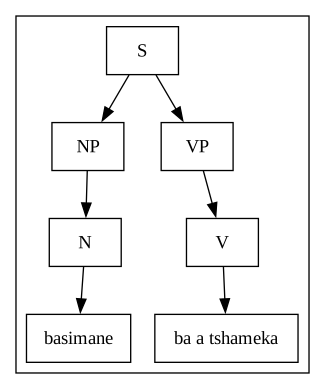
Syntax can also be described as the study of rules (phrase structure rules) which manage the formation of sentences and therefore it is possible to generate an infinite number of sentences Words are combined according to rules governing the word distribution, sequence and combination (Watters, 2000: 194; DALL, 2000: 1). Phrase structure rules contain the constituents and word order. For example, the structure of the sentence Basimane ba a tshameka. ‘The boys are playing.’ can be represented by the rule ‘S → NP VP’. This sentence consists of the NP (noun phrase) basimane ‘boys’ and the VP (verb phrase) ba a tsameka ‘they play’. The words are placed in a language specific word order and are arranged according to a specific rule. The NP consists of a noun and the rule for this phrase is ‘NP → N’. The VP consists of a verb and the rule for this phrase is ‘VP → V’. The following tree diagram represents the mentioned phrase structure rules.
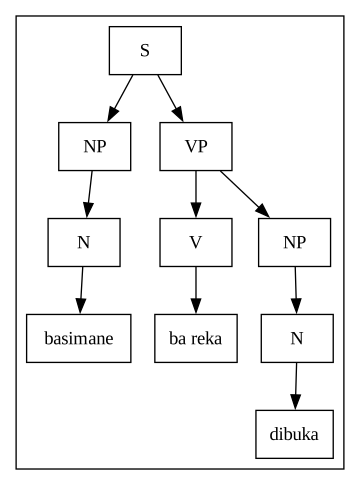
The ‘S → NP VP’ rule is also applicable to the structure of the sentence Basimane ba reka dibuka. ‘The boys buy books.’. The NP consists of the noun basimane ‘boys’ while the VP consists of the verb ba reka ‘they buy’ and the noun dibuka ‘books’. The noun dibuka is thus a NP within this VP. The rule for this phrase is ‘VP → V NP’. The following tree diagram represents the phrase structure rules of this sentence.
A study of the syntax of a language is also concerned with the internal and external syntax. Internal syntax thus deals with how a given phrase or sentence itself is constructed in a well-formed manner while external syntax is concerned with the external environment in which a phrase or sentence occurs. The internal syntax represents the framework in which a variety of phenomena operate (Krüger, 2013a: viii). These phenomena are:
- word categories
- structuring of phrases
- arrangement of constituents
- grammatical functions applicable to the constituents
The external syntax shows how phrases or sentences may combine as members of other more comprehensive structures and what their new function is in a newly formed internal structure (Krüger, 2013a: viii).
The description of the syntax of Setswana includes a description of the lexical items and constituents as well as the functional structure of phrases and sentences. The constituent structure expresses the order and grouping of constituents (Dalrymple, 2006: 82). The functional structure represents the functional or syntactic information of the internal structure of the sentence. The functional structure contains surface grammatical functions, such as subject and object, as well as features which are represented by the morphosyntactic properties of constituents. These morphosyntactic properties represent linguistic categories such as class, person, number, tense, aspect, mood etc. (Dalrymple, 2001: 7).
There are many reasons for studying syntax, from general humanistic or behavioural motivations to much more specific goals such as to help us to illustrate the patterns of a specific language more effectively and clearly and to enable us to analyse the structure of sentences in a systematic and explicit way (Kim & Sells, 2007: 7). The purpose with syntax is thus to study the structure of sentences and it includes a study of the structure of phrases as well.
Setswana word categories
In forming grammatical (valid) sentences, words as the basic units of syntax are used. The words are used to form phrases which are larger constituents. The phrases are used to form a clause which either is, or is part of, a well-formed sentence.
Setswana words can be classified into word categories (grammatical classes, lexical categories, parts of speech) according to morphological, syntactical, phonological, as well as semantic criteria (Van Wyk, 1966: 251-257; Krüger, 2006; Pretorius, 2014: 49). Based on the application of these criteria the following eight word categories for Setswana can be distinguished:
- nouns
- pronouns
- verbs
- particles
- conjunctions
- adverbs
- interjections
- ideophones
The nouns and verbs are morphologically productive and constitute open word categories while pronouns, particles, conjunctions, adverbs, interjections and ideophones are closed word categories as they are morphologically unproductive. Numerous subcategories can also be acknowledged and the division of words into subcategories is also based on the morphological, syntactical, phonological and semantic criteria applied to classify word categories (Van Wyk, 1966).
In syntactic descriptions a distinction is also drawn between lexical categories and functional categories with regards to the word categories. Lexical categories apply only to those word categories and their phrasal counterparts that form open classes and have full semantic content. The word categories that form closed classes and have mainly just functional content are called functional categories. Functional categories therefore not refer to grammatical functions such as subject and object (Wardhaugh, 2005: 4-30).
Nouns
Nouns are grouped into twenty noun classes.
The noun class prefixes determine verbal agreement, the agreement between heads and their complements and also the agreement between heads and modifiers (cf. Krüger, 2006: 57-98; Louwrens, 1994: 126; Poulos & Louwrens, 1994: 47; Letsholo & Matlhaku, 2014: 24; Berg, 2018: 189).
The odd class numbers of classes 1 to 14 express the singular and the corresponding even class numbers express the plural (3). Class 15 consists of the infinitive nouns (4). Classes 16 to 20 consists of the locative class nouns ((5) to (9)) (Take note: Classes 19 and 20 are either referred to as classes X and Y or the ga- and N-locative classes.)
| mosimane > basimane |
| mo- simane > ba- simane |
| NPre1-boy > NPre2-boy |
| boy > boys |
| go tsamaya |
| go- tsamy-a |
| NPre15-walk- VEnd |
| to walk, walking |
| fatshe |
| fa- tshe |
| NPre16-down |
| down, on the ground, below |
| godimo |
| go- dimo |
| NPre17-above |
| above, top |
| morago |
| mo- rago |
| NPre18-behind |
| behind, back |
| gare |
| ga- re |
| NPre19-between |
| between, middle |
| teng |
| (-)- teng |
| NPre20-inside |
| inside |
The subcategories of nouns are the basic nouns (noun classes 1 to 15) and locative class nouns (noun classes 16 to 20). However, locative nouns (10) and adjectives ((11) and (12)) are also subcategories of the noun (Cole, 1955: 59; Krüger, 2006: 57-98; Krüger, 2013a: 127-133; Krüger, 2013b: 157-159).
| sekolo > mo sekolong |
| se- kolo > mo se- kolo- ing |
| NPre7-school > LocPart-mo NPre7-school-LocSuf |
| the school > in the school |
| basimane ba botlhale |
| ba- simane ba botlhale |
| NPre2-boy QualPart2 adjective |
| the clever boys / the boys who are clever |
| mosimane yo mokhutswane |
| mo- simane yo mo- khutswane |
| NPre1-boy QualPart1 NPre1-adjective |
| a short boy / the boy who is short |
Pronouns
Setswana pronouns are divided into personal pronouns and the different pronoun types that agree with the noun classes.
The personal pronouns
Personal pronouns include pronouns for first, second and third person. The personal pronouns have corresponding possessive pronouns that indicate ordinary (13) or communal possession (14) (Cole, 1955: 163-164).
| tiro ya me |
| (ne-)-dir- o ya me |
| NPre9-work-DevSuf PossPart9 PossProP1sg |
| batho ba gaeno |
| ba- tho ba gaeno |
| NPre2-person PossPart2 PossProp2pl |
| people of our place/village |
The personal pronouns also have corresponding quantitative pronouns (inclusive (15), exclusive (16), selective (17), separative (18) and interrogative (19) (Cole, 1955: 154-158; Krüger, 2006: 141).
| rona rôtlhê |
| rona rôtlhê |
| PersProP1pl IncQProP1pl |
| all of us |
| ênê opê |
| ênê opê |
| PersProP3sg ExcQProP3sg |
| no one |
| bônê bôsi |
| bônê bôsi |
| PersProP3pl SelQProP2pl |
| only they |
| bônê basele |
| bônê basele |
| PersProP3pl SepQProP3pl |
| the unknown ones |
| bônê bafe |
| bônê bafe |
| PersProP3pl IntQProP3pl |
| which ones |
Pronouns for the noun classes
The pronouns for the noun classes show agreement with the noun classes. Absolute (Krüger, 2006: 131), demonstrative (Krüger, 2006: 134-135), quantitative (Cole, 1955: 154-158; Krüger: 2006: 137-139) and possessive (Krüger, 2006: 145; Cole, 1955: 163-164) pronouns are distinguished ant they also represent subcategories of the pronoun.
The absolute pronoun
The absolute pronoun has a meaning of ‘specific’ or ‘particular’ (20) or a meaning of ‘he’, ‘she’, ‘it’ or ‘they’ (21) (Krüger, 2006: 131).
| basimane bônê |
| ba-simane bônê |
| NPre2-boy AbsPro2 |
| the specific boys |
| Bônê ba a tshameka |
| bônê ba- a- tshamek-a |
| AbsPro2 AgrSubj2-PresPre-play- VEnd |
| They are playing. |
The demonstrative pronoun
The demonstrative pronoun is also class bound (Krüger, 2006: 134-135) as demonstrated by die examples below.
| basimane ba |
| ba-simane ba |
| NPre2-boy DemPro2D1 |
| these boys |
| basimane bao |
| ba-simane bao |
| NPre2-boy DemPro2D2 |
| those boys |
| basimane bale |
| ba-simane bale |
| NPre2-boy DemPro2D3 |
| the boys over there |
The quantitative pronouns
For Setswana inclusive (25), exclusive (26), selective 27), separative (28) and interrogative (29) quantitative pronouns are distinguished (Cole, 1955: 154-158; Krüger, 2006: 137-139).
| basimane bôtlhê |
| ba-simane bôtlhê |
| NPre2-boy IncQPro2 |
| all the boys |
| dijô dipê |
| di- jô dipê |
| NPre10-food ExcQPro10 |
| no food |
| basimane bôsi |
| ba-simane bôsi |
| NPre2-boy SelQPro2 |
| only the boys |
| basimane basele |
| ba-simane basele |
| NPre2-boy SepQPro2 |
| the unknown boys |
| basimane bafe |
| ba-simane bafe |
| NPre2-boy IntQPro2 |
| which boys? |
The possessive pronoun
The possessive pronoun has a referential lexical meaning of 'possessor' (Krüger, 2006: 145).
| mafoko a bônê |
| ma- foko a bônê |
| NPre6-word PossPart6 PossPro2 |
| their words |
Verbs
The verb in Setswana has three sub-categories, viz. the main, auxiliary and copulative verbs (Pretorius, 2003: 14; Pretorius, 1997: 76-81; Krüger, 2013b: 320).
The main verb
The main verb (31) is an independent verb and typically expresses the grammatical features of tense, aspect, mood and polarity (Kosch, 2006: 7; Krüger, 2006: 268).
| Basimane ba a tshameka. |
| ba- simane ba- a- tshamek-a |
| NPre2-boy AgrSubj2-PresPre-play- VEnd |
The auxiliary verb
The auxiliary verb is a dependent verb as it must be followed by a complement. It always occurs with a main (32) or a copulative verb (33) as complement (Berg, 2018: 119). The complement expresses the main action, process or event and the auxiliary verb enriches the meaning of the complement by adding semantic information regarding the progression or completion of the main verb (Louwrens, 1994: 17; Pretorius, 1997: 98, 259-343).
| O ne a reka dijô |
| o- ne a- rek-a di- j- ô |
| AgrSubj1-Aux AgrSubj1-buy-VEnd NPre10-eat-DevSuf |
| She was buying food. |
| Mosadi o ne a na le dijô |
| mo- sadi o- ne a- na le di- j- ô |
| NPre1-woman AgrSubj1-Aux AgrSubj1-AssCopV AssPart NPre10-eat-DevSuf |
| The woman had food. |
The copulative verbs
Three copulative verbs, i.e., the identifying, describing, and associative copulative verb are distinguished in Setswana.
The identifying copulative verb
The identifying copulative verb is used to identify a subject with regards to type, status or profession (34) or to predicate the existence or presence of a thing (35) (Cole, 1955: 311). The identifying copulative verb has different forms i.e., ke, -se, -le, -nna, -nne, -nnile) which are determined by mood, tense, aspect and polarity (Krüger, 2013b: 140-154). See examples (36) to (40) for the use of the different forms.
| Monna yo ke kgosi. |
| mo- nna yo ke (ne-)-kgosi |
| NPre1-man DemPro1D1 IdCopV NPre9-chief |
| This man is the chief. |
| Ke pene. |
| ke (ne-)-pene |
| IdCopV NPre9-pen |
| It is a pen. |
| Monna yo ga se kgosi. |
| mo- nna yo ga- se (ne-)-kgosi |
| NPre1-man DemPro1D1 NegPre-IdCopV NPre9-chief |
| This man is not the chief. |
| Monna e sa le kgosi. |
| mo- nna e- sa- le (ne-)-kgosi |
| NPre1-man AgrSubj-ProgPre-IdCopV NPre9-chief |
| The man is still a chief. |
| Monna e tla nna kgosi. |
| mo- nna e- tla- nna (ne-)-kgosi |
| NPre1-man AgrSubj-FutPre-IdCopV NPre9-chief |
| The man will be a chief. |
| Monna e nne kgosi. |
| mo- nna e- nne (ne-)-kgosi |
| NPre1-man AgrSubj-IdCopV NPre9-chief |
| This man is usually a chief. |
| Monna e nnile kgosi. |
| mo- nna e- nnile (ne-)-kgosi |
| NPre1-man AgrSubj-IdCopV NPre9-chief |
| This man was a chief. |
The describing copulative verb
Describing copulative verbs are used to predicate some quality, characteristic or state of the subject (41), or its situation or locality (42) (Cole, 1955: 319). The describing copulative verb exhibits class or person and number agreement with its subject noun or personal pronoun and also has different forms (-se, -le, -nna, -nne, -nnile) based on its mood, tense, aspect and/or polarity (Krüger, 2013b: 156-173). See examples (43) to (47) for the use of the different forms.
| Monna o mogolo. |
| mo- nna o mo- golo |
| NPre1-man DesCopV1 NPre1-adjective |
| The man is big. |
| Batho ba mo ofising. |
| ba- tho ba mo (ne-)-ofisi- ing |
| NPre2-person DesCopV2 LocPartmo NPre9-office-LocSuf |
| The people are in the office. |
| Monna o ne a se mogolo. |
| mo- nna o- ne a- se mo- golo |
| NPre1-man AgrSubj1-Aux AgrSubj1-DesCopV NPre1-adjective |
| The man was not big. |
| Monna o ne a le mogolo. |
| mo- nna o- ne a- le mo- golo |
| NPre1-man AgrSubj1-Aux AgrSubj1-DesCopV NPre1-adjective |
| The man was big. |
| Monna o tla nna mogolo. |
| mo- nna o- tla- nna mo- golo |
| NPre1-man AgrSubj1-FutPre-DesCopV NPre1-adjective |
| The man will be big. |
| Monna a nne mogolo. |
| mo- nna a- nne mo- golo |
| NPre1-man AgrSubj1-DesCopV NPre1-adjective |
| The man is usually big. |
| Monna o nnile mogolo. |
| mo- nna o- nnile mo-golo |
| NPre1-man AgrSubj1-DesCopV NPre1-adjective |
| The man was big. |
The associative copulative verb
The associative copulative verb expresses the idea of the English ‘have’ or ‘be with’ and indicates possession or association (Krüger, 2013b: 178-185). The associative copulative verb has different forms (-na, -nna, -nnile, -nne) determined by mood, tense, aspect and polarity. See examples (48) to (51) for the use of the different forms.
| Batho ba na le dijô |
| ba- tho ba- na le di- j- ô |
| NPre2-person AgrSubj2-AssCopV AssPart NPre10-eat-DevSuf |
| The people have food. |
| Batho ba tla nna dijô |
| ba- tho ba- tla- nna di- j- ô |
| NPre2-person AgrSubj2-FutPre-AssCopV NPre10-eat-DevSuf |
| The people will have food. |
| Batho ba nnile le dijô |
| ba- tho ba- nnile le di- j- ô |
| NPre2-person AgrSubj2-AssCopV AssPart NPre10-eat-DevSuf |
| The people had food. |
| Batho ba nne le dijô |
| ba- tho ba- nne le di- j- ô |
| NPre2-person AgrSubj2-AssCopV AssPart NPre10-eat-DevSuf |
| The people usually have food. |
Particles
No prepositions are distinguished for Setswana but the so-called particles are used to express the various meanings that are related to prepositions. Possessive, qualificative, instrumental, temporal, locative, agentative, associative, comparative and hortative particles are distinguished.
The possessive particle
In structures that denote possession or ownership a possessive particle that shows agreement with the possessor is included (Cole, 1955: 160). A possessive particle is always class bound (52) and has the meaning of ‘of’.
| bana ba kgôsi |
| ba- ana ba (ne-)-kgôsi |
| NPre2-child PossPart2 NPre9-chief |
| the children of the chief |
The qualificative particle
A qualificative particle has a referential relational meaning indicting ‘which is/are’ or ‘that is/are’ (Krüger, 2006: 157) and is also always class bound.
| thipa ê e bogale |
| (ne-)-thipa e e bo- gale |
| NPre9-knife QualPart9 DesCopV9 NPre14-adjective |
| the sharp knife, the knife that is sharp |
The instrumental particle
The instrumental particle ka (54) has the meaning of ‘with’, ‘by means of’ or ‘on’ (Poulos & Louwrens, 1994: 328).
| ka thipa |
| ka (ne-)-thipa |
| InstrPart NPre9-knife |
| with a knife |
Temporal particle
The temporal particle ka (55) conveys meanings such as ‘by’, ‘in’, ‘at’, ‘during’ or ‘per’ (Poulos & Louwrens, 1994: 329).
| kwa toropong |
| kwa (ne)- toropo-ing |
| LocPart NPre9-town- LocSuf |
| in/to town |
Locative particle
The locative particles are go, ga, ka, fa, mo and kwa and they convey the meaning of ‘to’, ‘at’, ‘into’, ‘in’, and ‘on’ (56).
| kwa toropong |
| kwa (ne)- toropo-ing |
| LocPart NPre9-town- LocSuf |
| in/to town |
Agentative particle
The agentative particle ke (57) conveys the meaning of ‘by’ in passive sentences (Lombard et al., 1985: 173).
| Mosimane o romilwe ke mosadi. |
| mo- simane o- rom- il- iw- e ke mo- sadi |
| NPre1-boy AgrSubj1-send-PerfSuf-PassSuf-VEnd AgPart NPre1-woman |
| The boy has been sent by the woman. |
Associative particle
The associative particle is le ‘with’ and act as the head of an associative particle phrase. This phrase functions as an adjunct in a sentence (58).
| Mosimane o tsamaya le mosadi. |
| mo- simane o- tsamay-a le mo- sadi |
| NPre1-boy AgrSubj1-walk- VEnd AssPart NPre1a-mother |
| The boy walks/goes with the woman. |
The associative particle is also used in an associative copulative verb phrase where it follows the positive of the associative copulative verb (59).
| Mosadi o na le bana. |
| mo- sadi o- na le ba- ana |
| NPre1-woman AgrSubj1-AssCopV AssPart NPre2-child |
| The woman has children. |
Comparative particle
The comparative particle jaaka (60) has a meaning of ‘like’ or ‘similar to’ (Krüger, 2006: 149).
| O bua fela jaaka wêna. |
| o- bu- a fela jaaka wêna |
| AgrSubj1-talk-VEnd Adv CompPart PersProP2sg |
| He talks just like you. |
Hortative particle
The hortative particle A (61) conveys a meaning of ‘let’ (Krüger, 2013b: 115).
| A nke ke bone! |
| A nke ke- bon-e |
| HortPart Aux AgrSubjP1sg-see-VEnd |
| Let me see! |
Interrogative particle
The interrogative particle A (62) is used to focus the question on the predicate itself (Krüger, 2013b: 331, 350).
| A basimane ba tlile? |
| a ba- simane ba- tl- il- e |
| IntPart NPre2-child AgrSubj2-come-PerfSuf-VEnd |
| Did the children come? |
Conjunctions
A conjunction is a word or word group that is used to link words in coordinated structures (Krüger, 2013a: 219; Cole, 1955; Le Roux, 2011). The conjunction kgotsa ‘or’ in (63) is used to link two nouns. It can also be used to link two clauses to form a complex or compound sentence (Louwrens, 1994: 29-33). The complex sentence in (64) includes the conjunctions gore ‘so that, that’ and kgotsa ‘or’. The compound sentence in (65) includes the conjunction mme ‘and’.
| mosetsana kgotsa mosimane |
| mo- setsana kgotsa mo-simane |
| NPre1-girl Conj NPre1-boy |
| the girl or the boy |
| A o batla gore ke go thuse go apaya dijo kgotsa ke phepafatse boapeelo? |
| a o- batl-a gore ke- go- thus-e go- apay-a di- j- o |
| kgotsa ke- phepafats-a bo- apay-el- o |
| IntPart AgrSubjP2sg-want-VEnd Conj AgrSubjP1sg-AgrObjP2sg-help-VEnd InfPre-cook-VEnd NPre8-eat-DevSuf |
| Conj AgrSubjP1sg-clean- VEnd NPre14-cook-ApplSuf-DevSuf |
| Do you want me to help you to cook food (with the cooking) or should I clean the kitchen? |
| Ba leboga mosadi mme ba ya kwa gae. |
| ba- lebog-a mo- sadi mme ba- y- a kwa (-)- gae |
| AgrSubj2-thank-VEnd NPre1-woman Conj AgrSubj2-go-VEnd LocPart NPre5-home |
Adverbs
In Setswana words (66) or word groups (67) that refer to time, place and manner etc. can act as adverbs. It is used as an adjunct in sentence (Krüger, 2006: 170-172).
| Re thusa batho jaanong. |
| re- thus-a ba -tho jaanong |
| AgrSubjP1pl-help-VEnd NPre2-person Adv |
| We are helping the people now. |
| Ngwana o taboga ka lebelo |
| mo- ana o- tabog-a ka le- belo |
| AgrSubj1-child AgrSubj1-run- VEnd IntrsPart NPre7-speed |
| The child is running fast. |
Interjections
Interjections are interposing remarks (68) that are used to express reactions and emotions such as joy, approval, disapproval, sorrow, distress, fear, disgust, agreement, disagreement, surprise, disbelief, and to draw attention or to call or urge on animals (Krüger, 2006: 165-166).
| Heei, nthuse! |
| Heei ni- thus-e |
| Interj AgrObjP1sg-help-VEnd |
| Hey, help me! |
Ideophones
Ideophones are highly expressive words that are used for sound symbolism regarding colour, sound, smell, taste, feeling, etc. (Louwrens, 1991: 79; Ras, 1991: 108-111). An example of an ideophone is tu that enhances a meaning of ‘quiet’ to ‘absolutely quit’ in (69). In this instance the ideophone acts independently. However, an ideophone can also be used as the complement of the the verb -re ‘say’ (Ras, 1991: 111). In (70) the sentence consists of a main clause and a subordinate clause. The ideophone tuu in the subordinate clause is the complement of the verb a re ‘he says’.
| Ba didimala tu. |
| ba- didimal-a tu |
| AgrSubj2-quiet- VEnd Ideo |
| They kept absolutely quiet. |
| A didimala a re tuu |
| a- didimal-a a- r- e tuu |
| AgrSubj1-quiet- VEnd AgrSubj1-say-VEnd Ideo |
| He kept quiet and said absolutely nothing. |
Structuring of phrases
The combinatory properties of words involve two aspects of structuring i.e., internal and external syntax. Internal syntax deals with how a given phrase itself is constructed in a well-formed manner whereas external syntax is concerned with how a phrase can be used in a larger construction. One important property with regard to the phrase-internal syntax of Setswana is that in constructing any phrase, there is one obligatory element in each phrase i.e., the head. A language can typologically be classified according to a head directionality parameter in word order (Baker, 2001: 68; Tanaka et al., 2011). This parameter classifies languages according to whether a phrase is head-initial (the head precedes its modifiers or complements) or head-final (the head follows its modifiers or complements) (Tallerman, 2005: 106-108). Setswana is a head-initial fixed word order language and the word categories and their subcategories can function as heads in phrases. Setswana phrases can consist of only a head, a head and a modifier or a head and a complement (Berg, 2018: 104). This will be discussed in detail in subsequent topics that focus on a description of the syntactic structure of each one of the Setswana phrases.
Heads
The head of a phrase is the nucleus of the phrase. It is the word that determines the syntactic category of the phrase. For example, the head of the noun phrase basimane ba ‘these boys’ is the noun basimane ‘boys’. A head is thus the essential, obligatory element within a given phrase (Tallerman, 2005: 95-98). The following phrases are distinguished for Setswana and their forming is based on a specific word category or sub category that appear in the head-initial position (Berg, 2018: 105):
| Phrase | Head |
|---|---|
| noun phrase | (head = basic noun) |
| locative noun phrase | (head = locative noun) |
| locative class noun phrase | (head = locative class noun) |
| adjective phrase | (head = adjective) |
| pronoun | (head = one of the subcategories of the pronoun) |
| verb phrase | (head = main verb) |
| auxiliary verb phrase | (head = auxiliary verb) |
| identifying copulative verb phrase | (head = identifying copulative verb) |
| describing copulative verb phrase | (head = describing copulative verb phrase) |
| associative copulative verb phrase | (head = associative copulative verb phrase) |
| possessive particle phrase | (head = possessive particle) |
| qualificative particle phrase | (head = qualificative particle) |
| locative particle phrase | (head = locative particle go, ga, ka, fa, mo or kwa) |
| instrumental particle phrase | (head = instrumental particle) |
| temporal particle phrase | (head = temporal particle) |
| agentative particle phrase | (head = agentative particle) |
| associative particle phrase | (head = associative particle) |
| comparative particle phrase | (head = comparative particle) |
| adverb phrase | (head = adverb) |
| interjection phrase | (head = interjection) |
| ideophone phrase | (head = ideophone) |
The head is thus a phrasal element that is essential in forming a phrase. Some of the mentioned Setswana phrases can only consist of a head as it is does not need an obligatory complement to form a grammatical phrase. The phrases that can only consists of a head word are:
| Phrase | Head |
|---|---|
| Noun phrase | (head = basic noun) |
| Locative noun phrase | (head = locative noun) |
| Locative class noun phrase | (head = locative class noun) |
| Adjective phrase | (head = adjective) |
| Pronoun | (head = one of the subcategories of the pronoun) |
| Verb phrase | (head = main verb) |
| Adverb phrase | (head = adverb) |
| Interjection phrase | (head = interjection) |
| Ideophone phrase | (head = ideophone) |
Complements
Some phrases cannot consist of only a head as the head needs to be followed by a complement in order to constitute a grammatical phrase. The complement is a phrasal element with which the head must combine with so as to be grammatical. The complement can also be a clause that is necessary to complete the meaning of a given expression. The head of each phrase thus determines its projection into a larger phrasal constituent. The word order requires the head to be in the initial position followed by a complement. Phrases that consist of a head and a compulsory complement are:
| Phrase | Head |
|---|---|
| auxiliary verb phrase | (head = auxiliary verb) |
| identifying copulative verb phrase | (head = identifying copulative verb) |
| describing copulative verb phrase | (head = describing copulative verb phrase) |
| associative copulative verb phrase | (head = associative copulative verb phrase) |
| possessive particle phrase | (head = possessive particle) |
| qualificative particle phrase | (head = qualificative particle) |
| locative particle phrase | (head = locative particle go, ga, ka, fa, mo or kwa) |
| instrumental particle phrase | (head = instrumental particle) |
| temporal particle phrase | (head = temporal particle) |
| agentative particle phrase | (head = agentative particle) |
| comparative particle phrase | (head = comparative particle) |
Modifiers
Certain relationships hold between words whereby one word, the head controls the other words, the modifiers (also in Setswana sources referred to as qualificatives or qualifiers) (Krüger, 2013a: 58). A given head may have one or more than one modifier. Words are thus grouped into phrases and the groupings typically bring together heads and their modifiers. The head is conveying a central piece of information and the modifiers expresses extra information. For example, in (71) the noun basimane ‘boys’ is modified with the demonstrative pronoun ba ‘these’ and in (72) the noun basimane ‘boys’ is modified with the inclusive quantitative pronoun botlhê ‘all’. A modifier is thus a non-essential element in a phrase and in Setswana it follows a head word to add more information with regards to some quality, feature or characteristic (Krüger, 2013a: 36).
| basimane ba |
| ba- simane ba |
| NPre2-boy DemPro2D1 |
| these boys |
| basimane bôtlhê |
| ba- simane bôtlhê |
| NPre2-boy IncQPro2 |
| all the boys |
Arrangement of constituents in sentences
In syntax a constituent is a word or a group of words that functions as a single unit within a syntactic structure. Constituents are phrases and a phrase is a sequence of one or more words built around a head and working as a unit within a sentence. One basic description of a language's syntax is the sequence in which constituents such as the subject, verb, and object usually appear in sentences. Most Bantu languages usually place the subject first in the sequence SVO (subject verb object) (Watters, 2000: 196-201). This is also the case in Setswana because this language is typically classified as an SVO language (Cole, 1955: 426; Krüger, 2006: 11-12). If an adjunct is included in a sentence the order is SVOX where X indicates the adjunct function.
The word order followed in simple sentences, compound sentences and complex sentences will be discussed in detail in the topics that focus on the syntactic structure of the simple, compound and complex sentences in Setswana.
Grammatical functions of constituents in sentences
The constituents in a sentence have specific grammatical functions and these grammatical functions are considered to be primitives of syntactic representation. The inventory of grammatical functions consists of the subject, direct object, indirect (secondary) object, oblique, complement and adjunct (Bresnan, 2001: 94-98, 307-309; Dalrymple, 2001: 8-27). These functions are applicable to sentence structure.
Subject
The subject executes or helps to execute the action or process that is indicated by the predicate. It is directly or indirectly involved in the execution of the action or process implied by the verb (73) (Tallerman, 2005: 172-175; Krüger, 2013a: 32-34).
| Banna ba tlilê. |
| ba- nna ba- tl- il- ê |
| NPre2-man AgrSubj2-come-PerfSuf-VEnd |
| The men have arrived. |
Direct object
The direct object is an object that is directly affected by the process or action indicated in the verb or it undergoes the process or action (74) (Tallerman, 2005: 179-181; Krüger, 2013a: 35).
| Mosadi o reka dijo. |
| mo- sadi o- rek-a di- j- o |
| NPre1-woman AgrSubj1-buy-VEnd NPre10-eat-DevSuf |
| The woman buys food. |
Indirect object
The indirect object is an object that is indirectly affected by the process indicated in the verb (75). It is referred to as the benefactor, i.e., the process is carried out on its behalf (Tallerman, 2005: 179-181; Krüger, 2013a: 35).
| Mosadi o rekela bana dijo. |
| mo- sadi o- rek-el- a ba- ana di- j- o |
| NPre1-woman AgrSubj1-buy-ApplSuf-VEnd NPre2-child NPre10-eat-DevSuf |
| The woman buys food for the children. |
Oblique
The meaning of some verbs requires the inclusion of a compulsory phrase in sentence structure. The oblique is thus a syntactically necessary or obligatory phrase that must be included in the structure of the sentence in order to form a semantically sensible and grammatically correct sentence. The oblique in Setswana is usually represented by a locative particle phrase (76) (Berg, 2018: 67-75).
| Batho ba tsamaela kwa nokeng. |
| ba- tho ba- tsamay-el- a kwa (ne)- noka- ing |
| NPre2-person AgrSubj2-walk- ApplSuf-VEnd LocPart NPre9-river-LocSuf |
| The people walk to the river. |
Adjunct
An adjunct describes the process or action contained in the predicate regarding place, time, manner, instrument, association etc. (77). Krüger (2013a: 38-39) refer to the adjunct as a descriptive.
| Batho ba tlilê gantsi. |
| ba- tho ba- tl- il- ê gantsi |
| NPre2-person AgrSubj2-come-PerfSuf-VEnd Adv |
| The people have come regularly. |
Krüger (2013a: 31-44) also describes functions applicable in the forming of word groups. These functions are antecedent and qualificative (modifier), introductory member and complement, first and succeeding member and main (head) member and appositional member.
Antecedent and modifier (qualificative, qualifier)
The antecedent is described by a modifier regarding a characteristic, quality or property (78). The modifier describes an antecedent regarding a characteristic (79) (Krüger, 2013a: 36).
| batho ba |
| ba- tho ba |
| NPre2-person DemPro2D1 |
| these people |
| batho ba |
| ba- tho ba |
| NPre2-person DemPro2D1 |
| these people |
Introductory member and complement
The introductory member is a word with a relational meaning and it is placed between its complement and a preceding member (80). It is syntactically independent and must compulsory be followed by a complement. Introductory members are particles, copulative verbs (identifying, describing, associative) and auxiliary verbs. The complement is the compulsory phrase that follows the introductory member (81). The complement indicates the information with which the introductory member determines the relation (Krüger, 2013a: 37-38).
| dibuka tsa me |
| di- buka tsa me |
| NPre10-book PossPart10 PossProP1sg |
| my books |
| dibuka tsa me |
| di- buka tsa me |
| NPre10-book PossPart10 PossProP1sg |
| my books |
First member and succeeding member(s)
A first member and succeeding members are syntactically equal or functionally even or on a par. They appear in coordinated structures. The members are combined with a conjunction such as le ‘and’ (Krüger, 2013a: 40-41). For example, in (82) the first member is monna ‘man’ and the succeeding member is mosadi ‘woman’.
| monna le mosadi |
| mo- nna le mo- sadi |
| Pre1-man Conj NPre1-woman |
| the man and the woman |
Main (head) member and appositional member
An appositional member re-defines, explains, describes or emphasise a head member in more detail. It therefore adds some additional information to the content of the head member in case some misunderstanding or vagueness might occur (Krüger, 2013a: 40). For example, in (83) banna bao ‘those men’ gives more information about the ‘they’ in ba tlile ‘they have come’.
| Ba tlilê, banna bao. |
| ba- tl- il- ê ba- nna bao |
| AgrSubj2-come-PerfSuf-VEnd NPre2-man DemPro2D2 |
| They have come, those men. |
These functions mentioned above will be discussed in detail regarding their role in the different phrases and also regarding the simple, compound and complex sentences in the topics that follow.
References
Baker, M. C. (2001) The Atoms of Language: The Mind's Hidden Rules of Grammar. New York: Basic Books.
Berg, A. (2018) Computational syntactic analysis of Setswana. Doctoral Thesis. North-West University, Potchefstroom.
Bresnan, J. (2001) Lexical-Functional Grammar. Oxford: Blackwell.
Cole, D. T. (1955) An introduction to Tswana grammar. Cape Town: Longman.
Dalrymple, M. (2001) Lexical Functional Grammar. Syntax and Semantics. Vol 34. California: Academic.
Dalrymple, M. (2006) ‘Lexical functional grammar’. In Brown, K. (ed.) Encyclopaedia of language and linguistics. 2nd edn. Oxford: Elsevier. pp.82-94.
Department of African Languages and Literature, Botswana University (DALL). 2000. The structure of Setswana sentences. Gaborone: Lightbooks.
Kim, J. & Sells, P. (2007) English Syntax: An Introduction. Stanford: Stanford University.
Kosch, I. M. (2006) Topics in morphology in the African language context. Pretoria: University of South Africa.
Krüger, C. J. H. (2006) Introduction to the morphology of Setswana. München: Lincom.
Krüger, C. J. H. (2013a) Setswana syntax: a survey of word group structures, Vol 1. München: Lincom.
Krüger, C. J. H. (2013b) Setswana syntax: a survey of word group structures, Vol 2. München: Lincom.
Le Roux, J. C. (2011) ‘The border dispute between adverbials and conjunctions in Tswana grammar’. South African Journal of African Languages. 31(1): 54-65.
Letsholo, R. & Matlhaku, K. (2014) ‘The syntax of the Setswana noun phrase’. Marang: Journal of Language and Literature. 24, 22-41.
Lombard, D., Van Wyk, E. B. & Mokgokong, P. C. (1985) Introduction to the grammar of Northern Sotho. Pretoria: Van Schaik.
Louwrens, L. J. (1991) Aspects of Northern Sotho grammar. Pretoria: Via Afrika.
Louwrens. L. J. (1994) Dictionary of Northern Sotho grammatical terms. Pretoria: Via Afrika.
Poulos, G. & Louwrens, L. J. (1994) A linguistic analysis of Northern Sotho. Pretoria: Via Afrika.
Pretorius, R. S. (1997) Auxiliary verbs as a subcategory of the verb in Tswana. Doctoral Thesis. North-West University (University of Christian Higher Education), Potchefstroom.
Pretorius, R. S. (2003) ‘Absolute tense forms in Tswana’. Journal for language teaching. 37(1): 13-25.
Pretorius, R. S. (2014) ‘The sequence and productivity of Setswana verbal suffixes’. Stellenbosch Papers in Linguistics Plus. 44, 1-23.
Ras, W. A. P. (1991) Die ideofoon in Tswana. Master’s Dissertation. North-West University (Potchefstroom University for Higher Education), Potchefstroom.
Tallerman, M. (2005) Understanding syntax. London: Hodder Arnold.
Tanaka, M. N., Brangan, H. P. & Pickering, M. J. (2011) ‘The production of Head-Initial and Head-Final languages’. In Yamashita, H., Hirose, Y. & Packard, J. L. (eds.). Processing and Producing Head Final Structures. Springer: Berlin. pp.113-120.
Van Wyk, E. B. (1966) ‘The word classes of Northern Sotho’. Lingua. 17(2): 230-261.
Wardhaugh, R. (2005) Understanding English Grammar. Oxford: Blackwell.
Watters, J. (2000). ‘Syntax’. In Heine, B & Nurse, D. (eds.). African languages: an introduction. Cambridge: Cambridge University. pp.194-230.