The simple sentence
Verbs being the most important constituents of sentences in isiXhosa undergo several changes and these are referred to as verb forms. Amongst their functions is an element which can display morphological contrasts of tense, aspect, voice, mood, person and number, Crystal (1980). This topic explicitly explores one of the above grammatical features known as mood.
Simple sentence
A simple sentence in isiXhosa has only one verb that is referred to as a finite verb. A finite verb is a word group that contains a finite verb form as its central element They are sometimes called main verbs. Such a verb can stand on its own, that is, without the assistance of any other verb, hence it is referred to as an independent verb.
- Umntwana utya isidudu. ‘The child is eating porridge.’
Even a copulative “… which is a predicative clause, can be a simple sentence with or without reference to any particular noun class”
(Van Rooyen et al., 1982).
- Lusana. ‘He/she is a toddler.’
- Lusana sasolu. ‘This is a toddler.’
In some instances, when the finite/main verb must form different potential and temporal forms (traditionally known as moods and tenses in some languages including isiXhosa), another form of a verb known as an auxiliary verb is used together with the main verb. In such a case, the auxillary verb precedes the main verb and the verb becomes a compound verb (Van Rooyen et al., 1982).
- Umntwana uza kutya isidudu. ‘The child is going to eat porridge.’
- Ulusu luza kuvuthwa. ‘Tripe is getting ready.’
Even copulatives have compound copulative verbs as is the case with verbs.
- Uba ngumfundi akuphuma emsebenzini. ‘He/she becomes a student after work.’
This section will focus on grammatical features of moods in isiXhosa, i.e., types of moods that the language has taken into consideration since each language has its own. It will also examine isiXhosa clause structure with reference to the independent clause in relation to the main verb, the identifying copulative, describing copulative verb and the associative copulative verb. In each case, syntactical aspects like, the word order, agreement, grammatical functions etc. will be presented.
Moods
Verb moods are classifications that indicate the attitude of the speaker toward what is said — it may be asserted, hypothesised, expressed as a wish etc. (Bunnick, 2012). Types of moods differ from one language to the next. In isiXhosa five types of moods have been identified by Pahl (1985), Satyo (1997) and Van Rooyen et al. (1982). These are:
- Infinitive mood
- Imperative mood
- Indicative mood
- Participial mood
- Subjunctive mood
Two of the above verb moods, namely the imperative and the indicative are discussed below.
The imperative mood
Almost all grammarians agree that the imperative mood differs from other moods as it has no subject concord, thus, it is “infinite as far as an indication of the subject in its morphology is concerned”
(Van Rooyen et al., 1982: 41; Pahl, 1983: 110; Satyo, 1987). Be that as it may, it is also understood that the subject is the second person since the command is understood to be directed at somebody. That includes the fact that it is used in the present tense only.
- Funda! ‘Read!’
- Vula! ‘Open!’
The sentence in the case of imperatives can just be one word.
When the speaker addresses himself/herself to more than one person, -ni is suffixed to the imperative to indicate that it is in the plural.
- Fundani! ‘Read you all!’
- Vulani! ‘Open you all!’
- Single syllable verbs
In single syllable verbs, the reflexive –yi- is inserted just before the verb stem.
Table 1 Singular Plural Translation Yifa! Yifani! ‘Die!’ Yilwa! Yilwani! ‘Fight!’ - Bi-syllable verbs
- In single syllable verbs with vowel –i- elided verbs such as -ima and –iva the stabilizer –y- is inserted and the elided vowel is brought back:
Table 2 Singular Plural Translation Yima! Yimani! ‘Stand/wait!’ Yiva! Yivani! ‘Listen!’ - In monosyllabic verbs with a presiding vowel such as -akha and –onga, the reflexive –y- is inserted at the stem of the verb: (cf. Pahl, 1983; Satyo, 1997).
Table 3 Singular Plural Translation Yakha! Yakhani! ‘Build!’ Yonga! Yongani! ‘Nurse!’
- When the stem is preceded by the object concord in single syllable verbs as well as verbs that begin with a vowel, the end-vowel –a undergoes a change and becomes –e, and the reflexive is elided:
Table 4 Singular Translation Plural Translation Mphe! ‘Offer him/her!’ Mpheni! ‘Offer them!’ Yakhe! ‘Build it!’ Yakheni! ‘Build it!’ Zolule! ‘Stretch yourself!’ Zoluleni! ‘Stretch yourselves!’
The imperative mood with its complements
The imperative mood auxiliary verbs are ma, kha, ze. In some instances, a request or a command, is made by utilizing the above imperative mood auxiliary forms that are followed by other mood verbs as complements (cf. Van Rooyen et al., 1982: 41; Pahl, 1983: 110; Satyo, 1987). These are:
- The subjunctive mood verbs as complements of the imperative mood.
In all three sentences below where the verbs are preceded by one of the auxiliary verbs above, each auxiliary verb is followed by the subjunctive mood as a complement.
- Khawundijonge! ‘Please look at me!’
- Ze ahambe!/Maze ahambe! ‘He must go!’
- Makathethe! ‘He/she must say something!’
In all instances the end vowel –a has undergone a change to -e.
- The imperative mood and the negative form.
According to Pahl (1983), the imperative mood has no negative form. Thus, some other means are created, like in this case, an imperative auxiliary mood verb whose complement is a verb that is not in the imperative mood is used.
- The imperative auxiliary mood verb musa followed by the Infinitive verb as a complement.
Table 5 Singular Plural Translation Musa ukuthetha! Musaniukuthetha! ‘Don’t say anything!’ Mus’ukuthetha! Musan’ukuthetha! ‘Don’t say anything!’ Sukuthetha! Sanukuthetha! ‘Don’t say anything!’
- The imperative auxiliary mood verb musa followed by the Infinitive verb as a complement.
- The imperative auxiliary mood verb ze followed by the subjunctive mood
Table 6 Singular Plural Translation Uzeungathethi! Nizeningathethi! ‘Don’t say anything!’ Ungathethi! Ningathethi! ‘Don’t say anything!’
The negative form of the imperative mood auxiliary verb form, ze, makes use of the subject concord morpheme u- in the above sentences.
The indicative mood
The indicative mood is used with the main clause, absolute phrase or a clause which is a pledge of acceptance to indicate specifically an act or situation in all the tenses, i.e., the basic and compound tenses in the affirmative and negative mode (cf. Pahl, 1985; Satyo, 1987; Van Rooyen et al., 1982). The indicative mood is interconnected with tenses. The present tense indicative has a long form and short form. “The occurrence of these two forms is the result of syntactical usage and also to give a difference in meaning, and especially emphasis”
(Van Rooyen et al., 1982: 31).
- The long form of the indicative mood.
- Utata uyalima. Father is ploughing.
- Intsimi yakhe utata uyayilima. His field father is ploughing.
- Utata uyayilima intsimi yakhe. Father is ploughing his field.
- The long form is used:
- When the verb in the indicative mood is at the end of the sentence.
- When the verb in the indicative mood has an object concord yi with the verb appearing at the end of the sentence as in the second example in the point above.
- When the verb in the indicative mood is in the middle of a sentence and is followed by the object. the verb may also have an object concord as in the last example.
- With an enclitic: nje, ke, bo.
- Uyafunda nje? ‘Are you attending school?’
- Uyavuma ke? ‘Are you in agreement?’
- Ndiyathetha bo! ‘I am talking to you!’
- The negative form of the long form.
The negative of the indicative form is formed by inserting the negative formative a- before the subject concord. If the subject of the sentence is a class 1 noun (singular), the subject concord becomes -ka-
- Uyalima. ‘He is cultivating.’
- Akalimi. ‘He is not cultivating.’
- Uyayilima intsimi. ‘He is cultivating the field.’
- Akayilimii ntsimi. ‘He is not cultivating the field.’
- The short form of the indicative mode.
- Utata uthenga intsimi. ‘Father is buying a field for ploughing.’
- Utitshala ufundisa izibalo. ‘The teacher is teaching mathematics.’
- Umntwana ufunda entsha incwadi. ‘The child is reading a new book.’
- The short form is used:
- When it is used without an object concord and the verb is followed by the object as in the first example above.
- When it is used in any extension of the predicate, i.e., even if the object is there or not as in the second example above.
- When it is also used with an object concord as long as it is immediately followed by a descriptive as in the last example above.
- With the use of interrogatives like: -ni, -phi, ngani etc.
- Utyani? ‘What are you eating?’
- Uhlala phi? ‘Where do you stay?’
- Uthetha ngani? ‘What are you talking about?’
- The negative form of the short form.
The negative form of the short form is also created by inserting the negative formative a- before the subject concord, and the end vowel –a changes to –i. As alluded to above, if the subject of the sentence is a class 1 noun (singular), the subject concord becomes –ka-.
- Uthenga intsimi. ‘He/she is buying the field.’
- Akathengi ntsimi. ‘He/she is not buying the field.’
- Ubhala ngosiba. ‘He/she is writing with a pen.’
- Akabhali ngosiba. ‘He/she is not writing with a pen.’
- The indicative mood takes almost all the tenses found in isiXhosa. However, that aspect has been dealt with in the section on morphology.
Clause structure (independent clause)
In isiXhosa a verb phrase is a syntactic unit composed of at least one verb and its dependents (Van Rooyen et al., 1982). Such dependents could be the subject, objects — direct and indirect, complements and other modifiers — depending on the nature of the verb, that is, whether the verb is transitive or intransitive (Du Plessis & Visser, 1992). It becomes the main verb or a principal verb by virtue of being a verb that shows the action performed by the subject and can stand alone unless it is used with an auxiliary verb. The grammaticality of the sentence depends on the verb being in agreement with the NP (noun/pronoun) with which it is used through the agreement particle.
- Usisi ulele. ‘My sister is sleeping.’ (intransitive verb)
- Inkwenkwe ikhaba ibhola. ‘The joung boy kicks a ball.’ (transitive verb)
- The VP in the first example is not followed by an object (NP) because it is an intransitive verb, that is, it does not need an object to express a complete thought.
- The VP in the second example is followed by an object because it is a transitive VP.
- The sentences in these examples represent a simple sentence in isiXhosa. In both instances the verb becomes the head of the phrase constituent as reflected on the following phrase structure tree diagrams:
Figure 1 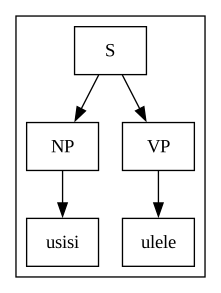 [click image to enlarge]
Figure 2 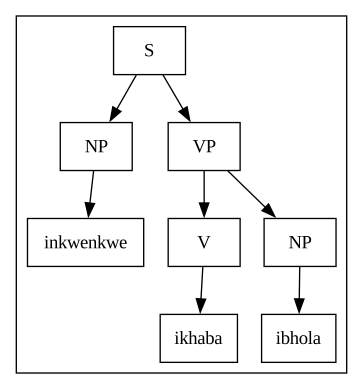 [click image to enlarge]
 - In some instances, when the main verb has to form different potential and temporal forms, another form of a verb known as auxiliary verb is used together with the main verb. In such a case, the auxiliary verb precedes the main verb and the verb becomes a compound verb (Van Rooyen et al., 1982).Example 1
Usisi / uza kulala NP VP My sister is going to sleep. Example 2Utitshala / uyakufundisa NP VP The teacher is going to teach. The following tree diagram represents the constituent structure of the example above.
Figure 3 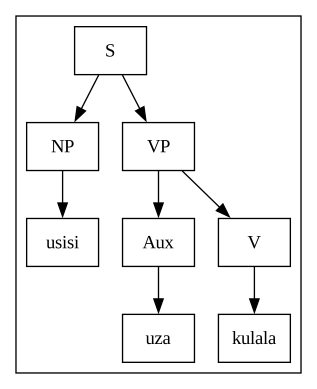 [click image to enlarge]
Figure 4 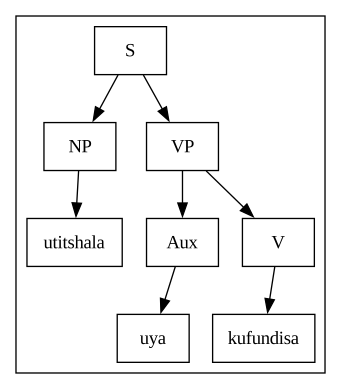 [click image to enlarge]
Grammatical functions
The most important function of the subjunctive mood is to connect predicates that are in sequence describing acts that follow each other. This can also happen after conjunctives and even auxiliaries. The first verb in the first clause is usually in the indicative mood, and those that follow are in the subjunctive mood (cf. Van Rooyen et al., 1982; Pahl 1983: 138).
- Walala, wavuka, watya. ‘He/she slept, woke up, ate.’
Clause structure (independent clause)
According to Pahl (1985: 166), the predicate has two offshoots, the verb and the copulative verb. This is in keeping with the view held by Wikipedia (05/13/2021) that, “A copular verb is often considered to be part of the predicate, the remainder being called a predicative expression…”
This explains the reason why an isiXhosa sentence without a verb becomes syntactically correct in the presence of a copulative verb.
- UNomsa upheka ukutya okumnandi. ‘Nomsa is cooking delicious food.’ (Verb Phrase)
- Kumnandi ukutya kukaNomsa. ‘Nomsa’s food is delicious.’ (Copulative verb)
The difference between the VP and the CopV is that:
- The verb has known verb stems, e.g., pheka ‘cook’.
- The copulative is derived from other parts of speech by means of copulative formatives/copulative particles:
- Kumnandi > ku = copulative formative/particle and mnandi = Relative.
The following tree diagram represents the constituent structure of the examples above.
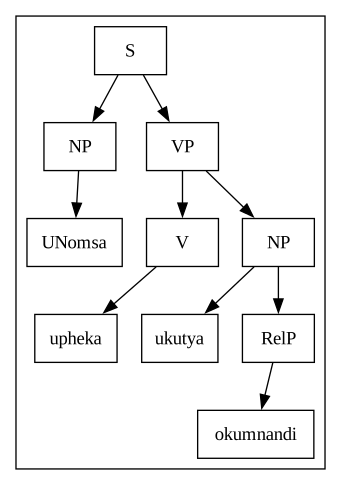
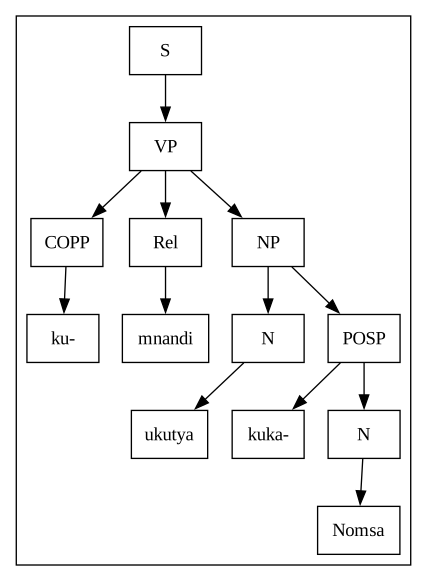
In the case of isiXhosa, three different copulative relations have been identified, and the relations are between the subject and the complement of the copulative. The three relations are: a relation of identification, description and association (Du Plessis & Visser, 1992: 223). These will be dealt with individually below.
- The identification relation
In this relation the subject and the complement are identified with each other and the relation is
“…morphologically recognized through the presence of a copula on the noun in isiXhosa”
(Du Plessis & Visser, 1992: 223). The following sentences are a true reflection to this.- ULizo ngumlobi. ‘Lizo is a fisherman.’
- Ithole liduna. ‘The calf is a male.’
Identificative relation regarding copulatives are identified by the equative status of the subject and the complement in terms of being interchangeable within the sentence without changing the meaning of the sentence (Du Plessis & Visser, 1992).
- ULizo ngumlobi. ‘Lizo is a fisherman.’
- NguLizo umlobi. ‘It’s Lizo who’s a fisherman.’
However, the second sentence does not have the equative status although it belongs to the identificative relation. For example, Ithole liduna cannot be lithole iduna because the latter is both semantically and syntactically incorrect. This implies that not all copulatives in this relation are equative. It may belong to the identification but also have qualities of the descriptive relation.
- The descriptive relation
In this relation the subject is described by the complement (Du Plessis & Visser, 1992), e.g., umthwalo ulula ‘the load is light’. This is in keeping with the contention of Van Rooyen et al. (1982) that the complement in many examples is a relative as is the case with ulula which is a relative. The complement ulula in the above example describes the subject umthwalo. A morphological difference between the descriptive and the identificative relation is the absence of the copula which is overtaken by an agreement morpheme (which acts as a copula), for example, the morpheme u- in ulula is an agreement morpheme and not a copula. Below is another example of the descriptive relation.
- Amazinyo amakhwenkwe made. ‘The teeth of the boys are long.’
- Ilifa laba bantwana yimali. ‘The inheritance of these children is money.’
In the second example, the subject and complement are truly equative and are thus interchangeable, e.g., the sentence may run as:
- Imali lilifa laba bantwana. ‘Money is the inheritance of these children.’
The implication is that even with descriptives,
“… not all copulatives are descriptive”
(Du Plessis & Visser, 1992) as is the case with the identificatives. - The associative relation
In this relation the association is between the subject and the complement, with the preposition –na- inserted between the agreement morpheme (that has taken the place of a copula) of the complement and the noun (that forms part of the complement) (Du Plessis & Visser, 1992). This implies that, like the descriptive relation, the associative relation does not use a copula but an agreement morpheme. The following examples reflect the above statement.
- Le nkomo inethole. > na + ithole < nethole
‘This cow has a calf.’
- Lo mthi unamagqabi. > na- + amagqabi < namagqabi
‘This tree has leaves.’
- Le nkomo inethole. > na + ithole < nethole
When we look at it closely, it is clear that this relation has qualities of the above descriptive relation except for the use of the preposition -na-. The use of the preposition –na- gives it all the features of a possessive. The examples above are a true reflection of this statement. This implies therefore that in all the three relations there is an element of overlapping in terms of their characteristics.
Conclusion
The topic has dealt with grammatical features of moods in isiXhosa in relation to the simple sentence, with the copulative verb being part of the discussion. It has highlighted the number of moods that isiXhosa language possesses; only focusing on two of these which are the imperative and the indicative moods. It has also examined the clause structure in isiXhosa with particular reference to the independent clause. The copulative verb has been the main focus in this regard, delineating the various copulative verb relations like the identificative, descriptive and associative verb relations.
References
Bunnick, R. I. (2012) The Oxford Handbook of Tense and Aspect. New York: Oxford University Press.
Crystal, D. (1980) A First Dictionary of Linguistics and Phonetics. London: Cambridge University Press.
Du Plessis, J. A. & Visser, M. (1992) Xhosa Syntax. Pretoria: Via Africa.
Pahl, H. W. (1983) IsiXhosa. Johannesburg: Educum Publishers.
Pahl, H. W. (1985) isiXhosa. 4th edn. Johannesburg: Educum Publishers.
Satyo, S. C. (1997) Igrama Noncwadi LwesiXhosa. Pretoria: Via Afrika.
Van Rooyen, C. S., Louw, J. A., Cantrell, J. V., Taljaard, P. C., Satyo, S. C., Ntuli, D. B. & Davey, A. S. (1982) Xhosa only guide for XHS201-3. Pretoria: University of South Africa.