The human speech communication process
This section provides an overview of three aspects related to the human communication process which will be followed by an inventory of research and academic publications in the field of Sotho phonetics and phonology. The Sotho languages comprise Sesotho, Sesotho sa Leboa and Setswana.
The human speech communication process
The nature of the human communication process through spoken language may best be illustrated in the following figure:
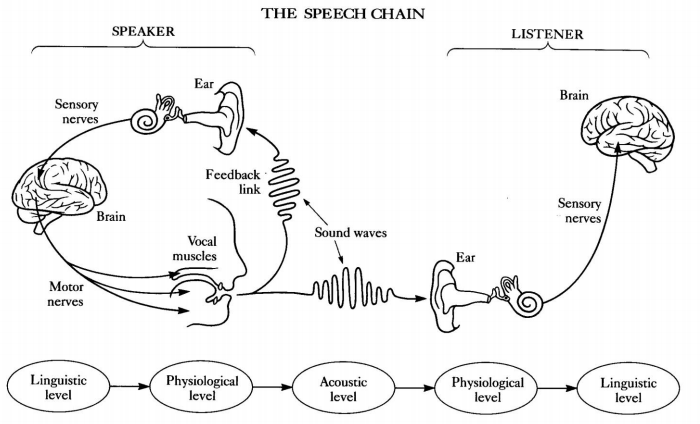
The Speech Chain cf. Denes & Pinson (1993: 5)
The initial and final (linguistic) levels above mainly relate to mental activities, whilst the physiological and acoustic levels represent physical aspects of the communication process. These two aspects can be examined as underlying (phonemic) elements being transformed to surface (phonetic) representations. The study of these events take place in the respective domains of Phonology and Phonetics.
Setswana Phonology
Phonology is “(A) branch of linguistics which studies the sound systems of languages. Out of a very wide range of sounds vocal apparatus can produce, and which is studied by Phonetics, only a relatively small number are used distinctively in any one language.”
Crystal (2008: 365). These sounds with distinctive values are labelled as phonemes which are represented between forward slash symbols, e.g., /a/, /p/, /b/ etc.
Sotho phonology research: a brief overview
Setswana is a member of the Sotho group of languages that share different phonetic and phonological features; the other languages are Sesotho sa Leboa (Sepedi) and Sesotho. Various theories have been developed to describe and explain the functioning of these phonemes. The discussions on phonological processes that will follow will however be theory neutral, e.g., not going into detail of any specific theory applied by researchers at different points in time.
Notable contributions to the phonology of the Sotho languages have been made by Malepe (1966); Khoali (1985); Janson (1985); Kotzé (1987); Krüger (1987); Herbert (1990); Khabanyane (1991); Mmusi (1993); Dichabe (1997); Mosaka (2000); Coetzee (2001); Zsiga et al. (2006); Coetzee et al. (2007); Kotzé & Zerbian (2008); Coetzee & Pretorius (2010); Gouskova et al. (2011); Wissing (2012); Lubinda (2012); Nkolola-Wakumelo et al. (2012); Boyer & Zsiga (2013) and Bennett (2019).
Setswana tonology
Setswana is a tone language which is a language in which pitch differences function to differentiate words while tonology is “(T)he study of the forms and uses of tone in language”
, i.e., Crystal (2008: 486). Three different tones are distinguished in Setswana, e.g., a high tone, a low tone and a high falling tone. However, no tone markings are displayed in the orthography of the language. In some specific cases however, tone may be indicated in the event of ambiguity and may respectively be indicated with the following symbols: high with the acute sign / ´ /, low with the grave sign / ՝ /, and high-falling with the circumflex sign / ^ /. Some dictionaries may include tonal markings.
Descriptions of the tonal features of these languages are mainly based on impressionistic observations of researchers. The use of tones comes quite naturally from the speakers of the language. Non mother tongue speakers however may not always be so sure about what they perceive and thus, many tonal descriptions are inconsistent. This is manifested in dictionaries that do provide tonal markings as well as in descriptions of researchers. Roux (2003) provides some examples of inconsistencies in the perception and description of tone in the Sotho and Nguni languages. Nevertheless, several descriptions have been produced describing tonal patterns in the Sotho languages as indicated below:
Sotho tonology research: a brief overview
Research in this field include descriptive, theoretical, and experimental contributions with overlaps in some areas as provided by Dickens (1986); Kisseberth & Mmusi (1990); Creissels et al. (1997); Creissels (1998, 1999, 2000); Batibo & Mae (1999); Kisseberth (1998); Zerbian (2011); Wissing (2012) and Zerbian & Barnard (2008).
Setswana phonetics
Phonetics is “(T)he science which studies the characteristics of human sound-making, especially those sounds used in speech, and provides methods for their description, classification and transcription.”
Crystal (2008: 363). Speech sounds or phones are indicated in brackets, e.g., [a], [p], [k] etc.
As indicated in Figure 1 the speech chain in essence, comprises the following three phases: articulation phase (linguistic and physiological), transmission phase (acoustic) and perceptual phase (physiological and linguistic).
Articulation phase
This process where a sound or a series of sounds are formed, may be referred to as the articulation process. Articulatory Phonetics is the study of these events which take place in two different modes:
- Impressionistic mode: in this mode, linguists / phoneticians make use of their knowledge of the nature and specific functions of the vocal organs of speech production. They identify, through introspection, the different manners on how sounds are formed. For instance, closure of both lips may produce stop sounds such as [b], [p], [m] which are labelled bi-labial sounds; pressing the tip of the tongue against the back of the alveolar ridge will produce alveolar sounds such as [t], [d], [n]; lowering the tongue in the oral cavity, opening the mouth and pushing air from the lungs with a vibration of the vocal folds will produce a low vowel such as [a].
Many descriptions of the sounds of a language such Setswana are impressionistically based. These descriptions are often found as introductory chapters in a variety of grammar books on the specific language. These descriptions have often been regarded as appropriate for students learning a language, or for researchers interested in phonological processes taking place in a particular language. Examples of these types of descriptions for Setswana may be found in grammar books such as Cole (1955) and monographs such as Doke (1954), and in dictionaries such as Matumo (1993) and articles such as Lombard (1982). In some of these cases diagrammatic sketches of the organs of speech corresponding to the alleged articulation of sounds are presented as visual demonstrations, as in for instance in Krüger (1987: 43-48).
- Instrumental mode: studying the nature and functions of the organs of speech, researchers in for instance, the fields of anatomy, physiology, speech pathology etc. need to have a more objective manner of describing the production of speech than relying on subjective impressionistic judgements. Therefore, different types of techniques and instruments are used to investigate the nature of speech production and perception. Results of these types of research have found their way into the domain of phonetics and phonology presenting verifiable information regarding the speech communication process and providing explanations for phonological processes. This approach is referred to as Experimental or Instrumental Phonetics which is conducted in all three phases of the communication process, i.e., for articulation, transmission (acoustics), and perception as listed below.
Experimental studies in articulatory phonetics of Setswana, Sebirwa, Shekgalagari and Sesotho include:
- X-ray techniques applied in the description of the vowels of Sesotho by Westphal (1971).
- Cinefluorographic and X-ray techniques applied to the description of vowels segments of Sesotho by Roux (1979).
- Electro-aerometer tools measuring relative flow of air from the nose and mouth in the articulation of, for instance, labialised ejectives and aspirated consonants in Sesotho by Roux (1979).
- Ultrasonic techniques in the study of consonant systems of Setswana and Sebirwa by Zsiga (2005).
- An electro-laryngograph study of plosives in Shekgalagari by Monaka (2005).
- Ultrasonic techniques in the production of labiocoronal fricatives in Setswana by Havenhill et al. (2017).
- Laryngographic and acoustic study on post-nasal devoicing in Shekgalagari by Solé et al. (2010).
Transmission phase
The articulation of a sound or sequence of sounds create sound waves that are transmitted through the air. This transmission phase is the domain of acoustic phonetics. The spectrograph is an instrument used in acoustic studies producing spectrograms which are visual representations of the spectra of frequencies of speech signals. Applicable computer software for analyzing, synthesizing, and manipulating speech are commonly used as tools for research in this domain. A program entitled PRAAT with excellent functions is widely used for research in this field (Boersma & Weenink, 2001).
Notable studies related to the acoustics of Sotho languages include the works of Khabanyane (1991); Dufberg (1986-1987); Roux (1979, 1980, 1984, 2003); Selebeleng (1997); Wissing & Roux (1995); Barnard & Wissing (2008); Wissing (2005, 2010a, 2010); Wissing et al. (1998); Zsiga (2005); Le Roux & Le Roux (2008); Le Roux (2012); Boyer & Zsiga (2013); Havenhill et al. (2017); Solé et al. (2010); Gouskova et al. (2011); and Duran et al. (2017).
Perceptual phase
Speech perception refers to the process by which human speech sounds are heard, interpreted and understood.
- Perceptual studies related to the Sotho languages: Roux (1984, 2003); Zsiga (2005) and Wissing & Roux (2017).
Digital Resources
Annotated digital speech data for Setswana and other Sotho languages are freely available for research and educational purposes at the South African Centre for Digital Language Resources (SADiLaR).
Setswana
- NCHLT Setswana Speech Corpus
Orthographically transcribed broadband speech corpus of approximately 56 hours, including a test suite of 8 speakers.
- NCHLT Setswana Auxiliary Speech Corpus
The corpus contains orthographically transcribed broadband speech in each of South Africa's eleven official languages. Transcriptions are provided in XML format.
Sesotho
- NCHLT Sesotho Corpus
Orthographically transcribed broadband speech corpus of approximately 56 hours, including a test suite of 8 speakers.
- NCHLT Sesotho Auxiliary Speech Corpus
The corpus contains orthographically transcribed broadband speech.
- Sesotho vowel speech data set
The primary aim of this speech dataset was to collect a representative set of words in which all the Sesotho vowels are present.
- African Speech Technology Sesotho Speech Corpus
African Speech Technology speech and transcription data for the Sesotho database. The “speech” directory contains Sesotho speech as spoken by Sesotho mother tongue speakers.
- Lwazi II Sesotho TTS Corpus
Orthographic and phonemically aligned transcriptions.
- Lwazi Sesotho ASR Corpus
Complete audio recordings and orthographic transcriptions used for Lwazi speech recognition systems.
- Sesotho tone data set
These recordings are of male and female speakers of the QwaQwa region (Eastern Free State).
Sesotho sa Leboa / Sepedi
- NCHLT Sepedi Speech Corpus
Orthographically transcribed broadband speech corpus of approximately 56 hours, including a test suite of 8 speakers.
- NCHLT Sepedi Auxiliary Speech Corpus
The corpus contains orthographically transcribed broadband speech in each of South Africa's eleven official languages.
- Lwazi Sepedi TTS Corpus
Orthographic and phonemically aligned transcriptions
- Lwazi Sepedi ASR Corpus
Complete audio recordings and orthographic transcriptions used for Lwazi speech recognition systems.
References
Barnard, E. & Wissing, D. P. (2008) ‘Vowel variation in Southern Sotho: an acoustic investigation’. Southern African Linguistics and Applied Language Studies. 26(2): 255–265.
Batibo, H. M. & Mae, D. (1999) ‘The tone pattern of Setswana nominal forms’. Malilime: Malawian journal of linguistics. 1, 1-21.
Bennett, W. G. (2019) ‘“Backwards” sibilant palatalization in a variety of Setswana’. In Clem, E., Jenks, P. & Sande, H. (eds.) Theory and description in African Linguistics: Selected papers from the 47th Annual Conference on African Linguistics. Berlin: Language Science Press. pp. 41– 61.
Boersma, P. & Weenink, D. (2001) ‘PRAAT, a system for doing phonetics by computer’. Glot international. 5, 341-345.
Boyer, T. O. & Zsiga, E. (2013) ‘Phonological devoicing and phonetic voicing in Setswana’. In Orie, Q. Q & Sanders, K. W. (eds.). Selected Proceedings of the 43rd Annual Conference on African Linguistics (ACAL).Cascadilla Proceedings Project. Somerville, Massachusetts. pp. 82-89.
Carr, P. (2008) Glossary of phonology. Edinburgh: Edinburgh University Press.
Cassimjee, F. and Kisseberth, C., 1998. Optimal domains theory and Bantu tonology. Theoretical aspects of Bantu tone. pp.265-314.
Chebanne, A. M., Creissels, D. & Nkhwa, H. W. (1997) Tonal morphology of the Setswana verb. München: Lincom.
Coetzee, A. W. & Pretorius. R. (2010) ‘Phonetically grounded phonology and sound change: The case of Tswana labial plosives’. Journal of Phonetics. 38, 404–421.
Coetzee, A. W. (2001) ‘Nasal-only syllables in Tswana’. In Horwood, G. & Se-Kyung, K. (eds.). RuLing Papers II. New Brunswick: Rutgers University. pp. 1–20.
Coetzee, A. W., Lin, S, & Pretorius, R. (2007) ‘Post-nasal devoicing in Tswana’. In Trouvain, J. & Barry, J. W. (eds.). Proceedings of the International Congress of Phonetic Sciences 16 (ICPhS-XVI). pp. 861–864.
Cole, D. T. (1955) An introduction to Tswana grammar. London: Longmans.
Creissels, D. (1998) ‘Expansion and retraction of H domains in Setswana’. In L. M. Hyman & Kisseberth C. W. (eds.). Theoretical aspects of Bantu tone, Stanford: Centre for the study of Language and Information (CSLI), Stanford University. pp. 109-152
Creissels, D. (1999) ‘The role of tone in the conjugation of Setswana’. In Blanchon J. A. & Creissels, D. (eds.). Issues in Bantu tonology. Koln: Rudiger Koppe Verlag.
Creissels, D. (2000) ‘A domain-based approach to Setswana tones’. In Wolff, E. & Gensler, O. D. (eds.). Proceedings of the 2nd world congress of African linguistics, Leipzig 1997, Cologne: Rudiger Koppe Verlag. pp. 311-321.
Crystal, D. (2008) A Dictionary of Linguistics and Phonetics. Oxford: Blackwell Publishers.
Denes, P. B. & Pinson, E. N. (1993) The speech chain. 2nd edn. New York: W. H. Freeman.
Dichabe, S. B. (1997) Advanced tongue root harmony in Setswana. Master’s Dissertation. University of Ottowa, Canada.
Dickens, P. (1986) ‘Tone in Qhalaxarzi main verb constructions’. South African Journal of African Languages. 6(2): 67-70.
Doke, C. M. (1954) The Southern Bantu Languages. Oxford: Oxford University Press.
Dufberg, M. (1986-1987) ‘Why two labialization strategies in Setswana?’ In PERILUS V. Institute of Linguistics. Stockholm: Stockholm University. pp 78-92.
Duran, D., Bruni, J., Dogil, G. & Roux, J. C. (2017) ‘The social life of Setswana ejectives’. in Proceedings of Interspeech. pp. 3787–3791.
Gouskova, M., Zsiga, E., & Boyer, O. T. (2011) ‘Grounded constraints and the consonants of Setswana’. Lingua. 121(15): 2120-2152.
Havenhill, J., Zsiga, E., Thale-Boyer, O. & Petersen, S., (2017) The labio-coronal fricative of Setswana: Its features and articulation. In 2017 Annual Meeting on Phonology. Georgetown University, Washington
Herbert, R. K. (1990) ‘Labial palatalization in Nguni and Sotho languages: internal and external languages’. South African Journal of African Languages. 10(2): 74-80.
Janson, T. (1985) Labialization in Setswana: phonetics and phonology. In Rennison, J. R. (ed.). Phonologica Africana 1984: Workshop on African Languages, Eisenstadt, 25-28 June 1984, Institut für Sprachwissenschaft, Universität Wien, Wien. pp. 73-84.
Khabanyane, K. E. (1991) ‘The five phonemic vowel heights of Southern Sotho: An acoustic and phonological analysis.’ Working Papers of the Cornell Phonetics Laboratory. 5, 1-36.
Khoali, T. B. (1985) ‘Speech variations in Xhosa demonstratives and Tswana passive verb stems: A generative phonological explanation’. South African journal of African Languages. 5(1): 12-16.
Kisseberth, C. W. & Mmusi, S. O. (1990) ‘The tonology of the object prefix in Setswana’. Studies in the linguistic sciences. 20,151-161.
Kisseberth, C. W. (1998) ‘Expansion and retraction of high tone domains in Setswana’. In Hyman, L. M. & Kisseberth, C. W. (eds.). Theoretical aspects of Bantu tone. Stanford: Center for the Study of Language and Information. pp. 133–194.
Kotzé, A. E. & Zerbian, S. (2008) ‘On the trigger of palatalization in the Sotho languages’. Journal of African Languages and Linguistics. 29(1): 1–28.
Kotzé, A. E. (1987) ‘Dealing with nasals within the phonological system of Northern Sotho: Another alternative’. South African Journal of African Languages. 7(4): 118-120.
Krüger, C. J. H. (1987) Elementary phonetics of Setswana. Cape Town: Via Afrika.
Le Roux, M. & Le Roux, J. (2008) ‘Acoustic assessment of Setswana vowels’. South African Journal of African Languages. 28, 2.
Le Roux, M. (2012) ‘An acoustic comparison of Setswana vowels versus the cardinal vowels’. South African Journal of African Languages. 32, 2.
Lombard, D. P. (1982) ‘On the places of articulation and obstruction in articulatory phonetics with reference to some Northern Sotho consonants’. South African Journal of African Languages. 2(2): 76-93.
Lubinda, J. (2012) On the phonetic and the phonological studies of Southern African languages. In Ndinga-Koumba-Binza, H. S. & Bosch, S. (eds.). Language Science and Language Technology in Africa. Stellenbosch: SUN Press. pp.33-46.
Malepe, A. T. (1966) A dialect-geographical survey of the phonology of the central, eastern, and southern dialects of Tswana. Maters Dissertation. University of South Africa, Pretoria.
Matumo, Z. I. (1993) Setswana English Setswana dictionary. Gaborone: MacMillan.
Mmusi, S. O. (1993) Obligatory contour principle effects and violations: the case of Setswana verbal tone. Doctoral Thesis. University of Illinois, Illinois.
Monaka, K. C. (2005) ‘Shekgalagari laryngeal contrasts: the plosives’. South African Journal of African Languages. 25(4): 243-257.
Mosaka, N. M. (2000) ‘Stress assignment in syllabic structures in Xhosa and Tswana’. South African Journal of African Languages. 2, 177-185.
Nkolola-Wakumelo, M., Rantso, L., & Matlhaku, K. (2012) Syllabifications of consonants in Sesotho and Setswana. In Ndinga-Koumba-Binza, H. S. & Bosch, S. (eds.). Language Science and Language Technology in Africa. Stellenbosch: SUN Press. pp.61-82.
Roux, J. C. (1979) Labialization in Sesotho: The role of phonetic data in phonological analyses. Doctoral Thesis. Stellenbosch University, Stellenbosch.
Roux, J. C. (1980) ‘The vowel system of Southern Sotho revisited’. Wentzel, P. J. (ed.). Miscellanea Congregalia. Vol 12. Pretoria: University of South Africa. pp.274-288.
Roux, J. C. (1984) ‘ ’n Akoestiese en perseptuele analise van vokale van Sesotho’ (An acoustic and perceptual analysis of the vowels of Sesotho). Stellenbosch Studies in African Languages. 2, 53 – 130.
Roux, J.C. (2003) ‘On the perception and description of tone in the Sotho and Nguni languages’. In Kaji, S. (ed.). Proceedings of the symposium: crosslinguistic studies of tonal phenomena: historical developments, phonetics of tone. pp. 155-176.
Selebeleng, K. Z. (1997) Phonetic and phonological aspects of vowel raising in Sesotho. Masters Dissertation. Stellenbosch University, Stellenbosch.
Solé, M-J., Hyman, L. & Monaka, K. C. (2010) ‘More on post-nasal devoicing: The case of Shekgalagari’. Journal of Phonetics. 38, 604–615.
Westphal, E. O. J. (1971) ‘Vowel systems and X-ray photography’. Communications from the School of African Studies Cape Town: University of Cape Town.
Wissing, D. (2012) On the many faces of tone in Sesotho and Setswana: a case study. In Ndinga-Koumba-Binza, H. S. & Bosch, S. (eds.). Language Science and Language Technology in Africa. Stellenbosch: SUN Press. pp.61-82.
Wissing, D. P. & Roux, J. C. (1995) ‘On the interrelationship between VOT and voice assimilation’. Proceedings of the 13th International Congress of Phonetic Sciences, ICPhS 95, Stockholm, Sweden. 1, 502-504.
Wissing, D. P. & Roux, J. C. (1995) ‘Voice assimilation in Tswana-Afrikaans: A phonetic solution for a phonological problem’. In Kotzé, E. F. (ed.). SA Linguistics. Port Elizabeth: University Press. pp. 262-268.
Wissing, D. P. & Roux, J. C. (2017) ‘The status of tone in Sesotho: A production and perception study’. Nordic Journal of African Studies. 26(4): 383-401.
Wissing, D. P. (2005) ‘Aspiration of English voiceless stop consonants in Southern Sotho: a case study’. South African Journal of African Languages. 25(3): 189-205.
Wissing, D. P. (2010a) ‘Aspects of the phonetics and phonology of Southern Sotho /a/’. South African Journal of African Languages. 30(2): 234-241.
Wissing, D. P. (2010b) ‘Aspects of vowel raising in Southern Sotho and Setswana: an acoustic approach’. South African Journal of African Languages. 30(2): 242-249.
Wissing, D. P. (2012) ‘On the many faces of tone in Southern Sotho: A case study’. In Ndinga-Koumba-Binza, H. E. & Bosch, S.E. (eds.). Language Science and Language Technology in Africa, pp.47-60.
Wissing, D. P., Pretorius, R. & Roux, J. C. (1998) ‘Front vowel variation in Tswana’. South African Journal of Linguistics. 36, 93-103.
Zerbian, S. &. Barnard, E. (2008) ‘Phonetics of intonation in South African Bantu Languages’. Southern African Linguistics and Applied Language Studies. 26(2): 235-254.
Zerbian, S. (2011) ‘A guide to tones in Tswana locatives’. South African Journal of African Languages. 31(2): 254-264.
Zsiga, E. (2005) A phonetic study of the consonants of Setswana and Sebirwa. Washington: Georgetown University.
Zsiga, E., Gouskova, M. & Thlale, O. (2006) ‘On the status of voiced stops in Tswana: against *ND*’. Graduate Linguistics Student Association (GLSA). University of Massachusetts, Amherst. https://rucore.libraries.rutgers.edu/rutgers-lib/54532/