The morphology of the verb
A morphological description of the Setswana verb without regard to the phonology, and syntax involved in its agglutinate nature is not possible. The orthographic representation of Setswana words and sentences does not render a precise representation of phonemic vowels, marked tones or indicate the boundaries of verbs, as prefixal morphemes of verbs are written disjunctively. Refer to the phonology section for a more detailed discussion of these two aspects. This topic attempts an overview of the structure and morphological components of only the main verb. Much wider reading is necessary to grasp the details of Setswana verbal morphology.
Subcategories of the verb
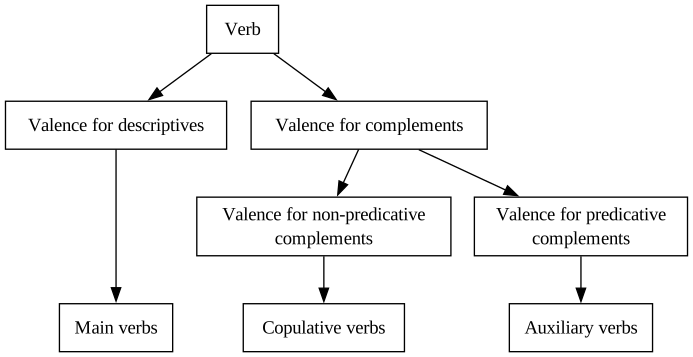
Setswana verbs are classified into three groups based on the complements that they take i.e., their valence for complements:
Language typology and the main verb
Setswana belongs to the group of Bantu languages and has an extensive noun class system on which a system of grammatical agreement is based. Main verbs have the most complex morphology of all the words in the language. The rich verbal morphology allows for the stringing together of several morphemes to indicate different inflectional categories. This has led to the classification of the Sotho-Tswana languages as agglutinative languages. Kosch (2006: 134) explains that: “In the context of language, agglutination refers to a process whereby various affixes are “glued” on, or simply “stuck” onto other morphemes in sequence”
. Kosch (2006: 138) goes on to summarise the agglutinating features of Bantu languages as:
- Words are typically polymorphemic (morphologically complex).
- Morphemes ideally undergo no changes and hence the boundaries between their morphs are clear.
- Individual grammatical categories or a semantic content may be fairly easily assigned to morphs, which follow one another serially.
The boundaries of main verbs
The disjunctive orthography followed in the Sotho languages mainly affects verbs where several orthographically separate units may represent a single verb (Krüger 2006: 12-28; Kosch, 2006: 3).
To give a proper morphological analysis of Setswana main verbs they have to be delimited properly, which implies that, the representation of all units (morphemes) that belong to the word must be recognised as part of it even if they are written disjunctively within the orthography. The left boundary of the main verb is thus the beginning of the first prefix. That will ensure that all prefixes are included as part of the main verb even if they are written disjunctively.
Several computational tools have been developed to investigate Setswana (verbs) including tools that rely on statistical methods and tools based on rule-based methods; a lemmatiser (cf. Brits et al., 2005), morphological analyser (cf. Pretorius et al., 2005), and tokeniser (cf. Pretorius et al., 2009 & Pretorius et al., 2014). A part of speech (POS) tagset to be used in a POS tagger was proposed by Van Rooy & Pretorius (2003).
The orthography followed in other Bantu languages such as the Nguni languages presents verbal prefixes in a conjunctive manner. If the orthographical difference in Setswana’s traditional orthography is disregarded, Sotho-Tswana languages are morphologically not different to other Southern African Bantu languages. The morphemes below are all part of one main verb.
| Ga re ba bone |
| Ga -re -ba -bon -e |
| NegPre- AgrSubjP1pl -AgrObj2-see -VEnd |
| We do not see them. |
Morphemes of Setswana main verbs
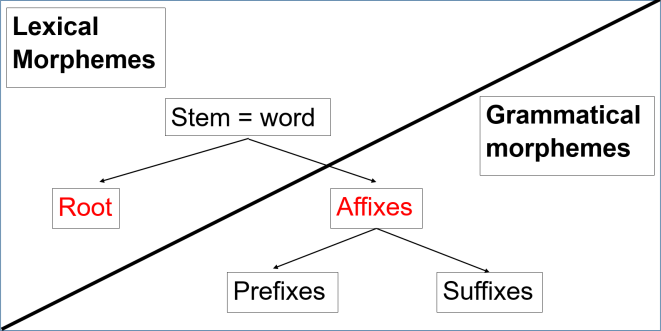
A semantic classification of morphemes that may appear in Setswana words renders the categories of lexical and grammatical morphemes (Krüger, 2006: 35). Roots and stems are lexical morphemes while affixes, which include prefixes and suffixes are grammatical morphemes. Grammatical morphemes indicate a grammatical category such as number, tense, aspect, voice, polarity, etc.
The structure of the main verb
The structure of Setswana main verbs is governed by a set of linguistic (grammatical) rules which can be referred to as morphotactics. Within these rules, prefixes and suffixes are sequenced and combined to form valid forms of the main verb. These grammatical components are simultaneously regulated by phonological and orthographical alternation, which is also referred to as morphophonological alternation rules that model the sound changes that occur at morpheme boundaries (Pretorius et al., 2010: 133-134).
In terms of morphotactics the prefixes and suffixes have a fixed order in the main verb structure (Krüger, 2006; Pretorius, 2014). These structural elements adapt or extend the meaning of a word and may influence tense, aspect, mood and polarity (TAMP) features of the main verb (Krüger, 2006: 268).
The structure of the main verb attempted here is based on two views; the template proposed for Proto-Bantu by Meeussen (1967: 108-111) and an account of Setswana verbal morphemes by Krüger (2006: 257) indicating their linear order as well as their hierarchy in verb formation.
The Proto-Bantu template
There is a similarity in the structure of main verbs in the Bantu languages. Nurse (2007: 240) states that: “Nearly all Niger-Congo branches and languages share the nucleus root - extension - final vowel, which corresponds generally to Meeussen’s radical - suffix – pre-final - final. We can assume this structure goes back to Proto-Niger-Congo and was part of the Proto-Bantu verb structure”
.
Creissels (2019: 6) states that: “A Bantu verb form typically consists of a root (an irreducible lexical element) together with an obligatory suffix (the final vowel, or simply final) and a variable number of other affixes whose presence depends on a variety of factors, each affix having its position in the string. The root may be immediately followed by derivational suffixes that modify its meaning without altering its valency. The part of the main verb form constituted by the root and such derivational suffixes can be referred to as the extended root”
.
Creissels (2019: 6) goes on to interpret and adapt Meeussen’s template to fit the structure of the Setswana main verb: The structure of Tswana S31 verb forms can be accounted for by a template very similar to that reconstructed by Meeussen (1967: 108-111). Taking the extended root as the zero point, the verbal template of Tswana can be described as a sequence of positions numbered from -4 (the leftmost possible position) to +5 (the rightmost possible position):
- Position -4: pre-initial - can be occupied by a negation marker.
- Position -3: initial - remains empty in the imperative. In the infinitive, which shows a mixture of nominal and verbal properties, it is filled by the class 15 prefix. In all the other cases, it is obligatorily filled by a subject index.
- Position -2: formative - can be filled by affixes expressing (or contributing to the expression of) various TAM-polarity values.
- Position -1: infix - can be occupied by object indexes and by the reflexive marker. Up to three successive affixes can be found in this position. Note that the reflexive is also treated as an object agreement morpheme.
- Position +1 can be filled by one or more affixes encoding valency operations: causative, applicative, anti-causative, reciprocal.
- Position 0 is filled by the extended root.
- Position +2 can only be occupied by the perfect positive marker.
- Position +3 can only be filled by the passive marker.
- Position +4: final - is the only one that cannot be left empty under any circumstances. The ‘final (vowel)’ filling this position contributes to the identification of the individual tenses but does not carry any syntactic or semantic information of its own, since with the exception of <e ~ ɩ> (found in the perfect positive only), each final is shared by a set of forms impossible to define straightforwardly as sharing a particular set of syntactic or semantic features.
- Position +5: post-final - can be filled by the imperative plural marker, the relative marker, or the clitic form of the interrogative pronoun ‘what’.The abbreviated form -ng from eng? ‘what’ when attached to the main verb is an idiomatic contraction and not a verbal suffix.
Based on this description the following table can be conceptualised for Setswana main verb morphemes.
| Slot | -4 Pre-initial | -3 Initial | -2 Post-initial | -1 Pre-radical | 0 Radical | +1 Pre-final | +2 | +3 | +4 Final | +5 Post-final |
| Function |
|
|
|
|
|
|
|
|
| Imp Pl, Rel. |
| Morphemes |
|
|
|
|
|
|
|
|
|
The following examples clarify the position of morphemes (also referred to as formatives) in Setswana main verbs:
| Example | -4 | -3 | -2 | -1 | 0 | +1 | +2 | +3 | +4 | +5 |
|---|---|---|---|---|---|---|---|---|---|---|
| Rema dikgong! ‘Chop (the) wood!’ | rem | -a | ||||||||
| Remisa Kabelo dikgong! ‘Let Kabelo chop the wood! / Help Kabelo chop the wood!’ | rem | -is | -a | |||||||
| Remela Kabelo dikgong! ‘Chop the wood for Kabelo!’ | rem | -el | -a | |||||||
| Ke rema dikgong. ‘I am chopping wood.’ | ke- | rem | -a | |||||||
| Di reme! ‘Chop them!’ | di- | rem | -e | |||||||
| Di mo remele! ‘Chop them for him/her!’ | di-mo- | them | -is-ets | -e | ||||||
| Ga ke reme dikgong tsa gago. ‘I am not chopping your wood.’ | ga- | ke- | rem | -e | ||||||
| Ke a rema. ‘I am chopping.’ | ke- | a- | rem | -a | ||||||
| Ke tla rema. ‘I will chop.’ (Creissels et al., 1997) indicate that based on tone the future tense morpheme tla is rather tlaa.) | ke- | tlaa- | rem | -a | ||||||
| Nka se reme tseo. / Ke ka se reme tseo. ‘I will not (cannot) chop those.’ | (ni)- | ka-se | rem | -e | ||||||
| Ke remile dikgong. ‘I chopped (the) wood.’ | ke- | rem | -il | -e | ||||||
| Ke remisitse Kabelo dikgong. ‘I let (made him) Kabelo chop the wood. / I helped Kabelo to chop the wood.’ | ke- | rem | -is | -its | -e | |||||
| Ke ithemiseditse Kabelo dikgong. ‘I let (made him) Kabelo chop the wood for me.’ | ke- | i(n)- | them | -is-ed | -its | -e | ||||
| Dikgong di remilwe. ‘The wood was (has been) chopped.’ | di | rem | -il | -w | -e | |||||
| Ke remisitswe dikgong. ‘I was made to chop the wood. / I was (have been) helped to chop the wood.’ | ke- | rem | -is | -its | -w | -e | ||||
| Lo remang dikgong tseo! ‘You (pl) must chop that wood!’ | lo- | rem | -e | -ng | ||||||
| Monna yo o remileng dikgong ‘The man that chopped the wood’ | o- | rem | -il | -e | -ng |
The linear and hierarchical order of Setswana verbal morphemes
Two prominent views on the sequence of verbal suffixes are that:
- the order of extensions is determined by the main processes of word formation, namely inflection and derivation; and
- the order of extensions in the Bantu languages is the result of a Pan-Bantu default template.
Thus, some researchers favour compositional reasons while others claim a fixed order.
Krüger (1994: 18) states that “structurally derivational morphemes tend to occur more centrally in the word form than inflectional morphemes”
. According to this postulation, the verbal extensions should then be evaluated as derivational morphemes, whereas the modal endings should be evaluated as inflectional morphemes.
According to Booij (2005: 71), “[g]iven the distinction between derivation and inflexion (derivation creates lexemes, inflexion creates forms of lexemes)”
, the following schema should apply to the order of affixes:
- Inflectional prefixes, Derivational prefixes, Root, Derivational suffixes, Inflectional suffixes
When viewed in linear order the structure of morphemes in the main verb include prefixes, a root and suffixes. When multiple prefixes and/or suffixes are included, they appear in a hierarchical order. Further reading, see Krüger, 2006: 167-282; Pretorius, 2014.
The table below, adapted from Krüger (2006: 257), presents the morphemes of the main verb and indicates their linear and hierarchical sequence. The Linear arrangement is marked (A), the Morphological items (B) and the Hierarchical arrangement from lowest rank (1) to (15) is marked (C).
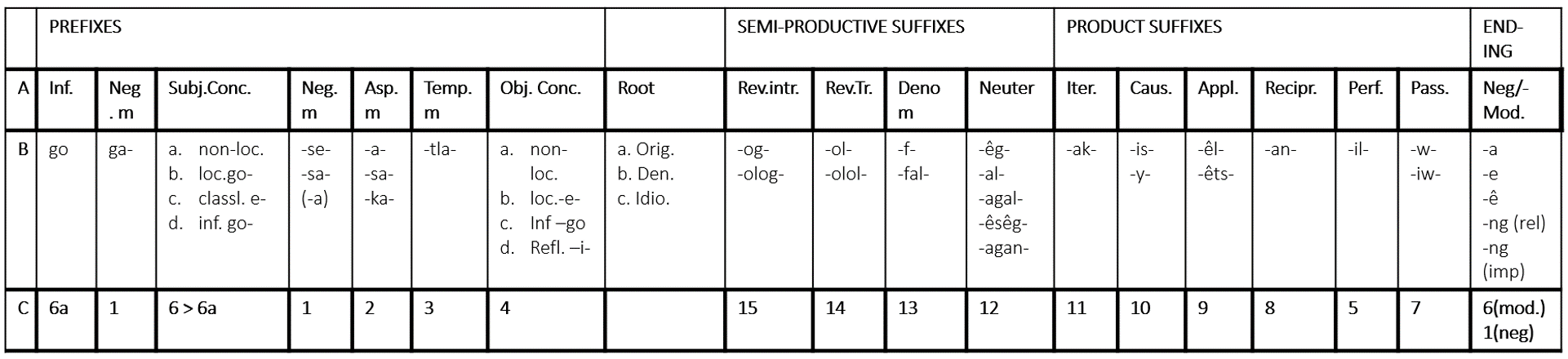
(Abbreviations: Inf. - Infinitive, Neg. – negative, Subj. con. – Subject agreement morpheme, Neg. – negative, Asp. – aspect, Temp. – temporal (refers to the future tense morpheme -tla-), Obj. con. – object agreement morpheme, Rev. Intr. – reversive intransitive, Rev. Tr. – reversive transitive, Den. – denominative, Neut. – neuter, Iter. – iterative, Caus. – causative, Appl. – applicative, Rec. – reciprocal, Perf. – perfect, Pass. – passive, Neg./Mod. – negative / modal)
Row A presents the various types of morphemes of the main verb according to their linear arrangement (prefixes and suffixes). The root is the fixed point.
Row B presents the forms and types of the various morphological categories.
Row C presents the hierarchy of the morphemes, as they occur in morphological structures by means of numbers: 1 indicating the lowest rank and 15 indicating the highest rank.
Morphological structure of the main verb
Essential components
Morphologically main verbs have the following essential (compulsory)morphemes in their infinitive or finite form:
| go bitse |
| go + bits + -a |
| compulsory prefix + root + verbal ending |
| to call |
The compulsory prefix is either an infinitive prefix or a subject agreement morpheme. This structure can be modified and extended by adding, replacing or deleting morphemes, i.e., including morphological processes.
Prefixes
Prefixal morphemes include:
- three negative morphemes ga-, -sa-, and -se- (Krüger, 2006: 182). They are distributed differently but have the same hierarchical ranking:Example 3
ga ba reke dijo ga- ba -rek -e di -j -o NegPre- AgrSubj2 -buy -VEnd NPre10- eat -DevSuf They are not buying food. In the negative of the perfect, ga- has a concomitant morpheme -a-:
Example 4Ba rekile dijo Ga -ba -a- rek -a di -j -o NegPre -AgrSubj2- NegPre -buy-VEnd NPre10 -eat -DevSuf They did not buy food. Example 5Fa ba sa reke dijo fa ba -sa -rek -e di -j -o Conj AgrSubj2 -NegPre -buy -VEnd NPre10-eat-food If they are not buying food Example 6...gore ba-se-rekê dijo gore ba -se -rek-ê di -j -o Conj AgrSubj2 -NegPre -buy-VEnd NPre10 -eat-DevSuf ...so that they should not buy food - Agreement morphemes referring to the subject (Krüger, 2006: 173-178). Subject agreement morphemes take an initial (left most) position in the main verb unless the main verb is negated with the negative morpheme ga.
- Agreement morphemes referring to the object (Krüger, 2006: 176-181).
- Aspectual morphemes (potential, progressive and present tense) (Krüger, 2006: 183-193). Note that Berg (2018: 56) indicates that
“The object agreement morpheme, the reflexive morpheme and the potential morpheme do not contribute to TAMP”
(Tense, Aspect, Mood, Polarity). Berg (2018: 65) gives a brief overview of aspect and aspectual morphemes. - The future tense morpheme (Krüger, 2006: 190).Example 7
Ke tla kwala lekwalo. Ke -tla -kwal-a le -kwal -o AgrSubjP1sg -FutPre- write-VEnd NPre5-write-DevSuf I will write a letter.
Roots
Three types of roots are identified:
- Original rootsExample 8
go opela go -opel -a InfPre -sing -VEnd to sing - Roots of nominal originExample 9
go boifa go -boi -f -a InfPre -fear -DenomSuf -VEnd to be afraid - Roots of ideophonic originExample 10
go fifala go -fi -fal -a InfPre -darkness -DenomSuf -VEnd to darken, to become dark (fii signifies darkness)
Suffixes
Suffixes are divided into three categories, unproductive, semi-productive and productive suffixes. The classification is based on their semantic productivity with stems and their position in relation to the root.
Unproductive suffixes are not indicated in the diagram as they have become fossilised to roots (Krüger, 2006: 198-203).
The semi-productive category consists of a series of suffixes which occur with a limited number of stems. They are mutually exclusive as they cannot occur simultaneously with the same stem (Krüger, 2006: 203-214). The semi-productive suffix -agan- is also found in the NCHLT corpus for Setswana (Pretorius, 2014). This suffix is identified in grammars for Sesotho sa Leboa (Lombard et al., 1985: 128; Louwrens et al., 1994: 31) as the associative suffix. It is considered as a fossilised part of selected verb roots.
Productive suffixes succeed each other in a set order referred to as a hierarchy (refer to Figure 2). Multiple productive suffixes are common with Setswana main verbs (Krüger, 2006: 214-248). Endings occur in verb-final position.
Unproductive suffixes
Unproductive (also referred to as inactive) suffixes can no longer be detached from their stems as the roots are not identifiable anymore. Their classification is based on semantic similarity, a technique that is only partly successful (Krüger, 2006: 200; Cole, 1975: 214). The unproductive suffixes are the contactive, dispersive, positional, statitve, deideophonic and durative suffixes (Krüger, 2006: 209-214).
- Contactive suffix (-ar-)
The contactive suffix -ar- signifies touching, or a kind of contact between the subject and another entity (Further reading Cole, 1975: 214; Krüger, 2006: 202).
Example 11go apar go -apar -a InfPre -wear -VEnd to wear, to put on upper clothes Example 12go tshwara go -tshwar -a InfPre -catch -VEnd to catch, to grasp, to seize, to hold in one's hand Example 13go ngaparêla go -ngapar -êl -a InfPre -cling -ApplSuf -VEnd to cling to, to hold - Dispersive suffixes (-alal- or -al-)
The dispersive suffixes -alal- or -al- signifies that the subject disperses, scatters, stretches out, or covers a surface or distance or position. Inflected main verbs are stative.
Example 14go phatlalala go -phatlalal -a InfPre -disperse -VEnd to disperse, become scattered as a crown Example 15go namalala go -nam-alal -a InfPre -stretch out -VEnd to lie stretched out (cf. go nama maoto ‘to stretch out the legs’)
- Positional (-am-)Example 16
go-atlhama go -atlham -a InfPre -yawn -VEnd to gape, to open the mouth Example 17go-khubama go -khubam -a InfPre -kneel -VEnd to kneel Example 18go-sêkama go -sôkam -a InfPre -bend -VEnd to become crooked, to bend (cf. go sôka ‘to twist’)
- Stative suffix (-al-)
The stative suffix -al- indicates a certain static or inchoative state or situation in which the subject finds itself. Cole (1975: 197) and Louwrens (1994: 139) refer to this suffix as a neuter suffix. Krüger (2006: 202) indicates that the meaning of the suffix does not align with the neuter and refers to it as a stative suffix based on the stative meaning it signifies.
Example 19go gakgamala go -gakgamal -a InfPre -surprised -VEnd to be amazed, to be surprised Example 20go robala go -robal -a InfPre -sleep -VEnd to be asleep, to sleep Example 21go tlala go -tlal -a InfPre -full -VEnd to become full - Deideophonic suffixes
The ideophonic suffixes are employed in the derivation of infinitive verbs from ideophones. The idiophone becomes the stem of the derived infinitive verb. The exact semantic value of the suffix is illusive. Krüger (2006: 204-205) identifies the following suffixes:
- -êl- (sometimes -m- + -êl-)
This suffix signifies some movement or a movement in a certain direction.
Example 22go nyêlêla (nyêlê) go -nyêlê -a InfPre -disappear -VEnd to disappear, to vanish Example 23go dikêla (dike) go -dikêl -a InfPre -disappear -VEnd to disappear over the horison, to go round, to set (as the sun) - -m-
This morpheme signifies the process as a state in which the subject finds itself.
Example 24go-phatsima (phatsi) go -phatsim -a InfPre -shine -VEnd to shine, to glitter Example 25go-phaphama (phapha) go -phapham -a InfPre -flutter -VEnd to flutter, to flap - -g-
This suffix signifies a sudden action accompanied by a positional change to bring forth the meaning of the ideophone.
Example 26go-ngwêga (ngwêê) go -ngwêg -a InfPre -vanish -VEng to slip away, to abscond, to vanish Example 27go ragoga (rago) go -ragog -a Inf-(root) -VEnd to dart off, to leap up and run
- -êl- (sometimes -m- + -êl-)
- The durative suffixes (-y- or -ay-)
Cole (1975: 215) states that the durative suffixes -y- or -ay- signify that the action is prolonged or that its effects are permanent. Krüger (2006: 203) states that he was not able to find a common semantic value between these verbs. He divides the verbs ending in -ay- into two groups; the a-roots and the e-roots:
- The a-rootsExample 28
go bolaya go -bolay -a InfPre -kill -VEnd to kill, to hurt, to murder Example 29go kaya go -kay -a InfPre -indicate -VEnd to indicate, to point out, to imply - The e-rootsExample 30
go apaya go -ape ya InfPre -cook -VEnd to cook Example 31go tsaya go -tse ya InfPre -take-VEnd to take, to resume
- The a-roots
Semi productive suffixes
Semi-productive suffixes are less mobile than productive suffixes but more mobile than unproductive suffixes. They thus occupy a position between the productive and unproductive suffixes in Table 2. In the formation of main verbs, semi-productive (sometimes referred to as derivational suffixes) follow immediately after the root. Note that unproductive suffixes are fused to their roots. They modify its meaning without altering its valency. The part of the main verb form constituted by the root and such derivational suffixes is referred to as the extended root.
- Reversive suffixes (-og-, -olog- and -ol-, -olol-)
Reversive suffixes signify the reversing or undoing of the lexical meaning of the main verb. They often occur in main verbs with no corresponding simple forms and sometimes the reversive semantic value is not clear. They can be separated into two groups based on the transitivity of the inflected stem (Krüger 2006: 205):
- Reversive-intransitive -og- and -olog-
The reversive intransitive suffixes have an intransitive semantic value. The shorter form -og- appears less than -olog-.
Example 32go bofa go -bof -a InfPre -tie -VEnd to tie, to fasten Example 33go bofoga go -bof -og -a InfPre -tie -RevIntrSuf -VEnd to become untied, to loose Example 34go thiba go -thib -a InfPre -obstruct -VEnd to close up, to ward off, to obstruct Example 35go thibologa go -thib -olog -a InfPre -obstruct -RevIntrSuf -VEnd to become uncorked, to clear up - Reversive-transitive suffixes (-ol- and -olol-)
The reversive-transitive suffixes have a transitive semantic value. The shorter form -ol- appears less than -olol-.
Example 36go tlhôma go -tlôm -a InfPre -come -VEnd to fix something Example 37go tlômola go -tlôm -ol -a InfPre -come -RevTranSuf -VEnd to pluck out Example 38go bôfa go -bôf -a InfPre -fasten -VEnd to fasten Example 39go bôfolola go -bôf -olol -a InfPre -fasten -RevTranSuf -VEnd to loosen, to urine
- Neuter suffixes (-êg-, -êsêg- and -agal-)
Grammarians chose the name neuter to indicate a neutral position between an active and a passive semantic value:
- The neuter-active suffix -êg-Example 40
go bofa go -bof -a InfPre -tie -VEnd to tie Example 41go bofega go -bof -eg -a InfPre -tie- NeutSuf -VEnd to be fastenable Example 42go rata go -rat -a InfPre -like -VEnd to like, to love Example 43go ratega go -rat -eg -a InfPre -like -NeutSuf -VEnd to be likeable, to be lovable - Neuter-active suffix (-êsêg-)Example 44
go amogêla go -amogêl -a InfPre -welcome -VEnd to accept, to welcome Example 45go amogêlêsêga go -amogêl -êsêg -a InfPre -welcome -NeutSuf -VEnd to be acceptable, to be welcomed Example 46go bônala go -bônal -a InfPre -visible -VEnd to be visible, to become seen Example 47go bônalêsêga go -bônal -êsêg -a InfPre -visible -NeutSuf -VEnd to become visible - Neuter-active suffix (*-yeg-)
Krüger (2006: 212) identifies this suffix and indicates that morphologically it consists of the causative suffix -y- plus the neuter suffix -êg-. It is only combinable with stems ending in -og-.
Example 48go lemoga go -lem -og -a InfPre -understand -RevIntrSuf-VEnd to grasp, to understand, to preceive Example 49go lemosêga go -lem -og -yêg -a InfPre -understand -RevIntrSuf -NeutSuf -VEnd to be able to be observed, to be grasped / to be able to be comprehended / to be able to be perceived Example 50go lôkologa go -lôk -olog -a InfPre -free -RevIntrSuf -VEnd to become freed, to be out of joint / to become released from obligation Example 51go lôkolosêga go -lôk - olog -yêg -a InfPre -understand -RevIntrSuf -NeutSuf -VEnd to be able to be freed, to be able to be out of joint / to be able to be released from obligations - The neuter suffix (-agal; -afal)
The suffix -agal- is thought to consists of the neuter suffix -êg- and the stative suffix -al- (which some grammarians view as a kind of neuter suffix), changing to -agal- as a result of vowel assimilation. A regional variant -afal- is found. The occurrence of this suffix is restricted (Krüger, 2006: 213).
Example 52go kgônêga go -kgôn -êg -a InfPre -possible -NeutSuf-VEnd to be possible, to be doable Example 53go kgônagala go -kgôn -agal -a InfPre -possible -NeutSuf-VEnd to become possible Example 54go-tlhôkêga go -tlhôk -êg -a InfPre -need -NeutSuf-VEnd to be needed, to be sought after Example 55go tlhôkagala go -tlhôk -agal -a InfPre -need -NeutSuf-VEnd to be scarce, to be lacking
- Denominative suffixes (-f- or -fal-)
Denominative verbs are formed from selected nouns by replacing the class prefix of the noun with the infinitive prefix go- and suffixing the denominative (denominalizing) verbal suffix -f- or -fal- to the root concomitantly. Krüger (2006: 197) indicates that the verbalising denominative suffixes -f- and -fal- have the exceptional feature that they begin with a consonant. All other verbal suffixes begin with a vowel. Most of these roots belong to noun class 14 (with class prefix bo-). As a result of the abstract significance of the nouns of this class, stative or inchoative verbs are formed:
Example 56botlhale bo -tlhale NPre14 -wisdom wisdom, cleverness Example 57go tlhalefa go -tlhale -f -a InfPre -wisdom -DenSuf -VEnd to become intelligent, to become wise Example 58tsididi (bo-) -tsididi NPre14 -cold cold Example 59go tsidifala go -tsidi -fal -a InfPre -cold -DenSuf -VEnd to become cold - Iterative (repetive/extensive) suffix (-ak-)
Depending on the inherent meaning of the main verb and the context in which it is used, the iterative suffix -ak- indicates that the process in the main verb is carried out extensively, repeatedly, forcefully, intensively or even violently. The iterative suffix does not bring about any phonological changes when suffixed to the verbal stem:
Example 60go tlola go -tlol -a InfPre -jump -VEnd to jump Example 61go tlolaka go -tlol -ak -a InfPre -jump -ItSuf -VEnd to jump around violently, jump uncontrolled Example 62go thula go -thul -a InfPre -bump -VEnd to bump, to butt (as a bull/sheep/goat) Example 63go thulaka go -thul -ak -a InfPre -bump -ItSuf -VEnd to bump heavily Example 64go thuba go -thub -a InfPre -break -VEnd to break Example 65go thubaka go -thub -ak -a InfPre -break -ItSuf -VEnd to break forcefully, break to pieces (Further reading Cole, 1975: 209; Krüger, 2006: 217. Note that Cole (1975: 209) treats this suffix as the extensive.)
Productive suffixes
Productive suffixes follow each other in what has been referred to as the default Bantu template CARP (causative, applicative, reciprocal, perfect and passive) (Hyman, 2002).
Productive suffixes have the following characteristics (Krüger, 2006: 216):
- They can be added to many main verbs; some to a fair number and others to nearly all basic verbal stems and extended stems. These stems may already include unproductive and semi-productive suffixes.
- They can occur together in the same root/stem for:Example 66
Baithuti ba apesitswe maabane. Ba -ithuti ba -ap -is -il -w -e maabane NPre2 -student AgrSubj2 -clothe -CausSuf -PerfSuf -PassSuf -Eend Adv The students were graduating yesterday. - Based on semantic reasons they differ with respect to their productivity and mobility.
Causative suffixes (-is- or -y-)
The causative indicates that the subject causes or brings about the action signified by the stem and has the significance of ‘cause to do’, make to do, ‘help to do’ or ‘assist in doing’. (Further reading Cole, 1975: 203; Khumalo, 2007: 107; Krüger, 2006: 218).
The causative suffixes -is- and -y- are distinguished. This makes the causative the only suffix with two phonologically related forms. The suffix -is- is used with a far wider range of stems than -y- which is regarded as the older form as it has historically become melted onto stems such as gotsa ‘to kindle a fire’, bitsa ‘to call’ and botsa – ‘to ask, to enquire’.
The causative enhances the valency of main verbs in that intransitive verbs become transitive while transitive verbs become ditransitive (double transitive). Morphophonological alternation rules for both forms of the causative are explicated in Cole (1975: 203-209) and Krüger (2006: 219-234). (Further reading Pretorius, 2014: 55; Berg, 2018: 67-70).
Applicative suffixes (-el-, -ets- or -lets-)
The applicative suffix -el- has the phonological variants /-ets-/ and /-lets-/. It renders two semantic values to the main verb. When attached to a transitive verb it indicates that the subject carries out the action ‘for’, on ‘behalf of’, ‘to the advantage or detriment of’ the primary object. (Further reading Cole, 1955: 199; Krüger, 2006: 234; Khumalo, 2007: 106-107).
| Ke tla go direla kofi. |
| Ke -tla -go -dir -el -a (ne-)-kofi |
| AgrSubP1sg -FutPre -AgrObjP2sg -make -ApplSuf -VEnd NPre9-coffee |
| I will make you coffee. |
When -êl- or -êts- is attached to transitive or intransitive verbs that have the inherent semantic value of potential ‘movement’ or ‘transition’ with respect to place or state or condition, this aspect becomes stressed or actualised (Krüger, 2006: 234), for example go boa ‘to go’, changes to go boela ‘to come back, to return’:
| Mosadi o tla boela kwa gae. |
| Mo-sadi o -tla -bo -el -a kwa (le-)-gae |
| NPre1-woman AfrSubj1 -FutPre -return -ApplSuf-VEnd LocPart NPre5-home |
| The woman will go back (to her) home. |
Such main verbs have a special valence for adjuncts (descriptives) of place and their meaning is rendered by prepositions such as ‘to’, ‘towards’, ‘from’, ‘at’, ‘in’, ‘into’, ‘against’.
The applicative suffix enhances the valency of main verbs in that intransitive verbs become transitive while transitive verbs become ditransitive (double transitive) (Pretorius, 2012: 211). Morphophonological alternation rules for the applicative are explicated in Cole (1975: 203-209) and Krüger (2006: 234-241).
Reciprocal suffix (-an-)
The reciprocal suffix -an- indicates that the action signified by the stem is carried out mutually (reciprocally) and simultaneously by two or more participants. The participants (agents) acting as subject of the predicate can carry out the process mutually or the one participant as subject can carry out the process in association with a participant that occurs as complement of the associative particle le. This is also referred to as a discontinuous reciprocal construction. (Further reading Cole, 1975: 209; Krüger, 2006: 241-242; Berg, 2018: 76-78).
| Re tla bonana ka mosô. |
| Re -tla -bon -an -a ka mosô |
| AgrSubjP1pl -FutPre -see -RecSuf -VEnd TempPart Adv |
| We will see each other tomorrow. |
| Ke dumelana le wena. |
| Ke -dumel -an -a le wena |
| AgrSubP1sg -agree -RecSuf -VEnd AssPart PersProP2sg |
| I agree with you. |
Dumelana ‘agree’ is sometimes realised as dumalana ‘agree’.
For semantic reasons, the reciprocal can only be attached to transitive verbs, although the meaning of some transitive verbs is not suited for reciprocal meaning, for example go kwala ‘to write’ and go opela ‘to sing’.
As a rule, most main verbs accept the suffix -an- without phonological influence. Morphophonological alternations that do occur with the reciprocal are treated by Cole (1975: 209-211) and Krüger (2006: 243-245).
Passive suffixes (-iw- or -w-)
The passive suffux -iw- or its variant -w- can be suffixed to both transitive and intransitive verbs. It has the semantic value of indicating that the object of the active verb (also referred to as the logical object) become (grammatical) subject of the passive verb. In sentences where a logical subject is present, it appears as complement of the agentative particle ke ‘by’ in an agentative particle phrase in the passive sentence. (Further reading Cole, 1955: 192-196; Krüger, 2006: 254-259; Berg, 2018: 79-80).
| Monna o bitsa basimane. |
| mo-nna o -bits -a ba-simane |
| NPre1-man AgrSubj1 -call -VEnd NPre2-boy |
| The man calls they boys. |
| Basimane ba bitswa ke monna. |
| ba-simane ba -bits-w -a ke mo-nna |
| NPre2-child AgrSubj2 -call-PassSuf-VEnd AgPart- NPre1-man |
| The boys are called by the man. |
The passive brings about several morphophonological alternations. They are treated by Cole (1975: 192-196) and Krüger (2006: 246-250).
Perfect suffix (-il-)
The perfect suffix -il- is concomitant with the ending -e (Lombard, 1985: 117). It is an inflectional morpheme which signifies either past tense or a state. (Further reading Pretorius, 2003; Krüger, 2006: 250, Berg, 2018: 56, 62-63). Cole (1975: 224) views the suffix -il- and the ending/final vowel -e as one suffix. The problem with this view is that when the passive is used with the perfect it appears after the perfect but before the final vowel as -ilwe. The passive has been viewed as an infix in this case.
| Monna o biditse basimane. |
| mo-nna o -bits -il -e ba-simane |
| NPre1-man AgrSubj1 -call -PerfSuf -VEnd NPre2-boy |
| The man called the boys. |
When used with inchoative verbs it indicates that the actions or processes have a stative meaning (Krüger, 2006: 251):
| Bana ba-rôbêtse. |
| Ba -ana ba -robal -il -e |
| NPre2-child AgrSubj2 -sleep -PerfSuf -VEnd |
| The children are sleeping. / The children are asleep |
The semantic value of the root determines whether a main verb indicates completion or a state when the perfect is used with it.
When the perfect verb is used as complement of an auxiliary in the relative tenses it can indicate perfective aspect. (Further reading Pretorius, 2003; Berg, 2018: 56, 62-63, Berg et al., 2020).
| Monna o ne a biditse basimane. |
| mo-nna o -ne a -bits-il -e ba-simane |
| NPre1-man AgrSubj1 -Aux AgrSubj1 -call-PerfSuf-VEnd NPre2-boy |
| The man had calles the boys. |
The perfect brings about several morphophonological alternations. Cole (1975: 224) mentions that the suffix frequently appears in the contracted form -yê, -ye or -e which gives rise to palatalisation of the consonant in the final syllable of the stem, and sometimes also affects the penultimate vowel.
References
Berg, A. (2018) Computational syntactic analysis of Setswana. Doctoral Thesis. North-West University, Potchefstroom.
Berg, A., Pretorius, L. & Pretorius, R. (2020) ‘Using LFG a-structure to determine the subcategorization frames of Setswana verbs’. Nordic Journal of African Studies. 29(2): 31-31.
Booij, G. (2005) The grammar of words. Oxford: Oxford University Press.
Brits, J. H., Pretorius, R. S. & Van Huyssteen, G. B. (2005) ‘Automatic lemmatization in Setswana: towards a prototype’. South African Journal of African Languages. 25(11): 37-47.
Chebanne, A. M., Creissels, D. & Nkhwa, H. W. (1997) Tonal morphology of the Setswana verb. München: Lincom.
Cole, D. T. (1975) Introduction to Tswana grammar, 2nd impression. Cape Town: Longman.
Creissels, D. (2019) The verb in Setswana. Unpublished document and discussions with the author.
Hyman, L. (2002) ‘Suffix ordering in Bantu: A morphocentric approach’. In Booij, G. & Van Marle, J., (eds.). Yearbook of morphology. Netherlands: Springer. pp.245–281.
Khumalo, L. (2007) An analysis of the Ndebele Passive Construction. Doctoral thesis, University of Oslo, Norway.
Kosch, I. M. (2006) Topics in morphology in the African language context. Pretoria: University of South Africa.
Krüger, C. J. H. (1994) ‘Notes on morphology with special reference to Tswana’. South African Journal of African Languages 14(1): 15-23.
Krüger, C. J. H. (2006) Introduction to the morphology of Setswana. München: Lincom.
Meeussen, A. E. (1967) ‘Bantu grammatical reconstructions’. Africana Linguistica. 3: 79-121.
Nurse, D. (2007) ‘Did the Proto Bantu verb have a synthetic or an analytic structure?’ In: SOAS Working Papers in Linguistics. 15: 239-256.
Poulos, G. & Louwrens, L. J. (1994) A linguistic analysis of Northern Sotho. Pretoria: Via Afrika.
Pretorius, L., Viljoen, B., Pretorius, R. & Berg, A. (2008) ‘Towards a computational morphological analysis of Setswana compounds’. Literator, 29(1): 1–20.
Pretorius, L., Viljoen, B., Pretorius, R. & Berg, A. (2010) ‘A finite-state approach to Setswana verb morphology’. In Yli-Jyrä, A., Kornai, A., Sakarovitch, J. & Watson, B. (eds.). Finite-State Methods and Natural Language Processing. Lecture Notes in Artificial Intelligence. Berlin: Springer. pp.131-138.
Pretorius, R. S. (2014) ‘The sequence and productivity of Setswana verbal suffixes’. Stellenbosch Papers in Linguistics Plus. 44: 1–23.
Pretorius, R. S., Pretorius, L. Viljoen, B. (2005) ‘A finite state morphological analysis of Setswana nouns’. South African Journal of African Languages. 25(1): 37–47.
Pretorius, R., Berg, A. & Pretorius, L. (2012) ‘Multiple objects in Setswana: A computational approach’. Southern African Linguistics and Applied Language Studies. 30(2): 201-218.
Pretorius, R., Berg, A., Pretorius, L. & Viljoen, B. (2009) ‘Setswana tokenisation and computational verb morphology: facing the challenge of a disjunctive orthography’. AfLaT2009 - Proceedings of the EACL 2009 Workshop on Language Technologies for African Languages. pp.66–73.
Van Rooy, B. & Pretorius, R. (2003) ‘A word-class tagset for Setswana’. Southern African linguistics and applied languages. 21(4): 203-222.